
The short answer
If you want the most capable flashcard app and do not mind a plain interface, use Anki. It is free on Windows, Mac, Linux and Android, has no limits of any kind, and every other app here is competing with something Anki has done since 2006.
If you want cards made for you from a PDF or a lecture recording, the AI tools are now genuinely good, and there are six below.
If you are learning Japanese or Chinese, skip the general apps. The specialists are better and it is not close.
Everything else is detail, and it is detail nobody else seems to have collected. Most "best flashcard app" lists name five apps, quote a price without saying when they checked it, and stop.
What we checked, and what we could not
Every app here passed a liveness check on 8 September 2026: the listing resolves, it was updated within the last year, and it has real ratings from real users. Thirty were checked and thirty passed, so nothing below is abandonware.
Prices are harder. Several vendors will not show a price to anything but a human with a browser: Cram and Chegg error out, Memrise's plans page is gone, Vaia publishes no price at all, and Clozemaster and Lingvist render their pricing tables with the cells empty.
So where you see a price below, we read it on the vendor's own page on 8 September 2026. Where you see "not published", we looked and found nothing. We have not filled a single gap with an estimate, because a wrong price is worse than no price.
The three everyone recommends
We will be brief, because you have read about these already.
Anki is free and open source on desktop and Android, has no card limits, no ads and no subscription, and uses the FSRS algorithm most rivals now imitate. Its interface is genuinely unfriendly. We compare the algorithms in FSRS vs SM-2.
Quizlet has the largest library of ready-made decks in existence and the best onboarding here. It carries ads, and its free tier has narrowed over the years. Quizlet Plus is $7.99 a month or $35.99 a year (checked 2026-09-08); what that buys, and where the meters sit, is broken down in Quizlet Plus cost.
Brainscape scores your confidence on each card from one to five and schedules from that rather than from a pass/fail. Free forever tier with unlimited cards you make yourself; Pro is $7.99 a month billed yearly (checked 2026-09-08).
The Anki trap on iPhone, which nobody mentions
There are three ways to run Anki and they are not equivalent.
The official iOS app costs $24.99 (checked 2026-09-08), is the lowest-rated of the three, and had not been updated for exactly one year on the day we checked. The money funds Anki's development, which is worth supporting, and the app works. But no other list we found mentions any of this.
Note also that "Anki Pro" and "AnkiApp" are not Anki. They are separate products from separate developers, and the Android package that once served AnkiApp now resolves to a different app, AlgoApp. If you want Anki, get it from ankiweb.net.
If you want AI to make the cards
This is where the category has moved since 2024, and where the five-app lists are most out of date.
Knowt has the most generous free tier here by a distance: unlimited file creation, unlimited storage, collaboration and five million browsable resources. It carries ads and rates 3.9 on Google Play, the lowest of the flashcard-first apps we checked. Ultra is $24.99 a month or $149.99 a year (checked 2026-09-08).
RemNote puts notes and flashcards in the same document, so a card is made from the sentence you were already writing. The free tier is real but tightly metered: 3 annotated PDFs, 5 image-occlusion cards, 250 AI credits a month, 2 knowledge bases. Pro is $8 a month, Pro with AI $18 (checked 2026-09-08). At 4.84 it is the highest-rated iOS app in our sample.
Mindomax generates cards from audio, PDFs and images, which matters if your source is a recorded lecture rather than a textbook. It is free to install with no in-app purchases listed on either store (checked 2026-09-08). In fairness, it is also by far the smallest app on this page: 1,000+ installs and no ratings yet on either store, against Quizlet's 912,000 reviews. If you want a large shared deck library or a long track record, the apps above have both and it does not.
Vaia, formerly StudySmarter, has 10M+ installs and a broad student toolkit. It carries ads, rates 4.0 on Play, and publishes no price anywhere on its site.
Flashcards World has 5M+ installs, rates 4.5, was updated the day we checked, and carries ads. Cardary, marketed as Anki Pro, is a friendlier front end for Anki-style decks on Android: free with ads, 4.4, 10K+ installs.
More in flashcard apps with AI and AI flashcard apps with spaced repetition.
If you want notes and cards in one place
RemNote, above, is the strongest option.
Mochi is the quiet one worth knowing about. Markdown-native, unlimited cards and decks offline on the free tier, $5 a month for the AI features (checked 2026-09-08). It meters that AI precisely rather than vaguely: 5,000 tokens, 20 dictionary lookups, 1,000 characters of translation, 500 seconds of transcription and 20 image searches per month. Small, at 10K+ installs, and rates 3.9 on Play against 4.66 on iOS.
If you want simple and free
Cram is the most stripped-down option that still has a large deck library. It rates 4.6 on Play but only 4.19 on iOS, the one app in our sample where the iPhone version is clearly rated worse. We could not reach cram.com at all on 8 September 2026, so we print no price.
AlgoApp has 1M+ installs, rates 4.5 on Play and 4.67 on iOS, and carries no ads.
Repetico is German-made and the cheapest paid tier we found anywhere: $3.49 a month or $23.49 a year (checked 2026-09-08). Free tier: 2 card sets of 200 cards each, with ads.
Flashcards Deluxe is a veteran, and one of only two apps here that costs money up front: $4.99 on iOS, one-time, no subscription (checked 2026-09-08). It is deep, it is ugly, and people who use it do not switch.
More in best free flashcard apps.
If you are learning a language
DuoCards pairs a browser extension with a phone app, so you save words while reading and they arrive as cards. Free tier: 20 added cards, up to 2 languages. No price published.
Memrise has 1.57 million reviews, the most of anything here, and teaches with clips of native speakers. It carries ads. Its plans page is a 404 and its store subscriptions contradict each other, so we print no price.
Clozemaster drills vocabulary inside real sentences rather than as isolated pairs, which is the right way round. 4.81 on iOS. Pricing page is a 404.
Lingvist adapts to what you already know rather than starting everyone at zero. Its pricing table renders with the prices missing.
Drops is visual, fast and strictly vocabulary. 10M+ installs, carries ads. Lexilize Flashcards is a small, well-rated tool for building your own decks: 4.7 on Play, carries ads.
To record your own pronunciation, see language flashcard apps with voice recording.
If you are learning Japanese or Chinese, use the specialists
This is the clearest recommendation here. The general apps are worse than the specialists and it is not close.
renshuu rates 5.0 on Google Play. Of the thirty apps we checked, it is the only one that does. Free tier, 1M+ installs.
Bunpro teaches Japanese grammar through SRS rather than vocabulary. Note that its Free Forever tier gives you grammar pages and reading passages but no SRS reviews at all, which is the actual feature. $5 a month or $150 lifetime (checked 2026-09-08). 4.91 on iOS.
Japanese Kanji Study is a 4.8-rated, ad-free kanji tool with 1M+ installs. Smouldering Durtles on Android and Tsurukame on iOS are free, well-rated WaniKani clients; both need a WaniKani subscription to be useful.
Skritter teaches Chinese and Japanese handwriting, stroke by stroke. It is the only app in our sample with no free tier at all, just a 7-day trial: $14.99 a month, $59.99 for six months or $99.99 a year (checked 2026-09-08).
Pleco is the Chinese dictionary every serious learner ends up with, and its flashcard system is a paid add-on. Base app free; Basic Bundle $29.99, Professional Bundle $59.99, both one-time (checked 2026-09-08).
More at best flashcard app for Japanese.
If you are teaching a class
Kahoot is the group quiz tool, not really a flashcard app, and very good at being what it is. Free Kahoot! Go caps you at 10 players per session. Kahoot!+ Bronze is $9 a month or $36 a year, Silver $15 or $84, Gold $25 or $144 (checked 2026-09-08 on the Kahoot study pricing page, with a "save 20%" promo running until 30 September; Kahoot's own home page advertises slightly different Gold figures).
Wayground is what Quizizz is now called. The rename appears on both app stores and in no competing article we read, so if you have been searching for Quizizz and finding nothing, that is why. 10M+ installs, 4.4 on Play, and the stalest listing in our sample at 14 November 2025.
The original, and one warning
SuperMemo is where spaced repetition software began, and every algorithm here descends from Piotr Wozniak's work. It is now two products: SuperMemo 19 for Windows is a $34.00 one-time purchase, while the courses site sells subscriptions in Polish zloty at 35.99 PLN a month or 359 PLN a year (both checked 2026-09-08).
Chegg Study appears because people ask about it, and the honest answer is that it is a homework-answers service, not a flashcard app. It rates 3.2 on Google Play, the lowest in our sample by some distance.
The full list
Every app below was verified alive on 8 September 2026.
"Not published" means no figure was findable on the vendor's own site on 8 September 2026. It does not mean the app is free.
What "free" actually stops you doing
This is the table we wanted when we started and could not find anywhere. Store listings say "Free" for 26 of the 28 iOS apps we checked, so the word is now almost meaningless. What matters is the number attached to the limit.
Two things the numbers told us
Bigger apps show more ads. Across the 30 we checked, half of those with 10 million or more installs carry advertising, against 30 percent in the 1-5 million band and 17 percent below a million. The apps a beginner finds first are the ones most likely to monetise their attention.
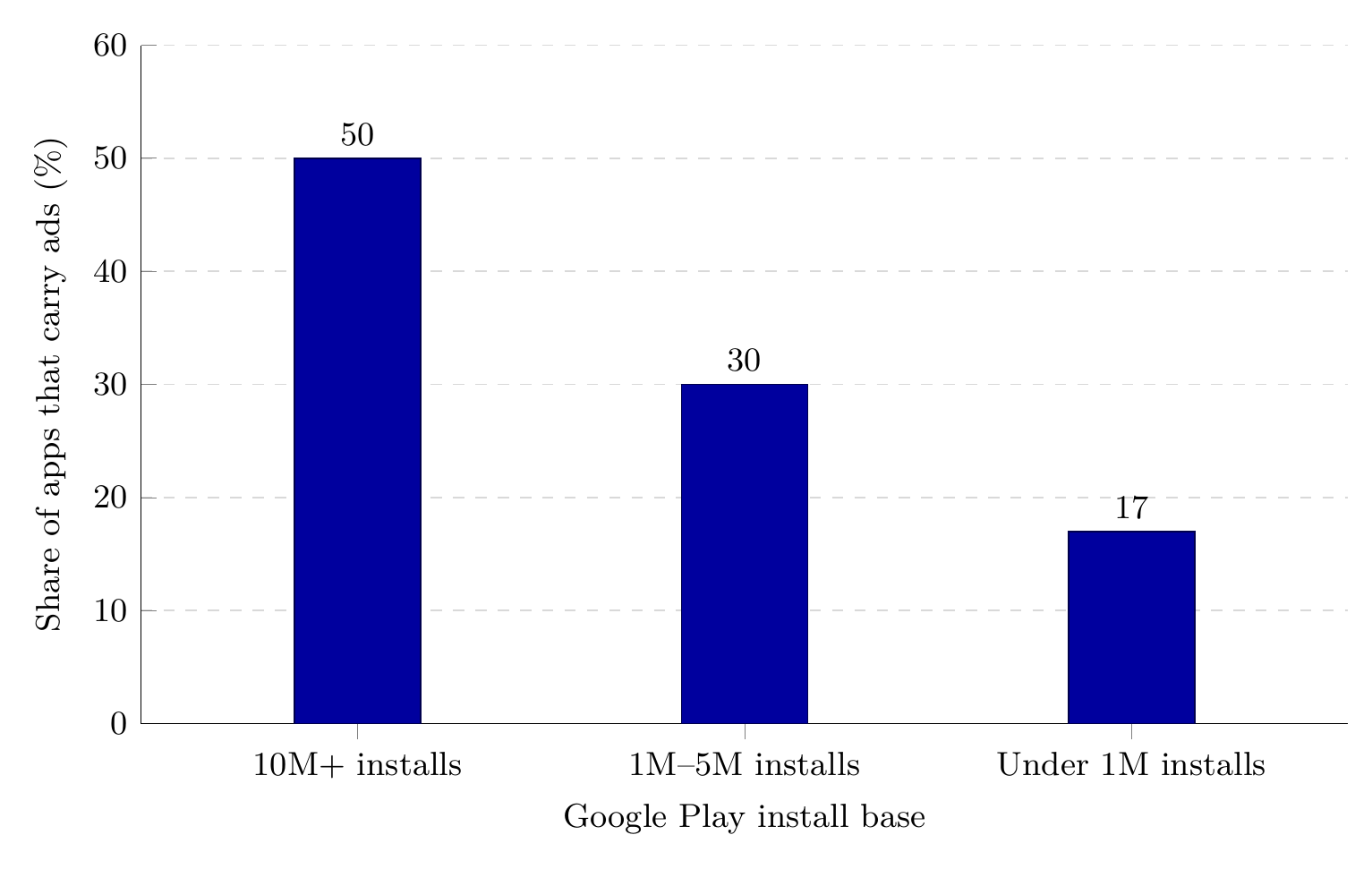
Ad-supported apps as a share of each install-size band, across 30 flashcard and study apps. Google Play listings checked 2026-09-08. Chart by Mindomax.
The price spread is sevenfold for apps that look identical in a store listing. Among the ten vendors publishing a monthly figure, the cheapest is Repetico at $3.49 and the dearest Kahoot!+ Gold at $25.00 (checked 2026-09-08). Nothing on a store page tells you this.
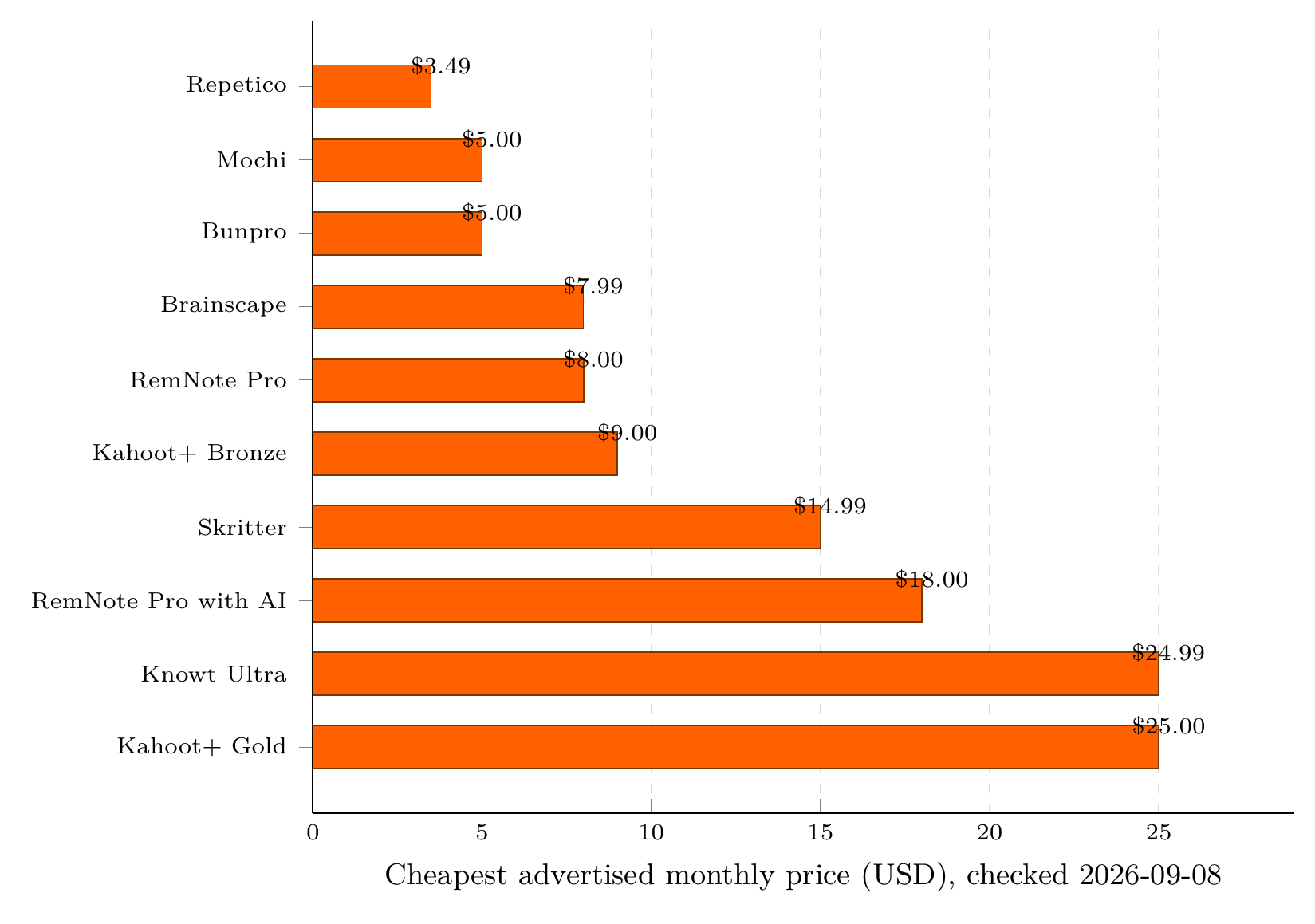
Cheapest advertised monthly subscription price, for the ten apps whose vendor publishes a monthly figure. Vendor pricing pages checked 2026-09-08. Chart by Mindomax.
How to actually choose
Pick the constraint that binds you, then pick from that group.
Need it to work with no signal? Start with offline flashcard apps. Studying across a laptop and a phone? See apps that sync across devices, or flashcard apps for PC and for Mac.
Preparing for a specific exam? The general answer is the wrong one; we have dedicated pages for USMLE Step 2 CK, the GRE and medical students.
Leaving an app rather than choosing one? See Anki alternatives or free Quizlet alternatives. For the reasoning rather than the list, how to choose the right flashcard app walks through it.
Whatever you pick, the app matters less than whether you open it. Anki with fifty cards you review beats a perfect setup you abandon in a week.
If the thing stopping you is making the cards in the first place, Mindomax builds them from a lecture recording, a PDF or a photo of your notes, and the free tier is enough to find out whether that suits you.
Frequently Asked Questions
What is the best flashcard app in 2026?
Anki, for most people: free on desktop and Android, no limits, and a scheduling algorithm the rest of the category imitates. Its interface is the price you pay. For cards generated from your own PDFs or recordings, Knowt has the most generous free tier and RemNote the best notes integration (checked 8 September 2026).
Are flashcard apps free?
Twenty-six of the twenty-eight iOS apps we checked on 8 September 2026 were free to install, which tells you almost nothing. Only Anki is genuinely unlimited. Most others meter something specific: RemNote 250 AI credits a month, Repetico 2 sets of 200 cards, Bunpro no spaced-repetition reviews at all. Check the limit, not the label.
Is AnkiMobile worth $24.99?
It is the only official Anki client on iOS and the purchase funds Anki's development. But before you buy: it rates 4.04 on the App Store against 4.8 for free AnkiDroid on Android, and on 8 September 2026 it had not been updated for a year. On Android you never need to pay anything.
What is the difference between Anki, Anki Pro and AnkiApp?
Only Anki is Anki. Anki Pro (listed as Cardary) and AnkiApp are separate products by separate developers using the name. The Android package that once served AnkiApp now resolves to AlgoApp. Download Anki from ankiweb.net and nowhere else.
What happened to Quizizz?
It was renamed Wayground. The new name is on both app stores, though no competing article we read mentions it, so searches for Quizizz can look as though the app vanished.
Which flashcard app is best for learning Japanese?
A specialist one. renshuu is the only app of the thirty we checked rating 5.0 on Google Play, Bunpro handles grammar through spaced repetition, and Japanese Kanji Study covers kanji without ads. General-purpose apps are noticeably weaker here.


