
The short answer
The 10 most common Spanish adjectives are bueno (good), grande (big, great), primero (first), mejor (better, best), nuevo (new), solo (alone), seguro (sure, safe), último (last), pequeño (small) and único (only). Together they make up 20.1% of all adjective use in spoken Spanish, and bueno alone is 6.4%.
Adjectives are a long-tail word class. The top 100 below cover 53.7% of all adjective use. For comparison, the 100 most common Spanish verbs cover 80% of verb use. So learn these 100 first, then pick up the rest as you meet them, attached to the nouns they describe.
Most Spanish adjectives go after the noun, but the most common ones are exactly the exceptions. In ten years of Spanish books, primero, último, bueno, grande and mejor come right before the noun more than 90% of the time (el primer día, una gran idea), while colors and nationalities stay after it about nine times in ten (una camisa blanca, un libro español).
We counted the ranking ourselves from 423 million words of Spanish film and TV subtitles, grouping every form under its adjective: buena, buenos and buen all count for bueno. How we did it, and where the method falls short, is explained at the end.
The 100 most common Spanish adjectives
"Per million words" is how often the adjective appears in every million words of subtitles, all its forms together. "Running total" is how much of all adjective use you cover once you know every adjective up to that row. "Feminine" shows the feminine form; "same" means the adjective has one form for both genders. An asterisk marks the 14 adjectives whose masculine form is mostly another word (bueno as "well, ...", solo as "only"), so their count is an estimate.
Where are simpático and trabajador? Much further down than a textbook would suggest: simpático is number 369, trabajador 816 and perezoso 957. Classroom lists pick adjectives for describing classmates. Real conversation is full of loco (42), raro (34) and increíble (44).
Serio is the other surprise. Lists that count raw words put it in the top 10, because "¿en serio?" (really?) is everywhere in conversation. As an adjective, serio is number 61.
How much Spanish do these adjectives cover?
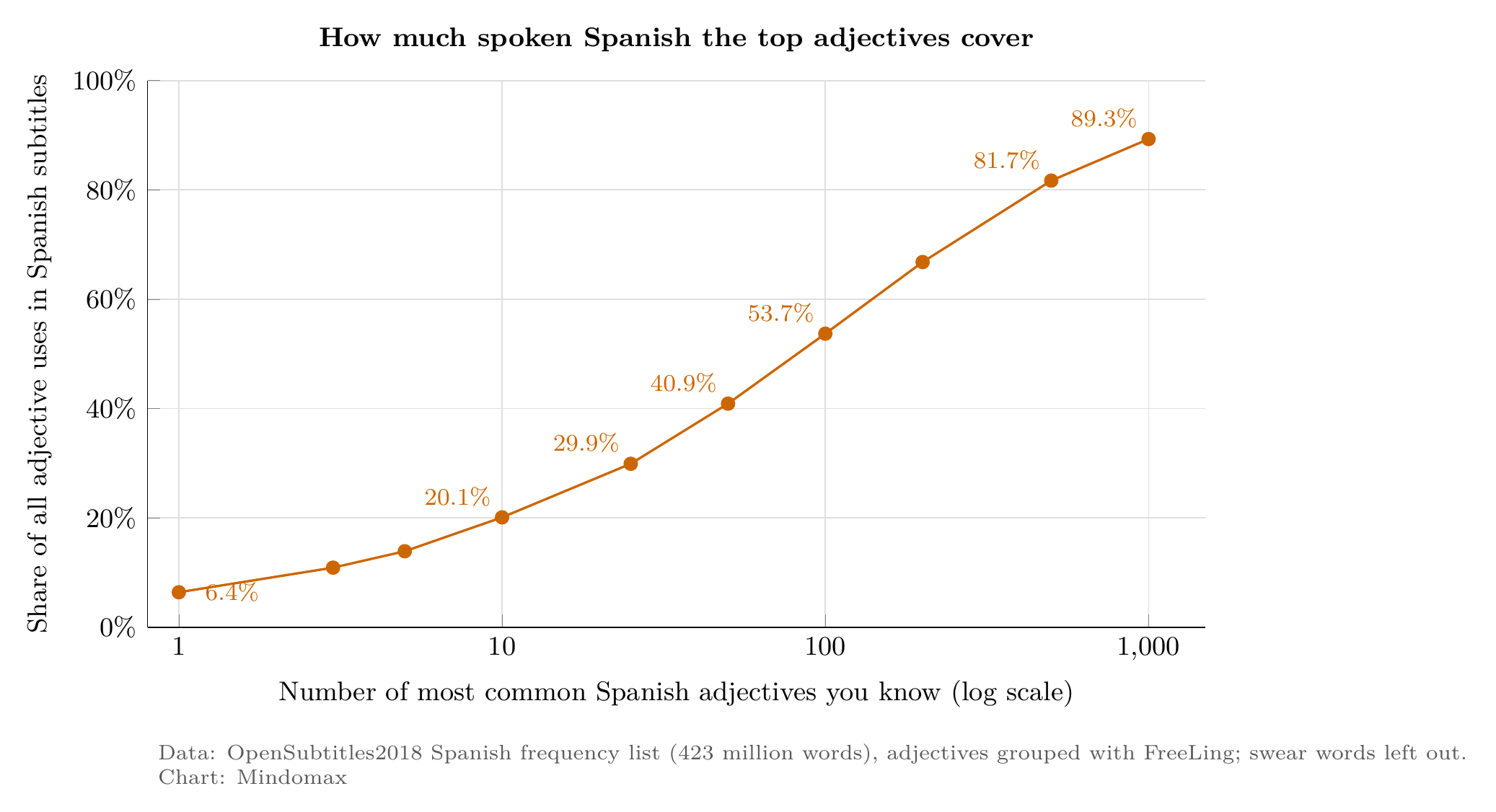
The 10 most common adjectives cover a fifth of all adjective use in spoken Spanish; the top 100 cover just over half. Data: OpenSubtitles2018 Spanish frequency list (FrequencyWords project, CC BY-SA 4.0), 423 million words; adjectives grouped with FreeLing and counted by Mindomax on 2026-10-21.
Adjectives are 4.2% of all words in our count, about one word in 24 (for all word classes together, see the most common Spanish words, counted from the same data). They behave differently from verbs. A few verbs (ser, estar, tener) do most of the work, so the top 100 verbs cover 80% of verb use. Adjectives spread out: the top 100 reach 53.7%, the top 500 81.7%, and you need about 1,000 to reach 89%.
That changes how to learn them. The first 25 are worth drilling until they are automatic. After about 100, a list stops paying off, and reading or listening with a dictionary does the job better.
Before or after the noun? What Spanish books show
Every grammar gives the same rule: Spanish adjectives usually go after the noun, and a few go before. We measured how often each common adjective actually sits right before a noun and how often right after one, in Spanish books published from 2010 to 2019, with all its forms added together.
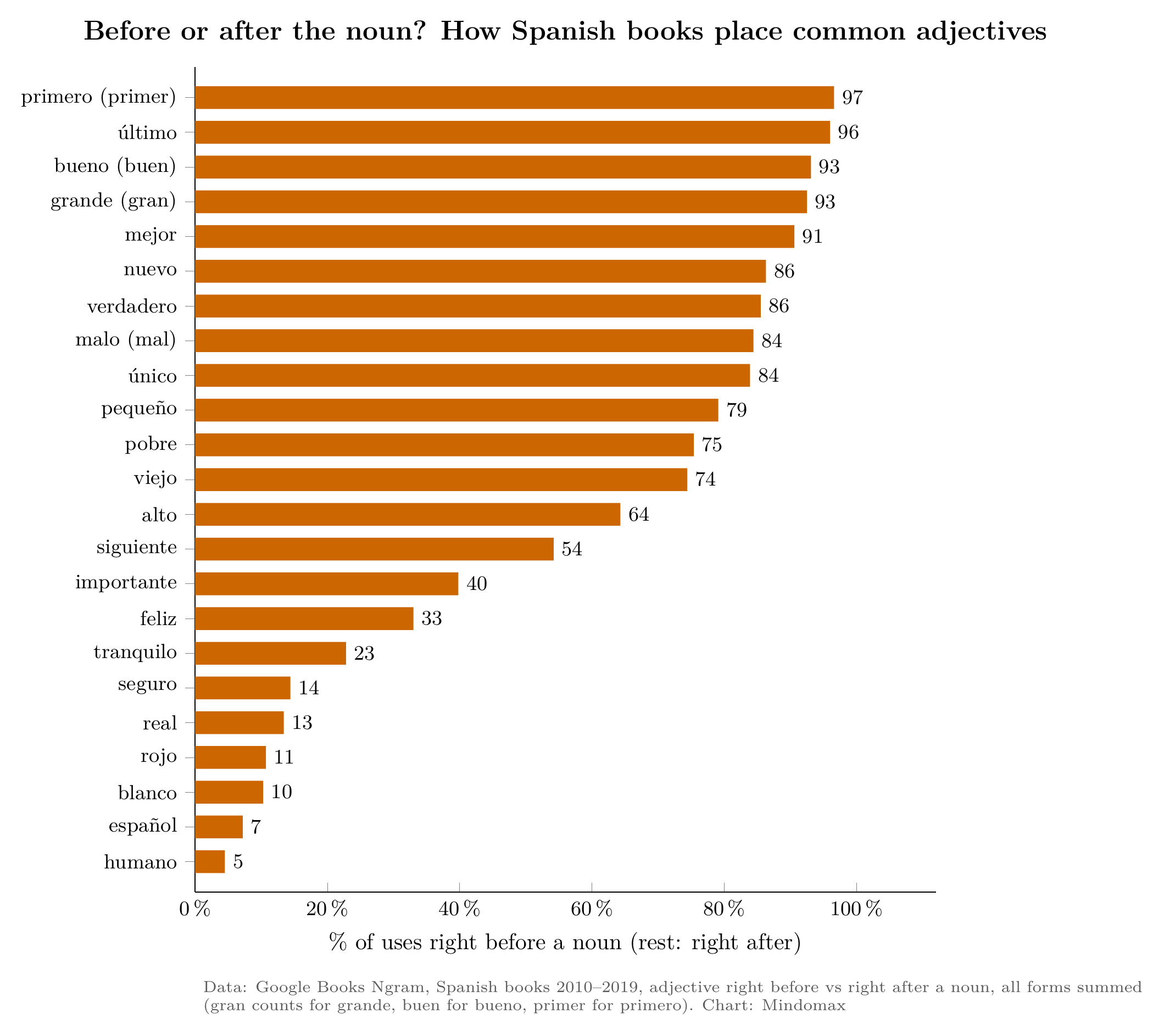
In Spanish books, the adjectives that rank or judge come before the noun most of the time; colors, nationalities and other "which kind" adjectives come after it. Data: Google Books Ngram, Spanish books 2010 to 2019, part-of-speech tagged; counted by Mindomax on 2026-10-21.
Three groups come out of it.
Before, almost always. Primero (97%), último (96%), bueno (93%), grande (93%) and mejor (91%) sit in front of the noun nine times out of ten or more: el primer día, la última vez, un buen trabajo, una gran idea, mi mejor amigo. Three of the five have short forms (primer, buen, gran) that exist only for that position. Nuevo (86%), verdadero (86%), malo (84%) and único (84%) are close behind.
Either side, often with a change in meaning. Pequeño (79%), pobre (75%), viejo (74%), alto (64%) and siguiente (54%) go both ways, and for several of them the position changes what the phrase says (table below).
After, almost always. Adjectives that put the noun into a category stay behind it: humano is after the noun 95% of the time (los derechos humanos), español 93% (un libro español), blanco 90%, rojo 89% and real 87%. Seguro is after the noun 86% of the time (un lugar seguro).
The rule of thumb: if the adjective says which kind of thing it is (color, origin, material, type), put it after the noun. If it is an order word (primero, último, próximo) or one of the short-form adjectives (buen, mal, gran), put it before. For everything else, after the noun is the neutral choice, and before the noun sounds more written or more emphatic: "una pequeña casa" reads like a story, "una casa pequeña" like a description.
These adjectives change meaning with their position:
Two cautions. These figures come from books, which are written Spanish; our subtitle list counts single words, so it cannot show word order in conversation. And the measure is strict: it only counts the adjective right next to the noun, so "una casa muy grande" does not count either way.
The short forms: buen, mal, gran, primer, tercer
Five common adjectives lose their last letters in front of a noun. Bueno, malo, primero and tercero become buen, mal, primer and tercer before a masculine singular noun: un buen día, un mal momento, el primer año, el tercer piso. Grande becomes gran before any singular noun, masculine or feminine: un gran amigo, una gran idea. The RAE's Diccionario panhispánico de dudas sets out the rules for grande, bueno and primero.
The short forms are not a rare exception. In our subtitle count, gran appears 257,648 times and grande 106,057 times, so you will hear the short form about 2.4 times as often as the full one. Buen appears 224,802 times, primer 104,138 times, and tercer 15,377 times against 5,965 for tercero.
Two traps. Bueno, malo, primero and tercero shorten only before masculine singular nouns: una buena idea, la primera vez, unos buenos amigos. And grande keeps its full form after más or menos: el más grande.
How Spanish adjectives agree with the noun
A Spanish adjective takes the gender and number of the noun it describes. How many forms it has depends on how it ends:
Two details catch learners. First, when one adjective describes a mix of masculine and feminine nouns, it goes masculine plural: el padre y la madre están cansados. Second, a few colors taken from nouns, like naranja and rosa, often stay the same for every noun: unas camisas naranja (many speakers also say naranjas).
In our count of 74 common four-form adjectives, the masculine singular form makes up 54.9% of all uses, the feminine singular 32.8%, and the two plurals only 12.4% together. So the -o form is the one you will hear most, and the -as form the one you will hear least.
Ser or estar with adjectives
Most adjectives work with both verbs: ser for what something is like, estar for how it is right now (es alegre, está alegre hoy). A handful change their meaning, and several of them are in the top 100:
Adjectives that come from verbs, like cansado (tired), ocupado (busy) and preocupado (worried), describe a state, so they almost always go with estar: estoy cansado.
Spanish adjectives to describe a person
These are the adjectives for people that come up most in real Spanish, with each one's place in our ranking:
Feelings and states usually take estar (estoy cansado); character and looks take ser (es divertido, es alto). Lindo is especially common in Latin America.
How to learn the most common Spanish adjectives
1. Learn them with a noun, not alone. "Una casa grande" teaches the meaning, the agreement and the position at once. "Grande: big" teaches one of the three.
2. Learn the top 25 first, in all their forms. They are a large share of everything you will hear, and most of the irregular behavior (buen, gran, primer) is in them.
3. Learn the pairs that change meaning as pairs: un gran hombre and un hombre grande on the same card.
4. Review them on a schedule. Spaced review, where each card comes back just before you would forget it, beats rereading a list by a wide margin; see our guides to the spacing effect and the testing effect. If you have not made cards before, how to make flashcards covers it in ten minutes.
5. Say them out loud about people you know. Adjectives for people are the ones you need first in conversation, and describing a friend in Spanish forces both the agreement and ser or estar.
Apps that help you drill them
You can learn 100 adjectives with paper cards. An app helps with two things paper is bad at: checking the agreement in a real sentence, and bringing each word back just before you forget it. Prices are from the US App Store and Google Play.
One drill app for agreement in sentences plus one flashcard app for meanings is a good combination: the first catches "una casa nuevo", the second makes sure nuevo is still there next month.
How we counted
The ranking uses the Spanish frequency list from the FrequencyWords project (CC BY-SA 4.0), built from OpenSubtitles2018: 423 million words of film and TV subtitles. Subtitles are the best open stand-in for everyday speech; word counts from subtitles predict how people process words better than counts from books (Brysbaert and New, 2009), and the same holds for Spanish (SUBTLEX-ESP, 2011).
We grouped every form under its adjective with the Spanish dictionary of FreeLing: buen, buena, buenos and buenas all count for bueno, and gran counts for grande.
A word list cannot see the sentence, so shared forms needed rules. When a form is also a noun or a verb (vivo, baja, pequeña), we counted only the share of it that is an adjective in Spanish books, using the part-of-speech tags of Google Books Ngram. Adjectives made from verbs that work as adjectives of state (cansado, ocupado, muerto) were treated the same way, so "estoy cansado" counts and "he cansado" does not; hecho and llamado, which are mostly verb forms, are not in the list. Chico is left out too: in subtitles it is almost always the noun (boy).
For 18 adjectives the main form is mostly another word: bueno ("well, ..."), solo ("only"), claro ("of course"), nuevo in "de nuevo" ("again"), mejor as an adverb, serio in "¿en serio?". For those we estimated the adjective uses from the other forms (the feminine, or the plural), using the usual ratio between forms in the same data. The 14 of them in the top 100 carry an asterisk.
We left out words that textbooks sometimes call adjectives but that work as determiners: mismo, otro, mucho, poco, todo, cada and the possessives (mi, tu, su). Swear words (maldito, puto, jodido) count toward the totals but are not in the list.
The position figures come from a second source, Google Books Ngram (Spanish books published 2010 to 2019): for each adjective, how often one of its forms comes right before a noun and how often right after one.
The limits: subtitles over-represent conversation and dramatic plots, and they mix Spain and Latin America. The position numbers come from books, so they describe written Spanish; conversation may put fewer adjectives in front. Treat every share as a close estimate: an adjective with an asterisk could move a few places, and below the top 30 neighbors can swap places.
If you would rather not type 100 adjectives into flashcards yourself, you can paste this list into Mindomax and try it for free.
Frequently Asked Questions
What are the 10 most common adjectives in Spanish?
In spoken Spanish: bueno, grande, primero, mejor, nuevo, solo, seguro, último, pequeño and único. Together they make up 20.1% of all adjective use in our count of 423 million words of subtitles.
What are 50 common adjectives in Spanish?
The first 50 rows of the table above, from bueno to igual. They cover 40.9% of all adjective use. Learn each one with a noun (una casa grande) and the agreement comes with it.
What are 100 common adjectives in Spanish?
The full table above, from bueno (good) at number 1 to cerrado (closed) at number 100. Together they cover 53.7% of adjective use in spoken Spanish.
Do Spanish adjectives go before or after the noun?
Most go after (una camisa blanca), but the most common ones are the exceptions. In Spanish books, primero, último, bueno, grande and mejor come right before the noun more than 90% of the time, while colors and nationalities stay after it about nine times in ten.
Why is it gran and not grande?
Grande shortens to gran before any singular noun: una gran idea, un gran día. In front of the noun it also changes meaning, from big to great. In spoken Spanish, gran is about 2.4 times as common as grande.
How do Spanish adjectives agree with nouns?
They take the noun's gender and number. Adjectives ending in -o have four forms (nuevo, nueva, nuevos, nuevas); those ending in -e or a consonant have two (grande, grandes; difícil, difíciles).
Which Spanish adjectives change meaning before the noun?
The common ones are grande (great before, big after), viejo (long-time, elderly), pobre (unlucky, without money), nuevo (another, brand-new), único (only, unique), antiguo (former, antique), simple (mere, simple) and puro (sheer, pure).


