
The short answer
The 10 most common Spanish verbs are ser (to be), estar (to be), haber (to have, as a helper verb), tener (to have), ir (to go), hacer (to do, to make), poder (can), decir (to say), saber (to know) and querer (to want). Together they make up 48.7% of all verb use in spoken Spanish, and every one of them is irregular.
The full top 100 below covers 80.3% of all verb use. Verbs are about one word in four in Spanish, so these 100 carry a large part of everything you will hear.
We counted the ranking ourselves from 423 million words of Spanish film and TV subtitles, grouping every form under its verb: soy, eres, era and sería all count for ser. How we did it, and where the method falls short, is explained at the end.
The 100 most common Spanish verbs
"Share" is how often the verb appears among all verb uses. "Running total" is how much of all verb use you cover once you know every verb up to that row. "Type" tells you how much work the verb is: irregular verbs change in ways you have to memorize, stem-changing verbs change a vowel in the middle (pensar becomes pienso), spelling changes only adjust the letters to keep the sound (buscar becomes busqué), and regular verbs follow the -ar, -er or -ir pattern.
How much Spanish do these verbs cover?
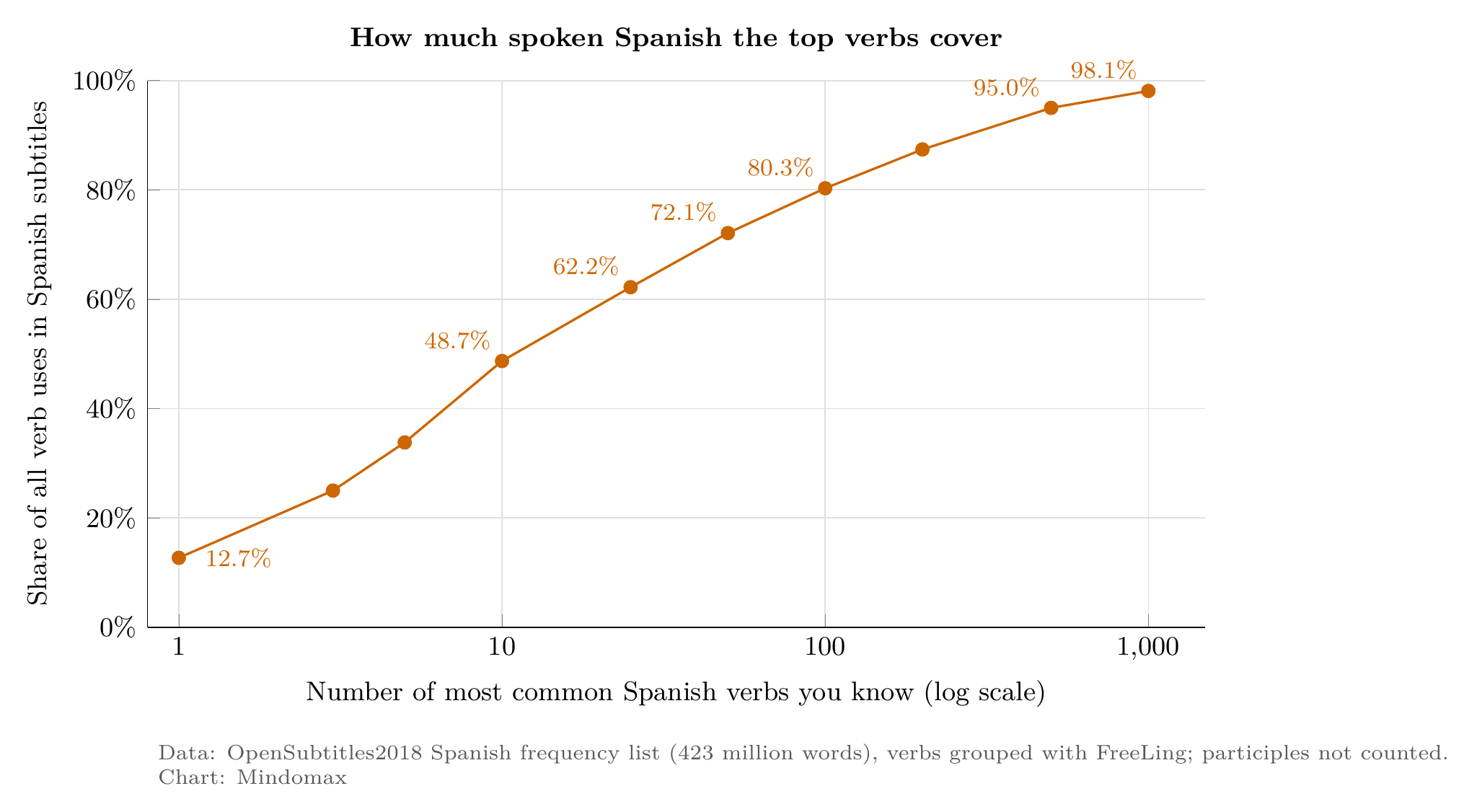
The 10 most common verbs cover almost half of all verb use in spoken Spanish; the top 100 cover 80%. Data: OpenSubtitles2018 Spanish frequency list (FrequencyWords project, CC BY-SA 4.0), 423 million words; verbs grouped with FreeLing and counted by Mindomax on 2026-10-20. Chart by Mindomax.
The curve climbs fast and then flattens. Ser alone is one verb in eight. Ten verbs take you to almost half, 25 verbs to 62.2% and 100 verbs to 80.3%. After that, every new verb adds less than the one before: the next 400 verbs together add about 15 points, and you need roughly 1,000 verbs to reach 98%. Our count found 6,098 different verbs in total.
In practice, if you know the top 100 well, four out of every five verbs you hear are ones you know. The fifth is often the verb that carries the meaning of the sentence, which is why this list is a strong start rather than a finish line.
The top 10, with the forms you will actually hear
Knowing that ser means "to be" does not help much when someone says "fue" or "eres". These are the forms that matter. The first five columns are the present tense; the last column gives the two most common past forms, "I" and "he/she".
The single most common verb form in Spanish is "es" (is): 6.9% of all verb use on its own. Next come está (2.4%), estoy (1.1%), ha (1.1%), vamos (1.0%) and hay (1.0%).
Three things in this group trip up almost every learner:
Ser or estar? Ser says what something is: "Es médica" (she is a doctor). Estar says where something is, or how it is right now: "Está cansada" (she is tired).
Haber is two verbs in one. "Hay" means "there is" or "there are". He, has and ha plus a participle make the perfect tense: "He comido" (I have eaten).
Saber or conocer? Saber is knowing a fact or how to do something: "Sé nadar" (I can swim). Conocer, number 38 on the list, is knowing a person or a place: "Conozco a Ana" (I know Ana).
You may have met the "super 7 verbs" in a Spanish class. They are a teaching set put together by Terry Waltz: es, está, tiene, hay, le gusta, va and quiere (The Comprehensible Classroom explains them). Our count backs the idea: six of the seven are in our top 10. The exception is gustar, at number 29. You need it to say what you like, but people use poder, decir and saber far more often.
Why the most common verbs are the irregular ones
It can feel unfair that the first verbs you need are the hardest ones. It is not an accident. All of the top 10 are irregular, and the 21 irregular verbs in the top 100 account for 54.7% of all verb use. The 47 fully regular verbs in the top 100 account for only 15.6%.
The reason is frequency itself. Verbs that people say all day keep their old, irregular forms, because every speaker hears them constantly. Rarer verbs slowly drift toward the regular pattern. Researchers measured this for English: a 2007 study in Nature found that an irregular verb used 100 times less often becomes regular 10 times as fast.
There is good news inside this. Most verbs on the list are either irregular, and worth drilling, or close to free:
The 47 regular verbs follow three patterns. Once you can conjugate hablar, comer and vivir, every regular verb on this list only costs you its meaning.
The 18 stem-changing verbs follow a few patterns: e to ie (pensar, pienso; also entender, perder, empezar), o to ue (encontrar, encuentro; also contar, recordar, volver, dormir), e to i (pedir, pido; also seguir, conseguir) and jugar's u to ue (juego). The change only happens when the stem is stressed, so the nosotros forms stay regular: pensamos, encontramos, pedimos.
The 9 spelling-change verbs, such as buscar (busqué), llegar (llegué) and creer (creyó), only change their letters to keep the sound the same. In speech they behave like regular verbs.
So spend your conjugation practice on the 21 irregular verbs and the stem changers, and your vocabulary practice on the rest.
Which verb forms to learn first
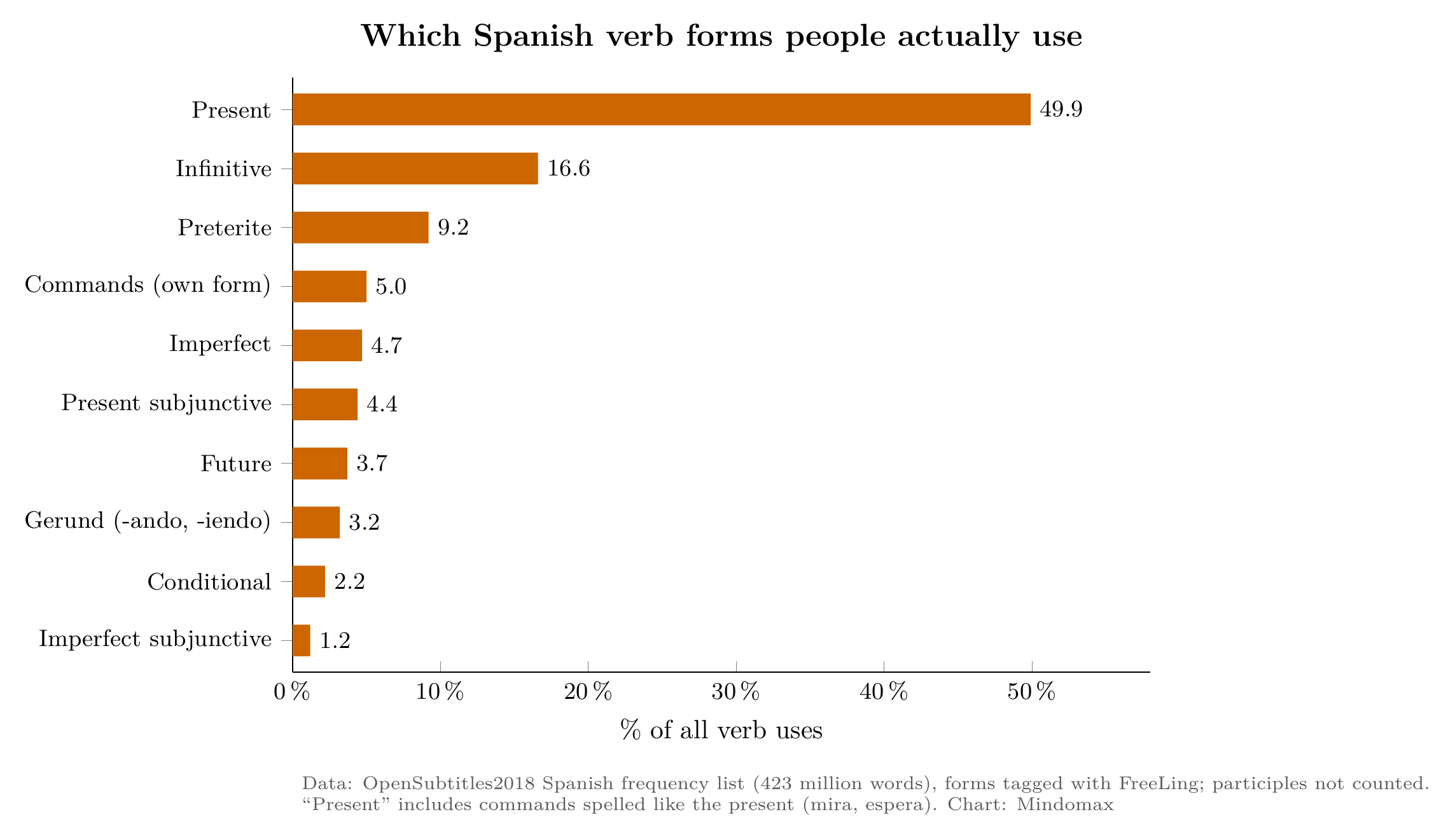
Half of all Spanish verb use is the present tense; add the infinitive and you have two thirds. Data: OpenSubtitles2018 Spanish frequency list, forms tagged with FreeLing; participles not counted. "Present" includes commands that are spelled like the present (mira, espera). Chart by Mindomax.
Spanish has many tenses, but people do not use them equally. In our count the present tense is 49.9% of all verb use. The infinitive (hablar, comer, vivir) adds 16.6%, often after a helper verb: "Voy a llamar" (I am going to call), "Quiero ir" (I want to go), "Tengo que trabajar" (I have to work). Together that is two thirds of everything.
Then come the preterite (9.2%: fue, dijo, hice), commands with their own form (5.0%: ven, di, haz, dime), the imperfect (4.7%: era, estaba, tenía), the present subjunctive (4.4%: que sea, no te preocupes), the future (3.7%), the gerund (3.2%: estoy hablando), the conditional (2.2%: podría, me gustaría) and the imperfect subjunctive (1.2%).
The persons are just as uneven. Among conjugated verbs, the él, ella and usted forms are 42.3%, yo forms 24.8% and tú forms 16.6%. Ellos and ustedes forms are 8.4%, nosotros 7.0% and vosotros only 0.8%.
That suggests an order of work:
1. The present tense of the top 25 verbs, in the yo, tú and él/usted forms.
2. The infinitive with the helpers: voy a, quiero, puedo, tengo que, necesito, hay que.
3. The preterite of the top 10: fui, fue, estuve, tuve, hice, pude, dije, supe, quise.
4. The imperfect, then the present subjunctive after common triggers such as quiero que, ojalá and no te preocupes.
5. Vosotros last. It is used only in Spain, so you can skip it if you are learning Latin American Spanish.
Spoken vs written: why verb lists disagree
If you compare lists online, you will find different verbs at the top. There are two reasons.
The first is what gets counted. SpanishDict's well-known list of 100 common verbs is in alphabetical order, so it tells you which verbs matter but not which matter most. Babbel's list of 20 gives no source and includes comer and vivir, which are useful but not top-20 verbs by frequency (they are 63 and 44 in our count).
The second is what kind of Spanish gets counted. The ranking on Spanish with Tati follows CORPES XXI, the Real Academia Española's corpus, which is mostly written: newspapers, books and websites. Written Spanish uses more formal verbs. These are the biggest differences between that list and ours:
Still, the two lists agree on the core: 68 verbs appear in both top 100s, and 8 of the top 10 are the same. If your goal is speaking and understanding people, use the spoken ranking. If you mainly read news or academic texts, the written one fits better. Our list has its own bias too: films and TV love crime, so matar (to kill, number 40) and disparar (to shoot, number 88) rank higher than they would in everyday life.
How to learn the most common Spanish verbs
This plan takes about 15 minutes a day for ten days.
Ten verbs a day, in table order. Day 1 is verbs 1 to 10, day 2 is verbs 11 to 20. Learn each one with its most common forms and a phrase you would really say: "tengo que", "voy a", "¿puedo...?", "no sé", "lo siento", "me gusta".
Test yourself instead of rereading. Cover the Spanish, read the English, say the verb out loud, then check. In a 2008 experiment published in Science, students who kept testing themselves on new foreign words remembered far more a week later than students who kept studying them, and the extra studying added almost nothing. Our guide to the testing effect explains why.
Space the reviews out. See a new verb again the next day, then a few days later, then after a week. A review of 317 experiments found that spreading practice out beats cramming, and that the best gap between reviews grows the longer you want to remember. More in our article on the spacing effect.
Drill conjugations only where they are needed. The 21 irregular verbs deserve conjugation drills. For the regular ones, learn the meaning and let the pattern do the rest. Our guide on how to make flashcards shows how to build cards that test one form at a time.
After the verbs, move on to the small words between them: our list of the most common Spanish words uses the same data.
Apps that help you drill them
You do not need an app to learn 100 verbs, but the right one saves time. Most verb apps do one of two jobs: conjugation drills, or flashcards that bring words back at the right moment. Prices are from the US App Store and Google Play.
A good combination is one drill app for the irregular forms and one flashcard app for the meanings, so both come back before you forget them.
How we counted
The data is the Spanish frequency list from the FrequencyWords project (CC BY-SA 4.0), built from OpenSubtitles2018: 1.2 million different word forms and 423 million words of film and TV subtitles. Subtitles are the best open stand-in for everyday speech. Word counts from subtitles predict how people process words better than counts from books (Brysbaert and New, 2009), and the same holds for Spanish (SUBTLEX-ESP, 2011).
We mapped every form to its verb with the Spanish dictionary of FreeLing, which also gives each form's tense and person. Forms with pronouns attached (dime, hazlo, déjame) count for their verb.
Some forms belong to two words, and a word list cannot see the sentence. Our rules: when a form is also a common small word, the small word wins, so "como" (like, or I eat) does not count for comer, and comer ranks a little low. Fue, fui and fueron belong to both ser and ir; we split them in the same ratio as era and iba (83 to 17). "Ven" (come!) counts for venir. Other shared forms were split by how common each reading is elsewhere in the data.
We left participles out (hecho, dicho, muerto). Most of them work as adjectives or nouns ("estoy cansado", "de hecho"), and without the sentence we cannot tell. Counting them would not change the top 10.
To label each verb, we generated its regular forms (present, preterite, future, present subjunctive, gerund and participle) and compared them with the real ones. Changes that only keep the sound the same (busqué, llegué, creyó) are labeled "spelling change", not irregular.
The limits: subtitles over-represent conversation (lots of yo, tú and commands) and dramatic plots, and they mix Spain and Latin America. Treat the shares as close estimates, not exact figures. The order of the top 50 is solid.
If you would rather not type 100 verbs into flashcards yourself, you can paste this list into Mindomax and try it for free.
Frequently Asked Questions
What are the 10 most common Spanish verbs?
In spoken Spanish: ser, estar, haber, tener, ir, hacer, poder, decir, saber and querer. Together they make up 48.7% of all verb use in our count of 423 million words of subtitles.
What are the 20 most common Spanish verbs?
The top 10 plus ver, creer, deber, dar, pasar, venir, dejar, hablar, sentir and esperar. The top 20 cover 59.0% of all verb use.
What are the super 7 verbs in Spanish?
A teaching set from Terry Waltz: es (ser), está (estar), tiene (tener), hay (haber), le gusta (gustar), va (ir) and quiere (querer). Six of the seven are in our top 10; gustar is number 29.
What is the most common Spanish verb?
Ser (to be). Its forms are 12.7% of all verb use, and "es" alone is the most common verb form in Spanish.
How many Spanish verbs do I need to know?
The top 100 cover 80.3% of verb use and the top 500 cover 95.0%. For everyday conversation, the first 100 to 200 verbs with their common forms do most of the work.
Are the most common Spanish verbs irregular?
Yes. All of the top 10 are irregular, and the 21 irregular verbs in the top 100 account for 54.7% of all verb use. Only 47 of the top 100 are fully regular.
Do I need to learn the vosotros forms?
They are 0.8% of conjugated verbs in our count and are used only in Spain. Learn them last, or skip them if you are learning Latin American Spanish.


