
The short answer
The most common Spanish words are small: de (of, from), que (that), no, a (to), la and el (the), y (and), es (is), en (in) and lo (it). Those ten alone make up 22% of everything people say in Spanish films and TV shows.
The full top 100 below covers 50.7% of all the words in a 423-million-word collection of Spanish subtitles. In plain terms: learn these 100 and you will recognise about every second word you hear. You will not understand every second sentence yet, and further down we explain why, and how much further you need to go.
We counted the list ourselves from an open frequency list built from OpenSubtitles, the largest public collection of film and TV subtitles. How we did it, and its limits, is explained at the end.
The 100 most common Spanish words
"Share" is how often the word appears among all words. "Running total" is how much of real Spanish you cover once you know every word up to that row.
A few rows look like duplicates and are not. Spanish uses a written accent to tell apart words that sound the same: que (that) and qué (what), si (if) and sí (yes), el (the) and él (he), tu (your) and tú (you), esta (this) and está (is). Learn each pair together.
Two rows really are the same word. sólo (#74) and solo (#89) both mean "only". The Royal Spanish Academy advised dropping the accent in 2010, but many subtitles still use the older spelling.
How much Spanish do these words cover?
The curve rises fast and then flattens. The first 100 words give you about half of all the words you meet. Each extra thousand gives you less than the one before.
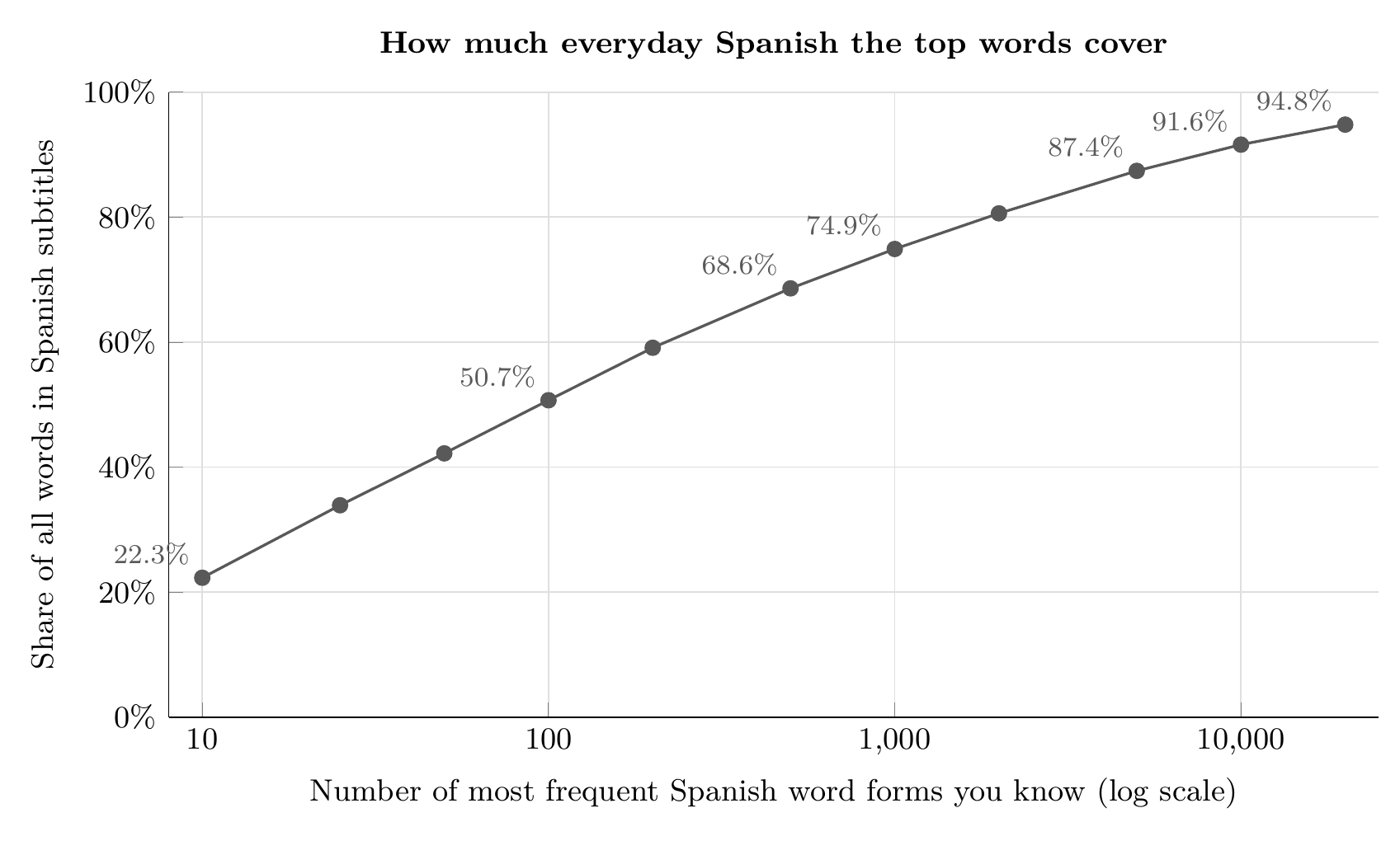
How much of everyday Spanish the most frequent words cover. Data: OpenSubtitles2018 Spanish frequency list (FrequencyWords project, CC BY-SA 4.0), 423 million words; coverage computed by Mindomax on 2026-10-10. Chart by Mindomax.
This is the strongest argument for starting with a frequency list instead of a themed one. Words like "Wednesday", "grandfather" or "elbow" are useful, but each of them appears far less often than "pero" (but), "ya" (already) or "algo" (something). At the start of your Spanish, every hour you spend on high-frequency words pays back many times more often.
Why "most common" lists disagree
If you compare lists online, you will find that they do not match. There are three reasons.
They count different things. Our list counts word forms. "estoy", "está", "estás" and "estaba" are four rows, but all of them are the verb estar (to be). A dictionary-based list would count them once, as "estar", and then rank it higher. Both methods are fair; just know which one you are looking at.
They count different Spanish. Subtitles are spoken Spanish. That is why "gracias" (#70), "hola" (#88) and "señor" rank high here and would rank lower in newspapers. Research on English found that subtitle counts predict how quickly people recognise words better than counts from books, which makes them a good guide for a learner who wants to understand conversation. If your goal is reading, a written list such as Mark Davies' Frequency Dictionary of Spanish is the better match.
Some lists are not frequency lists at all. Many pages called "most common Spanish words" are phrasebooks grouped by topic: greetings, family, days of the week. We checked the page that ranks first on Google for this search, titled "1,000 Most Common Spanish Words". Even counting a word as present if it appears anywhere on that list, including inside a phrase, it contains 54 of the real top 100 and 279 of the real top 1,000 (checked 2026-10-10). "que", the second most frequent word in Spanish, is not on it. Neither are "se", "si", "eso" or "su".
The 10 verbs behind a quarter of the list
27 of the top 100 are forms of just ten verbs. Together those 27 forms cover 6.9% of all spoken Spanish. If you want a shortcut into the list, start here.
"fue" is shared: it means both "was" (ser) and "went" (ir), and context tells you which.
Another 27 rows are small grammar words: articles, prepositions and pronouns such as de, la, el, en, por, para, con, me, te and se. They cover 29.0% of everything on their own. You cannot avoid them, so it is better to learn them early and in short phrases.
What 100 words will not give you
Recognising every second word is not the same as understanding every second sentence. The words you are missing are usually the ones that carry the meaning: the noun, the adjective, the specific verb.
Paul Nation's well-known estimate is that you need to know 6,000 to 7,000 word families to follow spoken English comfortably, and 8,000 to 9,000 for written text, at the point where you know about 98% of the words in front of you. Those figures are for English, but our Spanish curve tells a similar story: even 10,000 word forms cover 91.6% of subtitle Spanish, which still leaves roughly one unknown word in every twelve.
So think of the top 100 as the frame of the language. It lets you notice the new words, which is where your real progress happens. If you want a wider plan for the words that come after, our guide on how to improve your vocabulary covers how many encounters a word needs and how to find yours.
How to learn the 100 words in 10 days
This plan takes about 15 minutes a day.
1. Ten new words a day, in list order. Day 1 is words 1 to 10, day 2 is words 11 to 20, and so on. After 10 days you have seen all 100.
2. Learn them inside short phrases. "de" on its own is hard to remember. "la casa de mi madre" (my mother's house) is easy. For the small grammar words, a phrase is the only way they stick. For the verbs, pair the form with its person: "yo soy", "tú eres", "él es".
3. Test yourself from memory, do not reread. Cover the Spanish, look at the English, say the Spanish aloud, then check. In a well-known 2008 study, students who kept testing themselves on Swahili words remembered about 80% a week later; students who stopped testing and only reread remembered about 35%.
4. Spread the reviews out. Review a word the next day, then a few days later, then after a week. A review of hundreds of experiments found that spacing practice out beats doing the same amount in one sitting. Our article on the spacing effect explains why.
5. Meet each word again in real Spanish. One study found that learners who met a new word ten times in context knew far more about it than those who met it once or three times. With the top 100 this happens by itself: they are in every sentence of every show. Watch something in Spanish with Spanish subtitles and you will see them everywhere.
Flashcards are the simplest way to do steps 3 and 4. Our guide on how to make flashcards shows how to write good ones; for a 100-word list, put the phrase on one side and the meaning on the other.
Apps that help you learn them
You do not need an app for 100 words: paper cards work. An app helps because it decides for you which words to review each day. All prices below are from the US App Store and Google Play.
If you already use Anki, our guide to Anki for language learning covers the settings and daily load. If you are choosing an app for the long run, we compared more options in Spanish vocabulary apps.
After the first 100
Keep going in frequency order up to about 1,000 words. That takes you from half of all words to three quarters, and it is the stage where Spanish starts to feel readable. After 1,000, frequency lists help less. Your own reading and listening will show you the words you need, and those are the ones worth a flashcard.
Two changes help at this stage. First, switch from word forms to whole verbs: learn "tener" with its common forms instead of "tengo" as a separate word. Second, add your own words: every new word you hear twice in a week is a good candidate.
How we counted
We used the 2018 Spanish frequency list from the FrequencyWords project, built from the OpenSubtitles collection (licensed CC BY-SA 4.0). It contains 1,202,520 different word forms and 423,290,924 words in total. We sorted by count, added the counts from the top down and divided by the total to get each running coverage figure. The English meanings are ours and give the most common sense of each word.
Limits: this is film and TV Spanish, mixed from many countries, and translated subtitles are included. Names and filler words are counted like any other word. A list built from newspapers or books would likely put words like "año" (year) and "país" (country) higher and "gracias" lower.
If you would like to turn this list into review cards in a few seconds, you can try Mindomax for free.
Frequently Asked Questions
What are the 10 most common Spanish words?
In spoken Spanish they are de, que, no, a, la, el, y, es, en and lo. Together they make up 22.3% of all the words in our 423-million-word subtitle count.
How many Spanish words do I need to know to have a conversation?
The top 1,000 word forms cover about 75% of what people say on screen, which is enough for simple conversations if you also know some phrases. Following conversations comfortably takes several thousand words.
How long does it take to learn the 100 most common Spanish words?
About 10 days at 10 new words a day, with 15 minutes of review. Keep reviewing them for a few more weeks so they stay.
What is the most common Spanish verb?
In our count, forms of ser (to be) come first: es, ser, era, soy, son and eres are all in the top 100. estar, tener, ir and haber follow.
Are the most common Spanish words the same in Spain and Latin America?
Almost entirely. The top 100 are basic grammar words and verbs shared by every Spanish-speaking country. Differences show up later, in everyday nouns and slang.


