
The Pomodoro Technique is a time management method created by Francesco Cirillo in the late 1980s, when he was a university student. You work on one task for 25 minutes, take a short break of about 5 minutes, and after four rounds you take a longer break of 15 to 30 minutes. Each 25-minute round is called a pomodoro, Italian for tomato, after the tomato-shaped kitchen timer Cirillo used.
Does it work? Three experiments with university students, published in 2023, 2025 and 2026, give a more careful answer than most guides. Fixed breaks did not help anyone finish more work or score higher on a test than breaks the students chose themselves. In the first study they made students feel less tired and more focused; in the two newer ones they did not, and in 2026 students felt better taking breaks when they wanted. Below: the method as Cirillo describes it, what those studies measured, and how to pick a rhythm that fits the way you study.
Pomodoro® is a registered trademark of Francesco Cirillo. This guide is independent and not affiliated with him.
How to do the Pomodoro Technique in 6 steps
1. Choose one task and write it on a list. Cirillo calls it the To Do Today sheet.
2. Set a timer for 25 minutes.
3. Work on that task, and only that task, until the timer rings. If another thought or job pops up, write it on the list and go back to work.
4. When the timer rings, put a check mark next to the task. That round is one pomodoro.
5. Take a short break of about 5 minutes. Stand up and step away from the work.
6. After four pomodoros, take a longer break of 15 to 30 minutes. Then start the next set.
That is the version most people know. Three rules from Cirillo's book get lost when the method is reduced to a timer.
The rules most guides leave out
A pomodoro can't be split. If you stop halfway to do something else, the round doesn't count, and you start a fresh one later.
Interruptions get a routine. When someone needs you mid-round, you tell them you are busy, agree on a time, write it on your list and call them back after the timer rings: inform, negotiate, schedule, call back.
You keep a record. Counting how many pomodoros each task really took makes your next plan more honest, and the book builds on this in six objectives, from measuring how much effort a task takes to setting up a timetable and picking your own improvement goal.
Cirillo also warns against chasing a number. On his website he writes that even one pomodoro, or none, is fine, because the goal is to become aware of what happens in your mind while you work. When people ask him what to do in a break, his answer is "nothing".
Does the Pomodoro Technique work? What three experiments found
Researchers at Maastricht University in the Netherlands have now tested fixed breaks against self-chosen breaks three times, with real students doing their own study work or a real reading task.
2023: fixed breaks felt better
Felicitas Biwer and colleagues followed 87 bachelor's and master's students through one real study day. One group decided for themselves when to take a break. The other two took a 6-minute break after every 24 minutes (the Pomodoro group) or a 3-minute break after every 12 minutes.
Students who chose their own breaks studied in longer stretches and took longer breaks, and they reported more fatigue and distraction and less concentration and motivation. They did not get more done. Task completion and mental effort were the same in all three groups, so the fixed-break groups reached the same result in less time.
2025: no difference by the end of the session
Eva Smits, Niklas Wenzel and Anique de Bruin gave 94 students a two-hour study session under one of three rules: self-chosen breaks, Pomodoro (5 minutes after every 25), or Flowtime (break whenever you want, and the longer you studied, the longer the break).
Pomodoro students got tired faster as the minutes since their last break added up, and motivation fell faster under both Pomodoro and Flowtime. Over the whole session, though, the groups did not differ in fatigue, motivation, productivity, flow or task completion: on average students finished 69% of the tasks they had planned, whatever the rule.
2026: self-chosen breaks felt better
Ali Göksu, Wisnu Wiradhany and Anique de Bruin had 176 students read a text on climate change and then take a comprehension test. Half took a fixed 3-minute break after every 12 minutes, half chose their own breaks.
Test scores were close, 12.93 points with fixed breaks and 12.23 with self-chosen ones, and the difference was not significant. Students who chose their own breaks reported more energy, concentration and motivation and less distraction. They also liked their way of taking breaks more: 3.41 against 2.73 on a five-point scale.
What about the review that says it works?
Wikipedia quotes a 2025 scoping review in BMC Medical Education: time-structured Pomodoro breaks consistently improved focus and reduced fatigue compared with self-paced breaks. Two details matter. Its literature search ended in May 2023, before the 2025 and 2026 experiments. And its randomized evidence is described as three trials with 87 students in total, using exactly the 24/6 and 12/3 schedules of the 2023 Maastricht study, which had 87 students in three groups. That looks like the three groups of one study rather than three separate trials.
Breaks help how you feel more than what you get done
A 2022 meta-analysis pooled 22 study samples with 2,335 people on breaks of 10 minutes or less, not only Pomodoro breaks. Short breaks gave people more energy and less fatigue, small but reliable effects. Their effect on performance was smaller and not statistically significant, and it showed up only for less demanding tasks. Longer breaks helped performance more, and the authors suggest that recovering from very demanding work may need more than 10 minutes.
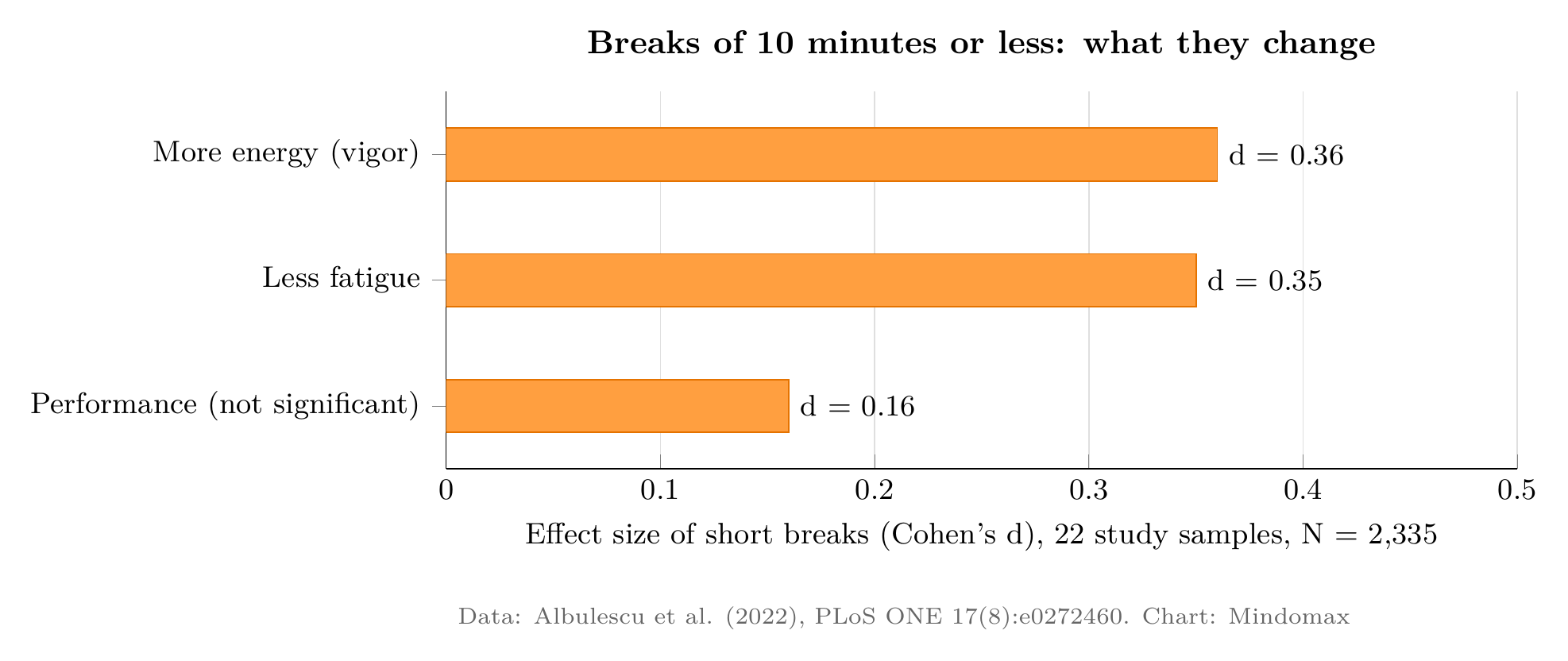
Short breaks lift energy and lower fatigue; their effect on performance was small and not significant. Data: Albulescu et al. (2022), PLoS ONE 17(8):e0272460, random-effects meta-analysis. Chart: Mindomax.
So, does it work?
What the evidence supports today:
Breaks help: short, regular breaks lift energy and lower fatigue.
A fixed timer helps people who forget to stop. Left to choose, the 2023 students drifted into longer stretches and felt worse.
25 minutes is not a magic number. No study found that fixed breaks led to more finished work or higher scores.
A strict alarm can cost focus: fatigue rose faster under Pomodoro in 2025, and in 2026 students preferred their own breaks.
None of these studies tested exam grades, learning over several weeks, or students with ADHD. If you have ADHD, our guide to ADHD study tips sorts the methods by what has actually been tested.
What to do in a 5-minute break
Cirillo's answer is "nothing". Students tend to do something else. In the 2026 Maastricht study, half of all reported break activities were social media or messages.
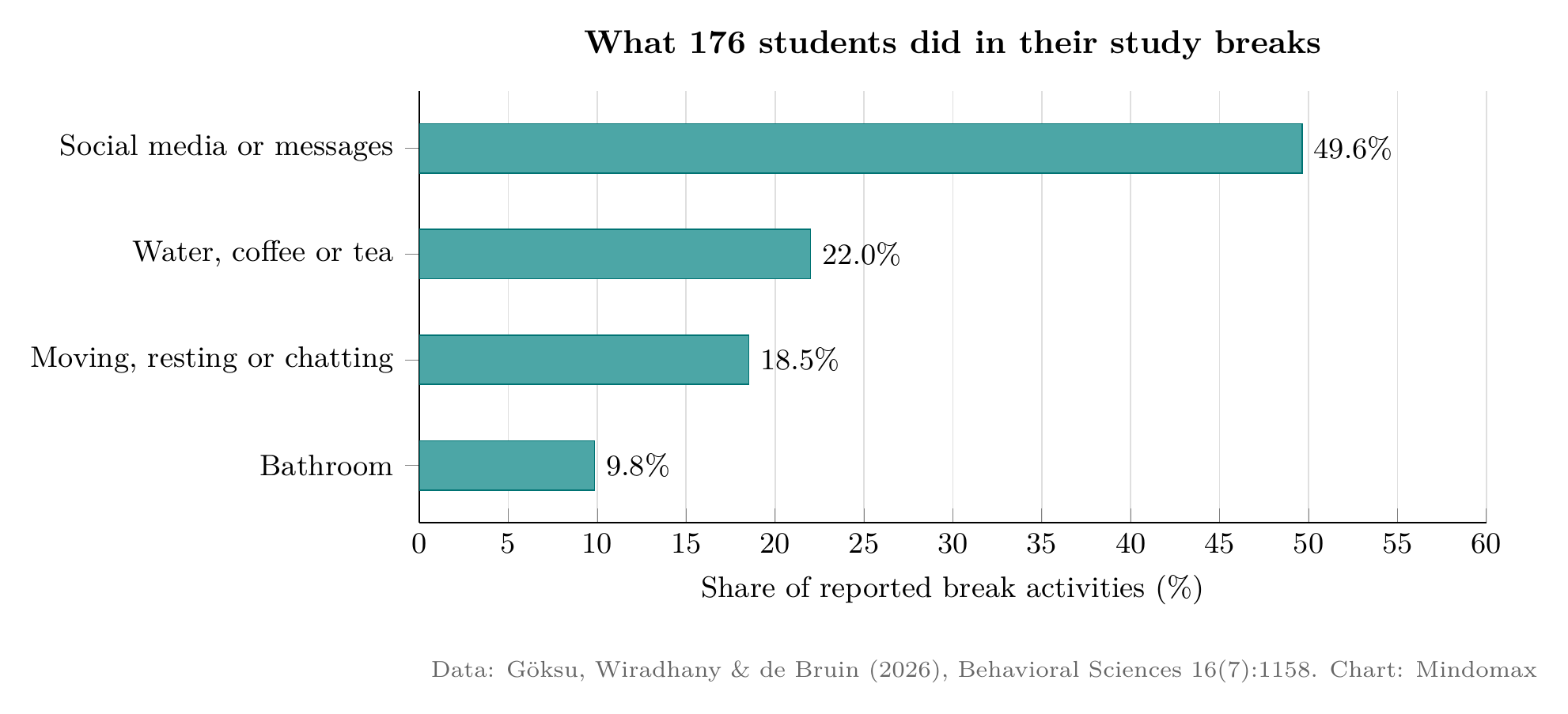
Half of all break activities were social media or messages. Data: Göksu, Wiradhany & de Bruin (2026), Behavioral Sciences 16(7):1158, break activities of both groups. Chart: Mindomax.
A feed is easy to open and hard to close after five minutes. Better options: get a glass of water, stretch or walk around, look out of a window, or close your eyes for a minute. And keep the long break after four rounds: in the meta-analysis, longer breaks did more for performance than very short ones.
Is 25 minutes the right length?
Where each popular number comes from, and how well it has been tested:
How to choose:
If starting is your problem, use 25/5. A short, fixed round is easy to begin, and the 2023 results favour fixed breaks for people who keep going until they are worn out.
If you lose yourself in deep work such as writing, coding or long problem sets, try longer blocks or Flowtime, so the alarm does not cut you off mid-thought.
For flashcards and memorization, 25 minutes is a good unit. Several short review sessions spread over days beat one long session, a finding known as the spacing effect.
If you are not sure, track one week. Write down how many rounds you finished and how you felt after each one, then adjust the length.
How to use the Pomodoro Technique for studying
Plan in pomodoros, not hours: "chapter 4, two pomodoros; practice problems, three". After a week your records show how many rounds a chapter really takes.
Start each round by testing yourself: close the book and write down what you remember, or go through flashcards on the topic. Pulling an answer out of memory teaches you more than reading it again, and it shows you what to work on next. Our guide on how to study with flashcards explains how.
Keep one subject per round, and spread rounds of the same subject over several days instead of stacking six in one evening.
Set a limit for the day. How many rounds are enough depends on the work, and our guide on how long you should study looks at session length and daily totals.
Pomodoro timer apps worth trying
Any kitchen timer works, and Cirillo prefers a mechanical one. If you would rather use an app, these were all updated within the last few months. Prices are from the US App Store unless the app is Android only (checked 2026-11-24). For apps that block distracting websites, see our list of the best focus apps for studying.
If you want your Pomodoro rounds, your flashcards and your study plan in one place, you can try Mindomax for free.
Frequently Asked Questions
What is the Pomodoro Technique?
A time management method by Francesco Cirillo: work on one task for 25 minutes, take a 5-minute break, and after four rounds take a longer break of 15 to 30 minutes. Each 25-minute round is one pomodoro, Italian for tomato.
Does the Pomodoro Technique really work?
Regular breaks lift energy and lower fatigue. But in three experiments with university students (2023, 2025, 2026), fixed Pomodoro-style breaks did not lead to more finished work or better test scores than breaks students chose themselves.
What should I do during a Pomodoro break?
Something that is neither your work nor your phone: drink water, stretch, walk, look out of a window. In a 2026 study, half of all break activities were social media or messages.
How many pomodoros should I do a day?
There is no tested number. Cirillo says even one, or none, is fine. Count your rounds for a week, see when your focus drops, and plan around that.
Is the Pomodoro Technique good for ADHD?
It is often recommended, but none of the three student experiments looked at students with ADHD, so there is no direct evidence yet. If the alarm keeps breaking your focus, try longer rounds or Flowtime.
What is the difference between Pomodoro and the 52/17 rule?
Pomodoro is 25 minutes of work and 5 of rest. The 52/17 rule comes from DeskTime's 2014 data on the most productive users of its tracking software, not from an experiment; its 2021 repeat found 112 and 26.
Sources
Francesco Cirillo, The Pomodoro Technique: the book, the method and the author's page. pomodorotechnique.com, About Francesco Cirillo
Pomodoro Technique. Wikipedia
Biwer, F., Wiradhany, W., oude Egbrink, M. G. A., & de Bruin, A. B. H. (2023). Understanding effort regulation: Comparing 'Pomodoro' breaks and self-regulated breaks. British Journal of Educational Psychology, 93(S2), 353-367. doi:10.1111/bjep.12593
Smits, E. J. C., Wenzel, N., & de Bruin, A. (2025). Investigating the effectiveness of self-regulated, Pomodoro, and Flowtime break-taking techniques among students. Behavioral Sciences, 15(7), 861. doi:10.3390/bs15070861
Göksu, A., Wiradhany, W., & de Bruin, A. B. H. (2026). When to take a break: Comparing effects of systematic short (Pomodoro) and self-regulated breaks on subjective experience and actual learning. Behavioral Sciences, 16(7), 1158. doi:10.3390/bs16071158
Ogut, E. (2025). Assessing the efficacy of the Pomodoro technique in enhancing anatomy lesson retention during study sessions: a scoping review. BMC Medical Education, 25, 1440. doi:10.1186/s12909-025-08001-0
Albulescu, P., et al. (2022). "Give me a break!" A systematic review and meta-analysis on the efficacy of micro-breaks for increasing well-being and performance. PLoS ONE, 17(8), e0272460. doi:10.1371/journal.pone.0272460
Kleitman, N. (1982). Basic rest-activity cycle, 22 years later. Sleep, 5(4), 311-317. doi:10.1093/sleep/5.4.311
DeskTime. Does the 52-17 rule really hold up? desktime.com
App prices: App Store US, checked 2026-11-24.


