
To study with flashcards well, say the answer before you flip, keep testing the cards you already know, study one big shuffled stack instead of small piles, and come back to each card over several days instead of one long night. That is most of it. The rest of this guide shows the numbers behind each rule, because several of them feel wrong while you are doing them, and the studies explain why your gut is a poor guide here.
The short version
If you only have a minute, here are the seven rules in order of how much they matter:
- Answer out loud or in your head before you turn the card over.
- Do not retire a card the first time you get it right.
- Shuffle everything into one stack. Small piles feel faster and work worse.
- Get each card right about three times in the first session, then see it again in three later sessions.
- Space those sessions. For an exam a week away, a gap of one to three days is about right.
- Put one fact on each card, and say it aloud when you can.
- Limit new cards to what you can review every day. Twenty new cards a day turns into roughly 200 reviews a day.
Each rule comes from a published study, listed at the end with links.
1. Answer before you flip
A flashcard only works if you try to pull the answer out of memory before you see it. Reading the front, flipping, and nodding along is rereading with extra steps. The effort of recall is the part that makes the memory stronger.
This is not a fringe idea. In a large review of ten common study techniques, Dunlosky and colleagues rated only two as high utility: practice testing and spreading practice over time (Dunlosky et al., 2013). Flashcards, used properly, are both at once. Highlighting and rereading, the two habits students rely on most, were rated low.
A simple test for yourself: if you cannot say the answer, or at least commit to a guess, before flipping, count the card as missed. We go further into why flashcards count as retrieval practice in are flashcards active recall?
2. Keep testing the cards you already know
This is the rule most students break, and the chart below shows why it matters.
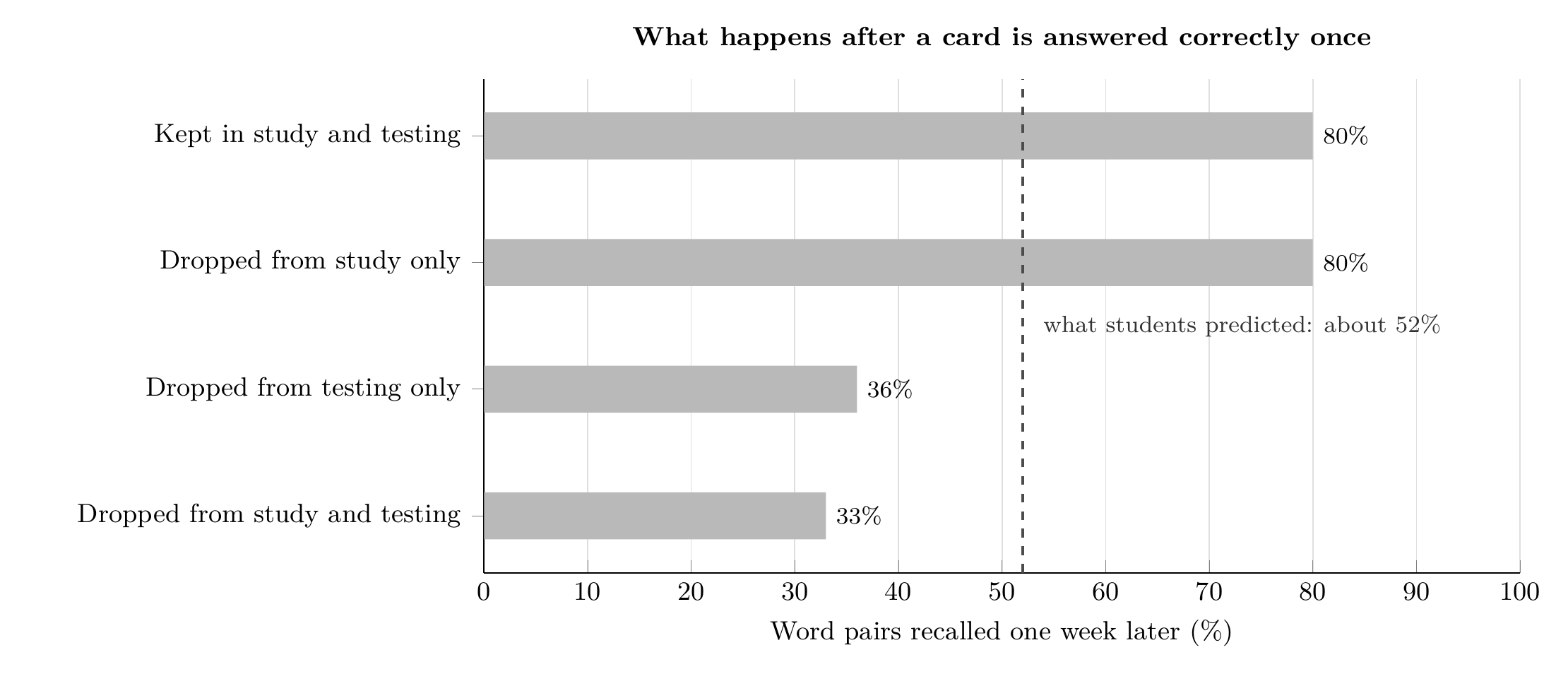
What happens after a card is answered correctly once. Data from Karpicke and Roediger (2008), Science 319, text and Figure 2: about 80% of word pairs recalled a week later in the two conditions that kept testing, 36% and 33% in the two that dropped words from testing. The dashed line is the students' own average prediction (about 52%). Chart by Mindomax.
Karpicke and Roediger (2008) had students learn 40 Swahili-English word pairs. Once a student answered a pair correctly, one of four things happened to it: it stayed in both study and testing, it was dropped from study but still tested, it was dropped from testing but still studied, or it was dropped from both. That last option is what most of us do with a pile of flashcards: you get it right, you put it aside.
A week later, the two groups that kept being tested recalled about 80% of the pairs. The groups whose pairs were dropped from testing recalled 36% and 33%. Extra studying without testing added essentially nothing. And every group predicted it would remember about half, so nobody could feel the difference while studying.
Kornell and Bjork (2008) found the same thing with flashcards directly: letting students drop cards they thought they knew had small but consistently negative effects on learning. The lesson is not that you can never set a card aside. It is that one correct answer is not the moment to do it.
3. Study one big stack, not small piles
Splitting a deck into small stacks and drilling each one until it is perfect feels efficient. You see the same card again a minute later, you get it right, and it feels like learning.
Kornell (2009) tested exactly this. Students learned GRE-style word pairs either as one large stack or as four smaller stacks studied one at a time. The large stack, which puts more time between repeats of each card, won. It also beat cramming everything on the last day. Across the experiments, spacing beat massing for 90% of the participants, yet after the first session 72% of them believed the small stacks had worked better.
So shuffle the whole deck. If a card comes back quickly because you missed it, fine. But do not build your session around seeing the same few cards over and over.
4. Three correct answers, then three return visits
How many times should you get a card right? Rawson and Dunlosky (2011) ran three experiments with 533 students and more than 100,000 recall responses to answer this. Their advice to students was specific: practice until you recall each item correctly three times in the first session, then relearn it in three later sessions spread well apart.
The second half is the part that pays. Coming back in later sessions had a large effect on how much students remembered one to four months later, for only a small number of extra trials. Drilling harder in the first session helped much less once the later sessions were in place.
In practice: on day one, stay with a card until you have produced it correctly three times across the session. Then make sure it comes back on at least three later days.
5. Space your sessions, and match the gap to the exam
How far apart should those sessions be? It depends on how long you need to remember.
Cepeda and colleagues (2008) taught more than 1,350 people a set of facts, reviewed them after gaps of up to 3.5 months, and tested them up to a year later. The best gap grew with the test delay. As a share of the time until the test, the best gap was about 20% to 40% for a test one week away, and about 5% to 10% for a test one year away.
You do not need to calculate this for every card. The point is that a single review the night before is far too short a gap for anything you want to keep, and that the gap should get longer as the goal gets further away. This is what the Leitner box system does on paper, and what apps with a review schedule do automatically. Our guide to Leitner system apps covers the paper method and the apps that copy it.
6. One fact per card, and say it out loud
A card that asks "Describe the causes of World War I" cannot be answered right or wrong in five seconds, so you end up half-knowing it and flipping anyway. Break it into cards that each test one thing. Piotr Wozniak, who wrote the first spaced repetition software, listed this among his well-known twenty rules of formulating knowledge, calling it the minimum information principle.
Two small habits help on top of that:
- Say the answer aloud. Words you produce aloud are remembered better than words you read silently, which is called the production effect (MacLeod et al., 2010). We explain it in the production effect.
- Add a picture or example when the fact is visual, such as anatomy, maps or chemical structures. Keep the card itself short.
If making cards is what stops you from studying at all, read what to do when flashcards take too long to make.
7. Limit new cards to what you can review
New cards are cheap today and expensive later, because each one comes back several times. The Anki manual gives a useful rule of thumb: if you consistently learn 20 new cards a day, expect roughly 200 reviews a day.
That is why people who add 100 cards on a motivated Sunday often quit by Thursday. Pick a number of new cards you can review every day for the rest of the course, and keep it there. As a rough starting point, many students manage 10 to 30 new cards a day, but the right number is the one you can keep up. If you want to know how long a session should be, see how long should you study.
A one-week plan before an exam
Here is how the seven rules fit together when the exam is a week away. It assumes you have your cards made on day 1.
Cards you still miss on day 5 are the ones to rewrite. Usually they are trying to test two things at once.
Paper cards or an app?
Both work. The weak point of paper is the schedule: you have to remember which cards are due and resist retiring the easy ones. We compare the two in paper vs digital flashcards.
An app handles the schedule for you, which covers rules 2, 4, 5 and 7 without effort. These five are common choices. Prices are from the US App Store and each app's own site, checked 2026-09-28.
If you already use Anki, you do not need to switch. If you are unsure whether it costs anything, see is Anki free?. For a wider comparison, our list of the best flashcard apps covers more options.
Mistakes that feel like progress
- Dropping a card after one right answer. It feels efficient. It cost more than half the recall in the Karpicke and Roediger study.
- Small stacks drilled until perfect. They feel fast. 90% of learners did better with one large stack (Kornell, 2009).
- Cramming the night before. It feels thorough, but spacing beat last-day cramming in Kornell's (2009) experiments.
- Flipping before answering. It feels like revision, but without a guess there is no retrieval.
- Adding more new cards than you can review. By the Anki manual's numbers, each daily new card means about ten daily reviews.
Frequently Asked Questions
How many flashcards should I study a day?
Separate new cards from reviews. As a rough starting point, 10 to 30 new cards a day; the Anki manual notes that 20 new cards a day leads to roughly 200 reviews a day. Reviews come first, then new cards if you still have time.
How many times should I review a flashcard?
Research by Rawson and Dunlosky (2011) suggests getting it right three times in the first session, then relearning it in three later sessions spread well apart. After that, longer and longer gaps are enough.
Should I stop studying a card once I know it?
Not after the first correct answer. In Karpicke and Roediger (2008), students who kept testing known words recalled about 80% a week later, against 33% to 36% for those who dropped them.
Is it better to study flashcards in small groups?
No. Kornell (2009) found one large shuffled stack beat several small stacks for 90% of learners, even though most of them believed the opposite after the first session.
Do flashcards help with understanding, or only memorising?
They are strongest for facts, terms and definitions. For concepts, write cards that ask why or how, and one idea per card. Rawson and Dunlosky's 2011 study used conceptual material, not word pairs, and the three-plus-three advice came from it.
The bottom line
Studying with flashcards comes down to two habits: pull the answer from memory before you look, and bring each card back over several days. Everything else, from one big stack to a daily limit on new cards, serves those two. Paper can do it if you keep the schedule yourself; an app can keep it for you.
If you want an app that makes the cards and keeps that schedule for you, Mindomax is free to try.
References
Cepeda, N. J., Vul, E., Rohrer, D., Wixted, J. T., & Pashler, H. (2008). Spacing effects in learning: A temporal ridgeline of optimal retention. Psychological Science, 19(11), 1095-1102. doi:10.1111/j.1467-9280.2008.02209.x
Dunlosky, J., Rawson, K. A., Marsh, E. J., Nathan, M. J., & Willingham, D. T. (2013). Improving students' learning with effective learning techniques. Psychological Science in the Public Interest, 14(1), 4-58. doi:10.1177/1529100612453266
Karpicke, J. D., & Roediger, H. L. (2008). The critical importance of retrieval for learning. Science, 319(5865), 966-968. doi:10.1126/science.1152408
Kornell, N. (2009). Optimising learning using flashcards: Spacing is more effective than cramming. Applied Cognitive Psychology, 23(9), 1297-1317. doi:10.1002/acp.1537
Kornell, N., & Bjork, R. A. (2008). Optimising self-regulated study: The benefits and costs of dropping flashcards. Memory, 16(2), 125-136. doi:10.1080/09658210701763899
MacLeod, C. M., Gopie, N., Hourihan, K. L., Neary, K. R., & Ozubko, J. D. (2010). The production effect: Delineation of a phenomenon. Journal of Experimental Psychology: Learning, Memory, and Cognition, 36(3), 671-685. doi:10.1037/a0018785
Rawson, K. A., & Dunlosky, J. (2011). Optimizing schedules of retrieval practice for durable and efficient learning: How much is enough? Journal of Experimental Psychology: General, 140(3), 283-302. doi:10.1037/a0023956
Anki Manual, Deck Options. docs.ankiweb.net/deck-options.html


