
The short answer
The Thai alphabet has 44 consonants, 16 vowel symbols that combine into at least 32 vowel forms, and 4 tone marks. You will not meet them equally often. Eight consonants, น ร อ ก ม ง ย ว, make up 54% of all the consonants in real Thai text. Twenty make up 91%. Two, ฃ and ฅ, are obsolete: we found one ฃ in every 172,754 consonants, and most of those were typos.
So learn the letters in the order you will meet them, not in the order of the chart. We tested both on 774,159 words of real Thai. After two days of 8 new letters a day, the frequency order lets you sound out 60% of the words. The chart order, ก ข ฃ ค, lets you sound out 6%.
Below you will find every consonant ranked, a six-day plan, the vowel signs and tone marks that matter most, and the apps that teach the script.
How the Thai alphabet works
Thai is written from left to right, and the words run together without spaces. A space marks the end of a phrase or a sentence, not the end of a word. The script is an abugida: the consonants carry the word, and the vowels are written around them, before, above, below or after the consonant, even when they are pronounced after it. In เมือง (mueang, "city"), the vowel is spelled with three symbols, เ, ื and อ, wrapped around the ม.
The 44 consonants stand for only 21 sounds, because several letters spell the same sound. ท, ธ, ฐ, ฑ, ฒ and ถ can all be "th". Every consonant has a name made of its sound and a picture word: ก is ko kai, "k as in chicken", and ข is kho khai, "kh as in egg". Thai children learn the letters in that order with a picture chart, and nearly every chart online uses it too.
Each consonant also belongs to a class: mid, high or low. Together with the tone mark and the length of the vowel, the class decides the tone of the syllable, which is why teachers want you to know the classes early. Thai has five tones and four tone marks. Tradition credits King Ramkhamhaeng with creating the script in 1283; the details, with every letter's history, are in the Wikipedia article on the Thai script.
How we counted 142.7 million letters
We took four collections of real Thai from the Leipzig Corpora Collection (news from 2011 and web pages from 2015, 2016 and 2018, about 400,000 sentences), the Thai film and TV subtitles of OpenSubtitles 2018 (9.1 million lines) and the 6,853 Thai sentences on Tatoeba. Then we counted every Thai character: 244.5 million in all, 142.7 million of them consonants.
News, web pages and dialogue are three different kinds of Thai, so every share below is the average of the three. That way the 120 million consonants in the subtitles do not outvote the rest. First we threw out 30,610 subtitle lines with broken encoding; left in, they would have made ฃ look more than 30 times as common as it is.
To test learning orders, we split samples of each kind of text into 774,159 words with PyThaiNLP and checked which words a learner could sound out after each new letter. The counts and the charts are ours, made on 2026-11-09.
The 44 consonants, most frequent first
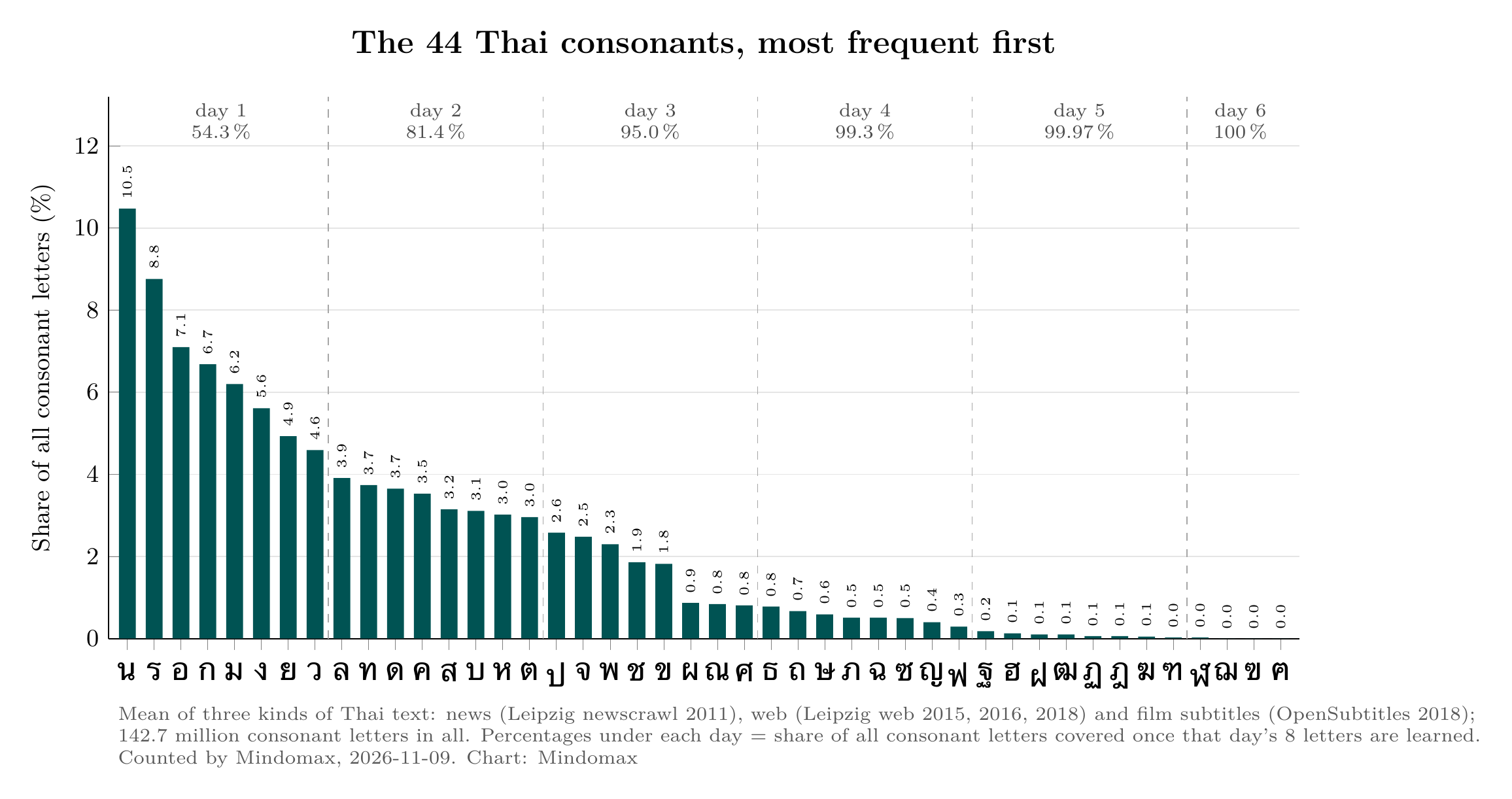
The 44 consonants ranked by their share of all consonant letters in news, web pages and film subtitles. The first eight make up 54.3%; the last twelve, all together, 0.75%. Data: Leipzig Corpora Collection and OpenSubtitles 2018. Calculation and chart: Mindomax (2026-11-09).
The top of the list is the same in every kind of text we counted. น, ร, อ, ก, ม, ง, ย and ว are the eight most common consonants in the news, on web pages, in film dialogue and in the Tatoeba sentences; only their order changes. น leads because it sits in so many everyday words, like ใน (in), นี้ (this), คน (person) and วัน (day). ร comes first on web pages, with 11.2%. One word explains much of that: การ, the Thai "-ing" or "-tion", holds 15% of every ร on the web pages we counted.
Two things surprise most learners. First, the class you are often told to learn first is not the one you meet first. Eight of the ten most common consonants are low class, and the first high-class letter, ส, comes in at number 13. Low-class letters make up 59.6% of all consonants, mid-class letters 28.7% and high-class letters 11.7%.
Second, the letters that make Thai look hard are rare. The twelve least common consonants, ฐ ฮ ฝ ฒ ฏ ฎ ฆ ฑ ฬ ฌ ฃ ฅ, add up to 0.75% of all consonants. Most of them live in Sanskrit and Pali loanwords, such as รัฐบาล (ratthaban, "government") and กีฬา (kila, "sport").
Here is the full list. "Sound" gives the letter's sound at the start and at the end of a syllable, and "-" means it never ends one. "Share" is its share of all consonant letters.
Why the chart order is the slowest way to start
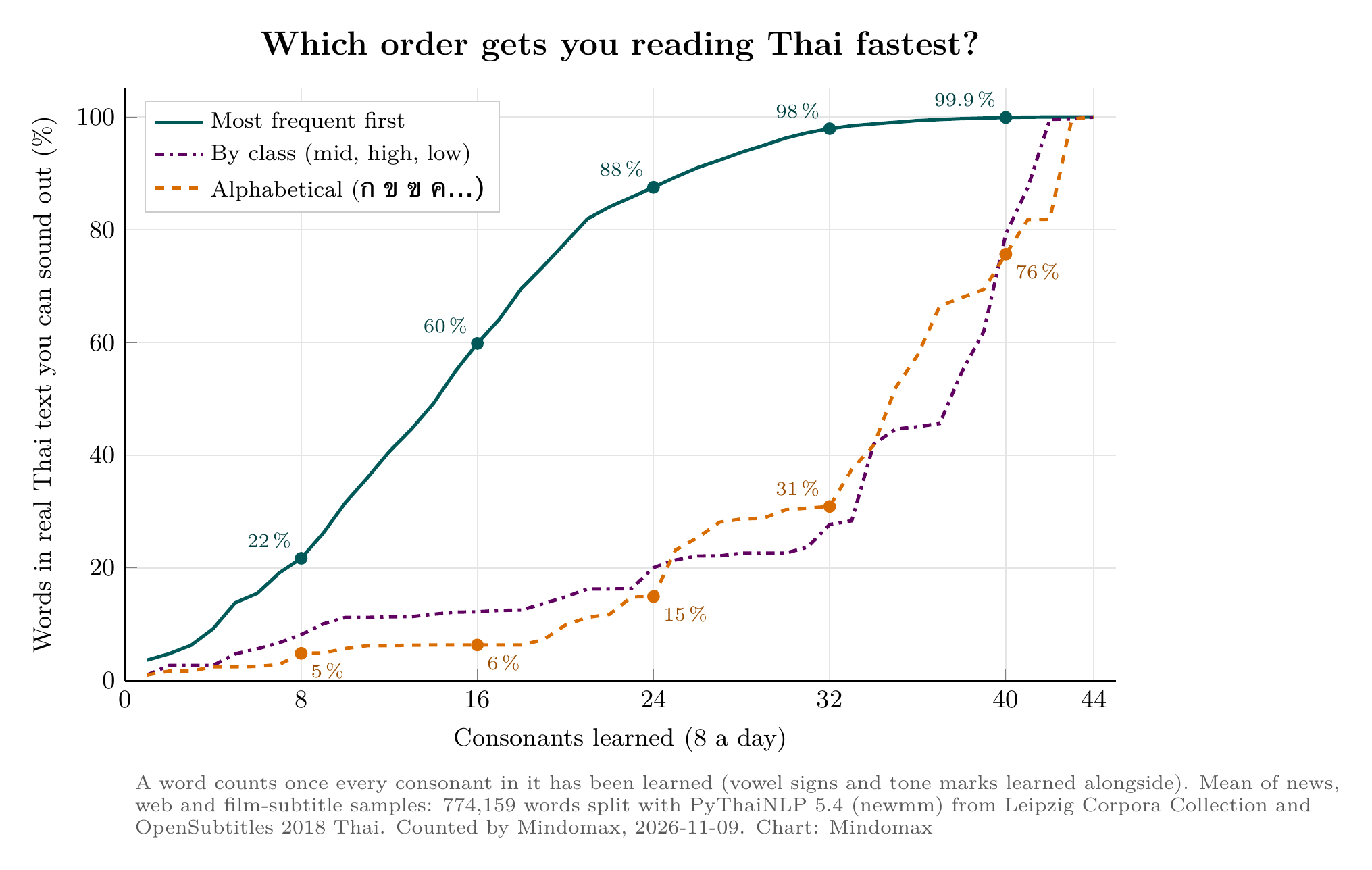
How many words of real Thai you can sound out after each day of 8 new consonants, for three learning orders. A word counts once you know all of its consonants; the vowel signs and tone marks are learned alongside. Data: 774,159 words from the Leipzig Corpora Collection and OpenSubtitles 2018, split with PyThaiNLP. Calculation and chart: Mindomax (2026-11-09).
The chart order, ก ข ฃ ค ฅ ฆ ง จ, spends day one on two obsolete letters and one rare one. After those eight letters you can sound out 4.8% of the words in real Thai text, and after 16 letters only 6.3%. Learning by class is not much better: 8.2% after one day and 12.2% after two, because the common low-class letters come last.
Learning the most frequent letters first gets you to 21.7% after one day, 59.8% after two and 87.5% after three. After day four you can sound out 97.9% of the words, while the chart order is still at 30.9%. All three orders reach 100% on day six, but only one of them lets you read real signs, menus and messages along the way.
You still need the classes for the tones. Learn them as a label on each card, not as the order of the cards: a color for mid, high and low, next to the letter's name.
A six-day plan: 8 letters a day
The table shows what each day adds. "Consonants covered" is the share of all consonant letters you now know. The two "words" columns show how many words of real Thai you can sound out after that day, in this order and in the chart order.
Each day, make a card for every new letter: the letter on the front, and on the back its name, its sound at the start and at the end of a syllable, and its class. Say the name out loud before you turn the card. Then read the day's words. The next day, review yesterday's cards before you add new ones.
Short reviews spread over several days beat one long session; that is the spacing effect. Trying to recall the answer before you look helps too; that is the testing effect. Our guide on how to make flashcards shows simple card layouts.
Learn the vowel signs from day one, three or four a day, starting at the top of the next table, so that the day's words are readable. By day six you will have met every consonant. Reading with ease takes longer, and the language itself much longer: the US Foreign Service Institute puts Thai at 44 weeks of full-time study.
Vowel signs: six do 70% of the work
Thai has 16 vowel symbols. Each vowel you hear is written with one of them or with two or three together. Counting every symbol on its own, า alone is 22.7% of all vowel signs, and six of them, า เ ั ี ิ ะ, make up 69.5%.
Three things help. เ, แ, โ, ใ and ไ are written before the consonant but said after it, so แม่ is "mae", not "aem". เ is also the first part of longer vowels such as เ-ีย (ia), เ-ือ (uea) and เ-า (ao): เรา, "we", is rao. And ใ is spelled in only twenty words, yet it makes 2.9% of all vowel signs, more than โ, because those twenty include ใน (in), ให้ (give), ใช้ (use), ใหม่ (new) and ใจ (heart).
Tone marks: two do 99% of the work
Thai has four tone marks, and two of them you will hardly ever see. Mai ek and mai tho make up 98.8% of all tone marks in our count. Mai tri and mai chattawa together are about 1 in 83, because they only sit on mid-class consonants. Dialogue uses far more tone marks than the news: 17.6 per 100 consonants in film subtitles against 11.5 in the news.
A mark does not give you the tone by itself. The tone comes from three things: the class of the first consonant, the mark, and whether the syllable is "live" (it ends in a long vowel or in m, n, ng, w or y) or "dead" (it ends in a short vowel or in k, p or t). This table is the whole rule:
What you can leave for later
Not everything on a Thai chart deserves a place in your first week.
ฃ and ฅ are obsolete. We found ฃ once in every 172,754 consonants and ฅ once in every 984,107. Most of the ฃ we found were typos for ช or leftovers of broken encoding, and ฅ turns up now and then in the old spelling ฅน for คน (person). Learn to recognize both on day six, but don't drill them.
Thai digits, ๐ to ๙, are rare in everyday text. They were 0.65% of all digits in the news and 0.21% in film subtitles; most numbers are written 0 to 9. Some web pages use them more, up to 14.6% in one of our web collections; Wikipedia notes they are used mostly in government documents and other official settings. Learn them in your second week.
The abbreviation mark ฯ shows up 1.2 times per 1,000 characters in the news and almost never in dialogue (0.03).
One small sign is worth learning early: ์ (thanthakhat), which silences the letter under it. It appears 4 to 12 times per 1,000 characters, in words you need from week one. The names of four weekdays carry it: วันจันทร์ (Monday), วันศุกร์ (Friday), วันเสาร์ (Saturday) and วันอาทิตย์ (Sunday). The same goes for ๆ (mai yamok), which repeats the word before it, as in เร็วๆ (reo reo, "quickly"); it is about 2 per 1,000 characters in dialogue.
Apps that teach the Thai script
Duolingo does not teach Thai. Its course list for English speakers runs from Arabic to Zulu, 40 courses in all, and Thai is not among them (checked 2026-11-09). These apps do. Ratings and prices are from the US App Store.
If you only want the script, one handwriting app and one deck you review every day are enough. If you want the whole language, Ling is built for Thai, and Pimsleur is for speaking, not reading.
If you want the six day lists above as cards that come back on the right day, paste them into Mindomax, which is free right now.
Frequently Asked Questions
How many letters are in the Thai alphabet?
44 consonants, two of which (ฃ and ฅ) are obsolete, plus 16 vowel symbols that combine into at least 32 vowel forms, and 4 tone marks. In real text, 20 consonants make up 90.7% of all consonant letters.
What is the first letter of the Thai alphabet?
ก, ko kai, "k as in chicken". It is the 4th most common consonant in real Thai (6.7% of consonant letters). The most common is น, no nu, with 10.5%.
Which Thai letters should I learn first?
น ร อ ก ม ง ย ว. These eight are 54.3% of all consonant letters, and they already spell words like ไม่ (not), ใน (in), มี (have) and มา (come).
How long does it take to learn the Thai alphabet?
At 8 new consonants a day, the consonants take six days, with the vowel signs learned alongside. Daily reviews over the following weeks make them stick. Reading quickly takes practice with real text after that.
Are ฃ and ฅ still used?
Hardly. In 142.7 million consonant letters we found ฃ once in every 172,754 and ฅ once in every 984,107. Most ฃ were typos for ช, and ฅ turns up now and then in the old spelling ฅน for คน (person).
Does Duolingo teach Thai?
No. Duolingo's 40 courses for English speakers do not include Thai (checked 2026-11-09). Ling, Drops and Pimsleur all have Thai courses.


