
The short answer
The Latin phrases English uses most in everyday writing are status quo, vice versa, per se, ad hoc, de facto and bona fide. Each is printed between 1.8 and 5.4 times in every million words of American books. Add et cetera, alter ego, modus operandi, pro bono, alma mater and quid pro quo, and you know most of the Latin an ordinary reader meets.
Across all books, the top of the list is science Latin: in vitro, in vivo and per capita. The famous lines are rarer than their fame suggests. Carpe diem comes in at number 101, and alea iacta est, "the die is cast", is printed about two and a half times in every billion words.
We did not pick these by taste. We took the 2,389 entries on Wikipedia's full list of Latin phrases, kept the 1,910 that can be measured, and counted how often each appears in American books. Of all the times those phrases are printed, the 100 below account for 91%. Most of the rest barely exist in print: 1,182 phrases, 62% of the list, show up less than once per billion words.
How we counted 1,910 Latin phrases
We looked up every phrase of two to five words in the Google Books Ngram Viewer, American English, 2010 to 2019: 103.5 billion words from about a million books. We averaged the ten years, counted any capitalization and turned the result into uses per million words, the same method as our list of fancy words.
Lines with commas, like "cogito, ergo sum", cannot be searched with the comma, so we counted their longest unbroken part ("ergo sum"). We dropped matches that are not really Latin ("in fine" is mostly "in fine condition"; Corpus Christi is mostly the city in Texas) and added pro bono and post hoc, which Wikipedia lists only in their long forms. To tell everyday Latin from lab and courtroom Latin, we also checked Google's fiction collection: in novels, vice versa, et cetera and status quo lead, while in vitro almost disappears.
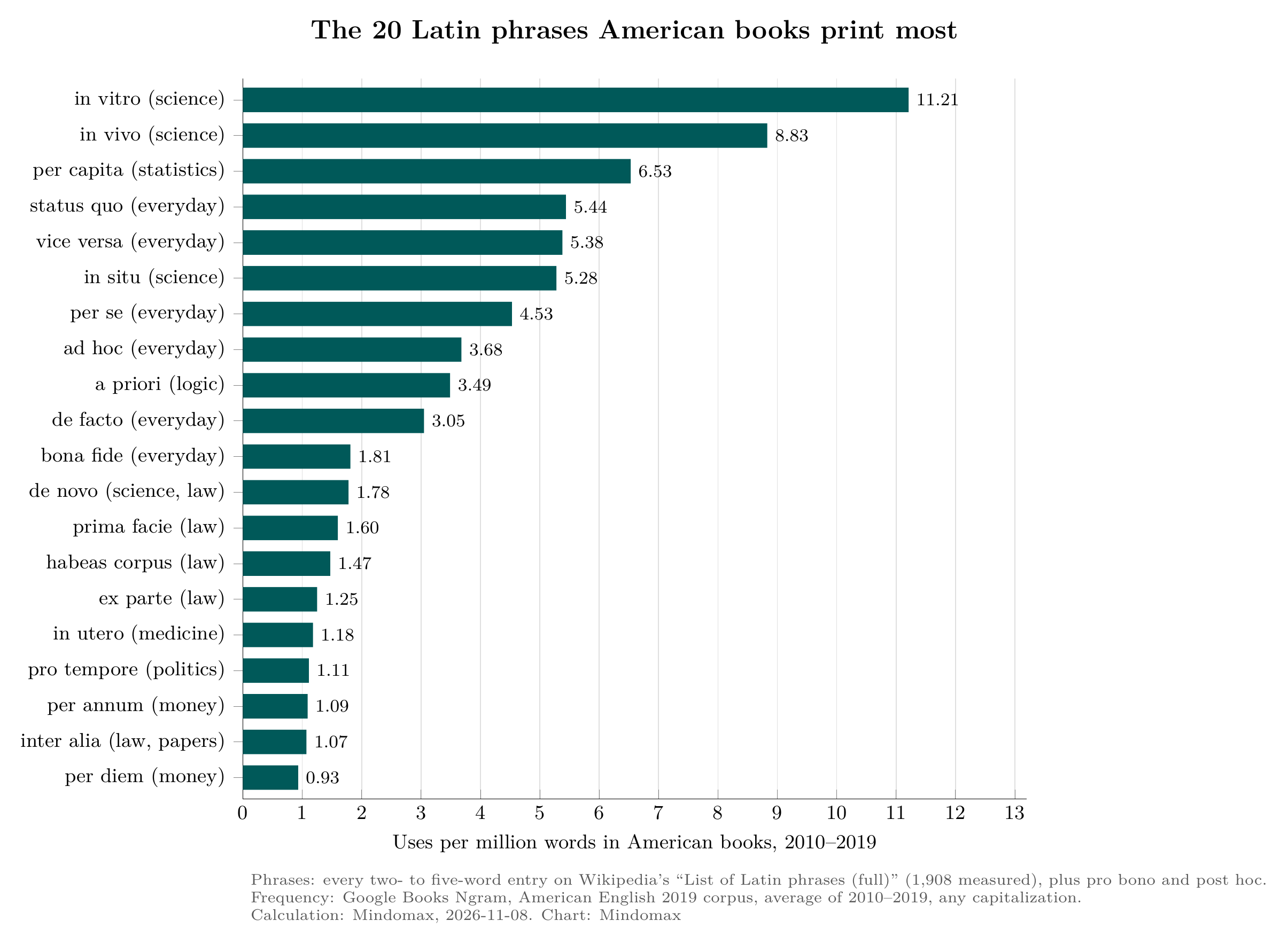
Read it like this: the Latin printed most in American books is science and law Latin, and status quo, vice versa, per se, ad hoc and de facto are the everyday phrases in the top ten. Data: Google Books Ngram, American English, 2010 to 2019. Calculation and chart: Mindomax (2026-11-08).
Everyday Latin: the 30 phrases you will actually meet
These are the everyday phrases in the top 100, by rank. "Say it" is the usual American pronunciation, based on the Cambridge Dictionary. "Per million" is how often the phrase is printed per million words.
Two traps: per se means "in itself", not "so to speak", and et cetera already contains "and", so "and etc." says it twice. Novelists love terra firma, rigor mortis and aurora borealis, which are all printed more often in novels than in books as a whole.
Latin at work, at school and in arguments
This is the Latin of reports, papers, budgets and debates. Per capita alone is printed more often than any everyday phrase.
A priori (known by reasoning) and a posteriori (known from evidence) are a pair, and the diploma honors climb in a set order: cum laude, magna cum laude, summa cum laude.
Latin in law and politics
A quarter of the top 100 belong to law, where each phrase names an exact legal idea in two or three words.
Habeas corpus has been a legal term since the 14th century or earlier. Pro tempore is best known from one job title, the president pro tempore of the U.S. Senate.
Latin in science and medicine
In vitro, "in glass", is the most-printed phrase in our whole count.
Five more of the top 100 come from religion and history: Magna Carta (#38), imago Dei, "the image of God" (#53), Ave Maria (#59), ecce homo, "behold the man" (#88), and sola scriptura, "by scripture alone" (#97).
Famous Latin quotes and where they come from
Famous is not the same as common. The lines on every "Latin phrases" list are printed far less often than a dull phrase like inter alia, so this table counts them per billion words. The rank shows where each would land among the 1,910 phrases.
The Latin line "et tu, Brute?" comes from Shakespeare's play; the Roman historians who describe Caesar's death never wrote it. Veni, vidi, vici at least has a Roman source: the message Caesar is said to have sent the Senate after a quick win at Zela. Lines with commas are counted by their longest unbroken part (ergo sum, et tu), and veni, vidi, vici by the word vici.
Popular "Latin phrases" that almost nobody uses
We ran the four lists Google shows on page one for "latin phrases" through the same count.
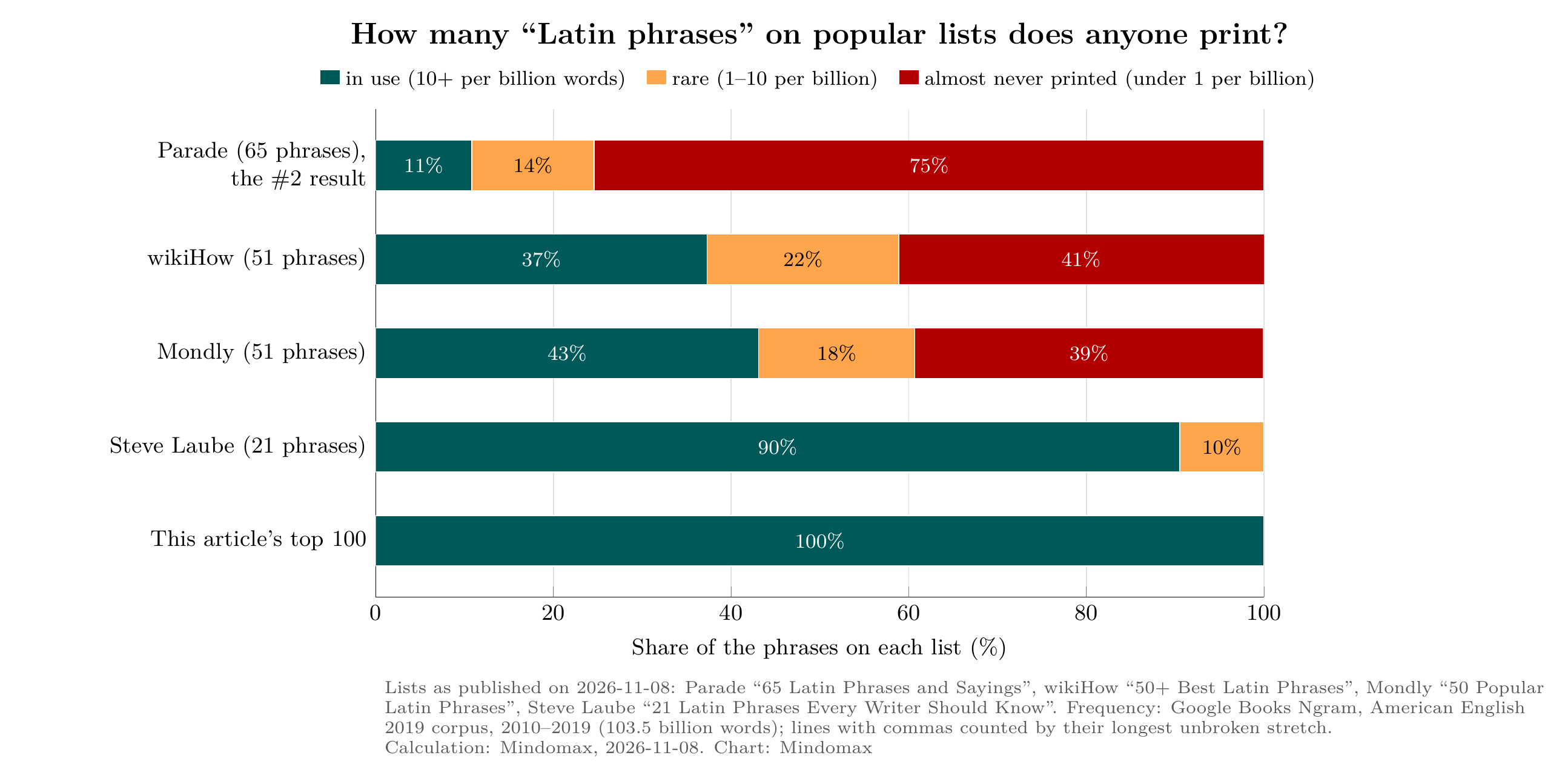
Read it like this: three of every four "Latin phrases" on Parade's list are printed less than once per billion words in American books. Data: the four lists as published on 2026-11-08; Google Books Ngram, American English, 2010 to 2019. Calculation and chart: Mindomax (2026-11-08).
Of Parade's 65 phrases, 49 (75%) are printed less than once per billion words, roughly 100 times in ten years of American books. "Carpe vinum", "Cras es noster" and "Melita, domi adsum" are too rare for the Ngram Viewer to count at all. Parade's third entry, "Audere est faucere", also on wikiHow's list, is misspelled: the motto is audere est facere, "to dare is to do", and it belongs to Tottenham Hotspur. Mondly and wikiHow do better, with about 40% almost never printed, and the shortest list is the best: 19 of Steve Laube's 21 phrases for writers are in real use. A rare line can still suit a tattoo or a motto; just check the spelling against a real source first.
Latin abbreviations you use without noticing
The Latin that English prints most is not a phrase at all. Et al. ("and others", in every citation) appears 361 times per million words, more than 30 times as often as in vitro.
Use i.e. when you restate something ("that is") and e.g. when you give one example of several ("for example").
How to say Latin phrases
In an English sentence, say Latin the English way, as lawyers and doctors do: ad HAHK, pur SAY, BOH-nuh FY-dee. Latin classes usually teach the classical sound of Caesar's time, where v is w and c is always hard: WAY-nee WEE-dee WEE-kee. Church Latin follows Italian: VAY-nee VEE-dee VEE-chee. Each is right in its own setting.
How to remember them
Reading a list once does very little. In a study of foreign-language vocabulary, Karpicke and Roediger (2008) found that studying words again after learning them had no effect on later recall, while testing them again had a large one. Spreading the tests over days beats cramming, as a 2006 review of 317 experiments found.
For phrases that sound strange, try the keyword method: link the Latin to an English word that sounds like it and picture the two together. In a Stanford study of Russian vocabulary, students using it scored 72% on the key test, against 46% for students who studied their own way. "Carpe" sounds like "carp": picture a carp leaping out of a pond to grab the morning sun, and carpe diem sticks.
Start with the 30 everyday phrases. Make one card per phrase, with the Latin in a real sentence on the front and the meaning and pronunciation on the back, and quiz yourself in both directions. Our guide to making flashcards covers the details, and the testing effect explains why quizzing beats rereading.
Apps and tools for learning Latin phrases
Any flashcard app will hold 30 phrases; the tools below go further. Prices are from the US App Store, checked on 2026-11-08, and every app was updated within the last year.
For one free option, Anki or Quizlet with the everyday table is enough. Latin Phrases Trainer is the only app here built just for phrases.
Mindomax is our own app. It turns pasted text into flashcards and schedules the reviews. It has no Latin deck of its own, so you would paste the tables in yourself, and it is new, with only a handful of App Store ratings. If you want to try it with these tables, everything in Mindomax is free right now.
Frequently Asked Questions
What are the most common Latin phrases in English?
In everyday writing: status quo, vice versa, per se, ad hoc, de facto and bona fide. In science and statistics, in vitro, in vivo and per capita are printed even more often.
What are 10 common Latin phrases?
Status quo, vice versa, per se, ad hoc, de facto, bona fide, et cetera, alter ego, pro bono and quid pro quo. All ten are in the top 31 of our count of 1,910 phrases.
What are some cool Latin quotes?
Carpe diem (seize the day), memento mori (remember that you will die), veni, vidi, vici (I came, I saw, I conquered) and ad astra per aspera (to the stars through hardship). All are real, and all are far rarer in print than status quo.
What is a powerful Latin phrase?
Sic semper tyrannis (thus always to tyrants), Virginia's motto, and acta non verba (deeds, not words) are short and forceful. Check the spelling first: "audere est faucere" should be audere est facere.
How do you pronounce Latin phrases in English?
The English way: STAY-tuhs KWOH for status quo, pur SAY for per se, ad HAHK for ad hoc. Classical and church Latin sound different (WAY-nee or VAY-nee for veni), and each is right in its own setting.


