
The short answer
The most common word in Korean is 하다 (hada), "to do." It shows up about 33,000 times in every million words of everyday Korean, and it hides inside thousands of other verbs: 공부하다 (to study), 생각하다 (to think), 사랑하다 (to love). Right behind it come 거 (geo, "thing"), 나 (na, "I"), 있다 (itda, "to be, to have") and 보다 (boda, "to see").
To build this list, we counted every word in 12 million words of real Korean: 7.3 million from film and TV subtitles and everyday example sentences, and 4.7 million from news and Wikipedia. A language analyser split each word from the particles and endings stuck to it and folded it back to its dictionary form, so 갔어요, 가서 and 가는 all count as 가다 (gada, "to go").
Three numbers from that count should shape how you study. First, the 100 most common words make up 46.8% of all the words in everyday Korean, and 1,000 words take you to 78.1%. Second, almost half of what you hear (46.6%) is not words at all but the particles and endings glued to them, and about 30 of those pieces do most of the work. Third, half of all sentences in subtitles end in casual speech (반말, banmal), not in the polite -요 that textbooks teach first.
Below are the top 100, the grammar pieces that hold them together, the speech levels, and the famous words that turned out to be rare.
The 100 most common Korean words
The ranking comes from everyday Korean: subtitles plus the Tatoeba example sentences. Romanization follows the official Revised Romanization. "Per million" is how many times the word appears in a million words of text. Verbs and adjectives are listed in their dictionary form ending in -다; in real speech you hear them as 해요, 했어, 하세요 and so on.
Four things stand out. First, the list is mostly verbs and nouns: 38 verbs and adjectives, 35 nouns and pronouns, 16 adverbs and conjunctions, 7 determiners and 4 interjections like 네 (yes). Second, 거 and 것 are the same word. 것 is how it is written, 거 is how people say it, and together they would beat 하다 for first place.
Third, some verbs rank high because they double as helpers. Half of all uses of 보다 (see) are as a helper, mostly the "try" pattern, as in 먹어 봐 (try it), and four in five uses of 주다 (give) are "do it for someone," as in 도와 주세요 (please help me). Learn the helper meaning together with the main one.
Fourth, a few words are inflated by the source. 당신 (you), 그녀 (she) and 자네 (an old-fashioned "you") sit high because much of the subtitle text is translated from foreign films, and 죽다 (die) and 죽이다 (kill) rank where they do because films are full of drama. The section on pronouns below explains what to use instead.
How much Korean do these words cover?
Coverage is the share of all the words in a text that come from a word list. It tells you how much a list buys you before you open your first Korean show.
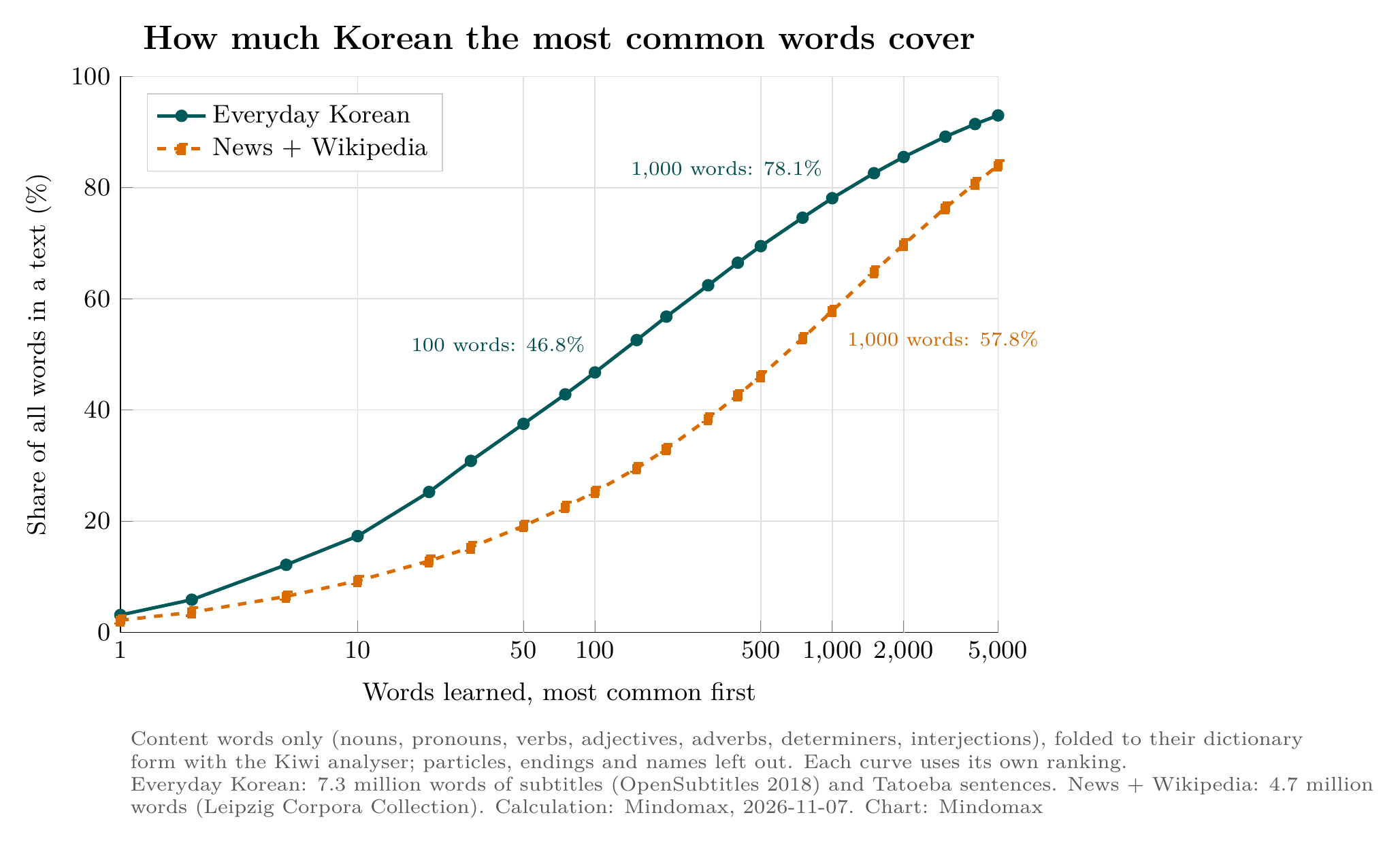
Read it like this: the 100 most common words already make up almost half (46.8%) of the words in everyday Korean, but only a quarter (25.3%) of news and Wikipedia. Data: OpenSubtitles 2018, Tatoeba and the Leipzig Corpora Collection. Calculation and chart: Mindomax (2026-11-07).
In everyday Korean, the first 10 words already cover 17.3% of everything, the first 100 cover 46.8%, and 500 take you to 69.5%. After that, each new word buys less: 1,000 words give 78.1%, 2,000 give 85.5%, and to reach 90% you need 3,316. Half of all everyday words come from just 126 dictionary entries.
Writing is a different language at this level. The top 100 words of news and Wikipedia cover only 25.3% of those texts, 1,000 words cover 57.8%, and 90% takes 8,123 words. Worse, the 1,000 most common everyday words cover just 40.8% of a news text. That is why a news article feels impossible long after you can follow a drama scene.
These figures count only the content words. Add the grammar pieces in the next section and the picture brightens: the 30 most common particles and endings plus the top 100 words account for 60.7% of all the pieces of everyday Korean, and with the top 1,000 words that rises to 76.8%. For context, the US Foreign Service Institute puts Korean in its hardest group for English speakers, at about 2,200 class hours (see our ranking of the hardest languages to learn). Starting with the most frequent words is the cheapest way to make those hours count.
The 20 grammar pieces that hold every sentence together
In Korean, the "word" between two spaces is usually a stem plus attachments. 학교에서 is 학교 (school) plus 에서 (at), and 갔어요 is 가다 (go) plus a past-tense piece plus a polite ending. Particles tell you who does what to whom; endings carry tense, politeness and the link to the next clause.
These pieces are 46.6% of everything in everyday Korean (42.9% in news and Wikipedia). Our data has about 1,500 different ones, but the 30 most frequent cover 78.7% of all their uses, so a short list goes a long way. Here are the top 20, with the spelling pairs merged (이 after a consonant, 가 after a vowel, and so on).
The copula 이다 tops the list because Korean uses it constantly to name and identify things: 뭐예요? (what is it?), 저예요 (it's me). If you learn one piece from this table on day one, make it the polite ending -아요 / -어요; with it, every verb in the top 100 becomes a sentence you can say to a stranger.
Casual, polite or formal: how Korean sentences really end
Korean marks politeness at the end of every sentence. The same "I'm going" can be 가 (casual), 가요 (polite) or 갑니다 (formal). We took the last ending of each sentence and sorted them by speech level.
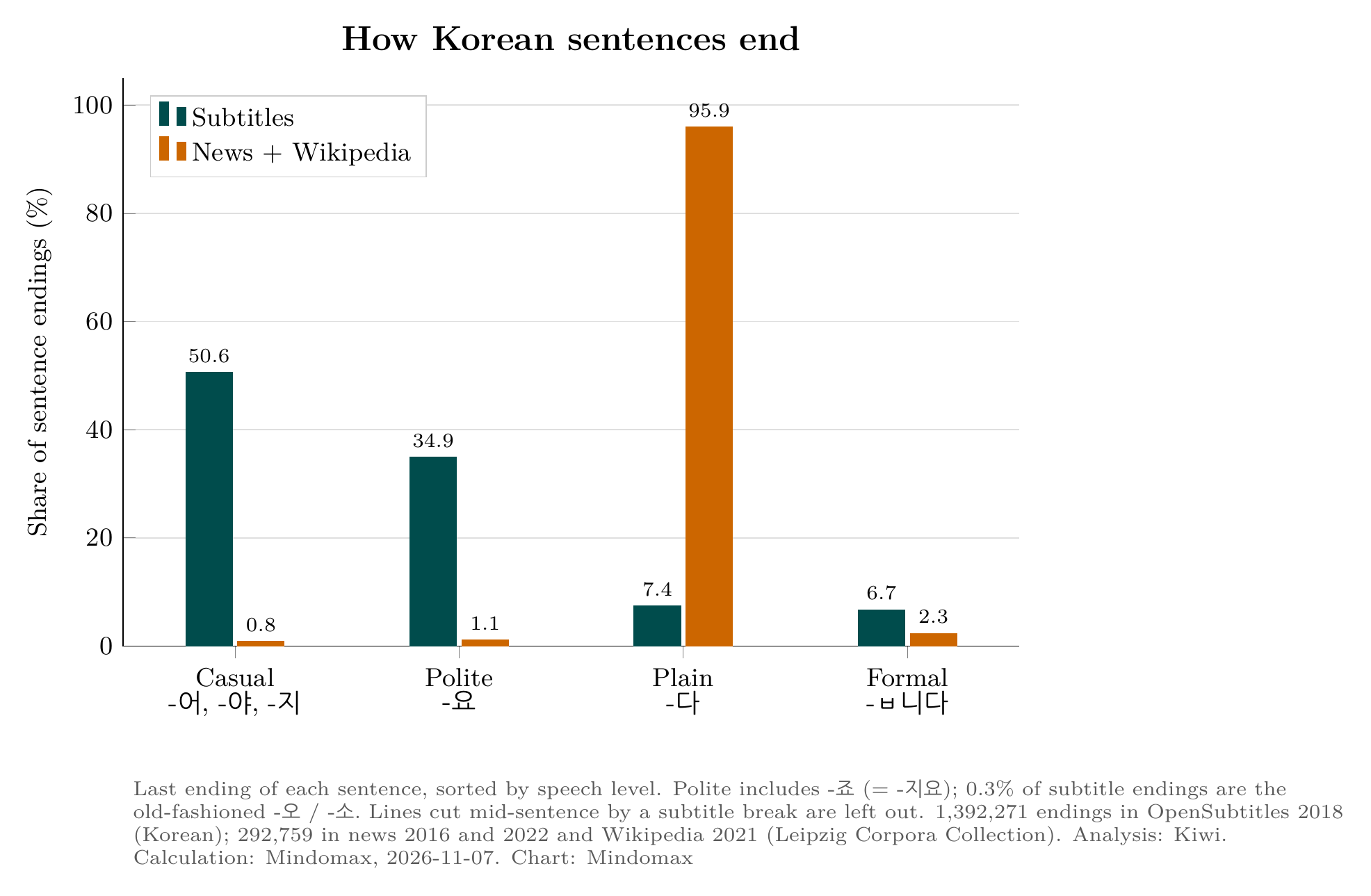
Read it like this: in subtitles, half of all sentences end in casual speech and a third in polite -요; news and Wikipedia end 96% of their sentences in plain -다. Data: OpenSubtitles 2018 and the Leipzig Corpora Collection. Calculation and chart: Mindomax (2026-11-07).
In subtitles, 50.6% of sentences end casually (-어, -야, -지), 34.9% end in polite -요, 7.4% in the plain -다 style and 6.7% in formal -ㅂ니다 / -습니다. The old-fashioned -오 / -소 of period dramas is 0.3%. News and Wikipedia are the opposite world: 95.9% of their sentences end in plain -다, the written voice of Korean.
What this means for a learner: speak polite -요 first, because it is safe with anyone you don't know well. But learn to recognize the casual endings early, because friends, couples and siblings on screen talk that way and you will hear it constantly. Keep formal -습니다 for announcements, presentations and customer service, and treat plain -다 as reading Korean.
I, you, she: the pronoun problem
나 (I) is the third most common word in everyday Korean, 너 (you) is eighth and 당신 (also "you") is 19th. In news and Wikipedia they almost vanish: 너 appears 87 times per million words there against 10,589 in everyday Korean, and 당신 77 times against 7,218.
Part of the gap is just conversation versus print. Part of it is translation. Much of the subtitle text comes from foreign films translated into Korean, and translators reach for 당신 and 그녀 (she) wherever the English script says "you" and "she." Tatoeba's example sentences, many of them translated from English too, use 그녀 7,274 times per million words; news and Wikipedia use it 270 times. 자네, an old-fashioned "you" that an older person uses for a younger adult, appears 1,598 times per million in everyday text and 3 times in writing.
In real conversation, Koreans drop pronouns whenever the meaning is clear, and use names or titles instead: 선생님 (teacher), 언니 or 누나 (older sister), 오빠 or 형 (older brother). 당신 is used between married couples, in arguments and in song lyrics; aimed at a stranger, it can sound rude. So learn 저 (I, polite), 나 (I, casual), 우리 (we) and 너 (you, for friends only), recognize 당신, 그녀 and 자네 when you hear them, and don't use them yourself yet.
Where are 안녕하세요 (hello) and 사랑해 (I love you)?
The phrasebook words are real, but most rank far lower than their fame suggests. Here is where they sit in everyday Korean; for verbs, the rank is that of the dictionary form in brackets.
Two pairs are worth knowing. 고맙다 beats 감사하다 2.9 to 1, and 미안하다 beats 죄송하다 1.7 to 1: both pairs mean the same thing, and the first of each is the everyday, slightly less formal choice. 감사합니다 is still the right "thank you" for a shop or a stranger. At the other end, 대박 and 파이팅, the words every K-pop fan knows, rank in the thousands. They are slang, and our subtitles run up to 2018, but they are a good reminder that famous and frequent are not the same thing.
Speech or writing? The words that change
Some words live almost only in conversation. 그래 (yeah) appears 3,153 times per million words in everyday Korean and 7 times in news. 네 (yes) is 3,247 against 16, 괜찮다 (to be OK) 2,966 against 32, 이거 (this thing) 2,523 against 31, and 뭐 (what) 8,689 against 113.
Others belong to print. 등 (and so on) appears 8,392 times per million in news and Wikipedia and 180 times in everyday text. 지역 (region) is 2,607 against 175, 및 (a formal "and") 2,028 against 47, 대통령 (president) 1,805 against 209 and 정부 (government) 1,793 against 157. If your goal is reading news, learn these early; if it is understanding dramas, they can wait.
One pattern runs through both. A quarter of all verb and adjective uses (25.1%) are 하다 or a verb built on it, and half of the 11,631 different verbs and adjectives in our data end in -하다. Learn the forms of 하다 well (해요, 했어요, 하세요, 합니다) and you can turn a long list of nouns into verbs: 공부 (study) becomes 공부하다 (to study), 운동 (exercise) becomes 운동하다 (to work out).
How to learn the 100 most common Korean words
Learn Hangul first. It takes a few days, and it pays off at once: when we counted the letters in 35 million Korean syllables, 10 letters made up two-thirds (66.9%) of everything written. Romanization is a crutch that breaks quickly, because the same letter is written differently depending on its neighbors.
Learn verbs with one polite form next to the dictionary form: 하다 / 해요, 가다 / 가요, 먹다 / 먹어요, 있다 / 있어요. The dictionary form is what you look up; the -요 form is what you say. Learn nouns with a particle when it helps: 저는 (as for me), 제가 (I, as the subject), 뭐예요? (what is it?).
Then spread the work out. Ten new words a day gets you through this table in ten days, and spaced repetition brings each word back just before you would forget it. Our guide on how to study with flashcards explains why you should cap new cards at what you can review each day. Finally, listen. Korean shows with Korean subtitles let you hear the casual endings from the chart above in context, and the words from this table will start to jump out at you.
If you are also learning Japanese, we ran the same count for the most common Japanese words.
Apps that help you drill them
Any flashcard app will hold these 100 words. The table below covers tools built for Korean vocabulary, from games for beginners to graded stories. Prices are from the US App Store and Google Play, checked on 2026-11-07, and every app was updated in the last month.
If you want one free option, Anki with a frequency deck is hard to beat, and our guide to Anki for language learning covers the settings. Ganada and TTMIK Stories are the ones to try if you learn best from stories and scenes. For full courses and how they compare, see our list of the best language learning apps.
Mindomax is our own app. It turns pasted text into flashcards and schedules the reviews, and everything in it is free right now. It has no deck built from this list, so you would paste the table in yourself, and it is new: two ratings on the US App Store so far.
How we counted
Everyday Korean is OpenSubtitles 2018 (2,102,355 subtitle lines in Korean, from the OPUS collection) plus 13,862 Tatoeba example sentences; we removed every Tatoeba sentence with 톰 or 메리 (Tom and Mary), which the site's translators use as stock names. Writing is three samples of 100,000 sentences each from the Leipzig Corpora Collection: Korean news from 2022, Wikipedia from 2021 and web news from 2016. In total that is 12.0 million words, counted as Korean writes them, between spaces.
Every line went through Kiwi, an open-source Korean morphological analyser, which splits a word from its particles and endings and gives the dictionary form of each verb and adjective. Names, numbers written as digits, Latin letters and Chinese characters were left out of the ranking. A helper verb counts with its main verb (the "try" use of 보다 counts as 보다), and -하다 verbs count as one word (공부하다, not 공부 + 하다).
As a cross-check, we compared the list with the Basic Korean Vocabulary List of the National Institute of Korean Language, which sorts about 5,900 words into levels A, B and C. All 100 of our top words are on it, and 86 are level-A beginner words. The two agree at the top and drift apart below it: only 454 of the list's 872 level-A words make our everyday top 1,000.
The limits are real. Subtitles are scripted, many are translated, and the 2018 collection misses newer slang. Tatoeba sentences were partly translated from English. News and Wikipedia are formal by design. The analyser sometimes tags a word two ways (그 can be "he" or "that"), and romanization for the top 100 was checked by hand. Treat the exact rank of any word as approximate; the shape of the list is solid.
If you would rather not copy these 100 words by hand, paste the table into Mindomax: it turns them into flashcards and tells you when to review each one, and you can try it for free.
Frequently Asked Questions
What are basic Korean words?
The most basic Korean words are the ones you meet in almost every conversation: 하다 (to do), 있다 (to be, to have), 없다 (to not have), 가다 (to go), 오다 (to come), 보다 (to see), 알다 (to know), 나 and 저 (I), 뭐 (what), 네 (yes) and 좋다 (to be good). All of them are in the top 50 of our count of 12 million words.
What is the most common word in Korean?
하다 (hada), "to do." It appears about 33,000 times per million words of everyday Korean, and one in four verb uses is 하다 or a verb built on it, like 공부하다 (to study). The most common noun is 거 / 것 (thing), and the most common ordinary nouns are 말 (words) and 사람 (person).
What is the most famous Korean word?
Foreigners know 안녕하세요 (hello), 사랑해 (I love you), 대박 (awesome) and 오빠 best. In real use they rank far apart: 사랑하다 is number 162, 안녕하세요 number 220, 오빠 number 515 and 대박 number 5,212 in our count of everyday Korean.
How many Korean words do I need to know?
In our count, 100 words cover 46.8% of the words in everyday Korean, 1,000 cover 78.1% and 3,316 cover 90%. News is harder: 1,000 words cover 57.8% of a news text and 90% takes 8,123 words.
How do you say 1 to 10 in Korean?
Korean has two sets of numbers. The native set, used for counting things, age and hours, is 하나, 둘, 셋, 넷, 다섯, 여섯, 일곱, 여덟, 아홉, 열. The Sino-Korean set, used for dates, money, minutes and phone numbers, is 일, 이, 삼, 사, 오, 육, 칠, 팔, 구, 십.
How do you say "I love you" in Korean?
사랑해 (saranghae) to a partner or close friend, and 사랑해요 (saranghaeyo) when you want to be polite. Both come from 사랑하다, "to love," which ranks 162nd in our list.
Should I learn Hangul before these words?
Yes. Hangul takes a few days, and romanization breaks down quickly because the same letter is written differently depending on its neighbors. In our letter count, 10 Hangul letters made up two-thirds of everything written, so you can start reading real words within a day or two.


