
Learning styles are the idea that each person learns best through one main channel. The best-known version, VARK, sorts people into four types: visual, auditory (VARK calls it aural), reading/writing and kinesthetic. If a quiz ever told you that you are a "visual learner", this is the theory behind it.
Here is the short answer first. Your preferences are real: most people can tell you whether they would rather watch, listen, read or do. But when researchers taught people in their own style and compared that with teaching them in another style, the match did not help. Seven of those tests are summarized below. What does help almost everyone is less exciting: testing yourself instead of rereading, and spreading your reviews over several days.
What are learning styles?
A learning style is a person's preferred way to take in and work with new information. On its own, that is harmless. The idea becomes a claim about learning when it adds one more step: you learn more when the teaching matches your style. Researchers call this the "meshing hypothesis". The name comes from a 2008 review by four cognitive psychologists led by Harold Pashler of the University of California, San Diego.
The theory is everywhere: in teacher training, in classrooms and in online quizzes. It is also one of the few ideas in education that has been tested head-on, and the tests have not gone its way. Before we get to them, here is what the styles are.
The 4 learning styles in the VARK model
VARK goes back to Neil Fleming, who described it with Colleen Mills in 1992 as a "catalyst for reflection". You answer questions about what you would do in everyday situations, and you get a mix of four letters.
A kinesthetic learner (sometimes called a tactile learner) is someone whose answers lean toward doing: examples, practice and real-life cases. A visual learner leans toward diagrams, an auditory learner toward listening and talking.
Most people, though, get no single letter at all. VARK publishes the results of its own online questionnaire. Of the 1,048,292 people who took it between September 2022 and August 2023, 66% came out "multimodal", with two, three or all four preferences. Only 1.9% came out purely visual. Kinesthetic was the most common single result, at 23.2%.
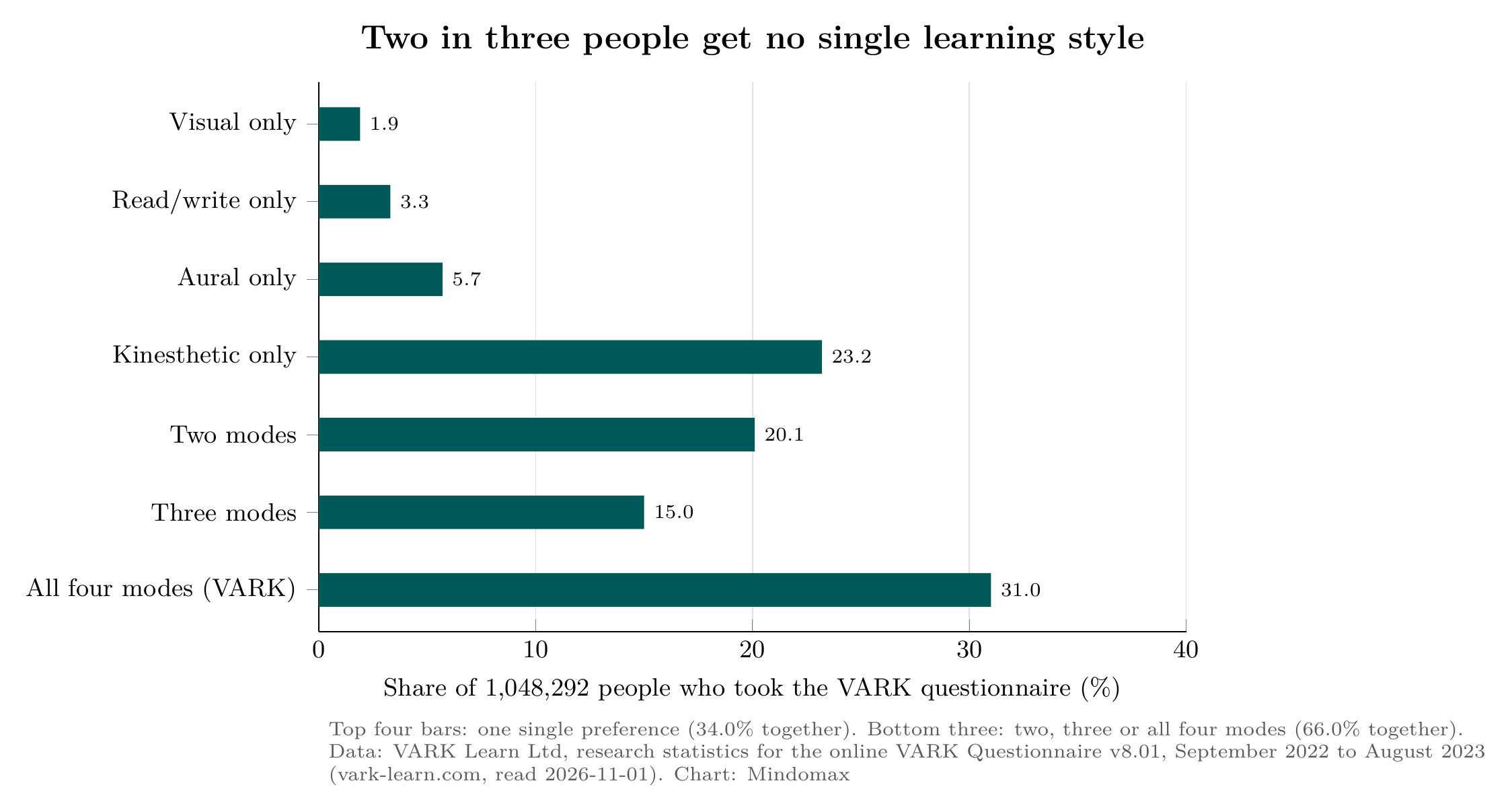
Results of 1,048,292 VARK questionnaires, September 2022 to August 2023. Data from VARK Learn Ltd, research statistics (read 2026-11-01). Chart by Mindomax.
Other learning style models you will meet
VARK is only one of many. When Frank Coffield and colleagues reviewed the field for England's Learning and Skills Research Centre in 2004, they counted 71 different learning-style models and examined 13 of the most influential in detail. These are the ones you are most likely to run into:
Even the number of styles depends on who you ask. Of the pages Google showed us first for this search, one lists 8 types and another lists 10. And Gardner's list does not belong in the table at all, in his own view: he has written that people who treat multiple intelligences as learning styles have it wrong, and he asks teachers to drop the word "styles".
The questionnaires do not even agree with each other. A study of 394 secondary school students (Martin, 2010) gave them both Kolb's inventory and Honey and Mumford's, which describe similar styles. The two results did not correlate.
What happened when researchers tested learning styles
Pashler's 2008 review set out the test any learning-style theory has to pass. Sort people by style. Randomly give each group different kinds of teaching. Give everyone the same final test. If the theory is right, the method that works best for "visual learners" should not be the one that works best for "auditory learners": the results should cross. The review found "virtually no evidence" for that pattern, and several of the few studies with the right design flatly contradicted it. These are seven tests of the idea, oldest first:
Look at what these studies did not find. Nobody showed that people lack preferences, and nobody showed that the format of a lesson never matters. When one format beat another, it beat it for everyone, whatever their style.
Why learning styles feel true
If the evidence is this consistent, why does almost everyone believe it? Three reasons come up again and again.
Preferences feel like knowledge. In the Knoll study, people who called themselves visualizers felt more confident about pictures, but they did not remember pictures any better. The same gap shows up in study habits: in the experiment charted further down, the students who reread the most felt the surest and remembered the least. That gap between feeling and knowing is a well-documented trap, sometimes called the illusion of knowing.
The quizzes agree with you. In VARK's own survey of its users, 72% said their result matched how they see themselves, and 80% expected it to be useful. A result that matches what you already believe feels like proof, even though it only repeats what you told it.
Content does have a best format. You learn a map from a map, a pronunciation from audio and a lab skill by doing it. That holds for everyone, which is why it feels like support for styles when it actually points the other way.
Even VARK keeps its distance from the strong claim. Its website says VARK "has never claimed" that teaching should be matched to a learner's style, and it presents the questionnaire as a tool for thinking about what you do when you study.
How many people still believe it
Belief is close to universal. In a US online survey, 93% of 3,045 members of the public agreed that "individuals learn better when they receive information in their preferred learning style" (Macdonald and colleagues, 2017). So did 76% of 598 educators and 78% of 234 people with a background in neuroscience. In the UK and the Netherlands, 93% and 96% of teachers agreed (Dekker and colleagues, 2012).
A systematic review of 37 studies covering 15,405 educators in 18 countries put agreement at 89.1%, and at 95.4% among trainee teachers, with no sign that belief was falling. The hopeful part: in four studies where educators got a short session on the evidence, agreement dropped from 78.4% to 37.1%.
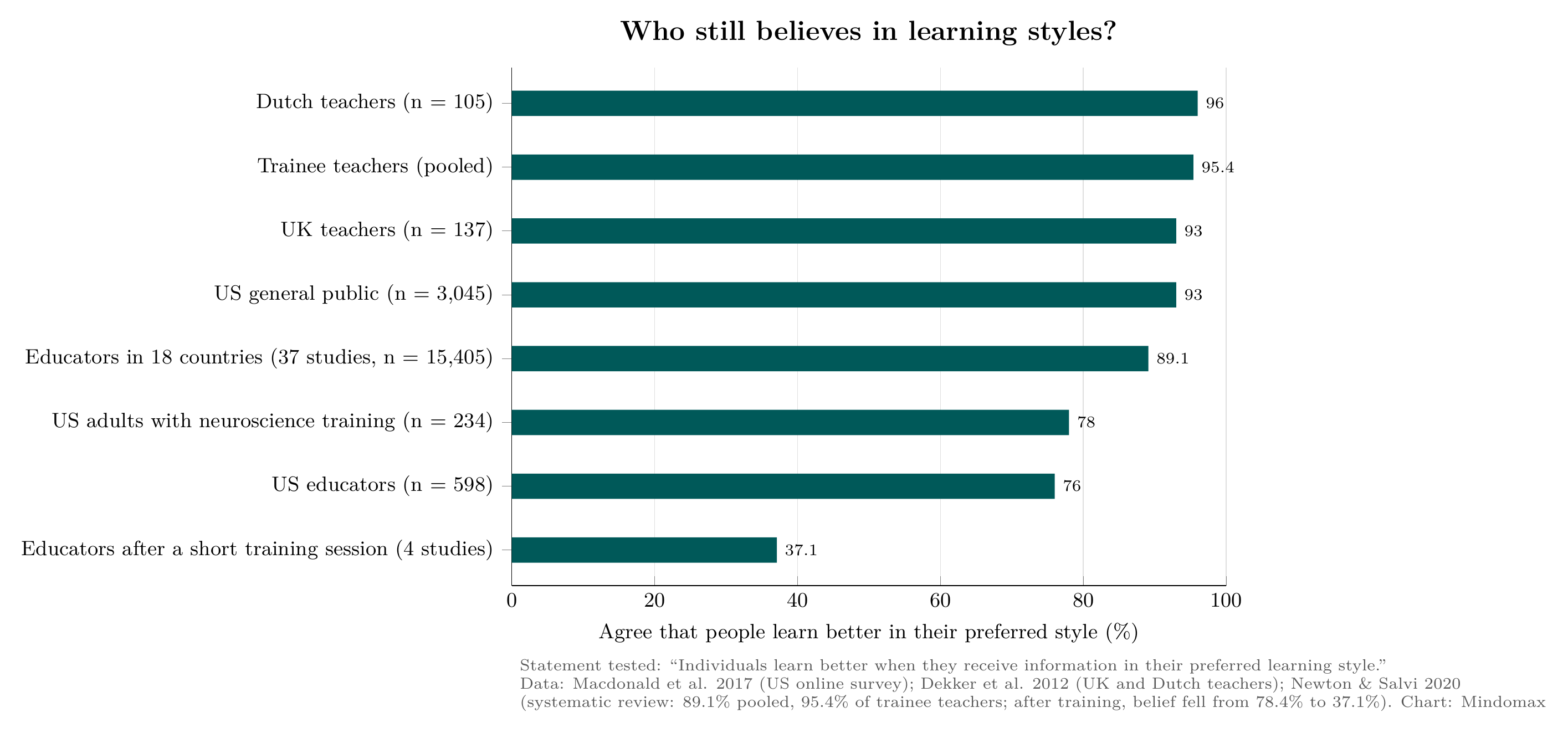
Share agreeing that people learn better in their preferred learning style. Data from Macdonald and colleagues 2017, Dekker and colleagues 2012 and Newton and Salvi 2020. Chart by Mindomax.
We also ran a small check of our own. On November 1, 2026, five of the six regular results on the first page of Google for "learning styles" (US) presented the styles as fact and cited no study. Only Wikipedia reported the research.
What to do instead: study methods with evidence behind them
In 2013, John Dunlosky and four colleagues rated ten common study techniques by how well the evidence holds up across ages, subjects and kinds of tests. Two earned the top rating, "high utility": practice testing and distributed practice, which means spacing your study out over time. Five got "low utility", including highlighting and rereading, the two habits most students rely on (Dunlosky and colleagues, 2013).
The chart below shows why testing wins. In a classic experiment, 180 students learned a short prose passage over four short periods. Some only read it; others read it once and then tried to recall it three times on blank paper.
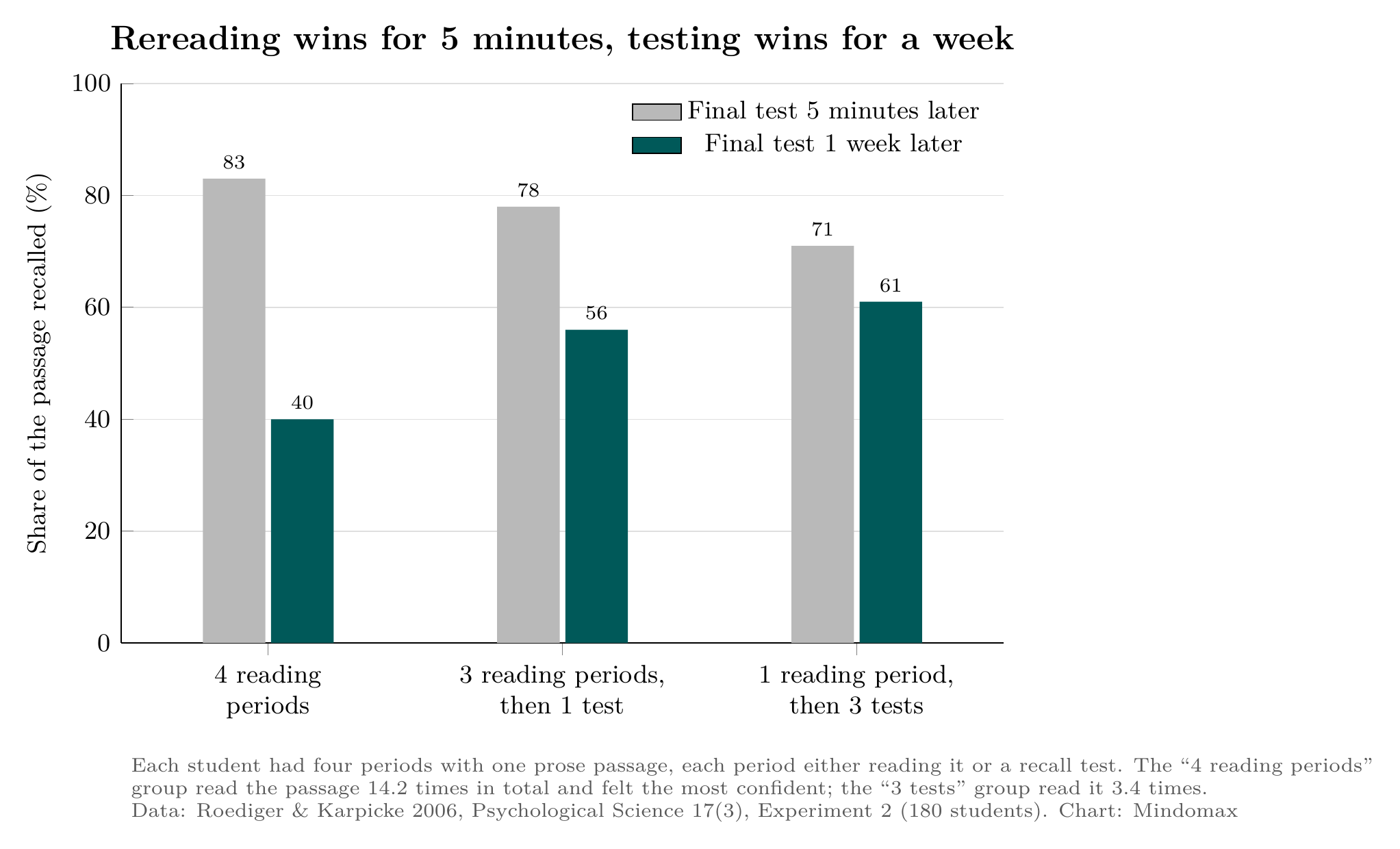
Share of the passage recalled 5 minutes and 1 week after studying. Data from Roediger and Karpicke 2006, Experiment 2. Chart by Mindomax.
Five minutes later, the readers were ahead, 83% to 71%. A week later the order flipped: the students who had tested themselves remembered 61% of the passage, the readers 40%. The readers had gone through the text 14.2 times on average, the testers 3.4 times, and the readers were the more confident group. You can read more about how the testing effect works in our explainer.
Spacing has a similar record. A 2006 review by Nicholas Cepeda and colleagues pooled 839 comparisons from 317 experiments: spreading study over time beat cramming it together, and the longer you need to remember something, the longer the gaps should be (Cepeda and colleagues, 2006). Our guide to the spacing effect shows how to set the gaps.
So instead of matching the method to yourself, match it to the job:
Keep your preferences for what they are good at: comfort and motivation. If you enjoy diagrams, make diagrams. Then close them and test yourself. The test does the remembering work. Our step-by-step guide on how to study with flashcards turns this into a routine.
Is there anything to learning styles at all?
Yes, in three limited ways. People differ in abilities: some have stronger spatial skills, some read faster, and Pashler's review says so plainly. People have preferences, and a method you enjoy is a method you are more likely to keep using. And Pashler's team noted that many style ideas have never been tested properly, so it would be wrong to say every possible version has been ruled out.
What has failed every fair test so far is the popular promise: find your style, study in it, and you will learn more. Good teaching does adapt to students, but to what they already know and where they get stuck, not to a quiz label. That is also how adaptive learning systems personalize lessons.
How we checked this article
Every study number above was checked on November 1, 2026 against the paper's full text or its published abstract (through Europe PMC, ERIC and the publishers), the Roediger and Karpicke figures in the original PDF, and each DOI through Crossref. Two facts are quoted as later reviews report them: Coffield's count of 71 models and Martin's study of 394 students. The VARK figures come from VARK's own statistics page, read the same day. The page-one count is from a US Google search (hl=en, gl=us) on the same morning. App prices are from the US App Store and the makers' own pages, checked 2026-11-01.
Tools that build the two habits that work
Testing and spacing are the habits worth building. Any of these will do the job, so pick the one you will actually open:
If you would rather have the testing and the spacing set up for you, you can try Mindomax for free with your own notes.
Frequently Asked Questions
What are the 4 learning styles?
The VARK model names four: visual (diagrams and charts), auditory or aural (listening and talking), reading/writing (text and notes) and kinesthetic (examples and hands-on practice). Other models use different lists, from Kolb's four styles to Gardner's eight intelligences.
What is a kinesthetic learner?
Someone who says they prefer learning by doing: examples, practice, building and real cases. It is the most common single VARK result (23.2% of 1,048,292 people). Hands-on practice helps everyone learn practical skills, but studies have not found that self-described kinesthetic learners learn more when everything is taught hands-on.
Are learning styles real or a myth?
Preferences are real. The myth is the next step: that you learn more when teaching matches your preference. In controlled tests, including seven summarized in this article, the match made no difference.
How do I find out my learning style?
You can take the VARK questionnaire or a similar quiz, and the result may help you think about how you study. Just do not use it to rule out methods. Two in three people get a mixed result anyway, and testing yourself and spacing your reviews work whatever the quiz says.
What is the best learning style?
None of them. The study methods with the strongest evidence work for everybody: practice testing and spaced review were rated highest in a 2013 review of ten techniques, while rereading and highlighting were rated low.
Are multiple intelligences the same as learning styles?
No. Howard Gardner's multiple intelligences describe different abilities, such as musical or spatial skill. Gardner has said publicly that they are not learning styles and has asked teachers to drop the word "styles".
How should a visual learner study?
The same way as everyone else, with the visual parts used well: draw diagrams and timelines, then cover them and redraw them from memory, and review them on spaced days. Drawing helps you learn; looking at a drawing again does not do the remembering for you.


