
The short answer
The digital SAT tests vocabulary in one way only: a short passage with a blank, four choices, and you pick the word that fits. College Board calls these Words in Context questions. We went through all eight full-length paper practice tests it publishes today (Tests 4 to 11) and pulled out every one of them. There are 82, and their right answers are the SAT vocabulary list below.
Most of those words are not rare. The middle one appears 8.4 times per million words of published English, about as often as fragile or featured. 87% of the right answers (71 of 82) are everyday or common words. Only 11 of the 82 are rarer than once per million words: stymie, popularize, redressing, speculates, oddity, unassuming, buttress, demarcated, corroborate, preventable and ameliorate.
The famous "1000 Most Common SAT Words" list from SparkNotes, which was Google's first result for this search when we checked, looks very different. Its middle word is nine times rarer (0.97 per million), half of its words are rarer than once per million, and only 10 of the 82 right answers are on it.
So here is the short answer. Learn the 82 words below with a sentence each, plus the 25 hard words the test uses as decoys. That is about 110 flashcards, not 1,000.
How the digital SAT tests vocabulary
The Reading and Writing section has 54 questions in 64 minutes, split into two modules of 32 minutes each (College Board). Every question has its own short passage of 25 to 150 words. There is no separate vocabulary section. Vocabulary sits in the Craft and Structure questions, which College Board says test "high-utility words and phrases in context" (the Reading and Writing section).
Words in Context questions come in two forms. In 75 of our 82, the passage has a blank and the question reads "Which choice completes the text with the most logical and precise word or phrase?" In the other 7, a word in the passage is marked and the question asks what it "most nearly" means.
In the paper practice tests, these questions always open a module: five per module in 14 of the 16 modules (Test 4 has four in its first module and eight in its second). That makes 82 of the 528 Reading and Writing questions in the eight tests, or 15.5%. The paper tests have 33 Reading and Writing questions per module, while the adaptive test in the Bluebook app has 27, so the exact count on test day can differ.
College Board also says that questions testing similar skills are "arranged from easiest to hardest". The words in our count follow that order (see the chart further down).
The 82 right answers, hardest first
This is the list: every right answer from the eight tests, sorted from the rarest word to the most common. "Per million" is how often the word appears per million words in books published from 2010 to 2019 (Google Books Ngram). Lower means rarer. "Where" gives the test, the module (M) and the question (Q), so you can look up the full question in College Board's free PDF. Seven answers come from "most nearly mean" questions; the word from the passage is in brackets.
Start at the top: the rare words are where a point goes to a word you have never seen. Points on the common words at the bottom go to reading too fast.
In these eight tests, no right answer appeared twice. Treat the list as a sample of the level the SAT works at, not as a forecast of the next test.
How common are SAT words? Four lists, measured
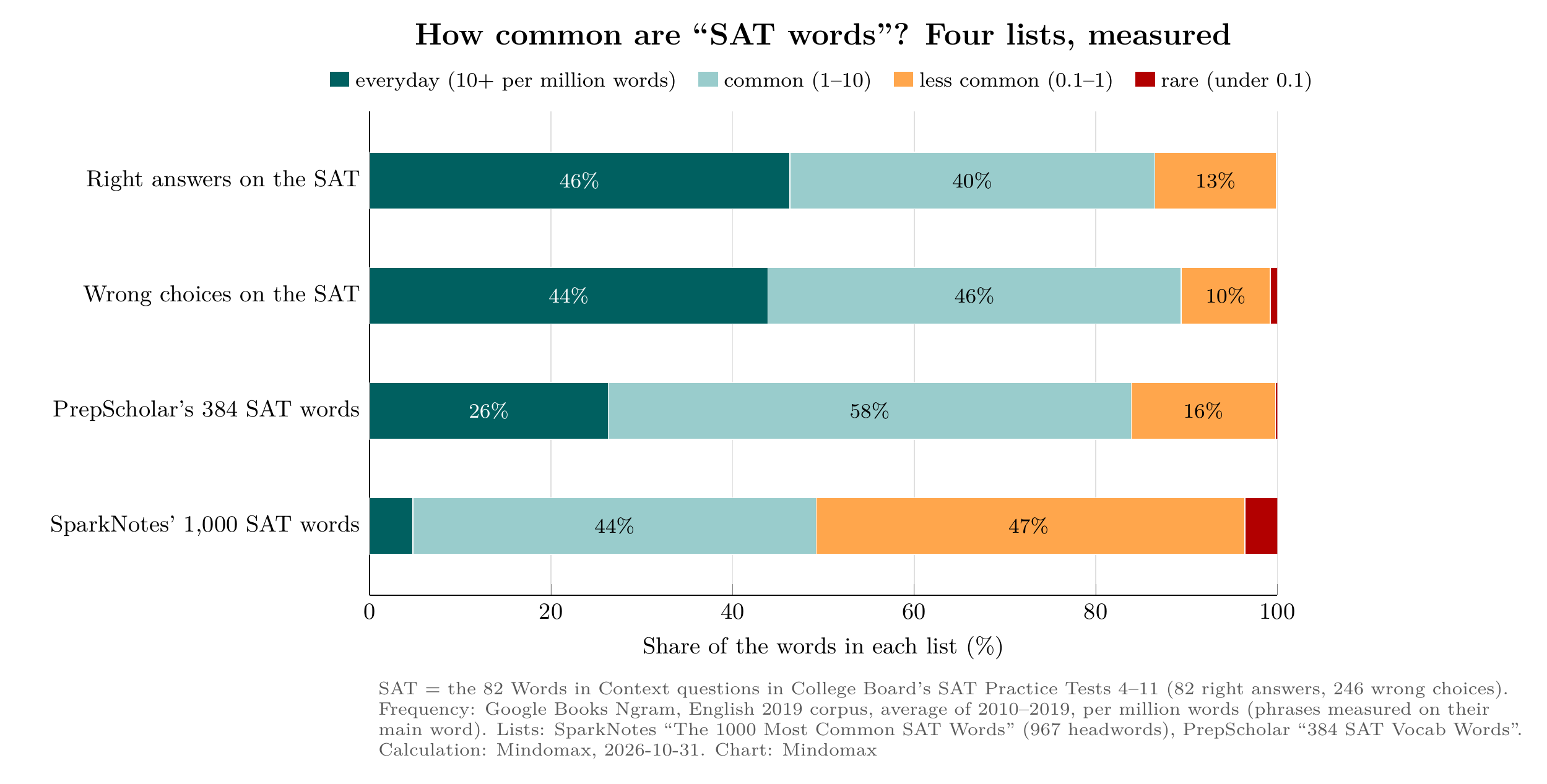
Share of each list's words by how often they appear in English books. Data: the 82 Words in Context questions in College Board's SAT Practice Tests 4 to 11; word frequency from Google Books Ngram (English 2019 corpus, 2010 to 2019); the SparkNotes and PrepScholar lists as published on 2026-10-31. Chart: Mindomax.
The right answers and the wrong choices on the digital SAT look alike. In both, about 45% are everyday words (more than 10 uses per million) and most of the rest are common ones (1 to 10 per million). Only 13% of the right answers fall below one per million, and none falls below 0.1.
The SparkNotes PDF, titled "The 1000 Most Common SAT Words", is a different kind of list. We read all 967 of its headwords that survive in the PDF's text layer. Half of them are rarer than one per million and 36 are rarer than 0.1, such as enamor, vituperate, expurgate, rhapsodize and pulchritude. Only 38 of its words appear anywhere in the eight tests, as a right answer or as a decoy (counting related forms such as cordial and cordially). The list was written for the old paper SAT: its example sentence for "aberration" says the Red Sox won the World Series in 1918 and "have not won a World Series since". They won it in 2004.
PrepScholar's "384 SAT Vocab Words You Must Know" is much closer to the real test. It contains 47 of the 82 right answers, and its middle word sits at 3.9 per million. What it does not show is which test a word came from, how often it came up, or which words were the decoys.
None of this means rare words never matter. They matter in a different place, which the next two sections show.
The later the question, the rarer the word
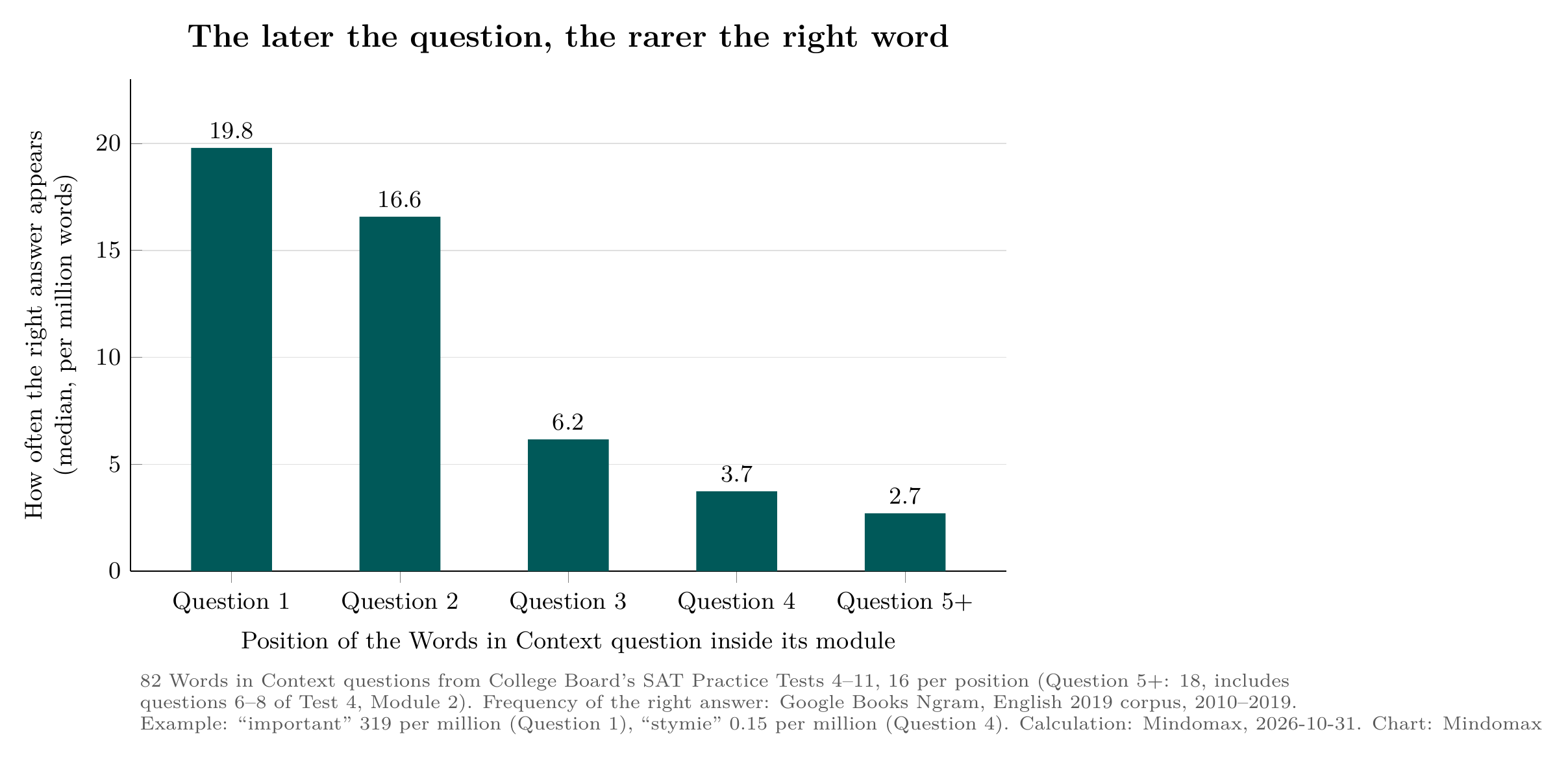
Median frequency of the right answer by the question's position in its module: 16 questions per position, 18 for question 5 and later. Data: College Board SAT Practice Tests 4 to 11 and Google Books Ngram. Chart: Mindomax.
The right answer to the first Words in Context question of a module appeared a median 19.8 times per million words. By the fifth question it was 2.7. Question 1 answers were words like collected, evidence, theory, important, source and effective. Questions 4 and 5 held corroborate, stymie, ameliorate, sanguine and latent. One right answer in 16 was rarer than once per million at question 1; at question 5 or later it was four in 18.
So the first questions test whether you read precisely. The first question of Test 4 turns on collected against attached, followed and replaced, words every student knows. The last questions test whether you know academic words. If a module feels easy at the start, that is by design. Slow down anyway.
Hard words are decoys as often as answers
You may have heard the tip: when in doubt, pick the hardest word. The tests do not support it. In 22 of the 82 questions the rarest of the four choices was the right answer (27%), and in 23 the most common choice was (28%). A blind guess gets 25%.
What the tests do is use hard words as decoys. 25 different wrong choices are rarer than once per million words, more than twice as many as the 11 right answers in that range. You cannot rule out "exacerbating" or "precluding" if you do not know what they mean, so these belong on your cards too.
Small words with second meanings
Seven of the 82 questions do not ask for a hard word at all. They take a common word from the passage and ask which meaning it has there. "Clear" meant transparent, not obvious. "Trace" meant evidence, not a sketch.
Phrases matter too. 19 of the 82 right answers are more than one word: 14 come with a preposition (comparable to, confined to, inspired by, demarcated from, inconsequential to) and five with "a" or "an" in front. The small word is part of the answer, so learn "inconsequential to", not just "inconsequential".
The same word can also be right in one test and wrong in the next. 15 words show up in two different tests. "Substantial" is a wrong choice in Test 4 and the right answer in Test 8. "Neglect" is wrong in Test 4 and right in Test 11. "Accidental" is right in Test 6 and wrong in Test 9. A word is never right on its own; the sentence makes it right, which is why the sentence belongs on the card.
How to study SAT vocabulary
Make about 110 cards. Take the 82 right answers and the 25 decoys above, and skip any word you already know well.
Put a sentence on the front. Write a short sentence of your own with a blank where the word goes, and put the word and a plain meaning on the back. That is the same task the test sets: find the word that fits the sentence. Our guide to making good flashcards shows the format.
Keep phrases and second meanings whole. "Confined to" is one card. "Clear: transparent" is its own card, separate from "clear: obvious".
Review a little every day. Spaced repetition brings each card back just before you would forget it, so 15 minutes a day goes further than an hour the night before (how spaced repetition works). Answer before you flip the card: testing yourself beats rereading a list.
Then take a full test in Bluebook. Vocabulary is one skill among many in the section, and a timed practice test shows whether the words hold up under pressure.
For vocabulary beyond the SAT, our guide on how to improve your vocabulary covers the reading habits that work over months.
Tools that help with SAT vocabulary
The official material is free. The rest is mostly a choice between ready-made decks and making your own cards. Prices are from the US App Store and Google Play.
Quizlet's paid plans are explained in our Quizlet Plus cost guide, and our list of 23 vocabulary apps covers general word apps.
How we counted
We downloaded the eight paper practice tests and their answer explanations from College Board (Tests 4 to 11; the old links to Tests 1 to 3 no longer return a PDF). A script found every question that asks for "the most logical and precise word or phrase" or what a word "most nearly" means, read its four choices and matched it to the explanation that names the right answer. 79 of the 82 matched automatically; we checked the other three by hand against the explanation text.
Word frequency comes from Google Books Ngram: the English 2019 corpus, the average of 2010 to 2019, all capitalizations counted together, per million words. A phrase is measured by its main word ("comparable" for "comparable to"), and words are measured in the form the test prints them ("collected", not "collect"), which makes the SAT words look slightly rarer than they are. The SparkNotes list was read from its PDF and PrepScholar's from its page, both on 2026-10-31.
The limits: eight tests are a sample of what College Board writes, not the full set. In the real, adaptive test the second module depends on how the first one went, which the paper tests cannot show. And frequency in books is a good guide to how hard a word is, not a perfect one: "sanguine" is rare in print, but you may know it from a novel.
If you would rather not type 107 cards by hand, you can paste this list into Mindomax and get flashcards with spaced review for free.
Frequently Asked Questions
Does the digital SAT still test vocabulary?
Yes, through Words in Context questions: a short passage with a blank or a marked word, and four choices. In College Board's eight current practice tests they make up 82 of the 528 Reading and Writing questions, about 15%.
How many SAT vocabulary words do I need to learn?
Fewer than the old lists suggest. The eight practice tests have 82 right answers and 25 hard decoys, about 110 words. Learn those with a sentence each, then keep reading: the next test will use new words at the same level.
What are the most common SAT vocabulary words?
No right answer came up twice in the eight practice tests. The answers range from everyday words (important, provide, theory, evidence, source, effective) to rare ones (stymie, popularize, redressing, speculates).
Is the "1000 Most Common SAT Words" list still useful?
Not for the digital SAT. Only 10 of the 82 right answers in the current practice tests are on the SparkNotes list, and half of its words are rarer than once per million words in English books.
What is the hardest SAT vocabulary word?
In the eight current practice tests, the rarest right answer was "stymie" (0.15 uses per million words, Test 10). The rarest decoy was "epitomizing" (0.07).
Should I pick the hardest-looking word when I am not sure?
No. The rarest of the four choices was right in 22 of 82 questions (27%), barely better than a blind guess at 25%.
How long does it take to learn SAT vocabulary?
At 10 new cards a day, about 110 cards take 11 days to introduce. After that, keep reviewing them every day until test day.


