
The short answer
If you want new words to show up without effort, install Vocabulary - Learn words daily. It puts a word on your lock screen every time you pick up your phone, it has 218,243 ratings at 4.8 stars, and the free version is enough to find out whether the habit sticks.
If you want to keep the words you meet, pick an app that tests you again a few days later. On this list that means Knudge, WordUp, Atlas, WordPal, Word of the Day or, if you would rather choose the words yourself, a flashcard app such as AnkiDroid or Quizlet.
If you are studying for the GRE, the free KMF 3000 Words for GRE was updated three days before we checked it. The Magoosh apps that almost every other list recommends were not.
How we checked
Every app below was looked up on the US App Store (or Google Play for AnkiDroid) on 2026-09-26. The rating, number of ratings and date of the last update come from Apple's own lookup service. The prices come from the "In-App Purchases" list on each app's store page, read the same day.
Two things about those prices. First, Apple lists several tiers per app, including intro offers, so we give the range the listing shows. The one you are offered can differ. Second, a price with no date is useless six months later, so every price here says when it was checked.
Every listing also went through our dead-app check: it must still exist, have real ratings, and have been updated in the last twelve months. Several well-known apps failed that test and are covered at the end.
The column "Brings words back?" means the developer's own listing says it uses spaced repetition, which is a schedule that shows you a word again just before you would forget it. We did not measure how well each schedule works. We only report whether the app claims to have one.
What a year costs
Across the 22 apps with a price we could chart, the lowest annual plan runs from $0 to $69.99 (all prices checked 2026-09-26).
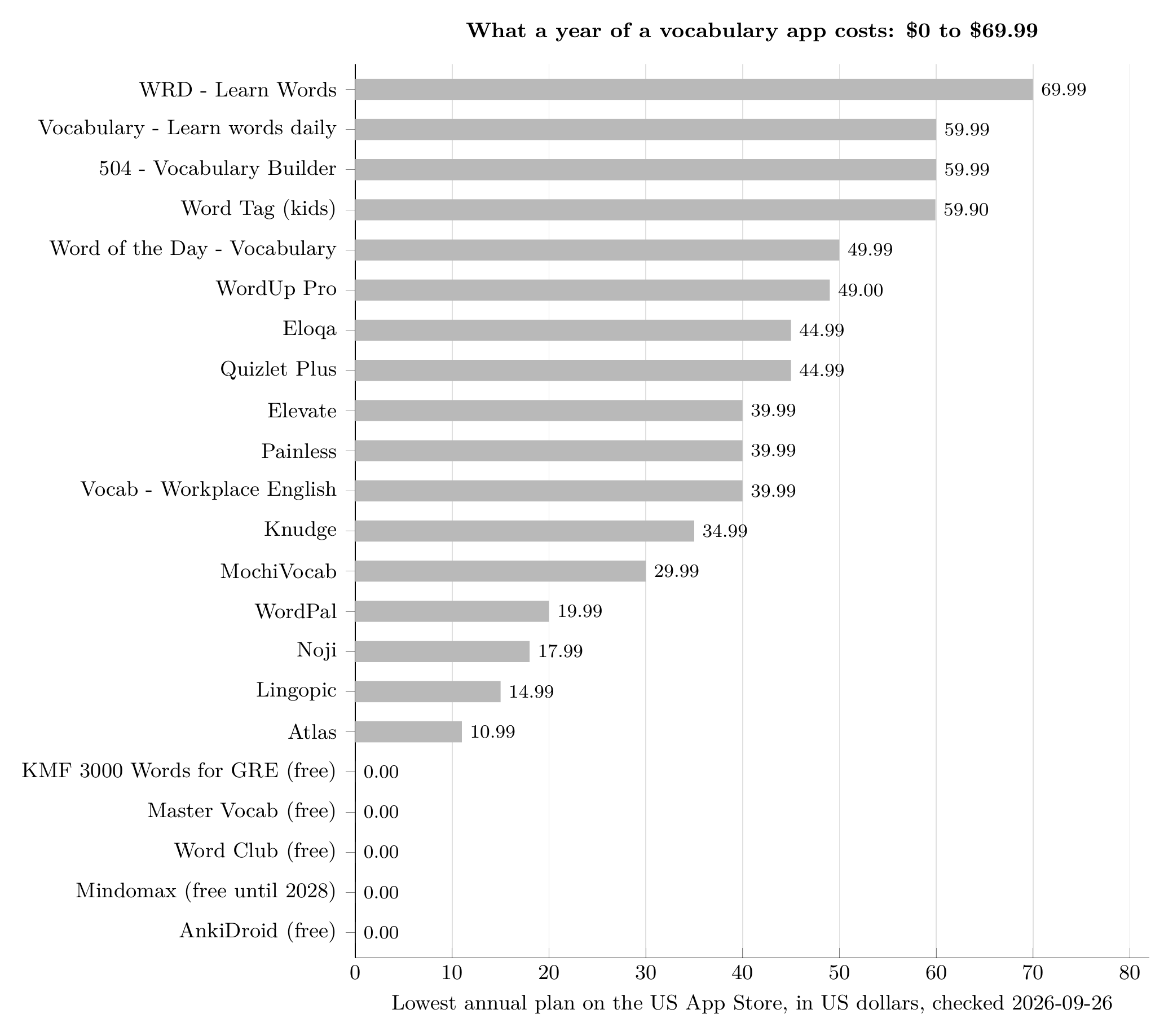
Prices checked 2026-09-26 on each app's US App Store listing, lowest annual tier shown, intro offers included. DuoCards is left off because its tier names do not say which plan is which. Chart by Mindomax.
Five apps cost nothing for the year. The most expensive plan, WRD at $69.99/year (checked 2026-09-26), is not the best app on the list. Price and quality have almost nothing to do with each other here.
All 23 apps side by side
Everyday adults: sound sharper at work and in writing
These are for people who already speak English well and want better words, not more grammar.
1. Vocabulary - Learn words daily: the lock-screen habit
The most rated app on this list by a wide margin: 4.8 stars from 218,243 ratings, last updated 2026-09-23. It shows one well-chosen word on your lock screen and home screen widget and lets you browse 10,000+ words by level and topic. Premium costs $14.99/month or $59.99/year, with other tiers of $29.99 and $47.99 on the listing (checked 2026-09-26).
The catch: it is built around meeting new words, not testing old ones. Its listing never mentions review scheduling, so words you liked on Monday may be gone by Friday.
2. Word of the Day - Vocabulary: daily words plus quick quizzes
From Vocabulous, 4.7 stars from 38,917 ratings, updated 2026-09-07. It starts with a short vocabulary test, then mixes a daily word with one-minute quizzes, and its listing says those quizzes use spaced repetition. Premium is $9.99/month, annual tiers run $49.99 to $99.99, a weekly plan is $7.99, and a $19.99 "Lifetime Premium" also appears (checked 2026-09-26).
The catch: six different premium prices on one listing. Read the paywall screen carefully before you tap.
3. Elevate: vocabulary as part of a brain-training bundle
4.8 stars from 542,771 ratings, updated 2026-09-21. Vocabulary is one skill among many, next to math, memory, speaking and focus games. Elevate costs $9.99/month or $39.99/year (checked 2026-09-26).
The catch: it is not really a vocabulary app. If words are all you want, you are paying for a lot of other games.
4. Painless: the pick from the top Reddit thread
Painless is the app a user recommends in the r/vocabulary thread that sits at the top of Google for this search. You swipe through word cards, and the app guesses how well you know each one from how long you look and what you tap, instead of asking you to mark it. 4.6 stars, updated 2026-08-21. Annual Pro is $39.99 or $59.99, Lifetime $79.99 to $149.99 (checked 2026-09-26).
The catch: only 92 ratings, from a small developer. Good idea, thin track record.
5. Eloqa: words through quotes and images
A small French-built app that teaches each word with a picture and a real quotation, aiming at two new words a day. Its listing says it uses a spaced repetition system. 4.6 stars from 101 ratings, updated 2026-09-25. Plans: $8.99/month, annual tiers $44.99 to $79.99, Lifetime $29.99, weekly $4.99 (checked 2026-09-26).
The catch: some plan names still appear in French on the US store, and the user base is tiny.
6. Vocabulary Builder by Atlas: words, phrases and idioms
4.8 stars from 12,458 ratings, updated 2026-08-19. Atlas goes beyond single words to phrases and idioms, has widgets, and says it schedules reviews. Monthly plans run $4.49 to $9.99, yearly $10.99 to $49.99, Lifetime $74.99 (checked 2026-09-26). At $10.99, its cheapest yearly tier is the lowest paid annual price on this list.
The catch: ten price tiers. Which one you see depends on the offer of the day.
7. WordPal: plain, quiet and scheduled
4.7 stars from 10,002 ratings, updated 2026-09-13. A clean word list with no distractions, and a listing that says its algorithm is built on spaced repetition. $4.99 to $7.99/month, annual $19.99 to $59.99 (checked 2026-09-26).
The catch: definitions and not much else. Little context, few example sentences.
8. Vocab - Workplace English: words for emails and meetings
4.9 stars from 302 ratings, updated 2026-09-25. Built around the words that come up at work: interviews, emails, meetings. Quizzes plus spaced repetition. $3.99 to $8.99/month, one year $39.99 to $49.99, weekly $2.99 to $3.99 (checked 2026-09-26).
The catch: it is really for people learning English. A native speaker will find it too easy.
Test prep: SAT, GRE, IELTS and TOEFL
Test vocabulary is a fixed list, so these apps can do something the daily-word apps cannot: tell you how much of the list you have left.
9. Vocabulary Builder by Knudge: spaced repetition since 2016
4.7 stars from 1,745 ratings, updated 2026-07-06. Knudge is built around spaced repetition and adaptive review, with flashcards and short games for SAT, GRE, IELTS and TOEFL words. $9.99/month or $34.99/year, lifetime tiers $8.99 to $19.99, topic packs $0.99 (checked 2026-09-26).
The catch: the design feels older than the rest of this list.
10. KMF 3000 Words for GRE: free and current
From Xueersi, a large Chinese test-prep company, 4.9 stars from 3,450 ratings, updated 2026-09-23. It covers the GRE word list with daily plans based on the forgetting curve. Its US listing shows no in-app purchases at all (checked 2026-09-26), so it is free. For more GRE tools, see our GRE flashcard app comparison.
The catch: GRE only, and parts of the app still reflect that it was built for Chinese test-takers.
11. 504 - Vocabulary Builder: the classic word list
4.8 stars from 4,595 ratings, updated 2026-09-18. Based on the well-known "504 Absolutely Essential Words" list, with definitions, examples and games. Premium tiers are $4.99, $9.99 and $34.99, and Yearly Pro is $59.99 (checked 2026-09-26).
The catch: 504 words is a small, fixed list, and the listing does not mention review scheduling.
12. Master Vocab: IELTS, TOEFL, GRE, 504 and 1100 Words
4.8 stars from 490 ratings, updated 2026-08-11. One app for several famous lists, with a review algorithm and short movie clips that show each word in use. No in-app purchases on its US listing (checked 2026-09-26).
The catch: one developer, and the interface mixes English with Persian, Arabic and Turkish.
13. WordUp: 25,000 words ranked by how common they are
4.8 stars from 13,844 ratings, updated 2026-08-27. WordUp maps which of the 25,000 most common English words you already know, then teaches the gaps with movie examples and spaced repetition. Pro is $9.99 to $10.99/month or $49.00/year; Standard is $7.99/month or $79.99/year; Pro Lifetime is $149.99 (checked 2026-09-26).
The catch: the Standard plan costs more per year than Pro. We could not work out why from the listing, and you probably will not either.
Learning English as a second language
14. DuoCards: save words from what you already watch
4.7 stars from 1,386 ratings, updated 2026-08-29. Save words from videos, subtitles and articles, then review them as flashcards on a spaced schedule, with an AI tutor for practice. Premium tiers run $19.99 to $162.99 and Plus is $33.00 (checked 2026-09-26).
The catch: the widest price spread on this list. Check exactly which plan you are buying.
15. MochiVocab: reminders timed to your memory
4.8 stars from 722 ratings, updated 2026-09-24. Its "Golden Time" feature looks at your history and reminds you to review each word at the right moment. 6 months $23.99, 12 months $29.99 to $41.99, 3 years $69.99 to $83.99 (checked 2026-09-26).
The catch: built in Vietnam, and some plan names are not translated.
16. Lingopic: point your camera, learn the word
4.7 stars from 329 ratings, updated 2026-08-03. A swipeable card feed, a camera that names the objects around you, and spaced repetition, in 35 languages. $4.99/month, yearly $14.99 to $29.99, Lifetime $99.99 (checked 2026-09-26).
The catch: cups and street signs, not advanced vocabulary. Best for beginners.
17. WRD - Learn Words: short exercises with native audio
4.7 stars from 2,730 ratings, updated 2026-08-23. Quick exercises by topic with audio recorded by native speakers. Pro is $3.99/week, $9.99/month or $69.99/year (checked 2026-09-26).
The catch: the most expensive annual plan on this list, and no mention of review scheduling.
Kids
18. Word Tag: a real game, not a worksheet
From Mrs Wordsmith, for ages 7 and up, 4.7 stars from 8,682 ratings, updated 2026-07-02. Ad-free, COPPA and kidSAFE approved, and its listing says it uses spaced repetition. $9.99/month, or $59.90 or $83.00 a year (checked 2026-09-26).
The catch: no free tier. After the 7-day trial, it is subscription only.
19. Word Club: the official spelling bee app
From the Scripps National Spelling Bee, 4.1 stars from 924 ratings, updated 2026-08-25. It covers the 4,000 words on the 2027 School Spelling Bee Study List. No in-app purchases (checked 2026-09-26), so it is free.
The catch: spelling first, meaning second. Great for bee season, less so for everyday vocabulary.
Build your own list: flashcard apps
The apps above choose the words for you. These four let you add the words you actually meet, from a novel, a textbook or a meeting. That is slower to set up, but the words are yours. We compare them in more depth in our best flashcard apps guide, and if you are learning Spanish rather than English, see our Spanish vocabulary app guide.
20. AnkiDroid and Anki: free and very powerful
Anki on the computer and AnkiDroid on Android are free and open source. AnkiDroid has 4.8 stars from about 165,000 reviews on Google Play and was updated 2026-05-04. The iPhone version, AnkiMobile, is $24.99 once (checked 2026-09-26). More detail in is Anki free?
The catch: you build or import every deck yourself, and the interface is not friendly on day one.
21. Quizlet: the one everyone already has
4.8 stars from 1,121,872 ratings, updated 2026-09-22. Huge library of shared word sets, including most SAT and GRE lists. Quizlet Plus is $9.99/month or $44.99/year (checked 2026-09-26).
The catch: the best study modes, including the scheduled review, sit behind Plus.
22. Noji: clean flashcards with spaced repetition
Formerly called AnkiPro, 4.6 stars from 13,906 ratings, updated 2026-09-24. Its listing says it uses an enhanced spaced repetition algorithm. Monthly $4.99 to $19.99, annual $17.99 to $89.99, Lifetime $74.99 (checked 2026-09-26).
The catch: despite the old name, it has nothing to do with Anki.
23. Mindomax: AI cards with review scheduling, free for now
Mindomax is our own app, so read this entry with that in mind. You type or paste words, or give it text, a photo, a PDF or an audio file, and it makes the cards, then schedules reviews with spaced repetition. It reads words aloud in 14 languages. Free Forever is $0, and Premium is also $0 until 2028 (mindomax.com/price, checked 2026-09-26). Last updated 2026-04-25 on the App Store.
The catch: it is new, it has no ratings on the US App Store yet, and it has no ready-made SAT or GRE list. You bring the words.
The famous ones we checked and left out
Three names appear on nearly every other list of vocabulary apps. We checked them too.
Magoosh. Its GRE Vocabulary Flashcards app was last updated 2025-06-05, Vocabulary Builder by Magoosh on 2020-01-06 and SAT Flashcards on 2025-05-06. All three still work and still have strong ratings, but none has been updated in over a year.
Vocabulary.com. The website is active. The iPhone app was last updated 2021-09-22, four years before we checked.
AnkiMobile. Last updated 2025-09-08, a few weeks past our twelve-month limit. It is still the official Anki app for iPhone, and it gets an update far less often than AnkiDroid.
Also out: Word Alert (last update 2021), GRE Vocabulary Cartoons (2024) and Ultimate Vocabulary Builder (2019), which one of the page-one lists still recommends.
How to choose
Ask one question first: do you want to see new words, or keep them?
A word-of-the-day app is pleasant and asks nothing of you, but seeing a word once rarely makes it stick. The reason is the forgetting curve: most of what we meet once is gone within days unless we see it again. Apps that bring the word back at growing gaps work with the spacing effect instead of against it.
So a simple rule. If you just enjoy words, pick from the everyday section. If you need the words for a test, a job or a new language, pick an app with "yes" in the "Brings words back?" column, and use it for five minutes every day rather than an hour on Sunday.
Frequently asked questions
What is the best free vocabulary app?
For a fixed test list, KMF 3000 Words for GRE and Master Vocab have no in-app purchases at all (checked 2026-09-26). For your own words, Anki on the computer and AnkiDroid on Android are free. For a daily word, the free version of Vocabulary - Learn words daily is enough to start.
Which vocabulary apps use spaced repetition?
By their own listings: Word of the Day, Atlas, WordPal, Eloqa, Vocab, Knudge, KMF, Master Vocab, WordUp, DuoCards, MochiVocab, Lingopic, Word Tag, Quizlet, Noji, Anki and Mindomax. Vocabulary - Learn words daily, Elevate, WRD and 504 do not mention it.
Is a vocabulary app worth paying for?
Only if you use it every day. Most paid plans cost $30 to $60 a year (checked 2026-09-26). Try the free version for two weeks first. If you open it most days, the upgrade is cheap. If you do not, no plan will help.
Is Magoosh Vocabulary Builder still updated?
Not recently. On 2026-09-26, the App Store showed its GRE flashcard app last updated 2025-06-05 and Vocabulary Builder by Magoosh on 2020-01-06.
What is the best vocabulary app for kids?
Word Tag for ages 7 and up if you are happy to pay, at $9.99/month (checked 2026-09-26). Word Club from the Scripps National Spelling Bee if you want free and your child is preparing for a bee.
How many new words a day should I learn?
Fewer than you think. Five to ten new words a day, reviewed on a schedule, adds up to well over a thousand a year. Twenty a day with no review mostly adds up to forgotten words.
If you would rather build your own list from the words you meet, you can try Mindomax free.


