
The short answer
Good spelling bee words are words a child already knows by meaning but can easily spell wrong: knee, receipt, rhythm, guerrilla. Below are nine lists of 25, one for each grade from 1st to 8th and one for regional bees, 225 words in all. Next to every word is its trap, the exact spot where spellers slip, because the trap is the thing to practice.
If your child's school is enrolled in the Scripps National Spelling Bee program, the words for this season's classroom and school bees come from the 2027 School Spelling Bee Study List, which has 450 words. School champions then move on to Words of the Champions, 4,000 words for district and regional bees. Those lists are copyrighted, so we don't reprint them, and the section on official lists below says where families get them for free. Use our lists to warm up, to run a classroom bee, or to drill the patterns the official words are built from.
How we chose 225 words out of 17,121
Most spelling lists online never say why a word sits in 4th grade and not in 6th. Ours follow two measurements.
The first is when people learn the word. The psychologists Victor Kuperman, Hans Stadthagen-Gonzalez and Marc Brysbaert collected age-of-acquisition ratings for 30,000 English words, published in Behavior Research Methods in 2012. Our 4th-grade list takes words people learn at about 8 or 9, so a 4th grader, at 9 or 10, already knows what each one means. We kept base forms only (no plurals, no past tenses), only nouns, verbs, adjectives and adverbs, and only words that at least 90% of the raters knew and that the pronouncing dictionary below lists. That left 17,121 words.
The second is how many traps a word holds. We checked every word against the CMU Pronouncing Dictionary, which records how each word is said, and flagged the classic traps: a silent letter (knee, doubt), a double consonant you can't hear (committee), ie or ei, ph for f, ch for k or sh, y used as a vowel, -tion and -cious, the blurred vowel in -ance or -ence, -able or -ible, -ary, -ery or -ory, ough, dge, rh and French endings like -que or -ette. Inside each age band, the words with the most traps came first. Then we read every list ourselves and took out names, grown-up topics and near-duplicates.
The trap count also explains why spelling bees get harder by grade. Words learned later in childhood are not just longer. They hide more traps.
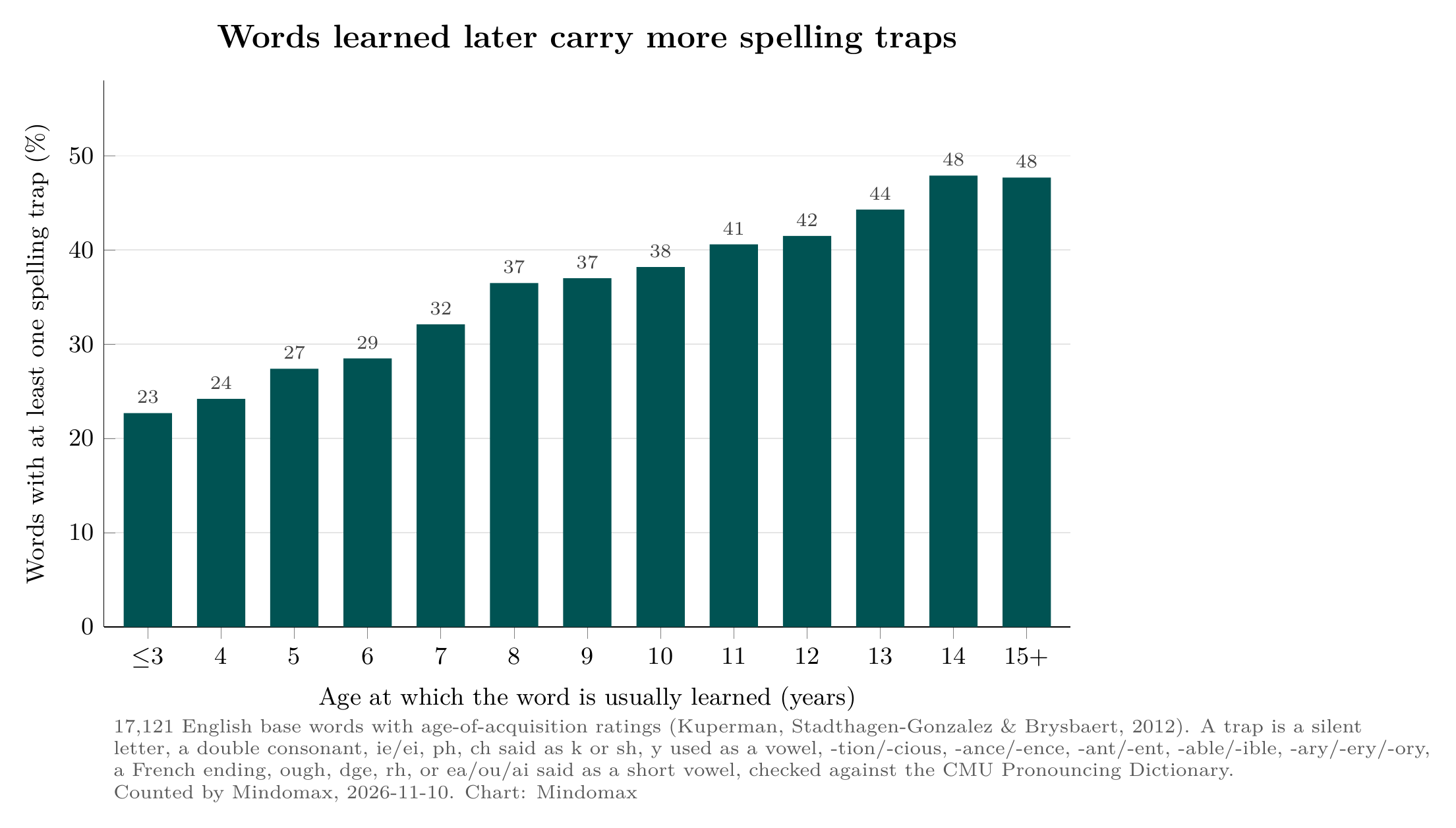
Of 17,121 English base words, 23% of the ones children learn by age 3 hold at least one spelling trap; for words learned at 14 or 15 it is 48%. Data: Kuperman, Stadthagen-Gonzalez and Brysbaert (2012), CMU Pronouncing Dictionary. Count and chart: Mindomax, 2026-11-10.
For words learned at 8 the share is 37%, and the words with two or more traps grow from 0.4% to 12% across the same range. A 1st grader meets one trap at a time. An 8th grader meets three in a single word, as in coefficient or irrepressible.
1st grade spelling bee words (ages 6-7)
Short words with one silent letter or one strange vowel team. A speller who has these has already met the most common traps in English: kn, wr, mb, gh, and weird, the word that breaks "i before e".
2nd grade spelling bee words (ages 7-8)
The eigh family (weight, sleigh), two more sounds of ough (dough, enough), and the first words ending in -ory and -ery.
3rd grade spelling bee words (ages 8-9)
Words you can't sound out at all: rhythm has no vowel letter except y, island hides an s, and schedule starts with a k sound spelled ch.
4th grade spelling bee words (ages 9-10)
Greek ph and y, the French ending -que, and words like receipt, where ei comes after c and a p stays silent.
5th grade spelling bee words (ages 10-11)
Double letters now come in pairs (committee, possession, success), and words borrowed from French keep their French spelling (chauffeur, etiquette, crochet).
6th grade spelling bee words (ages 11-12)
The endings take over: -ance or -ence, -able or -ible. Add classic traps like harassment, with one r and two s, and millennium, with two l and two n.
7th grade spelling bee words (ages 12-13)
Greek spellings (psychology, chlorophyll, synchronize) and the sc that hides in fluorescent and reminiscent.
8th grade spelling bee words (ages 13-14)
Long Latin and Greek words, often with three traps each. These are the words to save for the last rounds of a classroom bee.
Regional spelling bee words
For school champions heading to a district or regional bee. People learn these words at 14 or later, and plenty of adults would pause over them.
What the final rounds look like now
The words that win the Scripps National Spelling Bee have changed. We took all 108 winning words since 1925 from Wikipedia's list of champions (98 bees: there was none in 1943-1945 or in 2020, and ties give some years several words) and checked each one against wordfreq, a frequency list built from billions of words of books, news, film subtitles and the web. Its English list reaches down to words used about once in 100 million.
From 1925 to 1949, every winning word was in that list: knack, brethren, therapy, initials. Since 2010, 15 of the 26 winning words are too rare to appear in it at all.
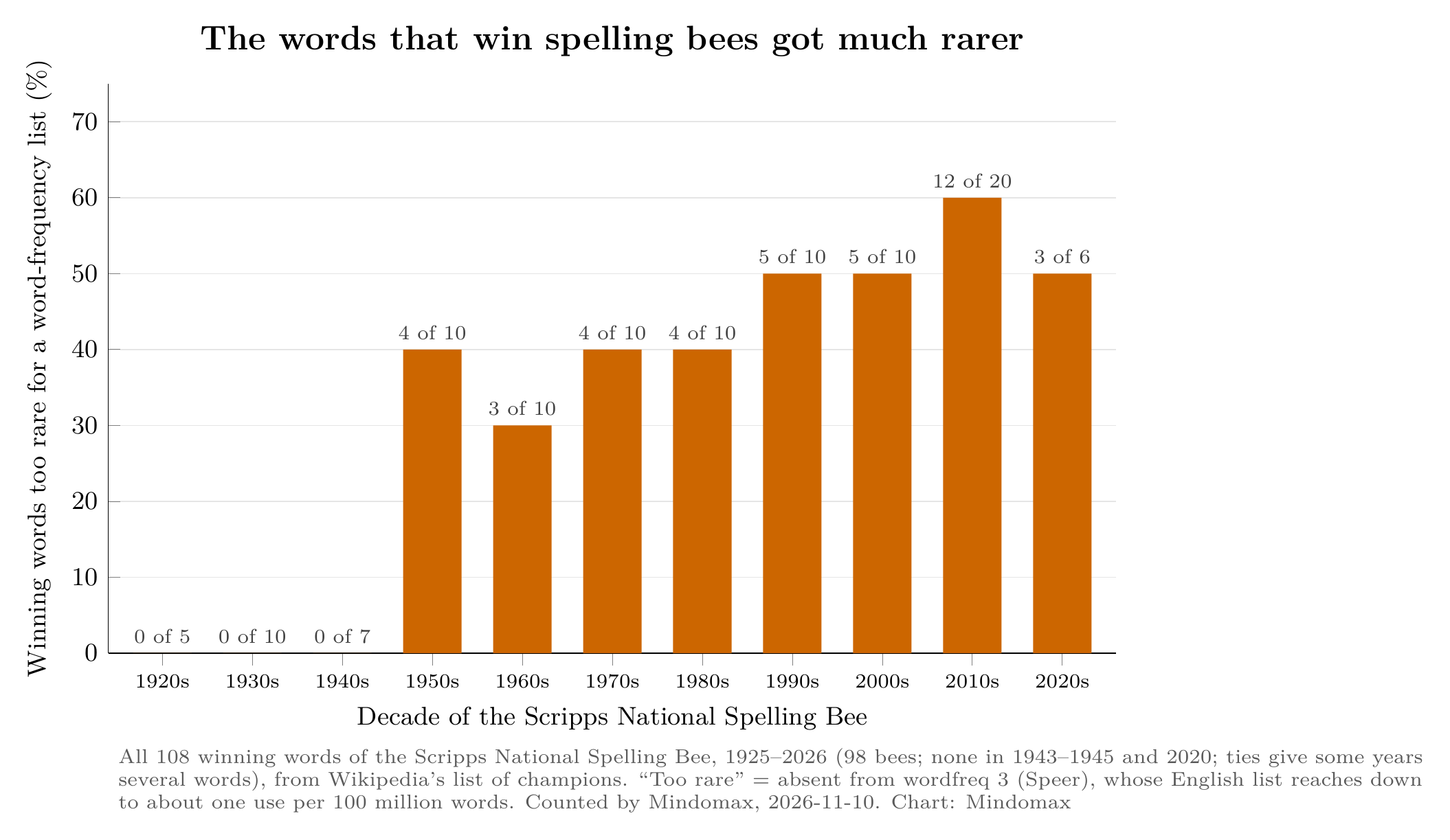
Share of winning words missing from the wordfreq list of everyday English, by decade. Before 1950: 0 of 22. Since 2010: 15 of 26. Data: Wikipedia list of champions, wordfreq 3.1. Count and chart: Mindomax, 2026-11-10.
The words did not get much longer. The median winning word has 9 letters, and the average went from 7.6 letters in the 1920s to about 10 in the 2000s. What changed is how rare they are. Scripps says it plainly in its own study guide: bees start with the study words, but they often end with words the spellers haven't studied.
So at the top, a memorized list is not enough. The final words usually come from outside the study lists, and knowing how Greek, Latin, French and German words are built is what lets a speller work them out. That is also why every list above shows the trap and not just the word.
Where to get the official lists for 2026-2027
Scripps does not post the current lists for everyone. This is how families get them (checked on spellingbee.com, 2026-11-10):
Word Club, the bee's free app for iPhone, iPad and Android, holds all 450 words of the 2027 School Spelling Bee Study List and the 4,000 Words of the Champions, with five spelling games and three vocabulary games.
The Spelling Bee Resource Center, launched with College Board, lets parents of spellers at enrolled schools open a free account and download the grade-level study lists and the full study list.
Teachers at enrolled schools get the lists through the school's login. A school enrolls for $199 until November 30 (checked 2026-11-10), and enrollment stays open until January 29, 2027. Without an enrolled school, Scripps sells the 4,000 study words as a Kindle eBook or a paperback on Amazon.
The Words of the Champions PDF that still ranks first on Google is the 2020 edition. It is fine for extra practice, but this season's school list is not in it.
The calendar: classroom and school bees come first, in the fall and winter. School champions compete in regional bees in February and March, and the national finals are in May. In 2026, 247 spellers reached the national competition in Washington, D.C., and Shrey Parikh won it with bromocriptine.
At the microphone, a speller may ask the pronouncer to say the word again, define it, use it in a sentence, and give the part of speech, the language of origin and other pronunciations. The pronouncer does not answer questions about root words and does not say the word more slowly (Scripps, 2027 Suggested Rules for Spelling Bees). Practice asking at home. It buys thinking time, and the language of origin is a real clue: a word from Greek often writes f as ph and k as ch, and a word from French may end in -que or -ette.
How many words a day?
A list only helps if it is learned before the bee. Here is the arithmetic for the official list sizes, with six study days a week:
For the school list, that is 10 to 19 new words a day when the bee is four to eight weeks away. Words of the Champions is a different job: a school champion with 12 weeks until the regional bee faces 56 new words a day, so test first and spend the time on the words your speller misses, not on the ones they already know.
How to spend that time:
Test from the sound. Say the word, let your child spell it out loud or on paper, then check. Reading a list again and again feels like studying but tests nothing, while pulling the spelling out of memory is what makes it stick, as our piece on the testing effect explains.
Name the trap. When a word goes wrong, say where: the silent p in receipt, the single r in harassment. That is what the trap column is for.
Bring misses back on a schedule. A word spelled wrong today comes back tomorrow, then three days later, then a week later. Reviews spread out like this beat the same reviews crammed into one evening, which is the spacing effect.
Write some of them by hand. In a study of young children just starting to spell, Cunningham and Stanovich (1990) found that writing the words by hand beat typing them. A 1992 follow-up found no difference, so treat it as a good habit rather than a law. Our piece on handwriting versus typing covers the wider research.
From 7th grade on, add the origin. Knowing that chlorophyll and synchronize come from Greek explains the ph, the ch and the y in one go.
Apps that help with spelling bee practice
A parent reading the words aloud is still the best pronouncer. These apps help with the rest. Prices are from the US App Store and Google Play. For more apps that build vocabulary, see our list of the best vocabulary apps.
Spell It, Spelling Bee Games & Tests, TurboWords and Spelling Notebook all start from your own list, so any of the 25-word lists above can go straight in. Word Club is the only one with this season's official words.
If you'd like one of the lists above as cards that come back right before your speller would forget them, paste it into Mindomax, which is free right now.
Frequently Asked Questions
What are good spelling bee words for beginners?
Short words with one trap each: know, write, thumb, light, guess, piece. The 1st and 2nd grade lists above are built for beginners, and each word shows the one spot to watch.
What are the hardest spelling bee words?
At the national finals, words like scherenschnitte (2015), éclaircissement (2025) and bromocriptine (2026). Since 2010, 15 of 26 winning words are too rare to appear in a standard word-frequency list. In school bees, the hard words are the ones with two or three traps, such as guerrilla, surveillance or acquiescence.
How many words should my child study for a school spelling bee?
If the school is enrolled with Scripps, start with the 450 words of the 2027 School Spelling Bee Study List. At six study days a week, that is 13 new words a day over six weeks. School champions then move on to Words of the Champions, 4,000 words.
Where can I find the official Scripps spelling bee word list?
In the free Word Club app, through the Spelling Bee Resource Center (a free parent account for families at enrolled schools), from your child's teacher at an enrolled school, or as a Kindle eBook or paperback of the 4,000 words on Amazon.
What can you ask for in a spelling bee?
You can ask to hear the word again, for the definition, a sentence, the part of speech, the language of origin and alternate pronunciations. The pronouncer won't answer questions about root words and won't say the word more slowly.
What was the winning word of the 2026 Scripps National Spelling Bee?
Bromocriptine, spelled by Shrey Parikh. The 2025 winning word was éclaircissement.
When are spelling bees held?
Classroom and school bees come first, in the fall and winter. School champions go on to regional bees in February and March, and the Scripps National Spelling Bee finals are held in May.


