
Australian slang is the casual English you hear in Australia: arvo for afternoon, servo for a petrol station, tradie for the plumber. The lists on Google pile up a hundred or more without saying which ones Australians still say, or which are Australian at all.
So we counted all 292 words and phrases from the seven top-ranking lists in Australian web text from 2002 and 2020, and in Canadian, Irish and South African text. Some are almost only Australian; bonkers and brolly are more Irish; and 61 never appear once in the 2020 Australian text.
The short answer
If you only learn ten, make them mate (a friend, or anyone), reckon (think), heaps (a lot), bloke (a man), arvo (afternoon), g'day (hello), no worries (no problem), tradie (a tradesperson), ute (a pickup truck) and footy (Australian rules or rugby league). All ten are on two or more top lists.
Skip bludger, ratbag and strewth: by 2020 each was down to one or two uses, while casual writing nearly tripled. And skip the postcard sayings: flat out like a lizard drinking never appears.
How we measured 292 Aussie slang words
We took every entry from the seven lists Google ranks highest in the US for "australian slang" (read on 2026-11-04): Nomads World, Charles Sturt University, Victoria University, Mental Floss, Berlitz, YHA and Pearson PTE. Merging spellings (brekkie, brekky) left 300 entries; minus five crude ones and three we can't count in their slang sense (tea for dinner, sick for great, Manchester for bed linen), that is 292.
The lists agree on very little. Only three entries are on six of the seven (arvo, barbie and hard yakka), and 190 of the 292 (65%) appear on just one.
We counted each one in the Leipzig Corpora Collection, a million sentences per sample from a country's websites (Goldhahn et al., 2012): Australian web text from 2002 and 2020, about 18 million words each, plus 2020 text from Canada (standing in for North America), Ireland and South Africa.
Two limits: slang lives in speech, so a phrase with no hits may still be said as a joke. And words spelled like other words (galah is mostly the bird, Crikey a news site) we counted through phrases or left blank.
In the tables, "Uses, 2002 / 2020" counts the word in each Australian sample, and "Aussie share" is Australia's part of its uses in the four 2020 samples (25% = no more Australian than the others; a dash = too few uses).

Australia's share of each word's uses in 2020 web text from Australia, Canada, Ireland and South Africa. 25% means no more Australian than the others. Data: Leipzig Corpora Collection. Chart by Mindomax.
Greetings, replies and everyday phrases
Reckon and heaps do the heavy lifting. Bloody oath, on three lists, doesn't appear once.
How ya going is common in speech but rarely written.
Australian slang for people
Mate and bloke come first. Tradie is new: absent in 2002, it appears 71 times in 2020, against 120 for tradesman and its kin. Bogan is a put-down.
Food and drink
Chook, esky and Maccas are close to 100% Australian. Barbie and snag are on most lists, but Australians write barbecue or BBQ about 30 times as often as barbie.
Places, clothes and things
Ute, footy and rego are among the most Australian words we measured; outback fell from 335 uses to 264. For a swimsuit, bathers is the safe bet; togs is more Irish than Australian.
Woolies scores low because South Africa has its own Woolworths, also called Woolies.
How you feel
Stoked is the big riser: 3 uses in 2002, 47 in 2020 (not counting stoked fires). Knackered and dodgy are on the lists too, but they are British-Isles words (see below).
Doing things
Chuck a u-ey is on five of the seven lists and doesn't appear once in either sample. Whinge is the verb you'll actually meet.
Yarn also means knitting wool, so we give it no share.
Which Aussie slang is growing, and which is fading
Between 2002 and 2020, Australian web writing got chattier: yeah, awesome, guys and the exclamation mark became two to four times as common. A slang word that merely doubled just kept pace.
Some rose far faster. Arvo went from 9 uses to 72: in 2002 it was 1 in 120 mentions of the afternoon, in 2020 it was 1 in 17. Stoked went from 3 to 47, good on ya from 6 to 32, and tradie from none to 71.
Others are fading even so. Bludger fell from 13 uses to 2, ratbag from 10 to 1, grog from 32 to 13, larrikin from 20 to 13 and tall poppy from 21 to 13. Bloke grew, but slower than guy: 12.5% of bloke-or-guy mentions in 2002, 9.2% in 2020.
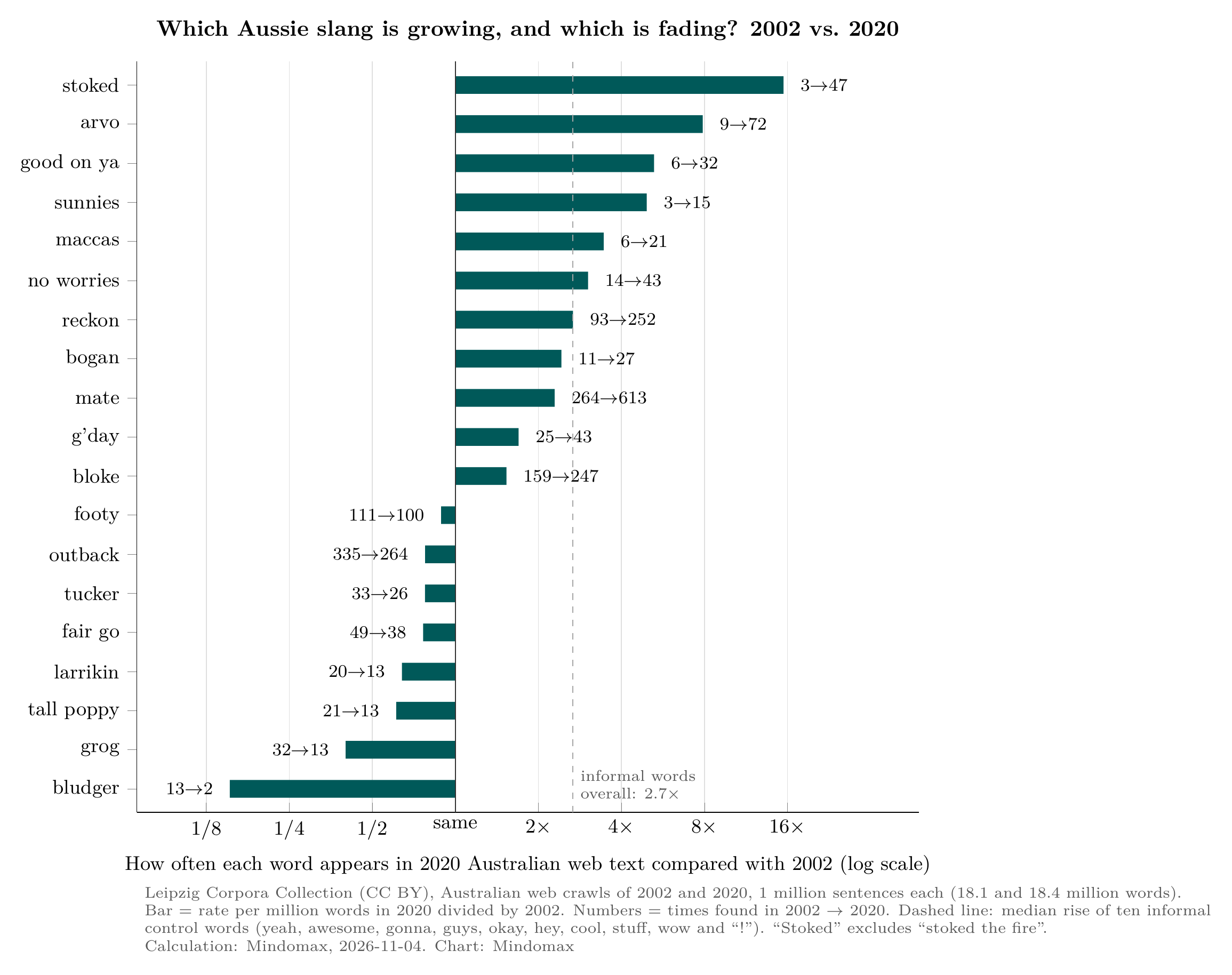
How often each word appears in 2020 Australian web text compared with 2002, on a log scale. The dashed line is the rise of informal words overall. Data: Leipzig Corpora Collection. Chart by Mindomax.
On these lists, but not really Australian
Fine to use in Australia, but they won't make you sound Aussie: each is used about as much, or more, in at least one of the other three countries. Bonkers is 10 times more common in Irish text; knackered was 12 times more common in 2002 British text.
No worries belongs here too: it has gone global, and only 43% of its uses in our four samples are Australian.
And 28 entries aren't slang at all but ordinary Australian and British English, such as petrol, footpath, trolley, chemist, jumper and boot: petrol turns up 29.7 times per million words in Australian text and 28.8 in Irish. 27 of them come from one list for international students.
Then there are sayings that never appear in the 2020 Australian text: flat out like a lizard drinking, face like a dropped pie, fair shake of the sauce bottle, two sandwiches short of a picnic, up a gum tree, as useful as an ashtray on a motorbike, shark biscuit, dunny budgie and bush telly. You may hear one as a joke; don't learn them first. Cheese and kisses (missus) and hit the frog and toad (road) are Cockney rhyming slang from London.
How to remember Australian slang
Slang is rare even in casual writing: arvo, one of the most common words here, turns up about four times per million words. Webb (2007) found that about ten encounters with a new word in context can produce sizeable gains, so don't wait to meet each word that often: pick the 20 or 30 you actually hear and put each on a flashcard with an example sentence.
Then test yourself instead of rereading. In Karpicke and Roediger (2008), repeated testing on foreign-language words produced a large gain at a later test, while repeated studying added nothing. Spacing the reviews over several days also beats one long session (Cepeda et al., 2006). More in why self-testing works, how spaced repetition works and how to study with flashcards.
Learning British English too? See our British slang list.
Tools that help you learn Australian slang
Slang apps show you the words; flashcard apps make you recall them. US App Store and Google Play prices, checked on 2026-11-04. To settle an argument, there's the Macquarie Dictionary, Australia's national dictionary.
For more apps, see the best vocabulary apps.
If you want your new slang on flashcards with the reviews spaced for you, you can try Mindomax for free.
Frequently Asked Questions
What is the most Australian slang word?
Of the common ones, tradie: 71 uses in our 2020 Australian sample and none in the Canadian, Irish and South African ones. Rego, ute, esky, Maccas, g'day, chook, footy and arvo are all over 93% Australian.
How do Australians say "I love you"?
Mostly the way other English speakers do: "I love you", or "love ya" between friends and family. Aussie slang has no special word for it.
How do Aussies say "cool"?
Ripper ("a ripper of a day"), which rose from 2 uses in 2002 to 14 in 2020. Bonza sounds old-fashioned: awesome appears about 90 times as often in 2020 Australian web text.
What do Aussies call a girl in slang?
Sheila is the famous one, but it is dated: it appears just 7 times in 18 million words of 2020 Australian web text. Most people say girl or woman, and mate works for women too.
What are some Aussie insults?
Mild ones: galah and drongo (a fool), dag (a nerd), bludger (a lazy person), sook (a crybaby) and bogan (an uncouth person), the only one that clearly grew, from 11 to 27 uses. Pom or pommy for an English person is usually teasing.
What does arvo mean?
Afternoon: "this arvo" means this afternoon. It is on six of the seven top lists, rose from 9 uses in 2002 to 72 in 2020, and 94% of its uses in our four 2020 samples are Australian.


