
Fancy words make you sound smart only when the person listening knows them. "Nuance", "pragmatic" and "meticulous" pass that test. "Perspicacious" and "loquacious" mostly do not: in American books they turn up about once or twice in every ten million words.
So we did not pick words by taste. We took the three fancy-word lists Google ranks highest, 183 different words in total, and counted how often each one is printed in Google Books' American English collection from 2010 to 2019. Below are the 48 words worth using, with their numbers, then the ones to skip and what to say instead, and finally how to make new words stick.
The short answer
If you want ten fancy words you can use this week, take these: nuance, pragmatic, mitigate, salient, caveat, meticulous, eloquent, ubiquitous, ephemeral and quintessential. Each is printed between 1.4 and 9.5 times per million words. That is rare enough to stand out and common enough that most readers know it.
Words printed more than 10 times per million, like "comprehensive" or "massive", are ordinary words and impress nobody. Words printed less than once per million, like "sagacious", are the ones your reader has to look up.
How we measured 183 fancy words
The three lists are Berlitz's 127 big fancy words to sound smart, the first result for "fancy words" (122 different words once repeats are removed), QuillBot's 40 Smart Words and OnlineCollegePlan's 50+ Sophisticated Words (51 words). We looked up every word in the Google Books Ngram Viewer, American English 2019 corpus, averaged the years 2010 to 2019 and turned the result into uses per million words. Verbs and nouns are counted with their other forms (mitigate, mitigated, mitigating), and capitalized uses count too. It is the same method we used in our study of SAT vocabulary.
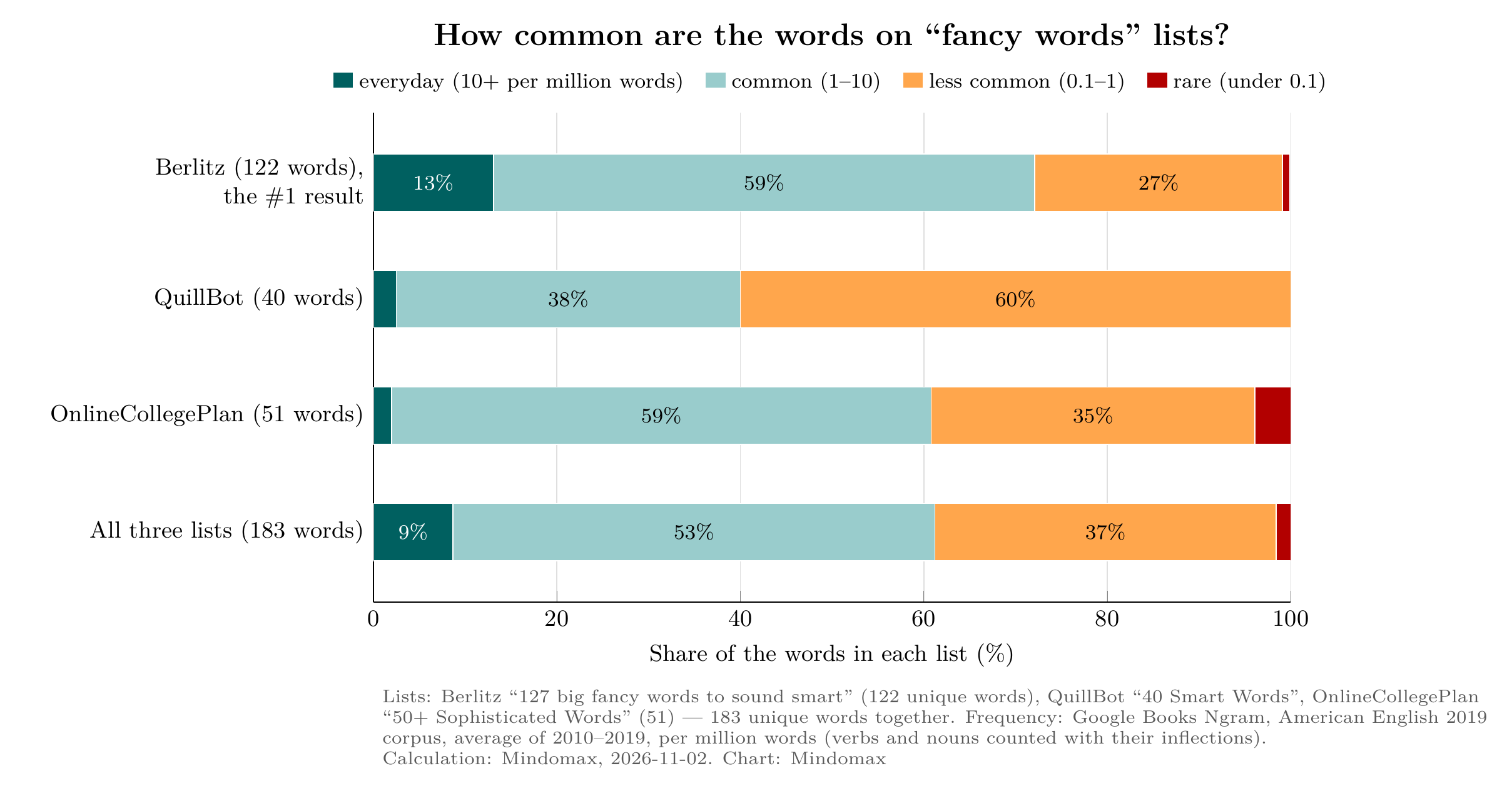
Share of each list by how often its words are printed. Lists by Berlitz, QuillBot and OnlineCollegePlan (read 2026-11-02). Frequency: Google Books Ngram, American English 2019 corpus, average of 2010 to 2019, per million words. Chart by Mindomax.
Three things stand out. First, 71 of the 183 words (39%) are printed less than once per million words, and on QuillBot's list it is 24 of 40 (60%). Second, the Berlitz list, the top result, is not that fancy: 16 of its words are everyday words printed more than 10 times per million, such as "embrace" (35.7), "comprehensive" (32.5) and "massive" (27.9). Third, the lists hardly agree. Only two words, "predilection" and "substantiate", appear on all three.
We also checked every word in the Cambridge Dictionary, which marks every word that is in the English Vocabulary Profile, Cambridge's list of the words learners of English know at each level from A1 to C2. Only 31 of the 183 words have a level. "Pragmatic", "meticulous" and "plethora" are C2, the top level. "Mitigate", "nuance" and "ubiquitous" have no level at all, even though they are printed more often than many C2 words.
One limit of the method: Ngram counts every meaning of a word, so "cerebral" includes "cerebral palsy" and "renaissance" includes the historical period. We left words like that out of the tables below.
Fancy words for work, school and arguments
These make an email, a report or an essay sound sharper. All 12 are printed between 1.6 and 9.5 times per million words. A level in brackets is the word's level in the English Vocabulary Profile.
Fancy words to describe people
Use these when "nice", "smart" or "hard-working" is too vague. All 12 are printed between 1.3 and 6.4 times per million words.
Fancy words to describe things and ideas
These replace "huge", "everywhere", "complicated" and "really bad". Two cautions: "plethora" means more than enough, often too much, and "egregious" works best for mistakes and behavior.
Rarer words to save for the right sentence
These 12 are printed between 0.6 and 1 time per million words. Most readers will understand them in context, but use one per page at most, and only when no plainer word says the same thing.
Fancy words to skip, and what to say instead
Some favorites of fancy-word lists are so rare that the plain word is the smarter choice. For the pairs in the chart, the plain word with the same meaning is printed 4.5 to 125 times more often than the fancy one.
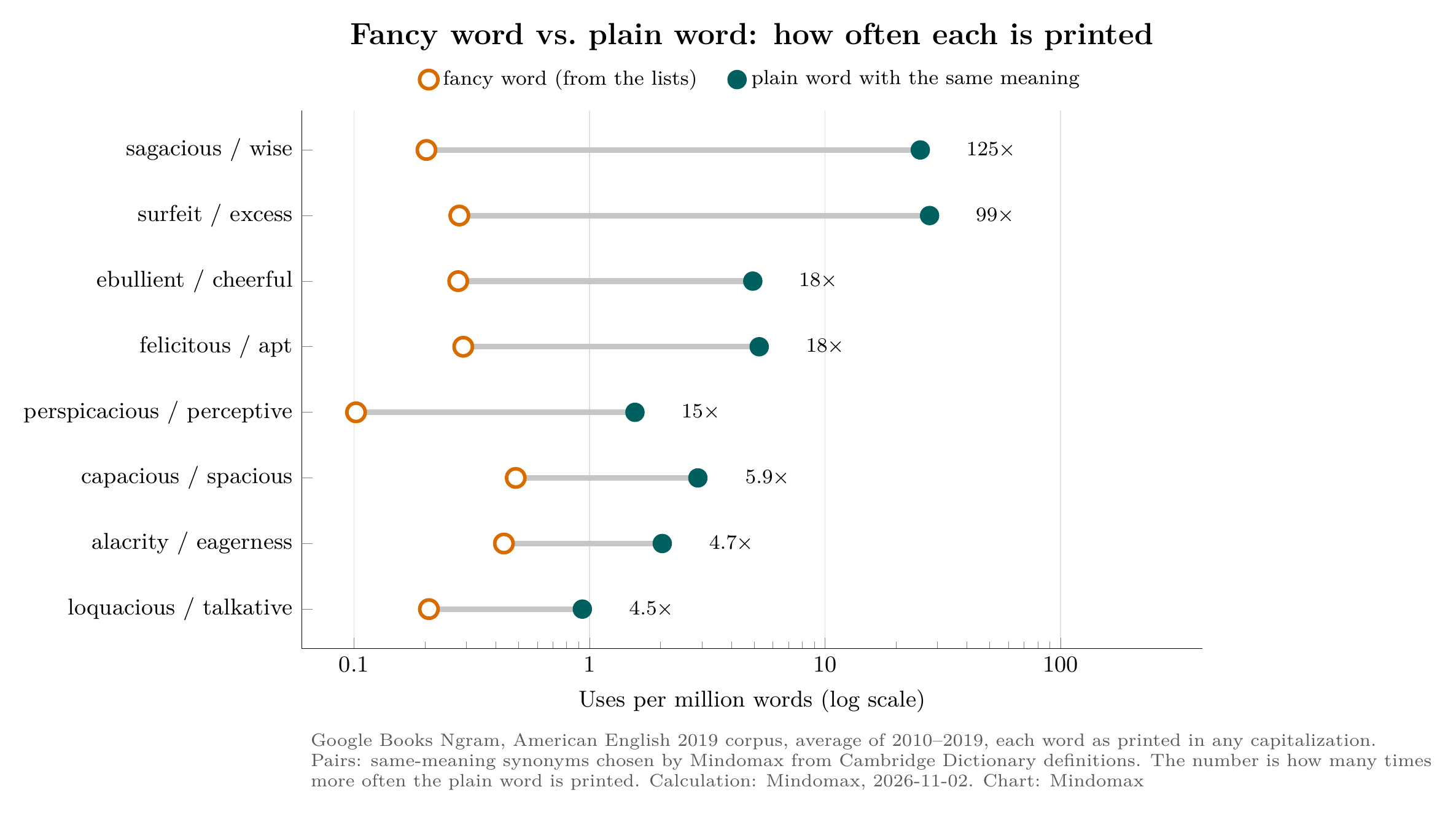
The plain word with the same meaning is printed 4.5 to 125 times more often than the fancy one. Data: Google Books Ngram, American English 2019 corpus, 2010 to 2019, each word as printed. Chart by Mindomax.
In this table each word is counted exactly as printed. Other words on the lists are rarer still: "mellifluous" (0.14 per million), "pellucid" (0.07) and "petrichor", the smell of rain on dry ground, at 0.01. Keep those for word games.
Why big words can make you sound less smart
The psychologist Daniel Oppenheimer tested the idea head on. In a 2006 paper in Applied Cognitive Psychology, he reported that a majority of the undergraduates he asked admitted to making their vocabulary more complex to seem intelligent. In his experiments, readers judged the authors of the more complex versions of a text as less intelligent, whatever the quality of the original essay. The reason was fluency: text that is harder to read makes its author seem less capable. Even a hard-to-read font had the same effect (Oppenheimer, 2006).
The paper's title is the joke. "Consequences of erudite vernacular utilized irrespective of necessity" simply means "problems with using long words needlessly", which is its subtitle. The lesson: use a fancy word when it is the precise word, not when it is the longer one. "Mitigate" says something "reduce" does not quite say. "Utilize" never says more than "use".
How to make new words stick
Reading a list once does not put words in your memory. Three findings explain what does.
You need many encounters. In a study of 121 Japanese learners of English, Stuart Webb found that meeting a new word ten times in context can produce sizeable gains, and that full knowledge of a word may take more than ten (Webb, 2007). A later meta-analysis of 26 studies with 1,918 learners found a medium link (r = .34) between the number of encounters and how much was learned (Uchihara, Webb and Yanagisawa, 2019).
Testing beats rereading. When students kept restudying foreign-language words they had already learned, it did nothing for their recall on a later test; when they kept testing themselves on those words, it had a large positive effect (Karpicke and Roediger, 2008). We explain why in why self-testing works.
Spacing beats cramming. Reviews spread out over time lead to better recall than the same number of reviews crammed together, a result confirmed by a large review of verbal learning experiments (Cepeda and colleagues, 2006). Here is how spaced repetition works.
A routine that uses all three:
Pick five to ten words a week from the tables above, not all 48 at once.
Make a flashcard for each word: the meaning and your own example sentence with a blank on one side, the word on the other, so you have to produce it.
Test yourself instead of rereading. Read the meaning, say the word, then check.
Review after one day, then after a few days, then after a week, and stretch the gaps when you get a card right.
Use each word once in real life that week, in an email, a message or a conversation. More ideas are in our guide on how to improve your vocabulary.
Tools that help you learn new words
Word-of-the-day apps are good at showing you words. Flashcard apps are good at making you recall them. Prices are from the US App Store and Google Play, checked on 2026-11-02.
We compare more options in our guide to the best vocabulary apps.
If you want your new words on flashcards with the reviews spaced for you, you can try Mindomax for free.
Frequently Asked Questions
What are some fancy words to use?
Words that sound smart but are still widely understood: nuance, pragmatic, mitigate, salient, caveat, meticulous, eloquent, ubiquitous, ephemeral and quintessential. Each is printed between 1.4 and 9.5 times per million words in American books.
What is a fancy word for smart?
"Erudite" (very learned) and "perspicacious" (quick to notice and understand) are the fancy options, but both are rare: 0.62 and 0.10 uses per million words. "Intelligent" (14.7) and "clever" (9.1) are what most writers use.
What is a fancy word for beautiful?
"Exquisite" (3.8 uses per million words) for something fine and delicate, "sublime" (4.2) for something overwhelming, "luminous" (2.5) for light and color and "resplendent" (0.67) for something dazzling. "Beautiful" itself is printed about 72 times per million words.
How do you use big words without sounding pretentious?
Use one only when it is the most precise word, keep it to one or two per page, and never use it where a plain word says the same thing. In Oppenheimer's experiments, needlessly complex wording made writers look less intelligent, not more.
How many times do you need to see a word to remember it?
In Webb's 2007 study, ten encounters in context could give learners sizeable gains, and full knowledge of a word may take more. Testing yourself on spaced days gives you those encounters much faster than waiting to meet the word in a book.
Are fancy words good for essays?
Precise words are; showy ones are not. A word like "substantiate" or "mitigate" helps when it says exactly what you mean, while a rare word like "perspicacious" mostly slows the reader down, and readers judge hard-to-read writing more harshly.


