
The short answer
To improve your vocabulary, do four things. Read material slightly above your level and write down the words you don't know. Study those words on purpose: look at their parts and an example sentence. Test yourself on them from memory, spread over days and weeks, instead of rereading a list. Then use each word yourself, in a sentence you write or say.
Reading gives you new words. Testing and spacing make you remember them. Most advice covers only the first half, which is why so many people read a lot and still feel their vocabulary is stuck.
How many words do you know, and how fast does that grow?
The best estimate comes from a 2016 study by Marc Brysbaert and colleagues. The typical 20-year-old native speaker of American English knows about 42,000 lemmas, which are dictionary words like "run" counted once, without "runs" or "running". The middle 90% of 20-year-olds know between 27,100 and 51,700.
By age 60 the median rises to 48,200. That is 6,200 more words in 40 years, or about one new word every two days. Counted as word families (one base word plus its forms), the figures are 11,100 at 20 and 13,400 at 60.
Two things follow from this. First, adults don't stop learning words; they learn them slowly, mostly by accident. Second, learning even five new words a week on purpose adds about 260 words a year, which is more than the natural rate. Small daily effort beats occasional big pushes.
Why "just read more" is slow
Reading is the main way adults pick up words, and it gets more important as we age. A meta-analysis of 99 studies by Mol and Bus (2011) found that how much people read explains 12% of the differences in oral language skills in preschoolers, 30% in high school students and 34% in college students.
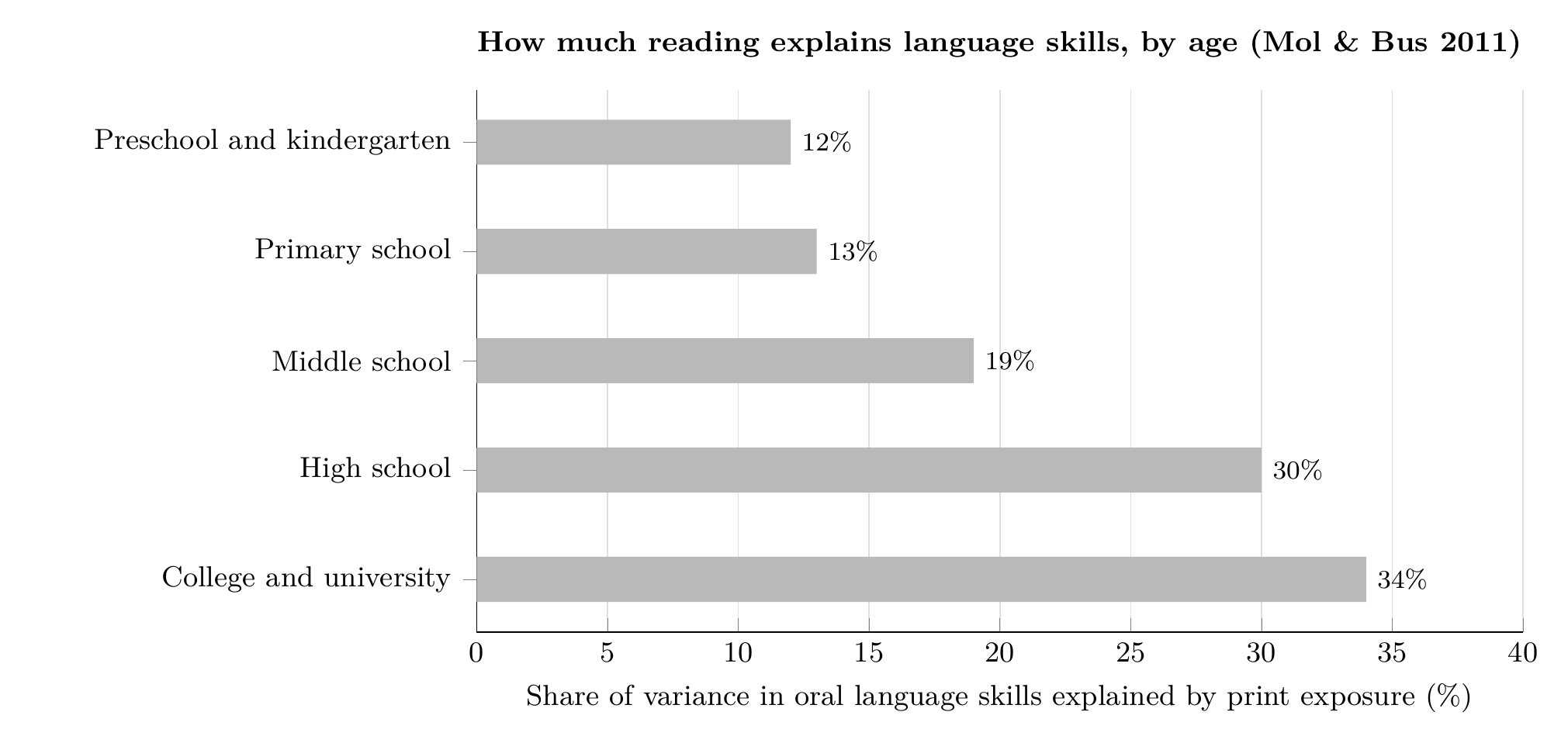
Share of the differences in oral language skills (vocabulary among them) explained by how much people read, by age group. Data from Mol and Bus (2011), a meta-analysis of 99 studies. Chart by Mindomax.
But one encounter with a new word in a book rarely teaches it. Nagy, Herman and Anderson estimated the chance of learning a word from a single meeting in context at roughly 5 to 15%, depending on how strictly "knowing" is measured. A meta-analysis of 20 experiments (Swanborn and de Glopper, 1999) found that readers learn about 15% of the unknown words they meet.
How many meetings does a word need? In Stuart Webb's 2007 study, learners met new words 1, 3, 7 or 10 times. Knowledge grew with each repetition, and even ten meetings did not give full knowledge of every word. A 2019 meta-analysis of 26 studies (Uchihara, Webb and Yanagisawa) found a medium link between the number of encounters and learning (r = .34).
So reading is the right source of words, but a slow way to keep them. A rare word you meet once a year in a novel may take a decade to stick. The methods below speed that up.
1. Read a little above your level, and capture words
Choose reading where you know most words but meet a few new ones on every page: long-form journalism, popular science, good fiction, or articles in your field. If you stop on every second sentence, the text is too hard.
When you meet a word you can't explain, write it down with the sentence it came from. A phone note works. The sentence matters because it shows how the word is used, which a dictionary definition alone does not.
Don't capture everything. Pick words you have seen before and could use yourself. "Ubiquitous" is worth learning; a 17th-century legal term in one novel is not.
2. Learn word parts, not just words
Many English words are built from parts you already know. In a classic count of prefixed words in school texts (White, Sowell and Yanagihara, 1989), four prefixes made up 58% of them: un- (26%), re- (14%), in-/im-/il-/ir- meaning "not" (11%) and dis- (7%).
Roots work the same way. If you know that "bene" means good, "benefactor", "benevolent" and "benign" become easier to guess and to remember. Nagy and Anderson estimated that printed school English contains about 88,500 word families, so no one learns them one by one. Word parts let one word open the door to several.
A warning: parts can mislead. "Unassuming" does not mean "not assuming". Use word parts to guess, then check.
3. Test yourself, don't reread the list
This is the step most people skip, and it matters most. In a well-known experiment, Karpicke and Roediger (2008) had students learn 40 Swahili-English word pairs. One week later, students remembered about 80% of the words they had kept testing themselves on, but only about a third (33-36%) of the words they had stopped testing once they got them right once. Extra rereading added nothing.
The students did not see it coming. They predicted they would remember about 50% in every condition. Rereading feels like learning; recalling from memory actually is. We explain the research in more detail in our article on the testing effect.
In practice: cover the definition and try to say what the word means, or see the definition and try to recall the word. Flashcards do exactly this, which is why they work so well for vocabulary. If you have never made good cards, see how to make flashcards.
4. Spread your reviews over time
Reviewing a word five times on Monday is worse than once on Monday, Wednesday, next week and next month. A review of 317 experiments (Cepeda and colleagues, 2006) found that spaced practice beats massed practice, and the longer you want to remember, the longer the gaps should be.
Nate Kornell tested this with GRE-style vocabulary in 2009. Studying words in one large deck, so each card came back after a long gap, beat studying them in small decks for 90% of participants. Yet after the first session, 72% believed the small decks had worked better. Cramming feels effective. It isn't. More on why in our guide to the spacing effect.
You don't need to plan the gaps yourself. Spaced repetition apps such as Anki schedule each word for you: easy words come back rarely, hard ones often.
5. Use the word in your own sentences
Hulstijn and Laufer (2001) compared three ways of learning ten unfamiliar English words. Writing a short composition with the words led to the best retention, reading with a fill-in task came second, and reading alone came last. The more work your brain does with a word, the more of it stays.
So once a word is in your review pile, write one sentence of your own with it, about your life. "My boss is ubiquitous on Slack" will stick better than the dictionary's example. Use it once in an email or a conversation that week, too.
6. Choose the right words for your goal
What to learn depends on who you are.
For learners, the numbers are clear. Paul Nation (2006) calculated that understanding 98% of the words in a written text, the level where reading becomes comfortable, needs about 8,000 to 9,000 word families. Spoken English needs about 6,000 to 7,000. Learn frequent words before rare ones.
7. Listen and play, but don't count on it alone
Podcasts, audiobooks and word games like Wordle or Spelling Bee keep words in front of you, and that helps. But they work like reading: lots of exposure, little review. Treat them as a source of words to capture, not as the method itself.
A 10-minute daily routine
Here is a plan that combines all of the above and fits into a coffee break.
Five words a week is about 260 a year. Five a day, kept up, is well over a thousand. Start small; the habit matters more than the number.
Tools that help, with prices
You can do all of this with a notebook and paper cards. These tools make the capture and the review easier. Prices are as shown on each vendor's own page or the US App Store, checked 2026-10-04.
Two popular names we left out of the table: Magoosh's Vocabulary Builder app is free but has not been updated since January 2020, and Vocabulary.com's iPhone app since 2021. Both still work, but check them before you rely on them. For more options, see our list of the best vocabulary apps.
Frequently Asked Questions
How long does it take to improve your vocabulary?
You will notice words you have studied in your reading within a few weeks. Real growth is slow: a typical adult adds about one word every two days without trying, so five deliberate words a week already speeds that up.
What is the fastest way to improve vocabulary?
Combine reading with self-testing on a spaced schedule. In Karpicke and Roediger's study, words that students kept testing themselves on were remembered about 80% of the time a week later, against about a third for words they stopped testing.
Does reading improve vocabulary?
Yes, and it matters more as you get older: reading explains about 34% of the differences in language skills among college students. But one encounter teaches a word only 5 to 15% of the time, so add review.
How many new words should I learn a day?
Three to five is realistic for most adults. More than that and the daily reviews pile up and people quit.
Do vocabulary apps work?
Apps that make you recall words on a spaced schedule work. Apps that only show you a word of the day mostly give you exposure, which is a start but rarely enough.
If you want your captured words turned into review cards for you, you can try Mindomax for free.


