
The short answer
Below are 47 quotes in Spanish with English translations: 32 famous lines from Spanish-language writers, painters and leaders, each with the author, the work and the year, and the 15 sayings Spanish speakers actually use most. The most-quoted line of all, measured in Spanish books, is Antonio Machado's "Caminante, no hay camino, se hace camino al andar" from 1912.
We checked every line against the original text, and that changed the list. Most "Spanish quotes" pages are not Spanish at all. Lingo Mastery's "100 Famous Spanish Quotes" credits 99 lines to someone, and 98 of them come from people who did not write in Spanish, from Walt Disney to Michael Jordan, translated into Spanish; the one Spaniard, Picasso, comes with no source. ThoughtCo's "35 Spanish Proverbs, Quotes, and Sayings" does not credit a single line to a person. And several of the most shared Spanish poems online were not written by the famous name attached to them.
So this page does three things the others do not: it gives you a source for every line, it names the fakes and who really wrote them, and it measures which sayings real people still say.
The most famous quotes in Spanish
These are the 16 lines Spanish books quote most often, ranked by how often each appears in Google's Spanish book corpus. The translations are ours.
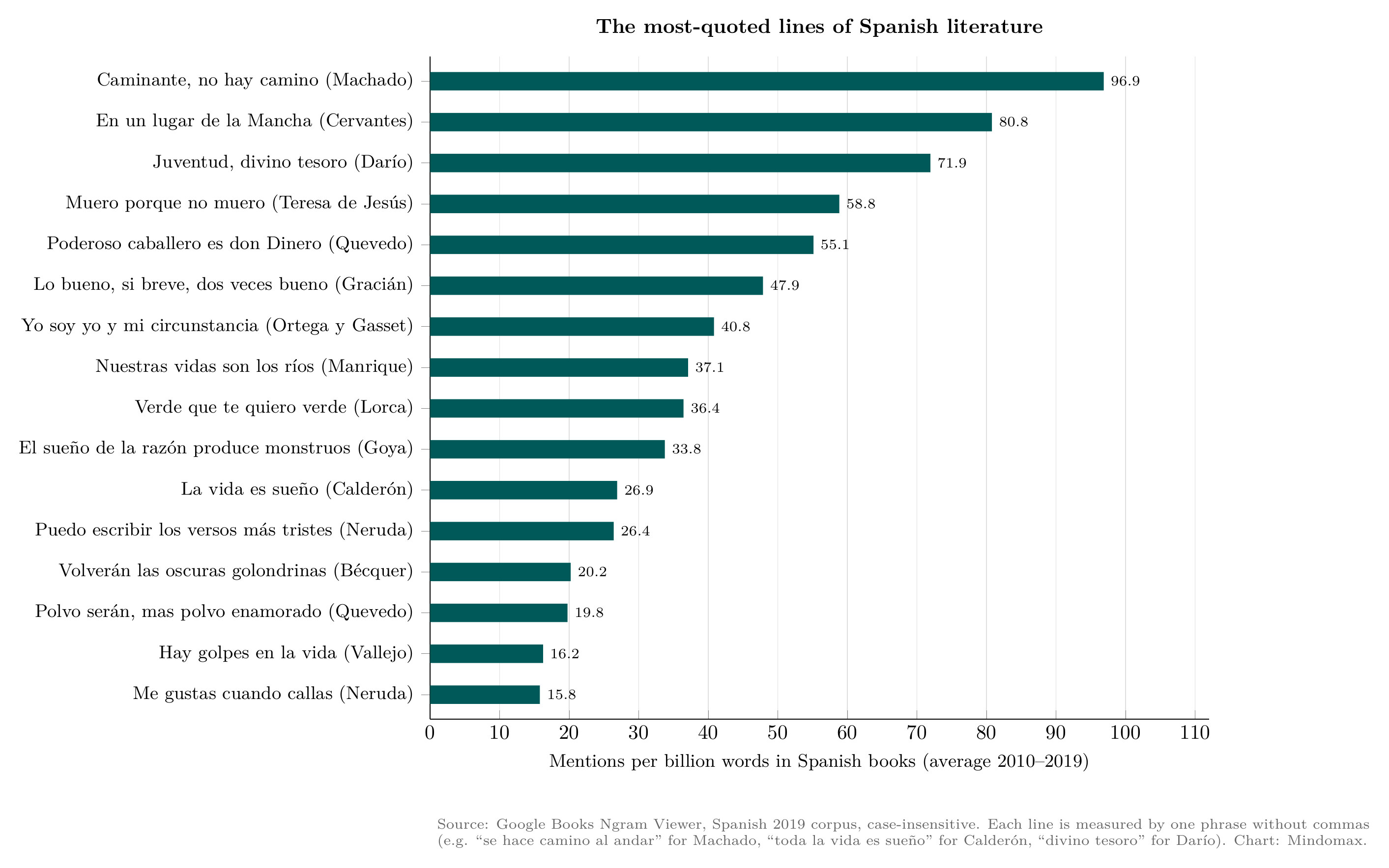
How often each famous line appears in Spanish books (average 2010-2019), measured by one comma-free phrase of each. Source: Google Books Ngram Viewer, Spanish 2019 corpus, case-insensitive. Chart: Mindomax.
Two things stand out. First, all 16 lines were written before 1930: what Spanish books quote most is the classic canon, not the inspirational lines that fill social media. Second, Machado's walking line is not just famous, it is growing: the phrase "caminante, no hay camino" appeared 0.7 times per billion words in the 1950s and 39.5 times in the 2010s. Ortega y Gasset's "circumstance" went the other way, from 116 to 41.
Love quotes in Spanish
Spanish love quotes worth knowing are older than most lists suggest. Besides Quevedo's "polvo enamorado" and Neruda's "Me gustas cuando callas" above, these five are the real thing:
Bécquer's kiss line is a good one to learn the grammar from: "qué te diera" uses the imperfect subjunctive where modern Spanish would say "qué te daría", I would give you. You will meet the same old-fashioned form in songs and poems all the time.
Quotes about life, time and memory
Machado, Calderón, Manrique, Darío and Ortega are in the table above. Three more lines belong here, and two of them are about memory itself:
García Márquez's line is closer to memory science than most people realise. We do not replay the past like a recording; each time we recall something, we rebuild it, which is why memory is constructive and why two people remember the same evening differently.
Quotes about learning, work and freedom
Most of these come from Don Quijote, which we searched in full (the Project Gutenberg text of both parts), so the chapter numbers are exact:
One famous line did not make the table. "La inspiración existe, pero tiene que encontrarte trabajando" (inspiration exists, but it has to find you working) is credited to Picasso everywhere. We found no original source: the earliest one Wikiquote's editors list is a 1994 book, and Google Books first shows the phrase in 1988, fifteen years after Picasso died. It may be his. Nobody has shown that it is.
Short Spanish quotes for captions and tattoos
If you want something short, every line below has seven words or fewer and comes from the verified tables above:
Before you print or ink one, check the accents and the ñ: "sueño" without its tilde looks wrong to every Spanish reader, and "mas" in Quevedo's line correctly has no accent (it means "but", not "more").
The sayings Spanish speakers actually use
Many "Spanish quotes" are really refranes, traditional sayings with no author. For our Spanish-language page on the 100 most used refranes, we counted 204 of them, with their usual variants, in 1.1 billion words of Spanish film and TV subtitles. These are the 15 that people say most:
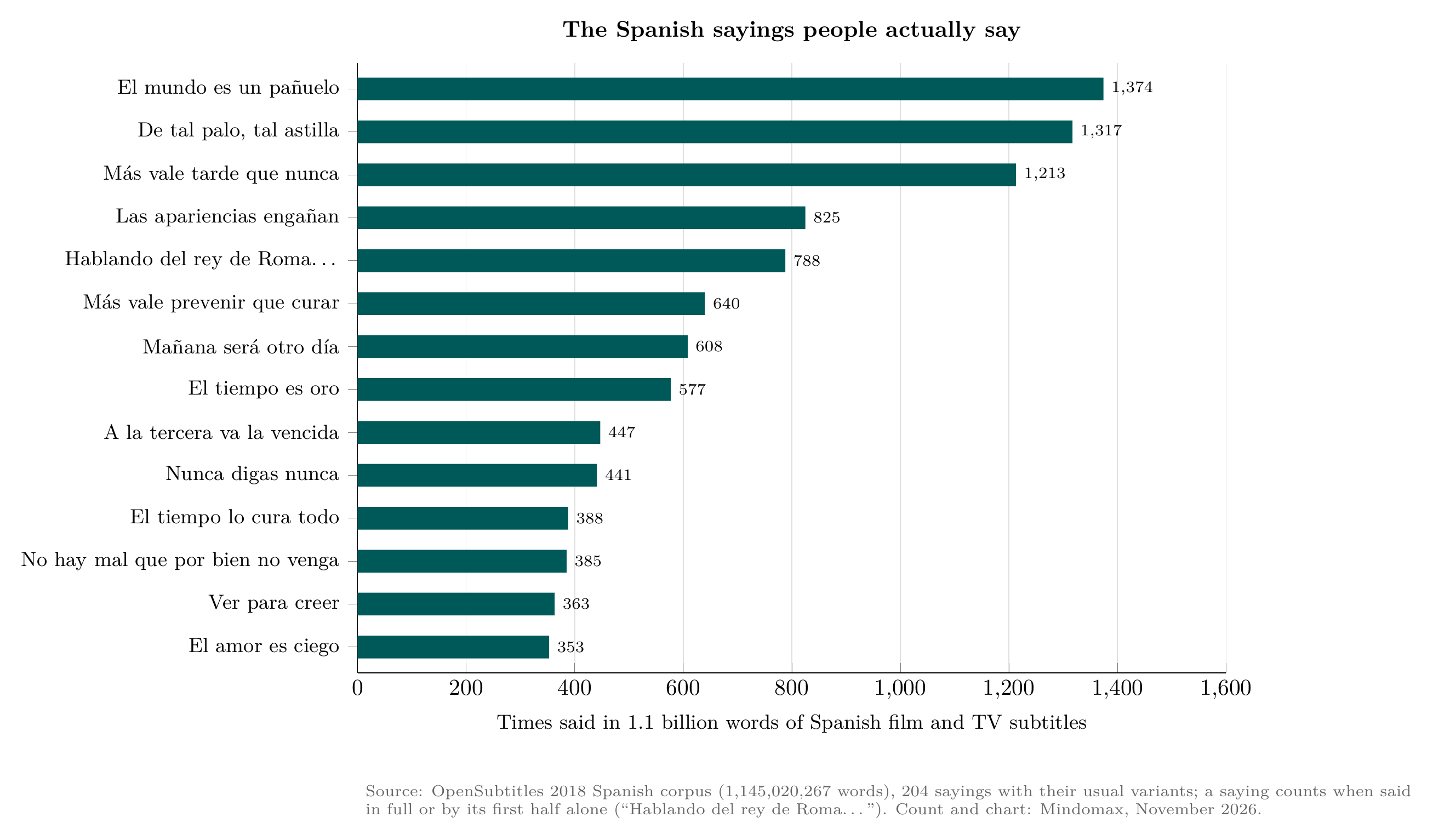
The sayings Spanish speakers actually say, counted in the OpenSubtitles 2018 Spanish corpus (1,145,020,267 words), in full or by their first half alone. Count and chart: Mindomax.
Two details from the count help you sound natural. Native speakers usually say only the first half of "Hablando del rey de Roma, por la puerta asoma": 754 of its 788 uses stop after "Roma". And the sayings on the top pages are often not the ones people use. Of the 36 on ThoughtCo's list, 7 are among the 100 most used, and "Al mal tiempo, buena cara", which opens Fluent in 3 Months' list and the proverbs in Google's AI summary, ranks 72nd. The full ranking, with meanings, is on our page of the 100 most used refranes (in Spanish).
Famous Spanish quotes that are fake
These are among the most shared "Spanish quotes" online. None was written by the person it is credited to:
Google Books gives several of them away. "Muere lentamente quien no viaja" first appears in Spanish books in 2003, "soy una marioneta de trapo" in 2000, "vivir nuevamente mi vida" in 1977 and "podrán cortar todas las flores" in 1982. Neruda had died in 1973. A line that only shows up decades after its author's death is worth checking before you share it.
Some real quotes have been quietly rewritten, too. Cervantes wrote "Con la iglesia hemos dado, Sancho" (part II, chapter 9). The version everybody knows, "Con la Iglesia hemos topado", is not in the novel, and since the late 1980s it has been the more common one in Spanish books in every five-year period:
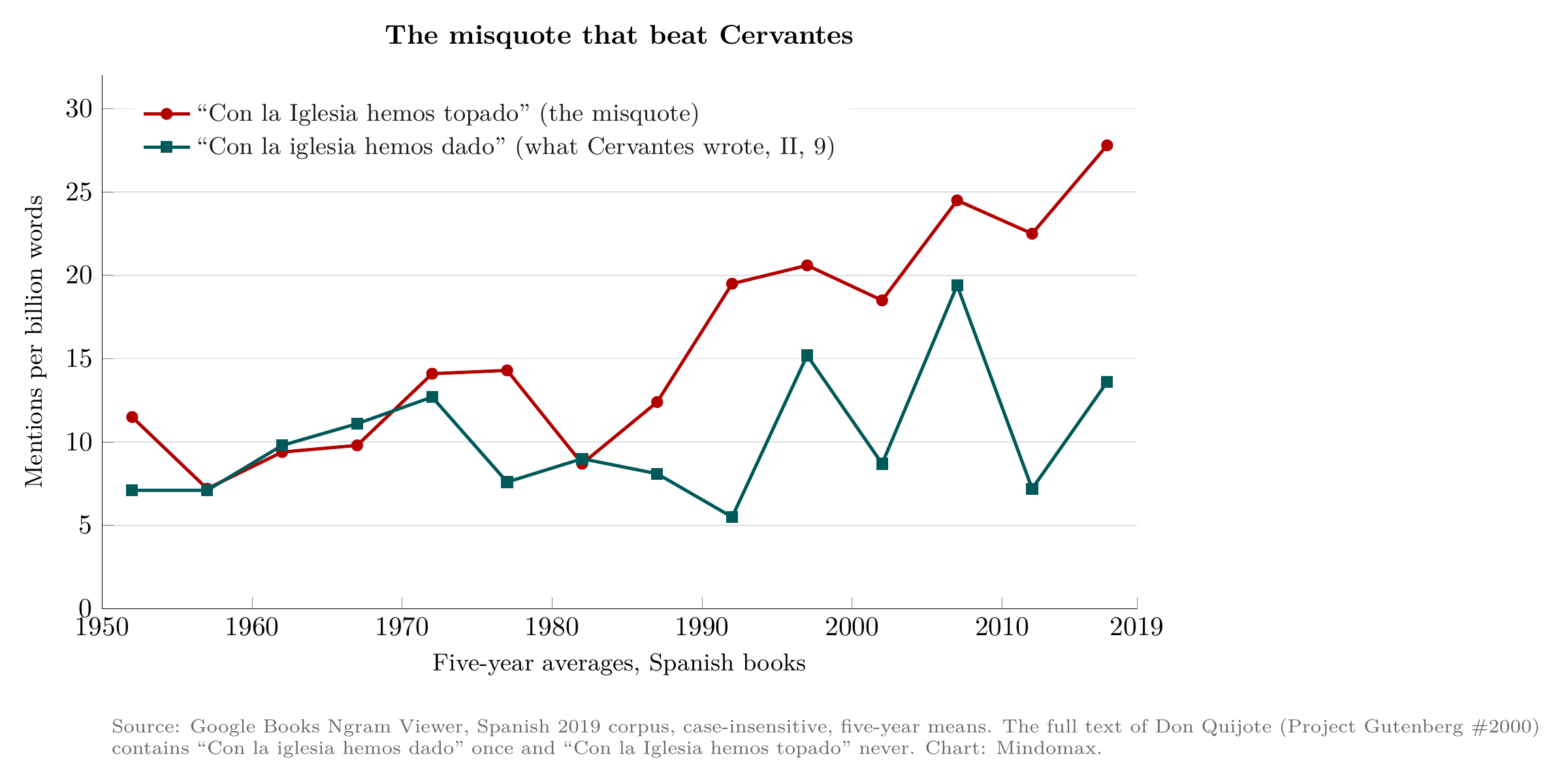
The misquote overtook the original. Five-year averages in Spanish books (Google Books Ngram, Spanish 2019 corpus); the full text of Don Quijote contains "Con la iglesia hemos dado" once and "Con la Iglesia hemos topado" never. Chart: Mindomax.
Borges has the same problem. The library line on countless posters, "Siempre imaginé que el Paraíso sería algún tipo de biblioteca", is not what he wrote. His words, in "Poema de los dones" (1960), are "yo, que me figuraba el Paraíso bajo la especie de una biblioteca". The popular version reads like a translation back from the English "I have always imagined that Paradise will be a kind of library".
How we checked every quote
For the older texts we searched the original wording in public-domain editions: Spanish Wikisource for the poems and plays, and the complete Project Gutenberg text of Don Quijote for every Cervantes line, which is how we know that "ladran" does not occur anywhere in the novel. For modern authors we followed the wording to a cited edition or the author's own institution, such as the University of Chile's Neruda pages. The fakes come from documented statements: García Márquez's interview, the Benedetti foundation, the Latin American Herald Tribune on Medeiros, Cuervo Barrero's own letter to the journal Vivat Academia, and the Argentine fact-checker Chequeado on the Sancho line.
The book frequencies come from the Google Books Ngram Viewer (Spanish 2019 corpus, case-insensitive), with each line measured by one phrase that has no comma, because the tool treats a comma as a word. Short phrases such as "divino tesoro" can also match other texts, so read the chart as an order of magnitude rather than an exact rank. The sayings were counted in the OpenSubtitles 2018 Spanish corpus, which is film and TV dialogue, so it shows what people say rather than what they write.
How to learn Spanish from quotes
A quote is a sentence a native speaker chose with care, which makes it a good thing to memorise. Three habits make them stick:
Hide one word and recall it. "Caminante, no hay camino, se hace camino al ___" is a better card than the whole line, because it makes you produce the Spanish. That is a cloze card.
Say it out loud. Reading aloud beats reading silently for memory, a result known as the production effect.
Review on a schedule. A line seen once fades within days; one reviewed after a day, then a few days, then a week or two, lasts far longer. That is spaced repetition.
Notice the grammar while you are at it. "No dejes para mañana lo que puedas hacer hoy" (don't put off until tomorrow what you can do today) uses the subjunctive "puedas" because "lo que" refers to something not yet known. "Se hace camino al andar" packs two patterns into five words: the impersonal "se" (the road is made) and "al" plus an infinitive (by walking, while walking). If you are building vocabulary around these lines, our list of the 100 most common Spanish words covers most of the small words they are made of.
These tools help with hearing the lines, reading the originals and keeping them in memory:
If you are choosing a main app for Spanish rather than a tool for quotes, our comparison of the best apps to learn Spanish goes through the full courses.
More Spanish worth learning
Quotes are one door into the language. For the Spanish people use on the street, see our guide to Spanish slang by country; for the classic sound drills, our Spanish tongue twisters; and for the Latin that English borrowed, our list of Latin phrases.
If you want to keep the lines on this page, you can paste them into Mindomax for free and let spaced repetition bring them back before you forget them.
Frequently Asked Questions
What is the most famous quote in Spanish?
Measured in Spanish books, it is Antonio Machado's "Caminante, no hay camino, se hace camino al andar" (Traveler, there is no road; the road is made by walking), from Campos de Castilla, 1912. In 2010-2019 its key phrase appeared about 97 times per billion words, ahead of the opening of Don Quijote, "En un lugar de la Mancha".
What is a good short Spanish quote?
"Hoy es siempre todavía" (today is always still here, Machado), "Poesía eres tú" (poetry is you, Bécquer) and "Lo bueno, si breve, dos veces bueno" (good things, if brief, are twice as good, Gracián) are short, verified and easy to remember.
Did Pablo Neruda write "Muere lentamente"?
No. "Muere lentamente quien no viaja, quien no lee..." was written by the Brazilian columnist Martha Medeiros and published in Zero Hora on 1 November 2000, 27 years after Neruda died. "Queda prohibido" is not his either; it is by the Spanish writer Alfredo Cuervo Barrero.
Is "Ladran, Sancho, señal que cabalgamos" in Don Quijote?
No. The word "ladran" does not appear anywhere in the novel. The earliest similar text that fact-checkers have found is Goethe's 1808 poem "Kläffer" ("Barker").
What is the difference between a Spanish quote and a refrán?
A quote has an author: Machado, Neruda, Cervantes. A refrán is a traditional saying with no known author, such as "El mundo es un pañuelo". Most "Spanish quotes" lists mix the two; the most used refranes are counted in the sayings table above.
How do you say "quote" in Spanish?
A famous line is a "cita" or a "frase célebre", and to quote someone is "citar". A price quote is a different word: "presupuesto" or "cotización".


