
Mandarin and Cantonese are both Chinese, they share most of their characters, and their speakers still cannot follow each other's conversations. Mandarin is the standard language of mainland China and Taiwan and has about 990 million native speakers. Cantonese is the everyday language of Hong Kong, Macau and Guangdong, with about 85 million speakers in its Yue language group, and for decades it was the main Chinese heard in America's Chinatowns.
Most comparisons stop at "four tones versus six". We counted instead. We took the 3,000 most common Chinese characters and read each one in both languages, counted the tones of more than a million syllables of real sentences and speech, and lined up 1,061 sentences that say the same thing in both. Below is what differs, by how much, and what it means if you are choosing one to learn.
The short answer: learn Mandarin if you want the most speakers and the most study material, or if you are heading for mainland China or Taiwan. Learn Cantonese if your goal is Hong Kong, Guangdong or a Cantonese-speaking family. The US State Department's language school gives both the same estimate: 88 weeks of full-time study.
Mandarin vs Cantonese at a glance
Speakers: Ethnologue figures, via Wikipedia. Hong Kong: 2021 Population Census. US: American Community Survey 2009-2013, the newest Census table that lists Cantonese and Mandarin separately; another 1.87 million people answered just "Chinese". FSI: State Department language timelines. Duolingo learner counts from its public course list on 2026-11-14.
Can Mandarin and Cantonese speakers understand each other?
Not in conversation. The same character usually sounds different: 我 (I) is wǒ in Mandarin and ngo5 in Cantonese, 你 (you) is nǐ and nei5, 人 (person) is rén and jan4, 國 (country) is guó and gwok3. A Mandarin speaker catches a word here and there and loses the sentence.
Writing is where people expect the two to meet, and they half do. Formal text, such as newspapers, signs and most subtitles, is written in standard Chinese, which readers of both can follow. Casual written Cantonese uses its own words. We compared 1,061 pairs on Tatoeba, an open sentence database, where a written Cantonese sentence is linked to its Mandarin translation. On average only 49.6% of the characters in the Cantonese sentence appear anywhere in its Mandarin translation, and just 30 pairs (2.8%) are identical. "What are they talking about?" is 佢哋講緊啲咩呀? in Cantonese and 他们在说什么? in Mandarin: not one character in common.
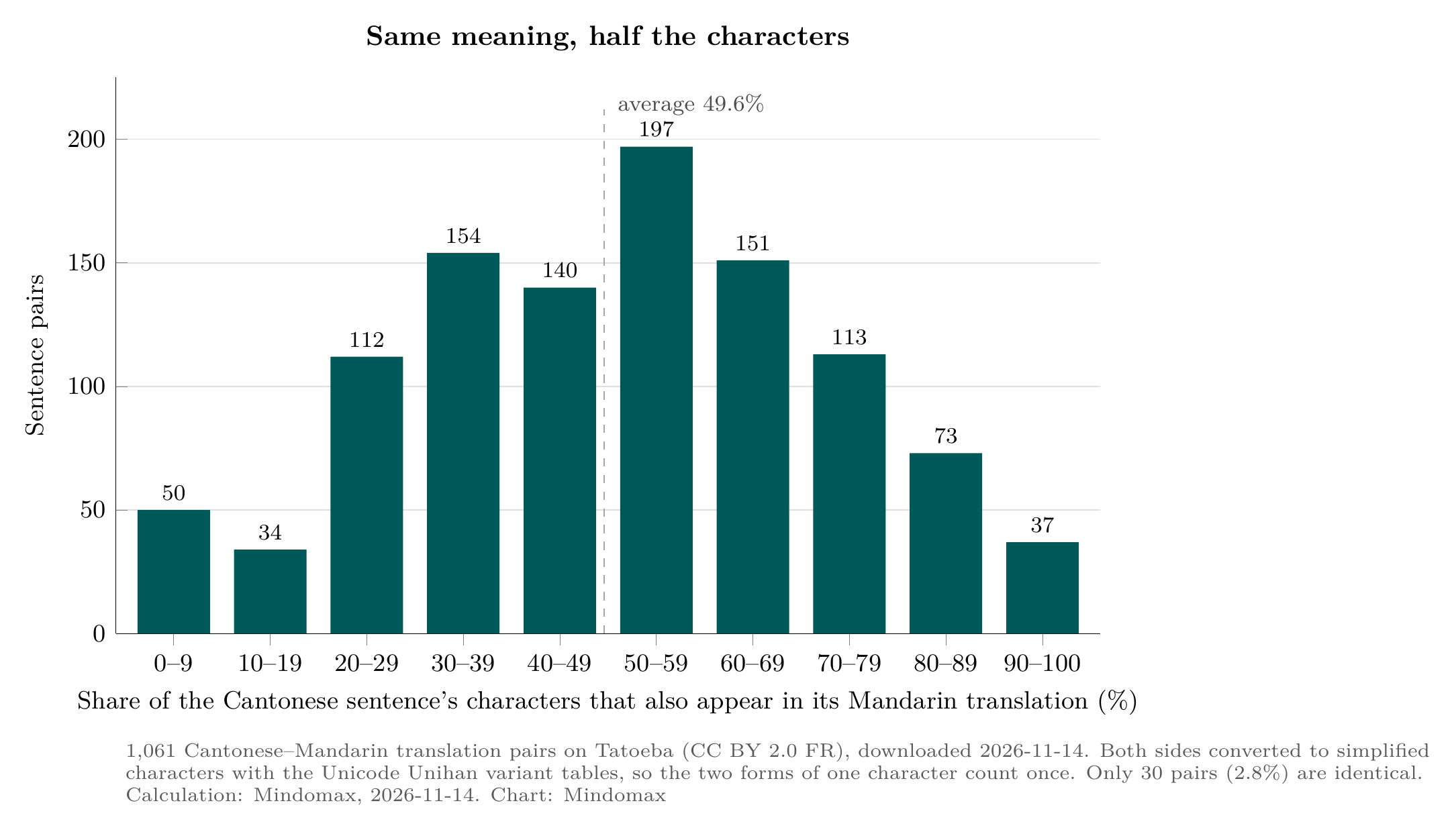
Same meaning, half the characters: on average 49.6% of a Cantonese sentence's characters also appear in its Mandarin translation, and only 30 of 1,061 pairs are identical. Source: Tatoeba (CC BY 2.0 FR), both sides converted to simplified characters. Chart: Mindomax.
In Hong Kong the gap is bridged by school, not by similarity. In the 2021 census 54.2% of residents said they could speak Mandarin (Putonghua), up from 47.8% in 2011, but only 2.3% use it at home, against 88.2% for Cantonese. Expect Mandarin to work at a hotel desk in Hong Kong and Cantonese to be the language all around you.
Cantonese has more sounds, Mandarin has more homophones
Take the 3,000 characters that make up 99.3% of the 7 million characters of Chinese news and Wikipedia text we sampled, and read them aloud. Mandarin needs 388 different syllables for them, or 1,023 if you count tones. Cantonese needs 540, or 1,276 with tones.
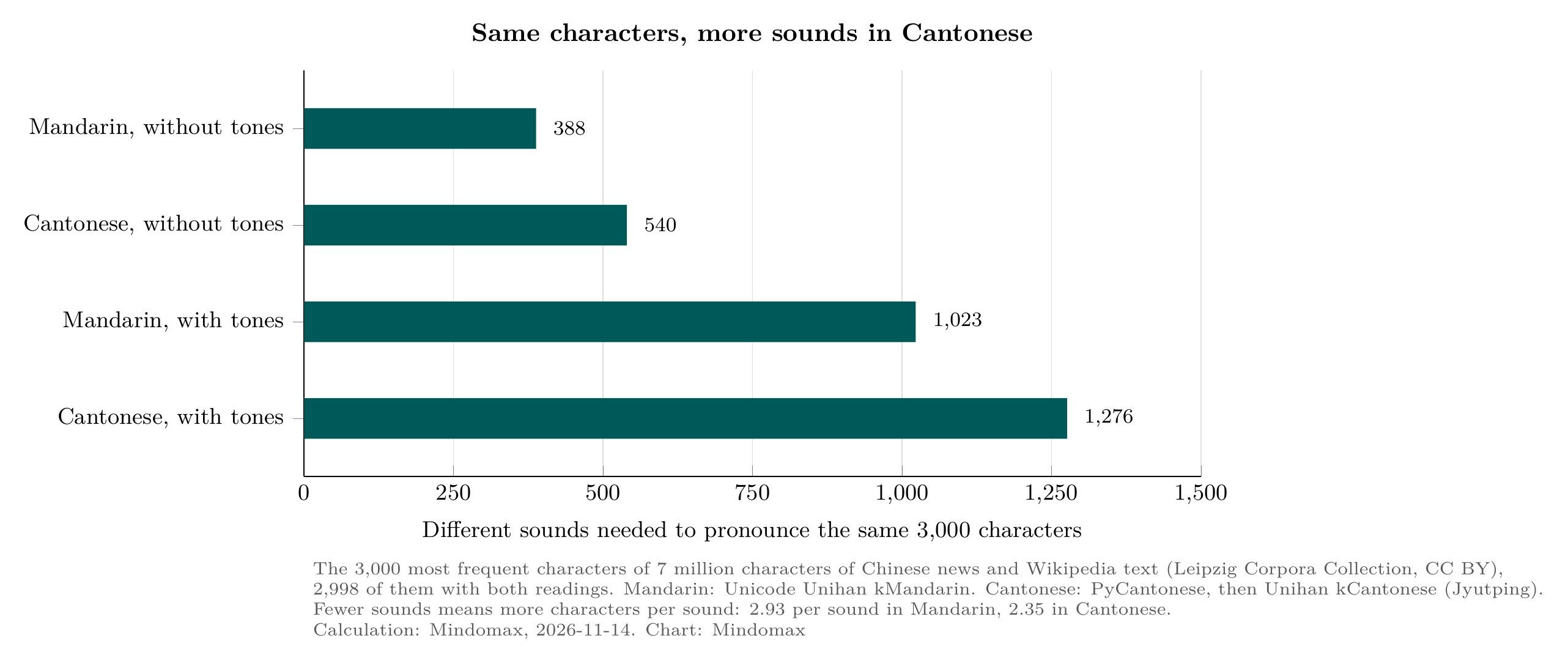
Read the same 3,000 common characters aloud: Mandarin needs 388 syllables (1,023 with tones), Cantonese 540 (1,276 with tones). Character list: Leipzig Corpora Collection (CC BY). Readings: Unicode Unihan and PyCantonese. Chart: Mindomax.
So Mandarin packs more characters into each sound: 2.93 characters per toned syllable, against 2.35 in Cantonese. In Mandarin, yì is the sound of 25 of those 3,000 characters and shì of 20. Cantonese's most crowded sound, jyun4, has 14. Mandarin makes up for it with two-syllable words, so a single syllable on its own often leaves you guessing.
Many of the extra Cantonese sounds come from endings that older Chinese had and Mandarin lost. Cantonese syllables can end in -m, -p, -t and -k; Mandarin syllables end only in a vowel, -n or -ng. Of the common characters, 481 (16%) end in -p, -t or -k in Cantonese:
ten: 十 is shí in Mandarin and sap6 in Cantonese
six: 六 liù and luk6; study: 學 xué and hok6; country: 國 guó and gwok3
three: 三 sān and saam1; heart: 心 xīn and sam1 (the -m ending)
Four tones or six: how often each is used
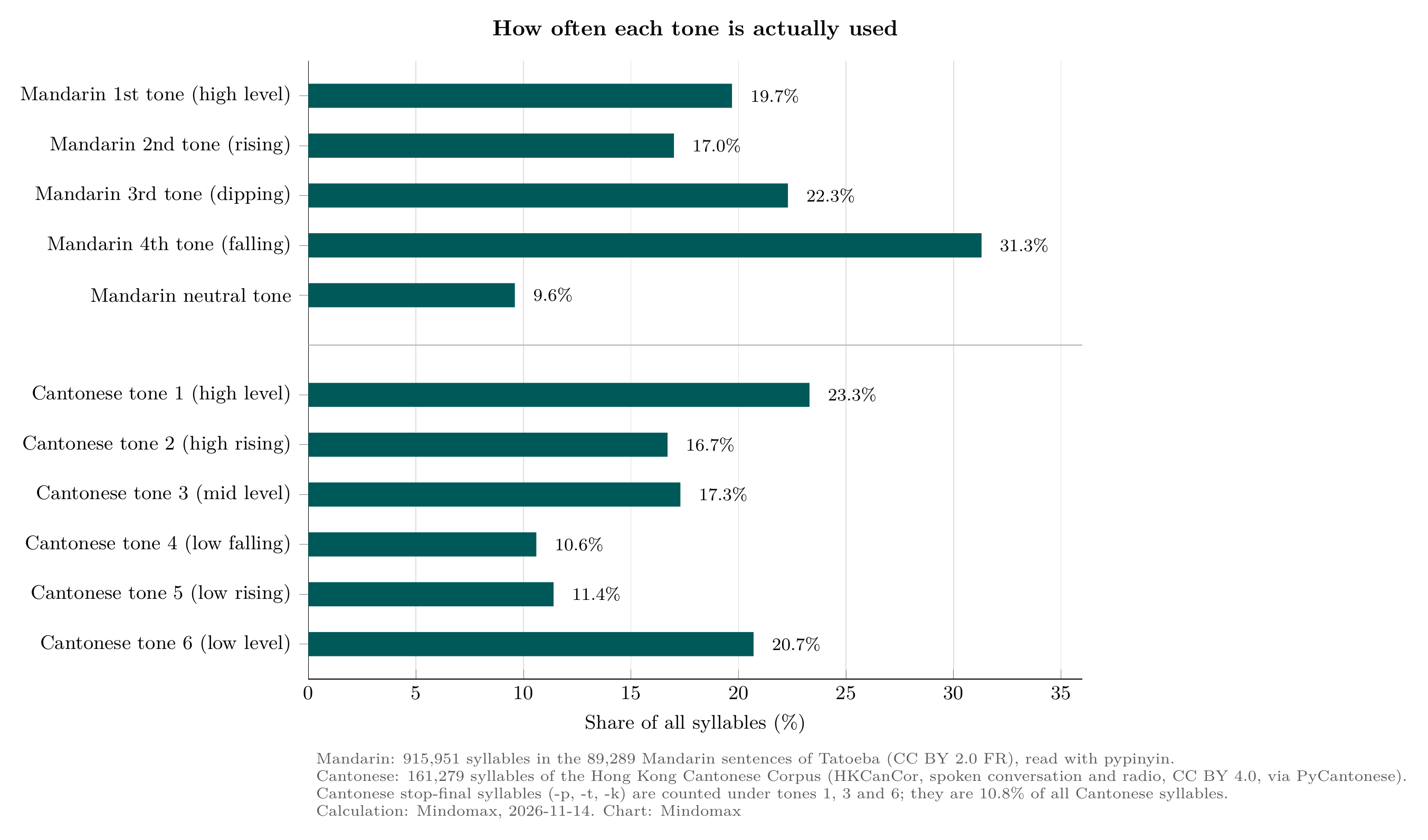
Mandarin leans on its falling fourth tone, which carries 31.3% of all syllables; Cantonese spreads its six tones far more evenly. Mandarin: 915,951 syllables in Tatoeba sentences. Cantonese: 161,279 syllables of Hong Kong speech (HKCanCor). Chart: Mindomax.
Mandarin's falling fourth tone carries almost a third of all syllables: 31.3% in 89,289 Mandarin sentences. The light, toneless syllables such as 的 de, 了 le and 们 men add another 9.6%. Cantonese spreads its six tones far more evenly in recorded Hong Kong speech. The high level tone 1 (23.3%) and the low level tone 6 (20.7%) lead, and the three low tones, 4, 5 and 6, together make up 42.7% of everything said. They all sit in the lower part of the voice and differ mainly in their contour, which is where learners usually need extra listening practice.
And the famous nine tones? The short syllables ending in -p, -t or -k carry tones 1, 3 or 6, and traditional descriptions count them as three extra tones. They are 10.8% of the syllables in the Hong Kong Cantonese Corpus.
Writing: the same characters, different words
Two separate things get mixed up here: the script and the words.
The script is simplified or traditional. Of the 3,000 most common characters, 758 (25.3%) look different in traditional script, such as 学 and 學 (study), 国 and 國 (country), 说 and 說 (say), 来 and 來 (come). In running text that is 18.8% of all characters. Mandarin in Taiwan is written in traditional characters too, so the script tells you the place, not the language.
The words are the bigger gap. Written Cantonese replaces the most common words of Mandarin with its own, often with characters standard Chinese never uses:
Counts come from 20,854 written Cantonese sentences on Tatoeba. In those sentences the Mandarin word almost disappears: 是 shows up 0.06 times per 1,000 characters, against 20.7 for 係.
Together, these Cantonese-only characters make up 154 of every 1,000 characters in written Cantonese and 213 in transcribed Hong Kong speech, but between 0.1 and 0.8 per 1,000 in Mandarin sentences and Chinese news. That is what "the same writing system" means in practice: a Mandarin reader gets through a Hong Kong newspaper but trips over a text message from a Hong Kong friend.
Should you learn Mandarin or Cantonese?
Choose by where you will use it, because difficulty will not decide it for you. The Foreign Service Institute puts both in its hardest group, at 88 weeks (2,200 class hours) for an English speaker; our ranking of the hardest languages to learn shows how the rest compare.
Learn Mandarin if:
You want the most people to talk to: about 990 million native speakers and 1.18 billion in total.
You are heading for mainland China, Taiwan or Singapore, or you need the HSK exam.
You want plenty of study material. Duolingo alone lists 9.3 million learners of Chinese from English, and HelloChinese, the most-rated Chinese-only app on the US App Store, teaches only Mandarin.
Learn Cantonese if:
Your goal is Hong Kong, Macau or Guangdong. In Hong Kong 88.2% speak Cantonese at home and 2.3% Mandarin.
Your family speaks it. In the US the two are almost tied at home: 458,840 Cantonese and 487,250 Mandarin speakers in the latest Census table that lists them separately.
You love Hong Kong films and Cantopop, which are made in Cantonese.
Want both? The usual route is Mandarin first: the characters and formal writing carry over, the sounds do not. Duolingo built its Cantonese course for people who already speak Mandarin, and lists 9.1 million learners for it.
Apps that teach Mandarin, Cantonese or both
Mandarin learners can choose from dozens of apps, Cantonese learners from a handful. Here are 13 we checked on the US App Store, all updated since September 2026. For a wider list, see our guide to the best language learning apps.
Whichever language you pick, you will be memorizing thousands of characters, each with a sound and a tone, and many of them look alike at first. That is the job spaced repetition was made for: short reviews, timed just before you would forget.
How we measured
Characters and readings: the 3,000 most frequent characters in 7.0 million characters of Chinese news and Wikipedia text from the Leipzig Corpora Collection (CC BY); Mandarin readings from the Unicode Unihan database (version 18.0); Cantonese readings from PyCantonese, with Unihan as the fallback. Tones: 89,289 Mandarin sentences on Tatoeba, read with pypinyin, and 161,279 syllables of conversation and radio in the Hong Kong Cantonese Corpus. Writing: 20,854 Cantonese and 89,289 Mandarin sentences on Tatoeba and their 1,061 translation pairs, converted to one script before comparing. The limits: a character with several readings counts once, with its usual reading, and Tatoeba's Cantonese sentences come from a small group of contributors, so we checked them against the Hong Kong corpus and against short sentences only (173 Cantonese-only characters per 1,000), and the picture held.
If you settle on either language and want your word list in your pocket, Mindomax turns it into flashcards with spaced reviews, free.
Frequently Asked Questions
Is Cantonese harder than Mandarin?
For most English speakers, yes, although the official estimate is the same: the Foreign Service Institute gives both 88 weeks. Cantonese has six tones instead of four and 540 basic syllables instead of 388, its everyday written form differs from the standard, and there is far less study material. Mandarin's own hurdle is homophones: 2.93 common characters share each sound, against 2.35 in Cantonese.
Can Cantonese speakers understand Mandarin?
Not without learning it, but in Hong Kong most have: 54.2% of residents said they could speak Mandarin in the 2021 census. In writing it is easier, because formal standard Chinese is shared, so a Cantonese speaker reads Mandarin text without trouble.
Is Cantonese written differently from Mandarin?
Formal Cantonese is written in standard Chinese, usually in traditional characters, so a Mandarin reader can follow it. Informal Cantonese uses its own characters, such as 嘅, 係, 唔 and 佢. In our sample they were 15% of all characters, and a Cantonese sentence shared only about half of its characters with its Mandarin translation.
How do you say hi in Cantonese?
你好 (nei5 hou2): the same characters as Mandarin nǐ hǎo, with a different sound. In the morning people say 早晨 (zou2 san4). "Thank you" depends on the situation: 唔該 (m4 goi1) for a service, 多謝 (do1 ze6) for a gift.
Should I learn simplified or traditional characters?
Match the place: simplified for mainland China and Singapore, traditional for Hong Kong, Macau and Taiwan, and for Cantonese in general. About three in four of the 3,000 most common characters are the same in both scripts, so switching later is less work than it looks.
Is Hong Kong Mandarin or Cantonese?
Cantonese. In the 2021 census 88.2% of residents spoke it at home and 93.7% could speak it. Mandarin was the home language of 2.3%, although 54.2% could speak it.


