
The Armenian alphabet has 39 letters in Armenia today. Mesrop Mashtots created 36 of them around 405 AD, two more (Օ and Ֆ) were added in the Middle Ages, and the Soviet spelling reform of the 1920s made the ligature և a letter of its own. Armenians in the diaspora and in Iran still use the older classical spelling, which counts 38. Either way, the script has been in continuous use for about 1,600 years, and almost every letter stands for one sound.
Every chart you will find lists the letters in alphabet order: Ա Բ Գ Դ and so on. That is the order Mashtots set, and it is the slowest order to learn them in. So we counted 149.8 million letters of real Armenian (news, websites, Wikipedia and everyday sentences) to see which letters actually carry the language. The answer is lopsided: ա alone is nearly one letter in six, and ten letters make up two thirds of everything written. Learn them in the order below and you can read 61% of running words after 24 letters. Learn them from Ա to Ֆ and you can read 21%.
The short answer
Learn the small letters first. Capitals start sentences and names, and in our count they were only 3.7% of all letters, about one in 27.
Start with two one-letter words, է ("is") and և ("and"), then ա ն ր ե ի մ. Those eight letters cover 53% of real text, and է on its own is 5.3% of all running words.
Leave the rare ten for last. զ ռ ջ ձ և ժ փ օ ճ ֆ together are 3.9% of what you will read, and ֆ turns up once in every 673 letters.
Expect the language, not the script, to be the hard part. The US Foreign Service Institute puts Armenian among its "hard languages", at about 44 weeks of full-time class for an English speaker; our guide to the hardest languages to learn shows where that sits. The letters themselves take a couple of weeks, not months.
All 39 letters at a glance
Here is the full alphabet in its official order, with each letter's name, its sound in Eastern Armenian (the standard in Armenia), the Western Armenian sound where it differs, and how much of real text it makes up. "No puff" means the consonant is said without the breath an English p, t or k carries at the start of a word; the letters with an apostrophe (t', p', k', ch', ts') are the breathy ones.
Two things in that table surprise most learners. ու is written with two shapes, ո and ւ, but it is one letter and one sound, "u", and it is the seventh most common letter in the language even though it sits 34th in the alphabet. And the classical spelling counts ւ as a letter (mostly a "v" sound) but not ու or և, which is where the count of 38 comes from.
How often each letter appears
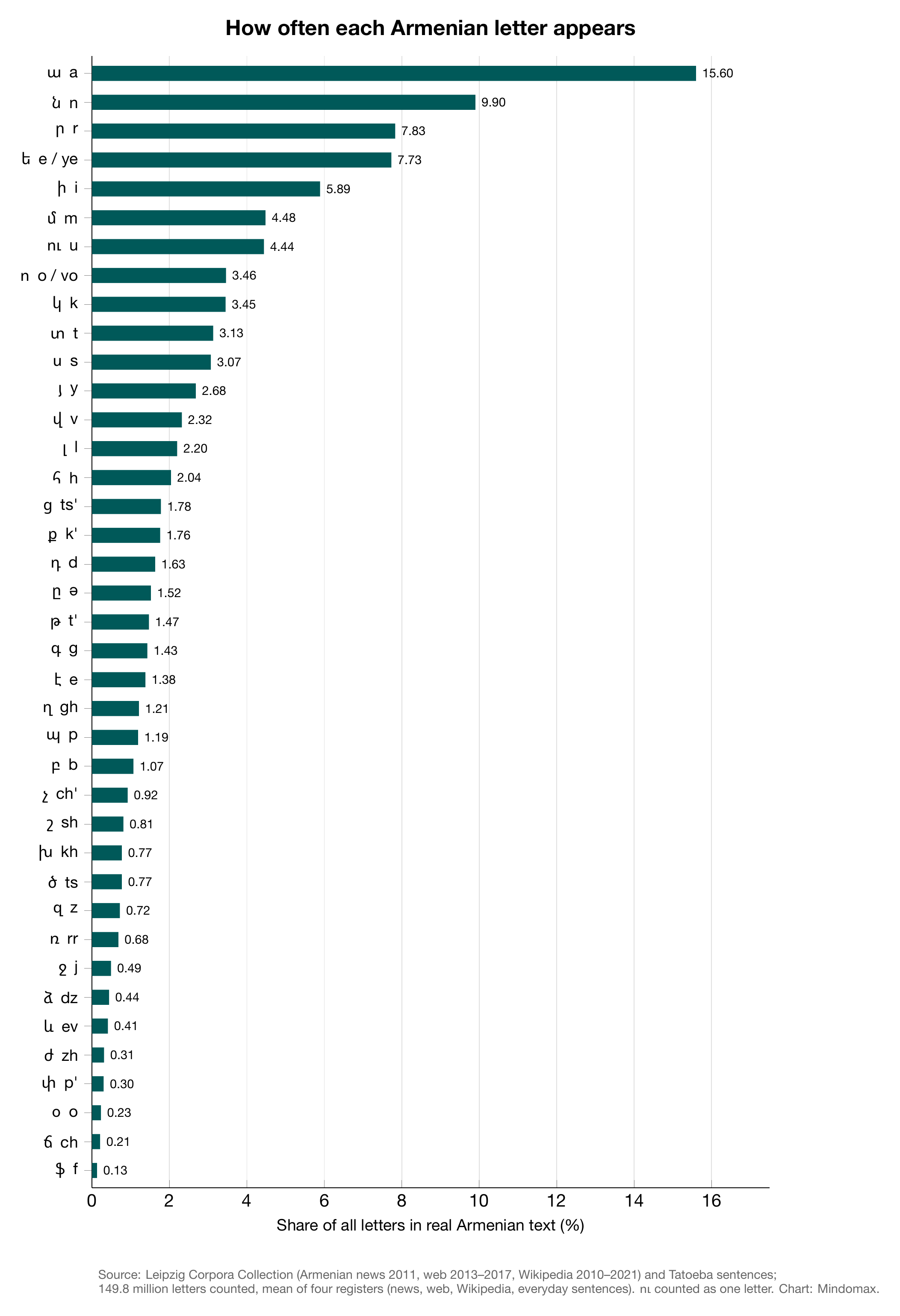
How often each Armenian letter appears: ա alone is nearly one letter in six, and the ten most common letters make up two thirds of real text. Source: Leipzig Corpora Collection and Tatoeba, 149.8 million letters, mean of four kinds of text. Chart by Mindomax.
The chart puts every letter in order of use. The top five, ա ն ր ե ի, are 46.9% of all letters. The top ten reach 65.9%, the top twenty 86.4%. Below that the curve goes flat: the last ten letters add less than 4% between them.
The order is also stable. In news, on websites and in Wikipedia the ten most common letters were the same ten in the same order, and the everyday sentences shared nine of them. Whatever you end up reading, these are the letters you will meet.
What breaks the alphabet order is where the busy letters sit. ն, the second most common letter, is 22nd in the alphabet. ր, the third, is 32nd. ու, the seventh, is 34th. The first eight letters of the alphabet, ա բ գ դ ե զ է ը, cover only 31% of real text; the eight most frequent letters cover 59%.
Why alphabet order is the slow way
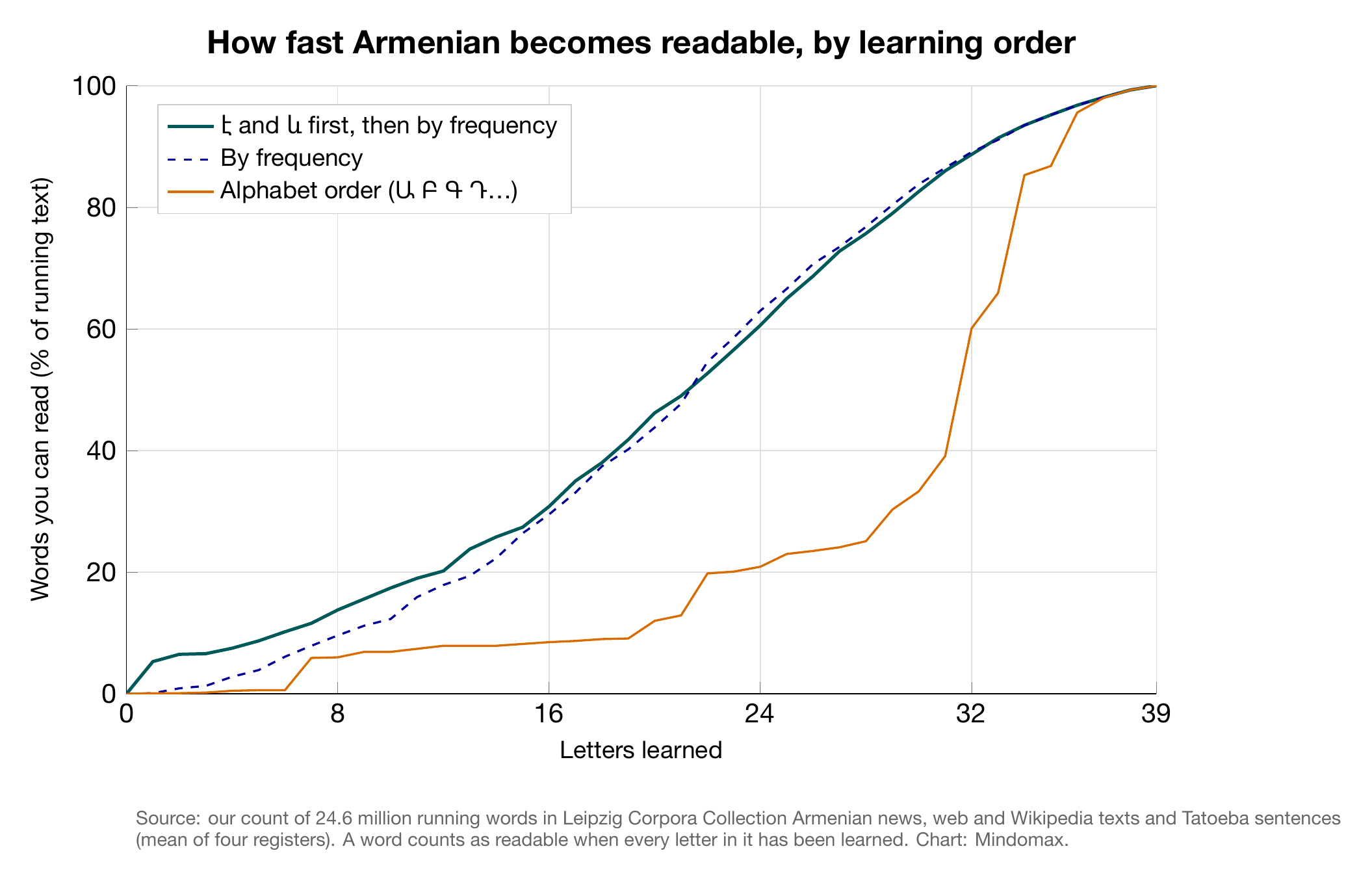
Words you can read after each letter you learn, for three learning orders. After 16 letters: alphabet order 8.5%, frequency order 29.5%, է and և first 30.8%. Source: our count of 24.6 million running words. Chart by Mindomax.
Letters are only useful once they add up to words you can read, so we tested three learning orders on 24.6 million running words. A word counts as readable once every letter in it has been learned.
In alphabet order you can read 6.0% of running words after eight letters and still only 8.5% after sixteen, because ն and ր, which sit in a huge share of Armenian words, arrive late. The line only jumps once ր comes in at letter 32. In frequency order you read 9.6% after eight letters, 29.5% after sixteen and 63.0% after twenty-four.
Our plan changes one thing: it starts with է and և. Both are rare as letters inside words, so frequency order puts է at number 22, but each one is a word on its own. է means "is" and is 5.3% of everything written; և means "and". With those two first you can already read 6.5% of running text after two letters, 13.8% after eight and 30.8% after sixteen. From letter 22 on, plain frequency order is a hair ahead (63% against 61% at letter 24), and both finish together.
A five-batch plan for the 39 letters
Take the letters in five batches of eight. Learn a batch until you can sound out every letter in it without stopping, then add the next one. At one batch every two or three days, that is about two weeks for the whole alphabet.
(The last 0.2% of letters is a stray ւ from old spellings, outside ու.)
After batch 1 you can read է (e) "is", և (ev) "and", են (en) "are", եմ (em) "am", նա (na) "he, she", էր (er) "was", մի (mi) "a, one", իմ (im) "my", մեր (mer) "our", նաև (nayev) "also", ամեն (amen) "every" and the name of the capital city, Երևան (Yerevan).
Batch 2 adds ես (yes) "I", որ (vor) "that, which", ու (u) "and", այս (ays) "this", այն (ayn) "that", մասին (masin) "about", վրա (vra) "on", կամ (kam) "or", նոր (nor) "new", լավ (lav) "good", մեկ (mek) "one", երկու (yerku) "two" and տարի (tari) "year".
Batch 3 adds հետ (het) "with", համար (hamar) "for", դու (du) "you", մենք (menk') "we", դուք (duk') "you all", որտեղ (vortegh) "where", եթե (yet'e) "if", հիմա (hima) "now", այստեղ (aystegh) "here", մարդ (mard) "person" and Հայաստան (Hayastan) "Armenia". By the end of batch 3 you can sound out six words in ten.
Batches 4 and 5 are mostly letters you will meet in a handful of words each, so give them less time. Before you add a new batch, run through the old ones first; reviewing letters you have nearly forgotten is what makes them stick, as the spacing effect shows. Say the sound before you check the answer, too: recalling it does more than reading it again, which is the testing effect. We used the same counting method for the Thai alphabet, where frequency order wins by an even wider margin.
The letters that trip learners up
Two letters for one e. ե and է both say "e". The difference is where they go: in our count, 70% of every է in real text was the one-letter word է, "is", and another 22% started a word. ե is the e you meet everywhere else, and at the start of a word it says "ye", as in Երևան. The exception is the verb "to be": եմ, ես, ենք, եք, են are said em, es, enk', ek', en. Watch ես: as a pronoun it means "I" and is said "yes"; as a verb it means "you are" and is said "es".
The o that says vo. ո is "o" inside a word but "vo" at the start of one, so որ is "vor". That happens a lot: 18.7% of all ո in our count started a word. The main exception is ով, "ov", which means "who". The other o, օ, is rare (one letter in 450) and usually opens a word (73% of the time).
The schwa you do not see. ը is the "uh" sound, and 86% of the time it sits at the end of a word, where it is usually the article "the": տուն (tun) is "a house", տունը (tunə) is "the house". Between consonants the same sound is usually said but not written, so գրել, "to write", sounds like "gərel".
Two r's. ր is a quick tap and ռ a rolled r. ր is more than eleven times as common, so learn it first and let ռ come in batch 4.
Breathy and plain pairs. English speakers hear t, p, k, ch and ts as one sound each; Armenian splits each into a plain and a breathy letter. In frequency order the plain ones mostly come first: տ (3.1%) before թ (1.5%), կ (3.5%) before ք (1.8%), պ (1.2%) before փ (0.3%). Two pairs run the other way: ց (1.8%) is more common than ծ (0.8%), and չ (0.9%) is more common than ճ (0.2%), because չ is the "not" in negative verbs, as in չի, "is not".
և has no capital. At the start of a sentence it is written as two letters, Եվ. In our count 46% of all և were the word "and"; the rest sit inside words such as Երևան or at the end of նաև.
38 or 39 letters? Eastern and Western Armenian
The Soviet spelling reform of 1922 to 1924, revised in 1940, changed how Armenian is spelled in Armenia. The reformed spelling counts և and ու as letters, with ու in the place of ւ, and writes many words closer to how they sound. It is the official spelling in Armenia and is widely used by Armenian communities in Georgia and Russia. The diaspora, most of which speaks Western Armenian, rejected it, and so did the Armenians of Iran, who speak Eastern Armenian but still write the classical spelling. That is the whole 38-or-39 argument: both counts are right, for different spellings.
The letters are the same, but Western Armenian reads ten of them differently (and says յ as "h" at the start of a word). Five pairs swap: բ and պ, գ and կ, դ and տ, ծ and ձ, ճ and ջ. In the West, բ is said p' and պ is said b, and so on through the pairs, as the Western column in the table shows. That is why the same names turn up in two forms: Տիգրան is Tigran in Yerevan and Dikran in Beirut or Los Angeles, Գևորգ is Gevorg or Kevork, Պետրոս is Petros or Bedros.
If your family speaks Western Armenian, learn the shapes the same way and swap the ten sounds. Our counts come from Eastern Armenian text in the reformed spelling, so the order fits Eastern best, but the busiest letters (ա ն ր ե ի) are busy in both.
Apps that teach the Armenian script
Duolingo has no Armenian course for English speakers; its course list, read on 2026-11-11, has 40 courses from English and Armenian is not among them. Mondly, Drops, Memrise, Babbel and Busuu don't list Armenian in their App Store descriptions either. These do, and all nine passed our check that the app is live and updated within the last year. Prices are from the US App Store.
If you want one app for the letters themselves, start with Tarer. If you want the letters to stay learned, put each batch on flashcards with the sound on the back; our guide to making flashcards that work covers the layout.
How we counted
The letters come from the Leipzig Corpora Collection at Leipzig University: Armenian news from 2011 (100,000 sentences), websites from Armenia from 2013, 2015 and 2017 (300,000 sentences each) and Armenian Wikipedia from 2010, 2016 and 2021, plus 52,056 everyday sentences from Tatoeba and 4,092 lines of film subtitles. We removed duplicate sentences and the stock names Tatoeba uses in its examples, counted ու as one letter the way schools in Armenia teach it, and took the mean of four kinds of text (news, web, Wikipedia, everyday sentences) so the large web set would not outvote the rest. That is 149.8 million letters and 24.6 million running words.
For the reading curves, a word counts as readable once all its letters have been learned, across 1.06 million different word forms. Letter names, sounds and the history come from Wikipedia's Armenian alphabet and Armenian orthography reform articles; the language-difficulty figure from the Foreign Service Institute of the US State Department. App prices were read on the US App Store on 2026-11-11.
If you want the five batches above as cards that come back on the right day, paste them into Mindomax, which is free right now.
Frequently Asked Questions
How many letters are in the Armenian alphabet?
39 in the reformed spelling used in Armenia: the 36 letters Mesrop Mashtots created, Օ and Ֆ added in the Middle Ages, and և counted as a letter since the 1920s reform. The classical spelling, used in the diaspora and in Iran, counts 38.
Who created the Armenian alphabet?
Mesrop Mashtots, a linguist and church leader, created it around 405 AD so that the Bible and the church service could be written in Armenian.
What is the most common letter in Armenian?
ա (a). In our count of 149.8 million letters it made up 15.6% of all letters, ahead of ն (9.9%) and ր (7.8%).
Is the Armenian alphabet hard to learn?
The letters are the easy part: almost every one stands for a single sound, and the ten most common cover two thirds of any text. The language is harder; the US Foreign Service Institute puts Armenian among its "hard languages", at about 44 weeks of full-time class.
Do Eastern and Western Armenian use the same alphabet?
Yes. Western Armenian uses the same letters in the classical spelling and says ten of them differently: բ and պ, գ and կ, դ and տ, ծ and ձ, ճ and ջ swap sounds, which is why Tigran becomes Dikran.
Should I learn capital or small letters first?
Small letters. Capitals start sentences and names, and they were only 3.7% of all letters in our count.
Does Duolingo teach Armenian?
Not from English. Its course list, read on 2026-11-11, has 40 courses for English speakers and Armenian is not one of them.


