
The short answer
For a native English speaker, the hardest languages to learn are Arabic, Mandarin Chinese, Cantonese, Japanese and Korean. The US State Department's Foreign Service Institute (FSI), which trains American diplomats, gives each of them 88 weeks of full-time study to reach professional working level. Italian, Dutch and Swedish take 24 weeks. The hardest languages take almost four times as long as the easiest.
A second government school agrees. The Defense Language Institute, the US military's language school, puts the four of those languages it teaches (Arabic, Mandarin, Japanese and Korean) in its longest course: 64 weeks.
Most pages on this question still copy an older version of the FSI list. This one uses the list as the State Department shows it today (last updated January 21, 2026), shows what changed, holds it next to the military's numbers, and then checks why these five are hard, using an open database of grammar features for more than 2,600 languages.
All 59 languages, ranked by study time
The FSI sorts the languages it teaches into four groups by how long its students usually need to reach level 3 on the government's ILR scale in speaking and listening. Level 3 is professional working proficiency: you can run a meeting, follow the news and argue a point. A typical FSI week is 23 hours of class plus 17 hours of study on your own. The first group runs from 24 to 30 weeks, so it takes two rows in the table.
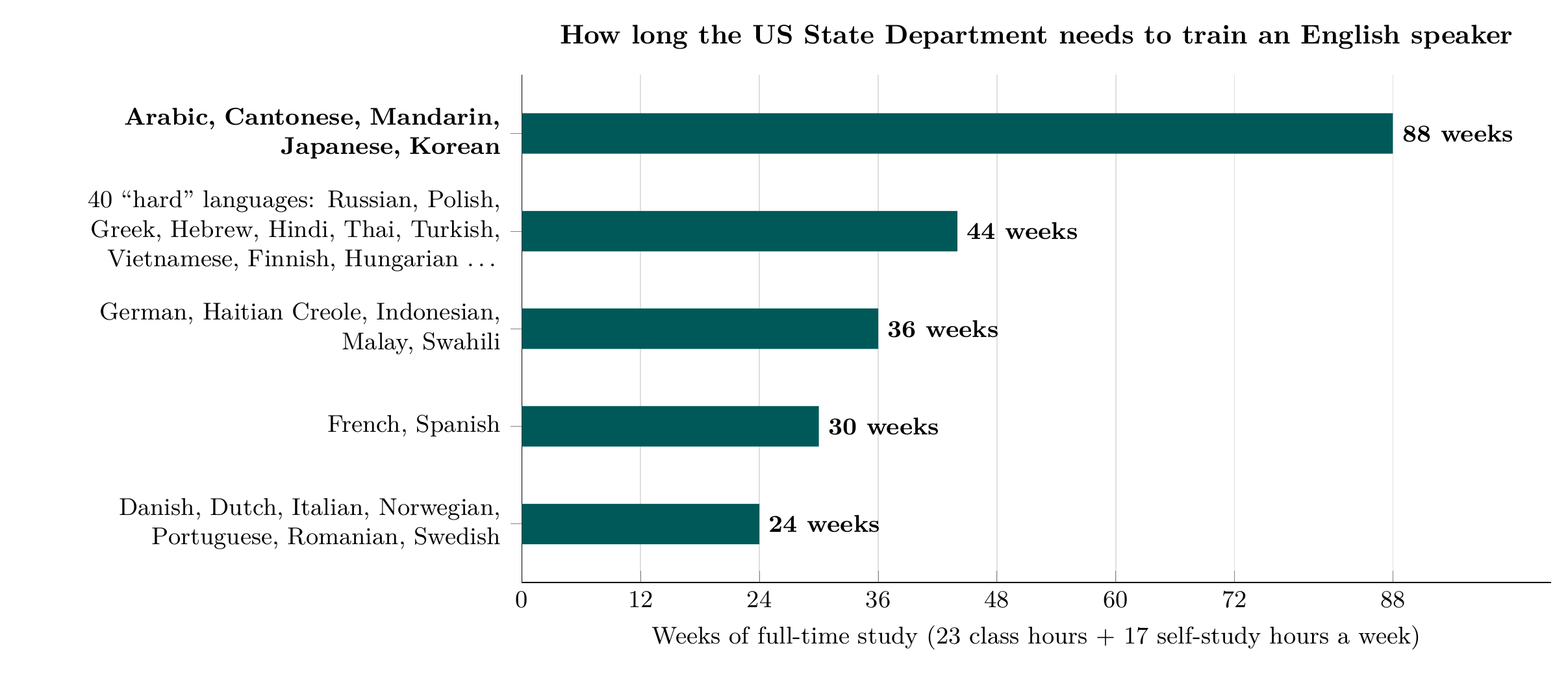
Weeks of full-time study an English speaker needs to reach professional working level (ILR 3 in speaking and listening). Data: U.S. Department of State, Foreign Service Institute, "Foreign Language Training" (page updated 2026-01-21, read 2026-10-23). Chart by Mindomax.
The FSI calls the 44-week group "hard languages" and the 88-week group "super-hard languages", the ones "exceptionally difficult for native English speakers". It does not rank languages inside a group, so Russian and Vietnamese are tied, and so are Japanese and Korean. It also says its hard list "is not exhaustive": a language missing from it is not automatically easy. Because the FSI ties the five super-hard languages, they appear below in alphabetical order.
What changed on the FSI list
The FSI page has changed in three ways since 2023, and none of the top-ranking pages we read has caught up. We compared the live page with the copies the Internet Archive saved between 2021 and 2025 (here is the October 2023 version, with Spanish still at 24 weeks).
Spanish moved from 24 to 30 weeks. It was listed at 24 weeks until at least October 2023; by May 2024 it was listed at 30, the same as French. The FSI does not say why.
The hours were recalculated. Until late 2024 the page gave 600-750 class hours for the first group, 900 for the second and 1,100 for the third, which assumes a 25-hour class week. Since early 2025 it gives 552-690, 828 and 1,012 hours, a 23-hour week. The super-hard group still reads 2,200 hours, which is 88 × 25. At 23 hours a week it would be 2,024.
Seven languages are no longer named in the hard group: Icelandic, Sinhala, Somali, Tagalog, Tamil, Telugu and Tibetan. Icelandic still appears on many "hardest languages" lists, including three of the six top-ranking pages we read. The FSI no longer lists it at all.
Two claims you will meet elsewhere are simply wrong. One page that ranks for this question opens with "UNESCO has ranked languages according to how difficult they are"; we could not find any such ranking, and the page names no source. Another sorts languages into a "Category V". The FSI has used four groups in every version of the page we checked, back to 2021.
1. Arabic: 88 weeks
Arabic is written from right to left in 28 letters, most of which join up and change shape depending on where they sit in a word. The script is an abjad: it writes the consonants and usually leaves the short vowels out, so you often have to know a word before you can pronounce it.
The bigger problem is that there are two Arabics. Modern Standard Arabic is used for writing, the news and speeches. At home and on the street people speak local varieties, and those differ from country to country. A learner who wants to read and to talk usually needs both. The Defense Language Institute teaches Modern Standard Arabic in its 64-week course.
2. Cantonese: 88 weeks
Cantonese is traditionally said to have nine tones: six on most syllables and three more on syllables that end in p, t or k. The same syllable said with a different pitch is a different word. It is written with traditional Chinese characters, and Hong Kong's official list of commonly used characters has 4,762 of them.
Cantonese is the one language in the top group that the Defense Language Institute does not teach, so of the two schools only the FSI gives a figure for it.
3. Japanese: 88 weeks
Japanese uses three writing systems at once: 46 basic hiragana, 46 katakana and the kanji. The official list of kanji for everyday use, issued in 2010, has 2,136 characters; Japanese children learn 1,026 of them in primary school and the rest in secondary school. Most kanji have more than one reading, and which one is right depends on the word.
The grammar runs the other way from English. The verb comes last, a small particle after each noun marks its role in the sentence (the World Atlas of Language Structures counts eight or nine), and personal pronouns are often avoided to stay polite, so the verb form and the words you choose depend on who you are talking to. Japanese also has a pitch accent, a rise and fall inside words that can tell two words apart.
If you take it on, start with the kana and add kanji early; our comparison of the best flashcard apps for Japanese covers the drilling side.
4. Korean: 88 weeks
Korean has the easiest script of the five. Hangul has 24 basic letters, 14 consonants and 10 vowels, and it is the part of Korean most learners finish first.
Korean is in the top group anyway. Like Japanese, it puts the verb last and marks each noun with a particle (six or seven case markers in WALS). Verbs also change with the listener: Korean has seven speech levels, each with its own set of verb endings, from formal speeches to talk between close friends (a few are fading from everyday speech). Korean is the clearest proof that an easy alphabet does not make an easy language.
5. Mandarin Chinese: 88 weeks
Mandarin grammar is the friendliest of the five: no cases, no grammatical gender, no grammatical past tense, and the same subject-verb-object order as English. The hard parts are elsewhere. Every syllable carries one of four tones, or a light neutral tone, and the tone changes the meaning. Reading needs characters: China's official list from 2013 has 8,105, and 3,500 of them are marked as frequently used. Each one has to be learned separately, with its sound, its meaning and the way it is written.
Why these five? What the data says
Every ranking page gives the same reasons: the alphabet, tones, grammar. We checked them against the World Atlas of Language Structures (WALS), an open database of grammar features for more than 2,600 languages, and against the official character lists.
"Word order" is the basic order of subject, verb and object. "Not coded" means WALS has no value for that language; for Arabic, WALS codes word order for Modern Standard Arabic (verb first) but not its cases. Four things stand out.
Grammar alone does not put a language at the top. Finnish and Hungarian have ten or more cases, the most in the table, and sit at 44 weeks. Mandarin has none and sits at 88.
Tones alone do not either. Norwegian has a pitch accent and is one of the fastest languages to learn. Vietnamese and Thai have full tone systems and sit at 44 weeks. Tones become a top-group problem when they come together with thousands of characters, as in Mandarin and Cantonese.
The writing system is the clearest dividing line. Three of the five super-hard languages need thousands of characters, and Arabic leaves its short vowels unwritten. No language that takes 36 weeks or less uses anything but the Latin alphabet.
Distance from English matters more than complexity. Swahili sorts its nouns into five or more classes, a gender system far bigger than German's, and takes 36 weeks. Korean has a 24-letter alphabet and takes 88. What the five share is that very little carries over from English: for Mandarin and Cantonese it is the characters and the tones, for Japanese and Korean the verb-last grammar and the politeness system (plus the kanji, for Japanese), for Arabic the script and the split between the written and the spoken language.
The easiest languages for English speakers
At the other end are the languages the FSI calls "close to English": Danish, Dutch, Italian, Norwegian, Portuguese, Romanian and Swedish at 24 weeks, and French and Spanish at 30. Much of their vocabulary is related to English through Latin, French or the Germanic family. Spanish, French, Italian and Dutch put no case endings on nouns at all, all of them use the Latin alphabet, and most follow the same subject-verb-object order as English.
German is the odd one out among its Germanic neighbors: with four cases and three genders, it takes 36 weeks. And Spanish's move to 30 weeks does not make it a hard language. It is still in the fastest group. If you start there, our list of the most common Spanish words gives you the first 100, ranked by how often people actually use them.
How long it will take you
FSI students study full time. Turning their weeks into your hours shows what each group really asks of you. We counted the FSI's full week, 23 hours in class and 17 on your own, and divided by the time you can give it each day.
Read this as a scale, not a promise. FSI students are adults studying full time, taught by native or near-native speakers. A self-learner usually covers less ground per hour; a Spanish speaker learning Italian starts far ahead. And the FSI only measures native English speakers, so the table says nothing about anyone else.
Professional level is also not where most learners stop. You can hold everyday conversations long before level 3; the table is the whole road, not the first useful part of it.
A second opinion: the Defense Language Institute
The FSI is not the only government school with numbers. The Defense Language Institute Foreign Language Center in Monterey, California, trains mostly US service members in almost ten languages, seven hours a day and five days a week, plus two to three hours of homework a night. Its courses last 36 weeks for French, Spanish and Indonesian, 48 weeks for Persian Farsi and Russian, and 64 weeks for Modern Standard Arabic, Mandarin, Japanese and Korean.
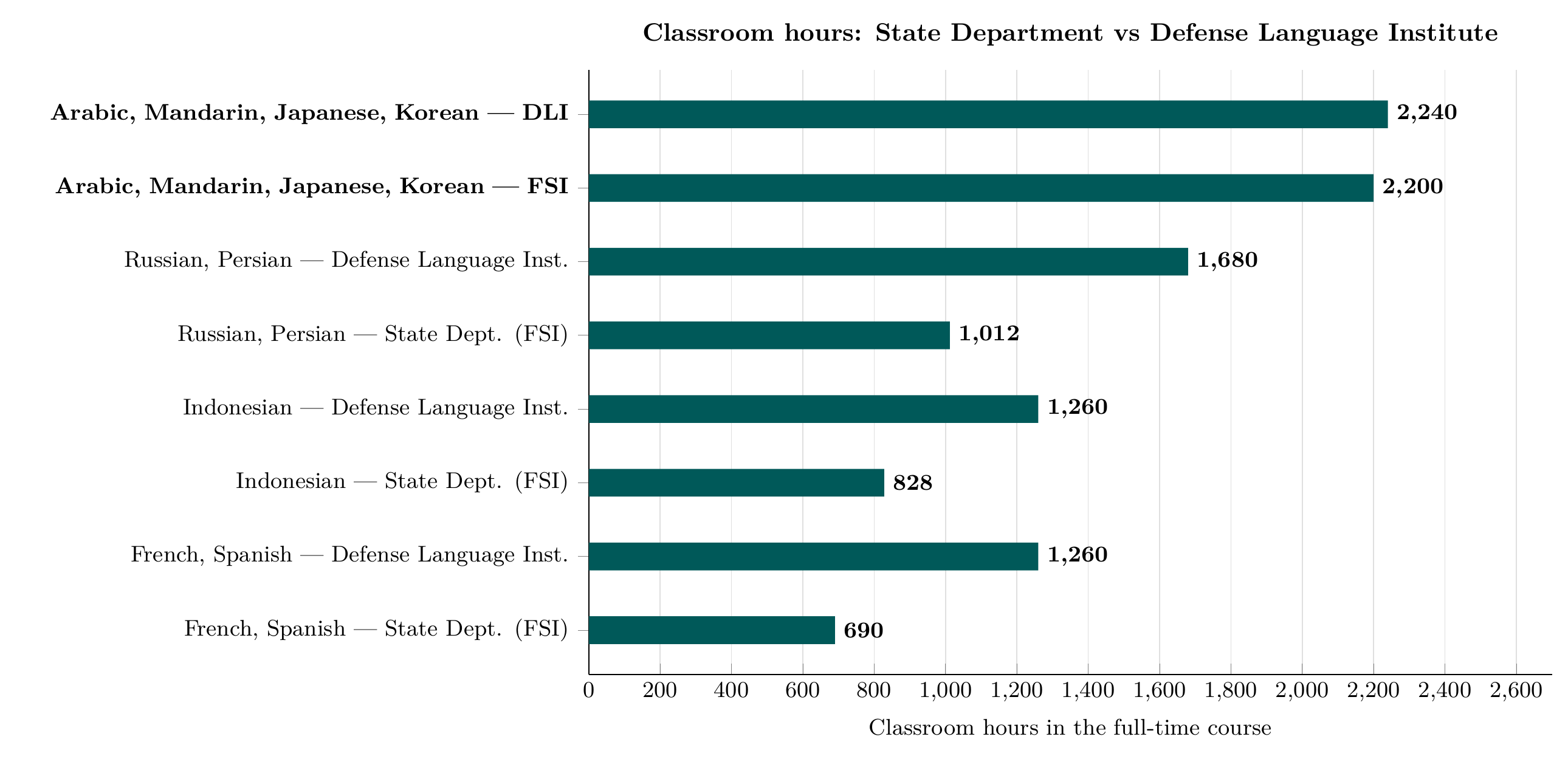
The two schools disagree on the easier languages and agree on the hardest ones. FSI hours as published; DLI hours are course weeks × 35 (seven class hours a day, five days a week, as the DLI states). Data: U.S. Department of State (page updated 2026-01-21) and Defense Language Institute Foreign Language Center, both read 2026-10-23. Chart by Mindomax.
In classroom hours, the two schools disagree about the easier languages: the military's French and Spanish course has about 1,260 hours of class, almost twice the FSI's 690. On the hardest four they almost exactly agree: about 2,240 hours at the DLI, 2,200 at the FSI. The schools train for different tests (the DLI writes its own, the Defense Language Proficiency Test), so the match is not exact science. But two schools with different students and different goals put the same four languages at the top, at almost the same cost in hours. That is as close to a measured answer as this question gets.
Where the hours go, and how to cut them
Most of the extra time in the hard languages goes into memory: thousands of characters, words with no English relatives, verb endings for every level of politeness. That is the part you can train on your own between lessons, and one of the methods with the strongest evidence is spaced repetition: short self-tests spread over growing intervals instead of long sessions of rereading (we explain the research behind it in the spacing effect). It does not replace a teacher or conversation practice. It makes sure the hours you put in are not lost to forgetting.
These are tools learners of the hardest languages use for that part. Prices are from the US App Store listings and the makers' own sites.
How to combine them: one course or teacher for the structure, one drill tool for characters or vocabulary, and real listening every day. For a broader comparison of courses, see our guide to the best language learning apps, and if you choose Anki, how to set up Anki for language learning.
Whatever language you pick, the hard part is remembering what you met last week. If you would rather not type thousands of cards yourself, Mindomax turns your own lesson notes into spaced-repetition flashcards, and it is free to try.
Frequently Asked Questions
What is the hardest language to learn for English speakers?
Arabic, Mandarin, Cantonese, Japanese and Korean. The US Foreign Service Institute puts all five at 88 weeks of full-time study to professional working level, twice the 44 weeks of Russian or Polish and almost four times the 24 weeks of Italian or Dutch.
What is the hardest language in the world?
There is no single answer, because difficulty depends on the languages you already speak. The best-known figures, from the FSI and the Defense Language Institute, only measure native English speakers. For them, the five above are the hardest.
Is Japanese harder than Chinese?
Both government schools give them the same time: 88 weeks at the FSI, 64 at the Defense Language Institute. They are hard in different ways. Mandarin has tones and 3,500 common characters; Japanese has three scripts, 2,136 everyday kanji with several readings each, verb-last grammar and politeness levels.
Is Korean harder than Japanese?
The FSI and the DLI rate them the same. Korean is easier to start reading, with 24 letters instead of two kana sets and 2,136 kanji, but its grammar and seven speech levels are as demanding as Japanese.
What is the easiest language to learn for English speakers?
Danish, Dutch, Italian, Norwegian, Portuguese, Romanian and Swedish, at 24 weeks each on the FSI list. French and Spanish follow at 30 weeks.
How many hours does it take to learn Spanish?
The FSI now gives Spanish 30 weeks: 690 class hours plus about 510 hours of self-study, around 1,200 hours in total to professional working level. At one hour a day that is a little over three years.
Is German hard to learn?
It is in the middle. With four cases and three genders, German takes 36 weeks at the FSI, more than French or Spanish but far less than Russian (44) or Japanese (88).
Is there a UNESCO ranking of language difficulty?
Not that we could find. The ranking usually quoted comes from the US Foreign Service Institute, and some pages repeat it under UNESCO's name without a source.


