
The short answer
The 10 most common French words are le (the), être (to be), je (I), de (of, from), avoir (to have), ce (it, this), que (that), un (a), pas and ne (the two halves of "not"). Together they make up 30.4% of everything said in French films and TV shows. Le alone, counted with la, l' and les, is 5.3%.
The 100 words in the table below cover 66.0% of all the words you hear: two out of every three. The first 1,000 cover 85.2%.
That 85% is the figure most word lists quote, and for French it holds, but only if you count words the way a dictionary does: est, suis, était and été all count as être. Count every spelling as a separate word and 1,000 words cover 79.4%.
We counted the ranking ourselves from 321 million words of French subtitles and grouped every form under its dictionary word with Lexique, an open French word database built by researchers. How we did it, and where the method falls short, is at the end.
The 100 most common French words
"Per million words" is how often the word appears in every million words of subtitles, all its forms together. "Running total" is how much of everything said you cover once you know every word up to that row. Where a word has several forms, the table shows the ones you will meet most.
Only three nouns make the top 100: chose (thing) at 64, monsieur (sir) at 81 and temps (time) at 96. Everything else is the frame of a sentence: who, what, not, and the verbs that carry it. Merci is the only greeting or thank-you word in the list, at 79. Bonjour is number 184.
How much French do these words cover?
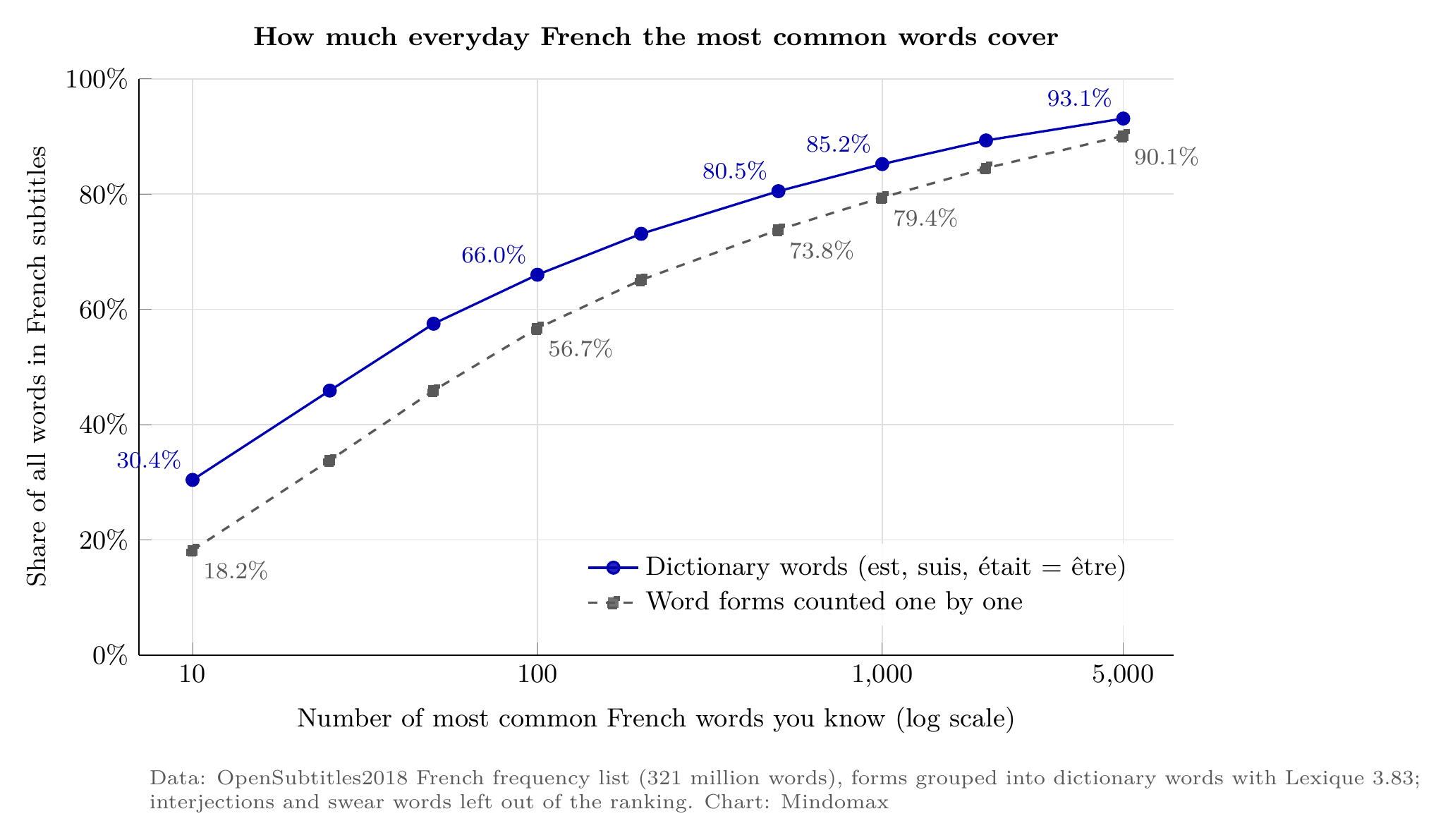
The 100 most common French words cover two thirds of everything said on screen; 1,000 cover 85%, but only if est, suis and était count as one word (être). Data: OpenSubtitles2018 French frequency list (FrequencyWords project, CC BY-SA 4.0), 321 million words; forms grouped into dictionary words with Lexique 3.83 (CC BY-SA 4.0) and counted by Mindomax on 2026-10-22. Chart by Mindomax.
The curve rises fast and then flattens. The first 10 words cover 30.4% of what people say on screen, the first 100 cover 66.0% and the first 500 cover 80.5%. After that, each extra thousand words adds less than the one before: 1,000 words reach 85.2%, 2,000 reach 89.3% and 5,000 reach 93.1%.
The dashed line shows why lists disagree about these numbers. A list that counts each spelling separately (est, suis, était, sont) needs more entries to cover the same French, because one verb like être appears in dozens of forms. Ten such forms cover only 18.2%, and 1,000 cover 79.4%. Both counts are useful. Dictionary words are what you learn; forms are what you hear, and each one has to be recognised by ear.
Coverage is not the same as understanding. Researchers usually put comfortable reading at about 98% of the words in a text (Hu and Nation, 2000), and listening research suggests something close to 95%. The top 100 words carry the grammar of almost every sentence, but most of the meaning sits in the last third: the nouns, names and verbs that tell you what the conversation is about.
What the top 100 is made of
Sorted by type, the 100 words fall into a few clear groups:
• 49 small words (articles, pronouns, prepositions, conjunctions, possessives like mon and ton, and the number deux) make up 43.0% of all the words in French conversation.
• 25 verbs make up 14.8%. Être and avoir alone are 7.6% of everything said and a third of all verb use. The 10 most common verbs (être, avoir, aller, faire, pouvoir, dire, vouloir, savoir, devoir, voir) make up 55.8% of all verb use.
• 18 adverbs, including oui, non and the two halves of "not", make up 7.0%.
• 4 adjectives (bon, juste, autre, petit), 3 nouns (chose, monsieur, temps) and merci are about 1% together.
So learning the top 100 teaches you how French sentences are built. It does not teach you what they are about. That is why a learner who knows these words recognises two words out of three in a film and still loses the plot: the missing third is where the content lives.
The 20 most common French nouns
Nouns carry most of the meaning, and each one comes with a gender you need to learn at the same time: le or la, un or une. These are the 20 most common nouns in the same count, with their place in the full ranking:
Eight of the 20 are feminine, nine are masculine, ami and enfant can be either (un ami, une amie; un enfant, une enfant), and gens is always plural. Two of them rank high because of set phrases: tout le monde (everyone) keeps monde in the top 130, and une fois (once) is how French says "one time". Dieu is mostly "mon Dieu" (my God).
Two more words are nouns in the dictionary but work like adverbs in speech: peu, as in "un peu" (a little), would be the fourth noun at 98, and accord is almost always "d'accord" (OK), number 111.
Speech or books? The words that change
Lexique counts every word twice: in 50 million words of film and TV subtitles and in 14.7 million words of novels. That makes it possible to see which common words belong to conversation and which belong to stories.
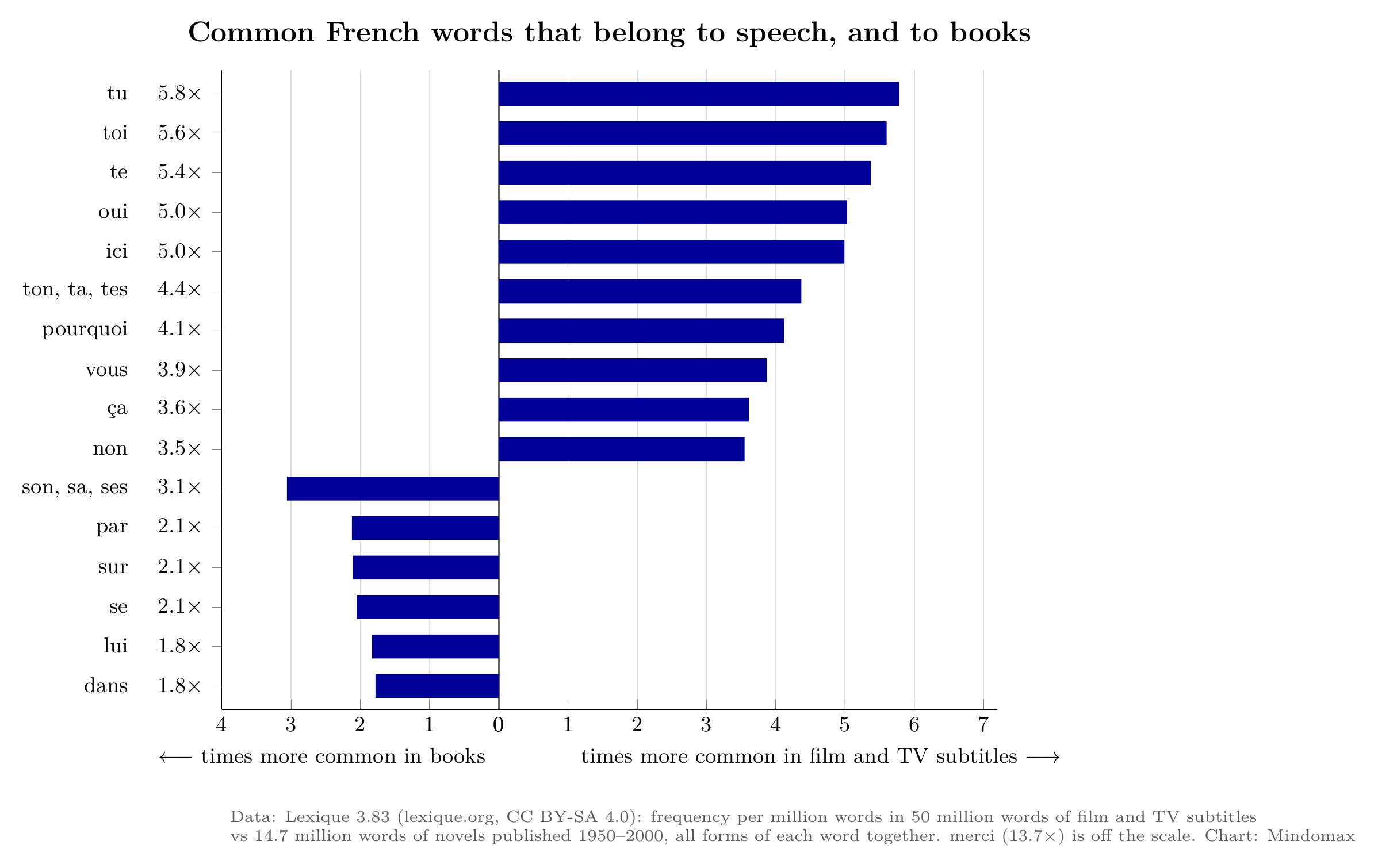
Film and TV dialogue talks to someone (tu, vous, ton) and asks why; novels tell what he or she did (son, se, lui). Data: Lexique 3.83 (CC BY-SA 4.0), frequency per million words in about 50 million words of film and TV subtitles and 14.7 million words of novels published 1950 to 2000, all forms of each word together; compared by Mindomax on 2026-10-22. Chart by Mindomax.
Film and TV dialogue talks to someone. Tu is 5.8 times as common on screen as in novels, toi 5.6 times, te 5.4 times and ton, ta and tes 4.4 times. Even the polite vous is 3.9 times as common. Dialogue also asks and answers: pourquoi (why) 4.1 times, comment (how) 3.9 times, oui 5.0 times, non 3.5 times. And it says thank you: merci is 13.7 times as common in subtitles as in novels.
Novels describe what someone else did. Son, sa and ses (his, her) are 3.1 times as common in books, and se (himself, herself, as in "il se lève") 2.1 times, like the prepositions par and sur. Lui is 1.8 times as common in books.
The practical point: if your goal is conversation, the "you" words, the question words and ça matter more than a list built from books would suggest. If you mostly want to read, son, se and lui deserve an early place.
Where are bonjour and merci?
Textbooks start with greetings. Real conversation uses them less often than you might expect:
Learn them on day one anyway: you will need them the first time you walk into a French shop. Just do not expect them to fill a conversation.
The same goes for textbook nouns. Pain (bread) is number 1,345 and fromage (cheese) 1,848, while tuer (to kill) is number 113, ahead of comprendre (to understand) at 133. That last pair tells you more about the films than about France, which is one of the limits of subtitles.
How to learn the 100 most common French words
1. Learn the small words in short phrases, not alone. C'est (it is), il y a (there is), je ne sais pas (I don't know), qu'est-ce que c'est (what is it) and ça va (how are you, I'm fine) put twelve of the top 40 words into five phrases you will use every day.
2. Learn the present tense of être, avoir, aller and faire first, in the forms you will hear most: est, suis, a, ai, va, vais, fait. These four verbs alone are 42% of all verb use.
3. Put the article on every noun card: la chose, le temps, une fois. A noun learned without its gender has to be learned twice.
4. Review on a schedule. Ten new words a day takes ten days; spaced review, where each card comes back just before you would forget it, keeps them. Our guides to the spacing effect and the testing effect explain why this beats rereading a list, and how to make flashcards covers the cards themselves.
5. Then listen. Two words in three in French film dialogue are on this list, so a French series with French subtitles turns into a review session after the first two weeks.
Apps that help you drill them
You can learn 100 words with paper cards. An app helps with three things paper is bad at: playing the word aloud, showing it in a real sentence and bringing it back just before you forget it. Prices are from the US App Store and Google Play.
A sentence app (Clozemaster, Lingvist or Reverso) and a flashcard app (Anki or Mindomax) make a good pair: the first shows the small words at work, the second makes sure you still know them next month. If you already use Anki, our guide to Anki for language learning covers the settings that matter for vocabulary.
How we counted
The counts come from the French frequency list of the FrequencyWords project (CC BY-SA 4.0), built from OpenSubtitles2018: 318 million words of film and TV subtitles, or 321 million once forms like dis-moi are split into dire and moi. Subtitles are the best open stand-in for everyday speech. Word counts from subtitles predict how quickly French speakers recognise words better than counts from books (New, Brysbaert, Véronis and Pallier, 2007). We used the same method for the most common Spanish words.
We grouped the forms into dictionary words with Lexique 3.83 (CC BY-SA 4.0), the open French database created by Boris New and Christophe Pallier. When a spelling belongs to two words, we split its count the way Lexique's tagged corpus does: 99.6% of est is a form of être and 0.4% is the noun for east; 94.5% of été is a form of être and 5.5% means summer.
Some fixes were made by hand. Lexique has no entry for c', j', qu' and m', which together are 3.4% of all the words in the subtitles, so we added them to ce, je, que and me. It tags about half of "suis" as a form of suivre (to follow), which cannot be right in "je suis", so all of it counts as être. Subtitles drop the accent on capital letters (Ecoute for Écoute) and write œ where Lexique writes oe; we matched those too.
Le, la, l' and les count as one word, and so do un and une, mon, ma and mes, and the other possessives. Du, des, au and aux are listed separately, because learners meet them as words of their own. Interjections (oh, ah, ouais, ok, euh) and swear words count toward the totals but are not in the list; oh would be number 89. Names, English words and other strings Lexique does not know (3.7% of the subtitles) count toward the totals and are never ranked.
The speech-or-books comparison uses Lexique alone: about 50 million words of subtitles from 9,474 films and series against 14.7 million words from 218 novels published between 1950 and 2000.
The limits: most of these subtitles are translations of American and British films and series (in Lexique's corpus, 46 of the 50 million words), so the counts lean toward thrillers and family drama, which is how tuer ends up in the top 120. Spelling is not sound, and a written list cannot show how much French drops ne in speech. Treat every share as a close estimate: below the top 30, neighbouring words can swap places.
If you would rather not type 100 words into flashcards yourself, you can paste this list into Mindomax and try it for free.
Frequently Asked Questions
What are the 10 most common French words?
In spoken French they are le (the), être (to be), je (I), de (of), avoir (to have), ce (it, this), que (that), un (a), pas and ne (not). Together they make up 30.4% of all the words in our count of 321 million words of subtitles.
What are 20 basic French words?
The first 20 rows of the table: the ten above plus il (he), vous (you), tu (you), à (to), et (and), aller (to go), en (in), faire (to do), ça (that) and on (we). Together they are 42.3% of everything said on screen.
What are 100 French words?
The full table above, from le (the) at number 1 to regarder (to look at) at number 100. Together they cover 66.0% of all the words in French film and TV subtitles.
How many French words do I need to know?
1,000 dictionary words cover 85.2% of what is said in French films and TV, 2,000 cover 89.3% and 5,000 cover 93.1%. Following a conversation comfortably takes several thousand words, so treat the first 1,000 as the base, not the goal.
What is the most common word in French?
Le, the word for "the", counted together with la, l' and les: 5.3% of all words. If you count each spelling separately, the most common single form is de (of).
What is the most common French verb?
Être (to be), at 4.3% of all words, then avoir (to have) at 3.3%. Together they are a third of all verb use, which is why est, suis, a and ai are among the first forms to learn.
Should I learn tu or vous first?
Both: vous is number 12 in the ranking and tu number 13, almost equally common. Use vous with strangers and anyone you would call monsieur or madame, and tu with friends, family and children.


