
Anki is the most common flashcard app among serious language learners, and for good reason: it is free on computers and Android, it schedules every word for you, and thousands of ready-made language decks exist. It is also easy to use badly. Most people who quit Anki do not quit because it failed to teach them words. They quit because the daily pile of reviews grew faster than they expected.
This guide is about avoiding that. It gives you the numbers most Anki guides leave out: how many cards a day each setting really costs, the settings worth changing for a language deck, the kind of card the research supports, and which shared decks other learners rate highest. We also say plainly where Anki is weak for languages.
The short version
- Start with 10 new cards a day, not 20. After a year, 10 a day means about 100 cards a day. 20 a day means about 200.
- Turn on FSRS and leave desired retention at 90%. Going to 95% cost about 40% more reviews in our test.
- Make cards that make you produce the word, say it out loud, then hear the answer. That beat simple listen-and-repeat in a controlled study.
- Start with a well-rated shared deck for the first 1,000 to 2,000 words, then make your own cards from what you read and hear.
- Review every day. Anki does not punish a slow pace. It punishes gaps.
What Anki costs in 2026
Anki itself is free on Windows, Mac and Linux. The current desktop version is 26.09.3, released on 2026-09-23. AnkiDroid, the Android app, is free. AnkiWeb, which syncs your cards between devices and runs in a browser, is free. The only paid part is AnkiMobile for iPhone and iPad: $24.99 as a one-time purchase (checked 2026-09-30), rated 4.0 stars from 2,343 ratings on the US App Store. We cover the free options in more detail in Is Anki free?
How many new cards a day can you keep up with?
This is the question that decides whether you are still using Anki in six months. Every new card comes back several times in its first weeks, then less and less often. So the daily load does not stay at your new-card number. It climbs for months.
The Anki manual gives one rule of thumb: if you learn 20 new cards a day, expect roughly 200 reviews a day. We wanted the whole curve, not just the end point, so we ran it. We simulated one year of daily study with FSRS, the open-source scheduler built into Anki, using its default settings and a 90% target for recall. Each simulated card was remembered or forgotten with the probability the scheduler itself predicted. The chart counts every card you answer in a day, including the two short learning steps on the day a card is new.
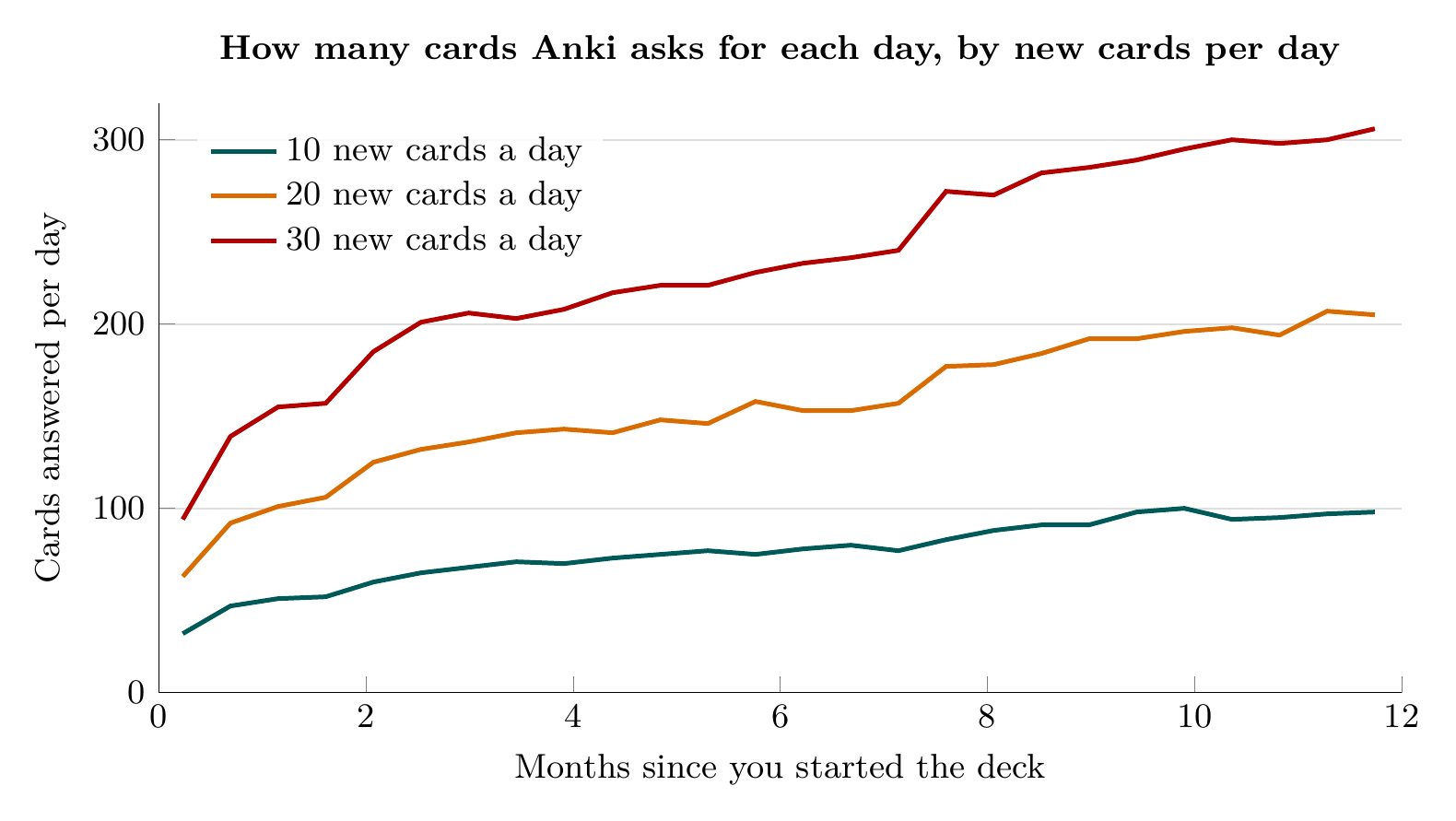
Simulated with the open-source FSRS-6 scheduler (py-fsrs 6.3.2, default parameters, 90% desired retention, learning steps 1 and 10 minutes). Each point is a 14-day average of cards answered per day. Run by Mindomax on 2026-09-30.
Our year-end figure for 20 new cards a day came out at 206 cards a day, close to the manual's "roughly about 200". Here is what each pace means in practice:
Three things stand out. First, the load you feel in week one tells you almost nothing. At 20 new cards a day you answer about 58 cards a day in the first week and about 206 a year later. Second, the pace scales almost in a straight line. Doubling new cards doubles your reviews. Third, the retention setting is expensive at the top. Moving from 90% to 95% added 39% more reviews over the year in our run. If you answer a card in 8 to 10 seconds, 100 cards is roughly 15 minutes and 200 cards is around half an hour.
How many words do you need? In Paul Nation's analysis of English, reading comfortably, with 98% of the words known, takes around 8,000 to 9,000 word families, and following speech takes around 6,000 to 7,000 (Nation, 2006). Those are word families, not cards, and many will come from reading rather than Anki. But the order of size is useful: 10 new cards a day adds 3,650 cards a year. That is a solid base for most learners, and it keeps the daily load at a level people actually sustain.
The settings worth changing for a language deck
Anki's defaults are reasonable, and you do not need an add-on or a spreadsheet of tweaks. Change these, in the deck options:
- New cards per day: 10. Raise it only after a month in which you never skipped a day.
- FSRS: on. FSRS is supported in Anki 23.10 and later, AnkiMobile 23.10 and later, and AnkiWeb. It sets intervals from your own review history instead of fixed multipliers.
- Desired retention: 90%. The manual calls this default a good balance of retention and workload, and our numbers agree.
- Maximum reviews per day: leave it high. A low cap does not remove reviews. It hides them and pushes them to tomorrow, and the pile grows.
- One deck per language. Use tags or subdecks for textbook chapters, but keep a single daily queue so you see one number.
If you want add-ons for audio, images or statistics, our list of the best Anki add-ons checks which ones still run on current Anki versions.
Which cards actually work for a language
Most competing guides say "add audio and example sentences" and stop there. The research is more specific than that.
Make yourself produce the word before you hear it. Kang, Gollan and Pashler (2013) taught US college students 40 Hebrew nouns. One group saw a picture, heard the word and repeated it. The other saw the picture, tried to say the word from memory, and only then heard it. The second group understood more words two days later and pronounced them better, both right after study and two days later. In Anki terms: put the picture or your native-language word on the front, say the answer out loud, then flip to hear the audio.
Train the direction you need. Webb (2009) found that learning word pairs in the productive direction (native language to target language) builds the ability to produce words, while the receptive direction (target to native) builds the ability to recognise them. If you want to speak and write, you need production cards. If you mainly want to read, recognition cards are cheaper. Note that each extra card direction adds a full set of reviews to the load in the table above.
Trust spacing even when it feels worse. Kornell (2009) had students learn GRE-type word pairs either in one large, spaced stack or in small stacks crammed together. Spacing worked better for 90% of the students, yet after the first session 72% believed cramming had worked better. The feeling that Anki is "too slow" is normal, and it is misleading.
Keep one fact per card. A card with a word, its gender, its plural and a verb form fails if you miss any part, so it keeps coming back. Split those into separate cards or leave the extras on the back as reading only.
Use a short sentence on the back. A sentence you understand shows you how the word is used and gives you a second chance to hear it in context. If your deck has no recorded audio, Anki's built-in text-to-speech can read the field aloud.
Shared decks: the most up-voted ones, with dates
A shared deck saves you weeks of card-making for the first common words. The catch is that many popular decks are old, and some are huge downloads. We read the votes, last update and file size of the best-known language decks directly from AnkiWeb on 2026-09-30.
What the numbers say. The French 5000 deck has the most up-votes by a wide margin. The Spanish Top 5000 deck is popular but about one vote in six is a thumbs down, the highest share among the decks here with more than 100 votes, and has not been updated since 2017. The German 4000 deck is from 2015; a newer, smaller German deck built around phrases (Languages on Fire) was updated the day before we checked. Kaishi 1.5k, for Japanese, is both highly rated and actively maintained. For Korean and Mandarin, the vote counts are small, so treat them as starting points rather than proven choices.
Two practical notes. The Spanish Top 5000 deck has 5,001 notes, and 4,881 of them carry audio. The 9000 sentences deck has audio on every one of its 9,263 notes. And AnkiWeb now asks you to log in after a handful of searches, so find the deck you want before you start browsing.
Shared deck or your own cards?
Use a shared deck for the first 1,000 to 2,000 most common words, where everyone needs the same list. After that, switch to cards you make yourself from sentences you have met in books, shows or lessons. A word you have already seen in context is easier to remember, and it is a word you know you will meet again. The testing effect works on any card, but the cards you write yourself are the ones that match your life.
A simple rule that keeps the load under control: suspend any shared card you already know on sight, and never add more than your new-card limit in a day, no matter how many words you collected.
Where Anki is weak for language learning
Anki is excellent at one job, which is scheduling. It is less good at the rest:
- Setup takes an evening. Card types, fields, templates and deck options are powerful but not obvious. Many beginners never get past this.
- Making good cards is manual. Adding audio, a picture and an example sentence to each word takes time, or add-ons.
- It cannot hear you. Anki plays audio but does not check your pronunciation. You grade yourself.
- The iPhone app costs $24.99 (checked 2026-09-30), while desktop and Android are free.
- Popular shared decks age. Five of the nine decks above have not been updated in more than five years.
If Anki is not the right fit
The scheduling idea matters more than the app. If Anki's setup is what stops you, these give you spaced reviews with less work:
- Anki itself, on another device. Many people who struggle on the phone find the desktop version easier for making cards, then review on AnkiDroid or AnkiMobile. Free, except AnkiMobile at $24.99 (checked 2026-09-30).
- Mindomax. Our own app. It schedules reviews for you, reads cards aloud in 14 languages, and can create cards from text, images, audio files or PDFs with AI. It is free, and Premium is free until the end of 2027 (checked 2026-09-30 at mindomax.com/price). The honest limitation: it is new, it has no ratings yet on the US App Store, and it does not have Anki's library of community decks or add-ons.
If pronunciation practice is your priority, we compared flashcard apps for language learning with voice recording separately.
Frequently Asked Questions
Is Anki good for language learning?
Yes, for vocabulary. Anki's spaced scheduling is well suited to remembering thousands of words, and spacing beat cramming for 90% of learners in a flashcard study. It does not teach grammar or listening on its own, so use it next to reading, listening and speaking practice.
How many new Anki cards a day for a language?
Start with 10. In our one-year simulation with Anki's default FSRS settings, 10 new cards a day led to about 100 cards a day after a year, and 20 new cards a day to about 200. Raise the number only after a month without missed days.
Should I use shared decks or make my own?
Both. A well-rated shared deck is the fastest way through the first 1,000 to 2,000 common words. After that, cards made from sentences you have actually read or heard are easier to remember and more relevant to you.
What desired retention should I use in Anki?
Leave it at the default of 90%. In our simulation, raising it to 95% added 39% more reviews over a year, while lowering it to 85% saved 14%.
Is Anki free on iPhone?
No. AnkiMobile costs $24.99 as a one-time purchase (checked 2026-09-30). Anki on Windows, Mac and Linux, AnkiDroid on Android, and AnkiWeb in the browser are free.
The bottom line
Anki works for language learning if you keep the daily load at a level you can repeat every day. Start at 10 new cards, use FSRS at 90%, make cards that make you say the word before you hear it, and lean on a well-rated shared deck only for the first common words. If you would rather skip the setup and have cards read aloud and created for you, you can try Mindomax for free.
References
Kang, S. H. K., Gollan, T. H., & Pashler, H. (2013). Don't just repeat after me: Retrieval practice is better than imitation for foreign vocabulary learning. Psychonomic Bulletin & Review, 20(6), 1259-1265. doi:10.3758/s13423-013-0450-z
Kornell, N. (2009). Optimising learning using flashcards: Spacing is more effective than cramming. Applied Cognitive Psychology, 23(9), 1297-1317. doi:10.1002/acp.1537
Nation, I. S. P. (2006). How large a vocabulary is needed for reading and listening? Canadian Modern Language Review, 63(1), 59-82. doi:10.3138/cmlr.63.1.59
Webb, S. (2009). The effects of receptive and productive learning of word pairs on vocabulary knowledge. RELC Journal, 40(3), 360-376. doi:10.1177/0033688209343854
Anki Manual: Deck Options. docs.ankiweb.net/deck-options.html
Open Spaced Repetition: py-fsrs, version 6.3.2. github.com/open-spaced-repetition/py-fsrs


