
The short answer
No single app will make you fluent. The apps at the top of most "best" lists are all-rounders: one method stretched across 14 to 70+ languages. They are a good place to start. But the best tool for Japanese kanji, Chinese characters or American Sign Language is almost always an app built for that one language, and those apps rarely make the lists.
So pick in three steps. Start with one all-rounder for structure: Duolingo for a free daily habit, Babbel for grammar explained in English, Pimsleur if you learn by listening, or Mango if your library pays for it. Add the specialist for your language from the table below. Then add a way to keep the words you meet, because course apps move on faster than your memory does.
Every price here was checked on 2026-10-18 in the US App Store. Many listings show several prices for the same plan; when they do, we give the lowest and say "listed from".
How we picked these 29
We started from the languages, not the apps. The Modern Language Association counts enrollments in language courses at US colleges, and its latest published census, for fall 2021, covers 2,455 institutions. Spanish has more students than the next nine languages combined, and American Sign Language is third, ahead of Japanese and German. The ten languages at the top of that count each get a section below, in that order.
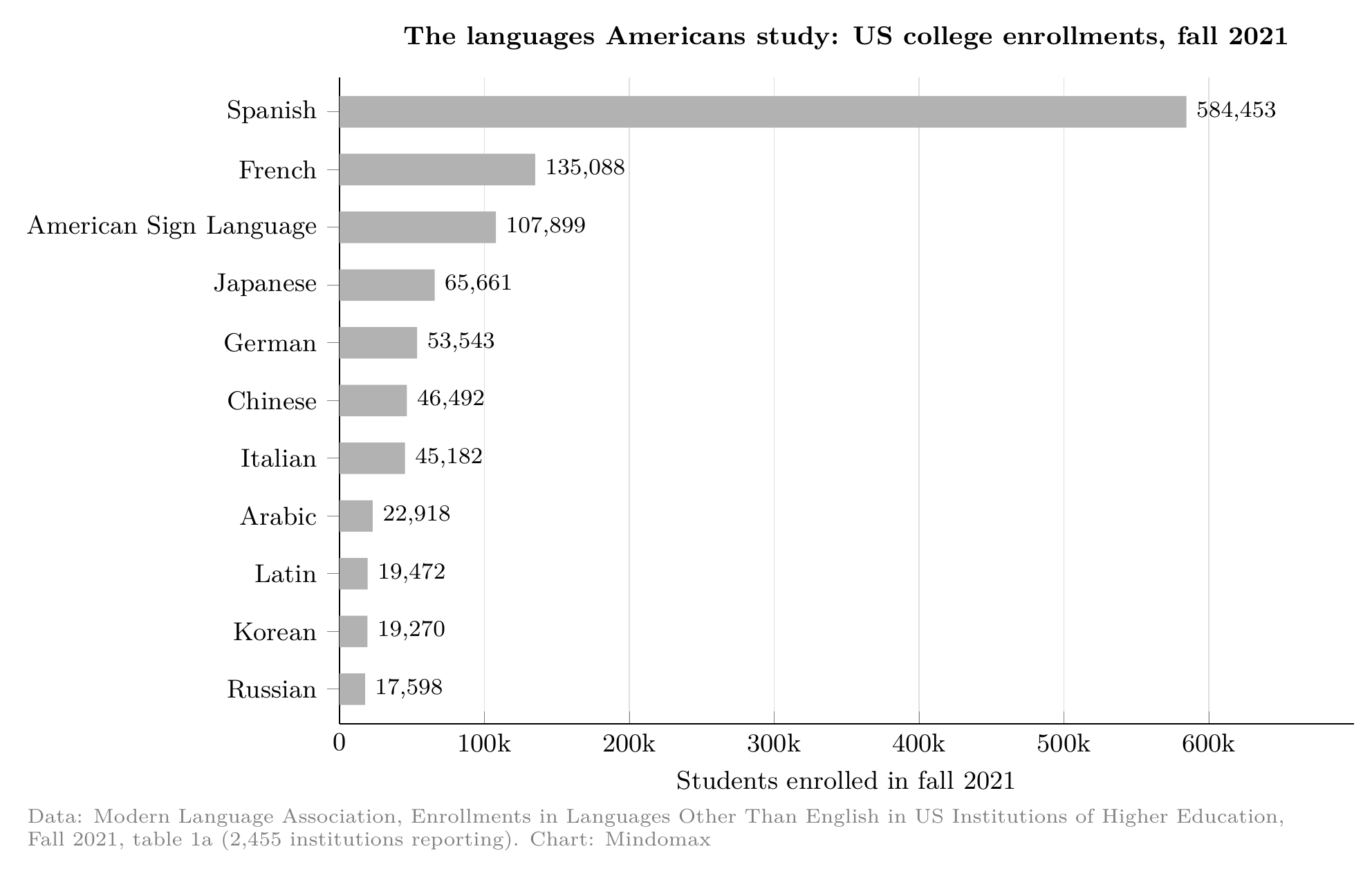
Spanish outnumbers the next nine languages combined in US college classes, and American Sign Language is third, ahead of Japanese and German. Data: Modern Language Association, Enrollments in Languages Other Than English in US Institutions of Higher Education, Fall 2021, table 1a (2,455 institutions reporting). Chart by Mindomax.
Then we looked for apps built for each language and checked every one in the US App Store on 2026-10-18: the listing had to exist, show real ratings and have been updated in the last 12 months. That removed some familiar names. The ASL App was last updated in March 2024, and Deutsche Welle's free German app in October 2025. Mindomax, our own app, is on the list too. It sits in the vocabulary group, not at the top, and it gets the same treatment as the rest: what it does, what it costs and where it falls short.
The all-rounders: start with one of these
These six teach many languages with one method. Pick one for structure, not all six. If you are leaving Duolingo rather than choosing your first app, our list of 28 Duolingo alternatives sorts them by what you want instead.
1. Duolingo. Short, game-like lessons in 40+ languages, and the easiest way to build a daily habit. It is free with ads and a daily limit; Super Duolingo is listed from $9.99 a month or $83.99 a year (checked 2026-10-18). Limitation: it explains very little grammar, and tapping word tiles is not the same as speaking.
2. Babbel. Each lesson states a rule in plain English, then makes you use it in a short dialogue, in 14 languages. One language costs $17.99 a month or $89.99 a year, and all 14 cost $107.99 a year (checked 2026-10-18). Limitation: only the first lesson is free, and the 14 languages are mostly European. Torn between the two most popular apps? Read Babbel vs Duolingo.
3. Busuu. A structured path in 14 languages where native speakers in its community correct your written and spoken answers. A lot of it is free; Premium is listed from $6.99 a month and from $70.00 a year (checked 2026-10-18). Limitation: the store shows many prices for the same plan, so what you pay depends on the offer you are shown.
4. Pimsleur. Audio lessons where you hear a phrase and say it back, in over 50 languages, with a free first lesson in 51 of them. All Access is $20.99 a month or from $131.99 a year, and one language is $19.99 a month (checked 2026-10-18). Limitation: almost no reading or writing, and the most expensive yearly plan in our price chart.
5. Rosetta Stone. Pictures, native audio and speech recognition, with no translations, in 25 languages. The new Sapphire app lists one plan at $19.99 after 7 free days (checked 2026-10-18). Limitation: by design it never explains a rule in English, which frustrates many adults. Rosetta Stone vs Babbel compares the two methods side by side.
6. Mango Languages. Conversation-based lessons in 70+ languages, and the best deal on this list if your public library subscribes, because cardholders use it at no cost. Without a library it is $13.99 a month or $119.99 a year, after a 14-day free trial (checked 2026-10-18). Limitation: whether it is free depends on your library, so check your library's website first.
Spanish: SpanishDict, Dreaming and ConjuGato
Spanish is the language most Americans study, and its best tools are free or cheap. Wondering which words to learn first? Our list of the most common Spanish words ranks them by how often they are actually used.
7. SpanishDict. A dictionary with over 200,000 App Store ratings, every verb conjugated, pronunciation videos, quizzes and lessons, and the core app is free. Premium is $12.99 a month or $59.99 a year (checked 2026-10-18). Limitation: it is a reference with drills, not a full course.
8. Dreaming. The app behind Dreaming Spanish and Dreaming French: videos sorted by level, so you learn by understanding stories instead of memorizing lists. It was named one of TIME's Best Inventions of 2025. Premium is listed at $9.99 (checked 2026-10-18). Limitation: no grammar drills and no speaking practice, on purpose, so you will need something else for both.
9. ConjuGato. Verb drills for a spare minute: see a verb, say the form in your head, tap to check. It is free for 250 common verbs and the first tenses, and $9.99 paid once unlocks the rest, with no subscription (checked 2026-10-18). Limitation: verbs only.
French: TV5MONDE EDU and Frantastique
10. TV5MONDE EDU. Hundreds of videos from the French-language TV channel TV5MONDE, each with subtitles, a transcript and exercises from beginner (A1) to upper intermediate (B2), with French as it is spoken in Paris, Geneva, Dakar, Montreal and Brussels. It is free, with no in-app purchases (checked 2026-10-18). Limitation: it trains understanding, not speaking.
11. Frantastique. One short, personalized French lesson a day from the team behind Gymglish, and the first lessons and a level test are free. Plans are listed from $9.99 a month (checked 2026-10-18). Limitation: the listing shows ten different prices, from $9.99 to $199.99, so read the offer before you pay.
American Sign Language: Lingvano and ASL Bloom
ASL is the third most studied language at US colleges, yet the popular app lists rarely include a single sign language app. Both of these teach with videos of Deaf signers.
12. Lingvano. Video lessons made by Deaf teachers, with 119,000+ ratings at 4.9 stars. ASL Premium is $17.99 a month or $119.99 a year (checked 2026-10-18). Limitation: one of the more expensive yearly plans here, and an app cannot replace signing with real people.
13. ASL Bloom. 23 modules, 120+ video lessons and 1,300+ signs and sentences, featured by Apple's editors as "Learn ASL From Deaf and Native Instructors". Plans are listed from $14.99 a month and from $48.99 a year, the cheapest yearly plan in our chart (checked 2026-10-18). Limitation: the listing shows several discounted prices at once, so the price you are offered may differ.
Japanese: Bunpro, Kanji Study and Satori Reader
Japanese needs three skills that most course apps blur together: grammar, kanji and reading. These three apps each do one of them well.
14. Bunpro. Japanese grammar points, from your first hiragana to JLPT level, each with example sentences and reviewed with spaced repetition. One month is free, then $6.49 a month, $64.99 a year or $194.99 for life (checked 2026-10-18). Limitation: it is built around grammar, so add other tools for kanji and listening.
15. Kanji Study. Teaches kanji through the 5,000+ JLPT words they appear in, from N5 to N1, instead of as bare characters. Levels cost $9.99 to $14.99 each, or $29.99 for all of them, paid once (checked 2026-10-18). Limitation: no grammar or speaking.
16. Satori Reader. Stories written by native speakers for intermediate learners, with audio and notes, and the first two episodes of every series are free. After that it is $8.99 a month or $89.99 a year (checked 2026-10-18). Limitation: too hard for a beginner, so start it once you know the basics.
German: Seedlang and Der Die Das
17. Seedlang. Speaking and listening practice with videos of real native speakers, built with the Easy German YouTube channel. Pro is $8.99 a month or $59.99 a year (checked 2026-10-18). Limitation: it focuses on speaking and listening, so pair it with a course for grammar.
18. Der Die Das. Type a noun and see its article, or play a quick game with the 18,000+ nouns in its dictionary. It is free, with one $0.99 add-on (checked 2026-10-18). Limitation: it does one job only, but it is the job that trips up almost every English speaker.
Chinese: Pleco, Du Chinese and Skritter
19. Pleco. A Chinese dictionary from a company that has made Chinese learning apps since 2001, with two free built-in dictionaries of 110,000+ and 125,000 entries. Optional add-ons come in bundles of $29.99 or $59.99, paid once (checked 2026-10-18). Limitation: it is a toolbox, not a course.
20. Du Chinese. Graded stories and articles with audio; tap any word to see what it means. You can start free, and Premium is $14.99 a month or from $79.99 a year (checked 2026-10-18). Limitation: it builds reading and listening, not speaking.
21. Skritter. Practice writing characters on your screen, stroke by stroke, with an app that has been around for more than 10 years. Premium is listed from $9.99 a month and from $99.99 a year (checked 2026-10-18). Limitation: writing only, and expensive if you do not plan to write by hand.
Italian: use an all-rounder, then add real Italian
Italian is the seventh most studied language at US colleges, but the Italian-only apps we found were either not updated in over a year, simple phrasebooks, or too new to have ratings. Babbel, Busuu and Pimsleur all teach Italian well enough for a start. Then add Italian you actually hear:
22. Lingopie. Italian TV shows and films with subtitles in Italian and English; tap any word for a translation and save it for later. It also covers Spanish, French, German, Japanese, Korean, Chinese and more. You get 8 minutes free each week, and plans are listed from $11.99 a month and from $59.99 a year (checked 2026-10-18). Limitation: it is a library, not a course, so it suits learners past the very beginning.
Arabic: Kaleela
23. Kaleela. Starts with the alphabet, teaches Modern Standard Arabic, then lets you explore five spoken dialects: Jordanian and Palestinian, Syrian, Egyptian, Iraqi and Saudi. It costs $11.99 a month or $95.99 a year (checked 2026-10-18). Limitation: only 237 ratings so far, far fewer than the big apps.
Latin: Legentibus
24. Legentibus. A Latin library with synchronized audio and built-in dictionaries, from beginner to advanced, so you learn by reading and listening instead of reciting tables. It costs $9.99 a month or $99.99 a year (checked 2026-10-18). Limitation: it does not drill grammar or word endings.
Korean: TTMIK Courses and Teuida
Korean grew faster than any other top-ten language at US colleges between 2016 and 2021, up 38.3 percent.
25. TTMIK Courses. The official app of Talk To Me In Korean, with all of its courses, its Core Grammar lessons, a TOPIK 1 course and occasional live classes. It costs $16.99 a month or $121.99 a year (checked 2026-10-18). Limitation: the app is new, with only 14 ratings and 3.9 stars so far.
26. Teuida. Speaking practice in first-person scenes, as if you were in the conversation yourself; it also teaches Japanese and Spanish. Plans are listed from $14.99 a month and from $59.99 a year (checked 2026-10-18). Limitation: it teaches phrases for real conversations more than grammar.
Keep the words: the step course apps leave out
Course apps introduce a word, test it a few times and move on. A word you meet once and never see again is easy to forget. Spaced repetition apps bring each word back just before you would forget it, at longer and longer gaps, and they work alongside every app above. Our guide to Anki for language learning shows the settings and daily load that work.
27. Anki. The free, open-source standard for spaced repetition: add a word once and Anki decides when you see it again. It is free on Windows, Mac, Linux, Android and the web, and the iPhone app costs $24.99, paid once (checked 2026-10-18). Limitation: you build and look after your decks yourself, and the iPhone app was last updated in September 2025.
28. Mindomax. Our own app, so weigh this accordingly. It makes flashcards for you with AI from a word list, a photo, a PDF or an audio file, schedules reviews with spaced repetition, reads cards aloud in 14 languages and has millions of ready-made cards. Everything is free right now, and Premium is free until the end of 2027 (checked 2026-10-18). Limitation: it is not a course and will not teach you grammar, and it is new in the US App Store, with no ratings yet.
29. Clozemaster. Fill-in-the-gap sentences in 50+ languages, so you learn each word in context, and it is free to start. Pro is listed from $8.99 a month and from $69.99 a year (checked 2026-10-18). Limitation: it assumes you already know some grammar.
What a year costs
A year of a single-language specialist usually costs less than a year of the big course apps. Free apps and one-time purchases are left out of the chart.
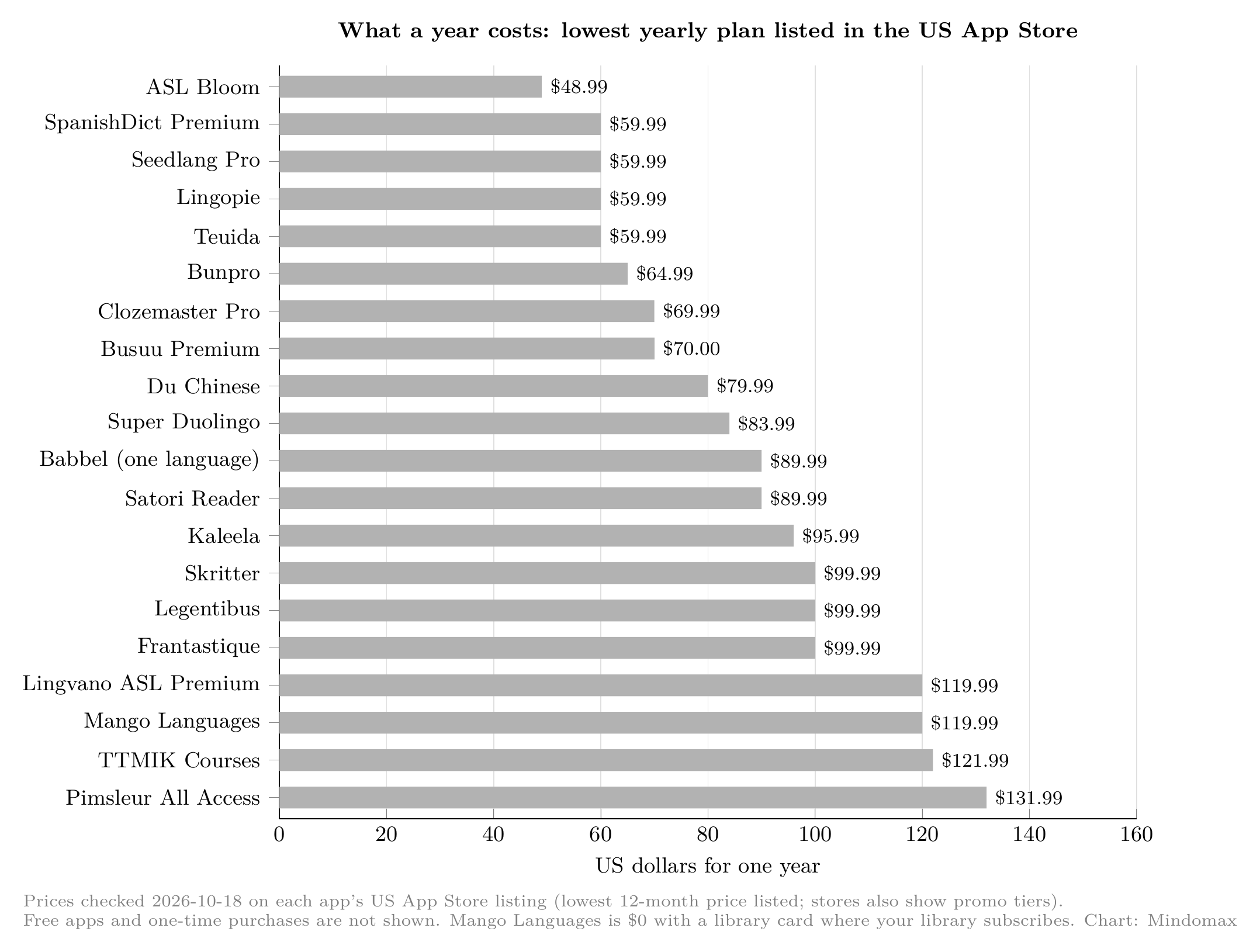
What one year costs: the lowest 12-month plan each app lists in the US App Store (checked 2026-10-18). Stores also show promotional prices. Mango Languages is $0 with a library card where your library subscribes. Chart by Mindomax.
Which one should you start with?
If you are a complete beginner with no budget, use Duolingo, the free specialist for your language (SpanishDict, TV5MONDE EDU, Pleco or Der Die Das) and Anki. Check your library for Mango before you pay for anything.
If you are a beginner who will pay for one year, choose Babbel or Busuu for structure, or Pimsleur if most of your study time is in the car. Add the specialist for your language once the course feels easy.
If you are past the basics, you can drop the course app. Your time is better spent on real input, such as Dreaming, Satori Reader, Du Chinese, Lingopie or Legentibus, with a spaced repetition app keeping the new words.
If you want one place to keep the words all these apps teach you, Mindomax is free.
Sources
Modern Language Association, Enrollments in Languages Other Than English in US Institutions of Higher Education, Fall 2021 (2023), table 1a.
US App Store listings of all 29 apps, including their in-app purchase lists, read on 2026-10-18; each app's name above links to its listing or official site.
Mango Languages, Mango for Libraries, read on 2026-10-18.
Frequently Asked Questions
Is Duolingo or Babbel better?
It depends on what you need. Duolingo is free and best for building a daily habit. Babbel explains the grammar and costs $89.99 a year for one language, close to Super Duolingo's $83.99 a year (checked 2026-10-18). A common path is to start free on Duolingo and switch when you want the rules explained.
Is Babbel really free?
No. You can try the first lesson free, but the rest needs a subscription: $17.99 a month or $89.99 a year for one language in the US App Store (checked 2026-10-18).
What is better, Rosetta Stone or Babbel?
For most adults, Babbel, because it explains why a sentence works, while Rosetta Stone never uses English. Rosetta Stone covers 25 languages to Babbel's 14 and suits people who like to work things out from pictures and sound.
Is Duolingo still the best language learning app?
It is still the most popular: 5.5 million ratings in the US App Store, at 4.7 stars, in October 2026. It is the best free way to start, but not the best way to go deep in any one language. For that, add the specialist for your language.
What is the best free language learning app?
Duolingo for a full free course. Then add the free specialists: SpanishDict for Spanish, TV5MONDE EDU for French, Pleco for Chinese, Der Die Das for German noun genders, and Anki for reviewing words. If your public library subscribes, Mango is free too.


