
The short answer
Pick Duolingo if you want to start for free, if your language is one Rosetta Stone does not teach, or if a daily streak is what keeps you going. Its full course is free with ads, and Super Duolingo costs $83.99 a year (checked 2026-10-11).
Pick Rosetta Stone if you want lessons that stay in the new language from the first minute, with no translation, plus speech feedback on every spoken line. It is paid only: $19.99 a month or $159 a year for all 25 of its languages (checked 2026-10-11), after a 7-day free trial.
One thing most comparisons still miss: the Rosetta Stone you can buy today is not the one they reviewed. In May 2026 the company released a new app, Rosetta Stone Sapphire. The old app, now called Rosetta Stone Classic, is only open to people who already had an account, and new customers can no longer buy a lifetime plan. Everything below is about the 2026 versions of both apps.
Rosetta Stone vs Duolingo at a glance
What changed at Rosetta Stone in 2026
Rosetta Stone has belonged to IXL Learning since 2021. In May 2026 it put a new app in the stores, Rosetta Stone Sapphire, and in September it announced it as the version for all new subscribers. The App Store page of the old app, Rosetta Stone Classic, now says it is only for current Classic subscribers and school or company users.
Three things are new in Sapphire, and each one answers an old complaint about Rosetta Stone:
Chat Missions. You get a scenario, such as ordering coffee or asking a taxi driver for directions, and three goals to reach in a written chat with a virtual partner. The app corrects spelling, grammar and word choice as you go. Old Rosetta Stone never let you produce your own sentences like this.
Flashcards. There are more than 500 topic sets per language, about 12 cards each, with pictures and native audio. You can flip, shuffle and share them (Rosetta Stone's description). What Rosetta Stone does not describe is a review schedule: the cards do not come back on their own when you are about to forget them.
Sapphire Studio. You type a topic and it builds a word list, flashcards, a matching game, a simplified text, a reading guide or an email draft for you.
What did not change is the core: lessons in the new language only, with pictures standing in for translation, and TruAccent, the speech engine that compares your voice with recordings of native speakers.
The price model changed too. Classic was famous for lifetime deals, often sold through third parties. Sapphire is sold as a monthly or yearly plan only. Rosetta Stone's own support page says lifetime buyers keep access "for as long as" the products are available, and on Reddit's r/languagelearning, Classic lifetime owners have complained that this wording lets the company retire what they paid for. If a site still offers you a Rosetta Stone lifetime deal, check which app it unlocks before you pay.
How much Rosetta Stone and Duolingo cost in 2026
All prices below are US prices, read from the App Store and from Rosetta Stone's plans page on 2026-10-11.
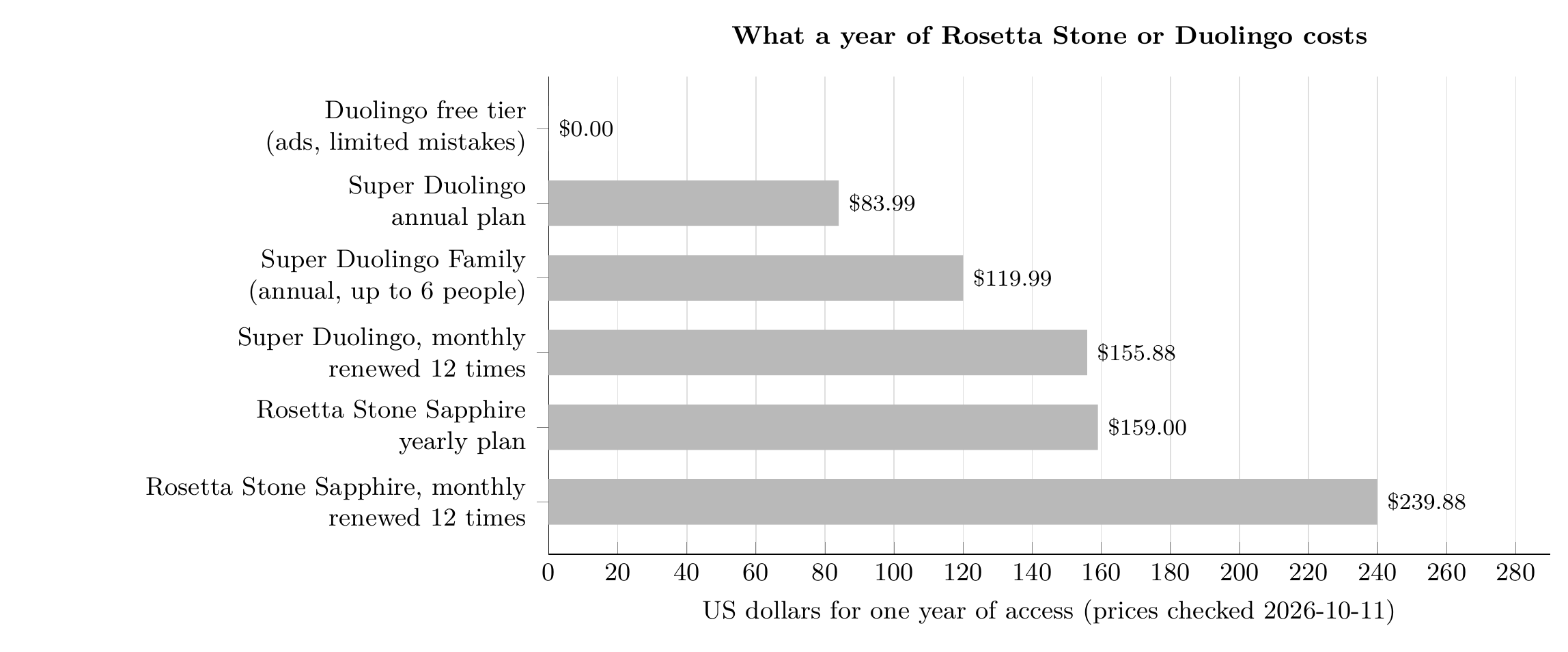
What one year costs on each plan. Duolingo: US App Store prices; Rosetta Stone: rosettastone.com and App Store; all checked 2026-10-11. Monthly plans multiplied by 12. Chart by Mindomax.
Two things stand out. First, a Rosetta Stone year costs about twice as much as a Super Duolingo year: $159 against $83.99 (checked 2026-10-11). Second, paying month by month is the most expensive way to use either app. Twelve months of Super Duolingo at $12.99 add up to $155.88, and twelve months of Sapphire at $19.99 add up to $239.88 (checked 2026-10-11). If you are sure you will keep going, the yearly plan is the better buy in both apps; if you are not sure, start with Duolingo's free tier or Rosetta Stone's 7-day trial before you pay anything.
The Family plan is the cheapest way to pay for Duolingo per person: $119.99 a year shared by up to six people (checked 2026-10-11). Rosetta Stone has no family plan in the Sapphire store listing.
How the two apps teach
Duolingo teaches in lessons of a few minutes each. You translate sentences in both directions, pick words from a bank, match pairs, type what you hear and say sentences out loud. It explains grammar in short tips and, in Duolingo Max, with AI explanations. Streaks, leagues and gems make it hard to skip a day, which is the main reason people stay with it. Behind the scenes, a model called half-life regression decides which words you need to practise again (Settles and Meeder, 2016).
Rosetta Stone never shows you a translation in a lesson. You see a picture, hear a native speaker and match the two, then build up to phrases and sentences. The idea is to learn the way a child does, from context. It works well for concrete words and everyday phrases. It works less well for grammar you cannot see in a picture, such as the subjunctive or a Japanese verb form, and some learners find it slow because nothing is explained.
Speaking is where Rosetta Stone has always been stronger. TruAccent checks every spoken line and asks you to repeat until it is close enough. Duolingo has speaking exercises too, but they are a smaller share of each lesson and they are more forgiving about pronunciation.
Conversation is where both apps added something in recent years. Duolingo Max has Video Call, a spoken chat with the character Lily. Rosetta Stone Sapphire has Chat Missions, which are written, not spoken. Neither replaces a real conversation partner, and Rosetta Stone sells tutoring separately for that.
Languages: which app teaches yours
Both apps teach the 20 languages most people ask for. The differences are at the edges.
Sources: Rosetta Stone's language list in its Sapphire App Store listing, and Duolingo's public course list, both read on 2026-10-11.
How far each course goes matters as much as whether it exists. In July 2026 Duolingo said nine of its biggest courses (English, Spanish, French, German, Italian, Portuguese, Japanese, Korean and Chinese) now reach B2, an upper-intermediate level (Duolingo blog). Its smaller courses are much shorter. Rosetta Stone does not give a CEFR level per course on the pages we read, so if you need a certificate level for work or study, ask before you pay.
What the research says, and who paid for it
Both companies like to say their app equals a college semester. Those claims come from a small set of reports, and most of them were written by the same researcher, Roumen Vesselinov, with his colleague John Grego. Each report was paid for by the company whose app it measured.
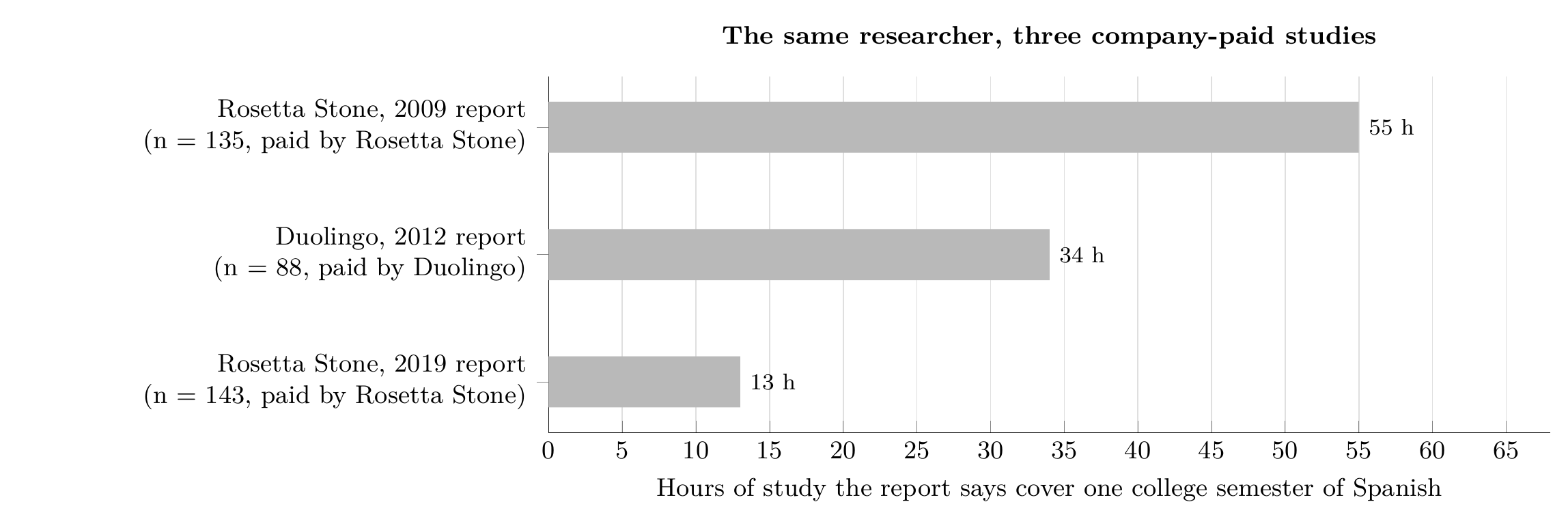
Hours to "one college semester of Spanish" as each company-paid report states it. Data from Vesselinov (2009), Vesselinov and Grego (2012) and Vesselinov and Grego (2019). Different samples and starting levels, so the bars are claims, not a fair race. Chart by Mindomax.
The chart shows how much the headline number moves even when the same researcher uses the same test: from 55 hours to 13 hours for Rosetta Stone alone, ten years apart. That does not mean either number is false. It means a placement test after a few weeks of app use is a weak yardstick, and the learners in each study started at different levels.
The most useful comment on all of this comes from Duolingo's own researchers. In their 2021 paper in Foreign Language Annals (Jiang and others), they point out that these reports were white papers on company websites, not peer-reviewed studies, and that the hours-per-semester estimates "can also be seen as making unwarranted claims". They write that it is hard to compare the products this way because the learners' starting scores differ.
So what can you take from the research? Both apps teach real beginners real Spanish, measured by outside tests. Neither has been shown to beat the other, because no study has put the two side by side with the same learners. The 2009 and 2012 reports suggest Duolingo learners gained more test points per hour (8.1 against 4.3), but with different people, different years and different versions of both apps, that is a hint, not a verdict.
Where both apps fall short
Neither app lets you decide which words you review and when.
Duolingo schedules practice of its own course words, and you cannot add a word you met in a podcast, a TV show or a conversation. Rosetta Stone's new flashcards are pre-made topic sets that you flip and shuffle, plus sets that Sapphire Studio builds for you, but Rosetta Stone does not say they come back on a schedule.
That matters because memory research is clear on one point: words you review a few times, spread out over days and weeks, stay much longer than words you meet once or cram in one sitting. A large meta-analysis of more than 300 experiments found this spacing effect again and again (Cepeda and others, 2006; our summary: the spacing effect). Lessons introduce words; spaced review is what keeps them.
The fix is cheap: keep using whichever app you like for lessons, and put the words you actually need into a spaced-repetition flashcard app.
If you are new to this, our guides to Anki for language learning and how to make flashcards show how to set it up in an evening. Learning Spanish? Start with the 100 most common Spanish words.
Which one should you choose?
For most people starting a language in 2026, Duolingo is the better first step: it is free, it teaches more languages, and its big courses now reach B2. Rosetta Stone is the better buy for a learner who already knows that immersion and pronunciation feedback work for them, and who is happy to pay $159 a year for it (checked 2026-10-11).
Whichever you choose, add spaced review of your own words, because neither app does that part for you. If neither fits, our list of Duolingo alternatives compares 28 other apps with their prices.
If you want a free place to keep and review the words you collect, Mindomax is free to try.
Sources
Rosetta Stone: Meet Rosetta Stone Sapphire (2026-09-01); Rosetta Stone Flashcards (2026-09-02); plans and pricing. Vesselinov, R. (2009). Measuring the Effectiveness of Rosetta Stone. Vesselinov, R. and Grego, J. (2012). Duolingo Effectiveness Study. Vesselinov, R. and Grego, J. (2019). The 2019 Rosetta Stone Efficacy Study. Jiang, X., Rollinson, J., Plonsky, L., Gustafson, E. and Pajak, B. (2021). Evaluating the reading and listening outcomes of beginning-level Duolingo courses. Foreign Language Annals, 54(4), 974-1002. Settles, B. and Meeder, B. (2016). A Trainable Spaced Repetition Model for Language Learning. ACL. Cepeda, N. J. and others (2006). Distributed practice in verbal recall tasks. Psychological Bulletin, 132(3), 354-380. App Store listings: Duolingo, Rosetta Stone Sapphire, Rosetta Stone Classic, AnkiMobile, Mindomax.
Frequently Asked Questions
Is Rosetta Stone better than Duolingo?
Not across the board. Rosetta Stone is better for immersion and pronunciation feedback; Duolingo is free, teaches more languages and explains grammar. No study has compared the two with the same learners.
Is Rosetta Stone worth the money in 2026?
It is worth $159 a year (checked 2026-10-11) if you will use it several times a week and like learning without translation. If you are not sure, use the 7-day free trial first, or start with Duolingo's free course.
Can I still buy Rosetta Stone lifetime?
Not from Rosetta Stone as a new customer. Since the Sapphire app launched in 2026, new users choose a monthly or yearly plan. Older lifetime plans belong to the Classic app.
What is Rosetta Stone Sapphire?
It is the new Rosetta Stone app, released in May 2026. It keeps the immersion lessons and TruAccent, and adds written Chat Missions, 500+ flashcard sets per language and Sapphire Studio, which builds study materials from a topic you type.
Can you become fluent with Duolingo or Rosetta Stone alone?
Unlikely. Duolingo's own study found finishers of its beginner course reading at Intermediate Low and listening at Novice High. Both apps work best as one part of your learning, next to real conversation and spaced review of your own words.
Which is better for Spanish, Rosetta Stone or Duolingo?
Both teach Spanish well for beginners, and Rosetta Stone lets you choose Spain or Latin American Spanish. Duolingo's Spanish course is free and now reaches B2; Rosetta Stone gives more speaking feedback.


