
The short answer
Pick Duolingo if you want to start for free, learn a language Babbel does not teach, or need a daily habit more than a curriculum. Pick Babbel if you are learning one of its 14 languages, want grammar explained in plain English, and are ready to pay about $108 a year (checked 2026-10-02) for structured lessons built around real conversations.
On price, the gap is smaller than most comparisons suggest. Duolingo Super costs $83.99 a year and Babbel's All Languages plan costs $107.99 a year on the US App Store (both checked 2026-10-02). The big difference is that Duolingo has a usable free tier and Babbel does not.
On results, both companies have published studies in the same peer-reviewed journal, and both studies were run or paid for by the company itself. Neither study compares the two apps with each other. We go through what each one really measured below.
Babbel vs Duolingo at a glance
Ratings, prices and course lists were read on 2026-10-02 from the US App Store, the Duolingo course list and Babbel's price page.
How much Duolingo and Babbel cost in 2026
Both apps sell subscriptions inside the app, so the App Store's list of in-app purchases is the most reliable place to see what Americans actually pay. Here is every plan we could confirm.
Two things stand out. First, Babbel's single-language yearly plan ($89.99) costs only $18 less than the plan with all 14 languages, so if you might ever try a second language, the All Languages plan is the better buy. Second, paying month by month is expensive in both apps (all prices checked 2026-10-02). A year of Duolingo Super paid monthly costs $155.88, and a year of Babbel paid monthly costs $215.88.
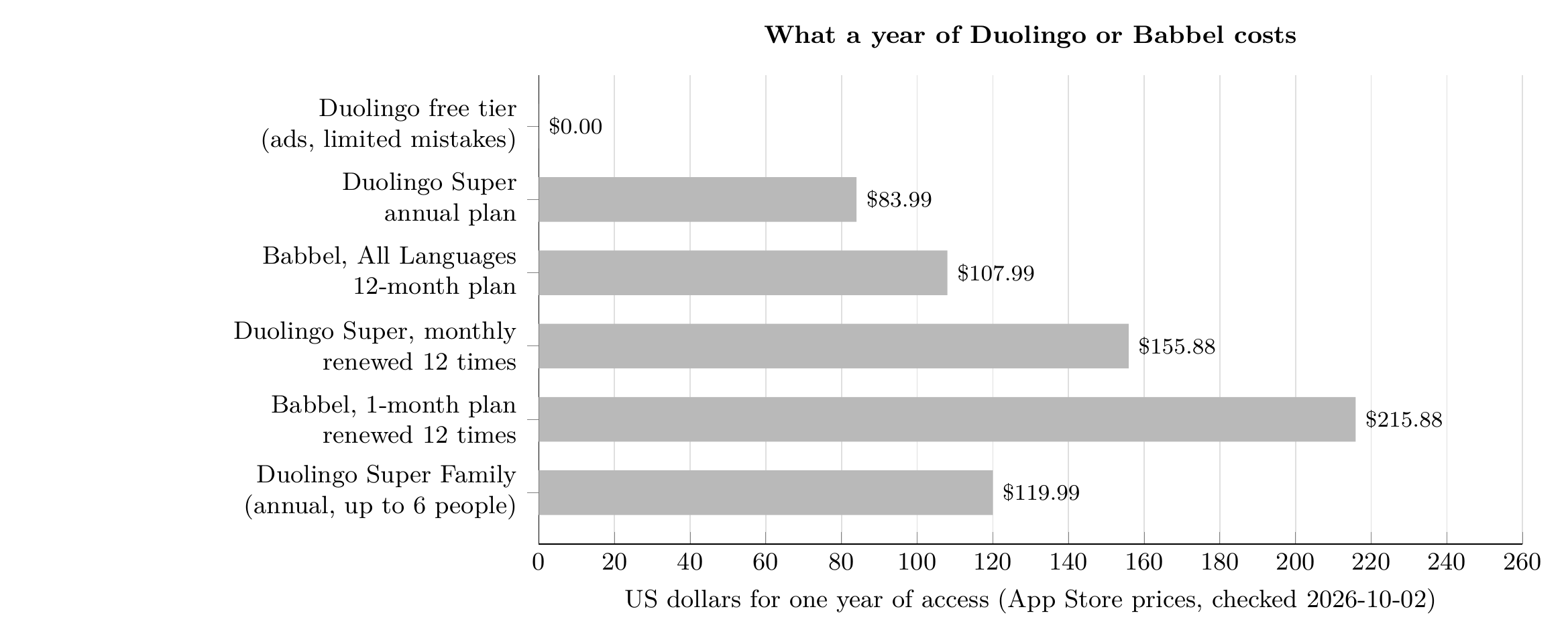
What one year costs on each plan. US App Store prices checked 2026-10-02; monthly plans multiplied by 12. Chart by Mindomax.
Duolingo does not publish a price for Max on its website, and third-party sites quote figures we could not confirm, so we have left it out of the chart. In its Q2 2026 shareholder letter, Duolingo said it was bringing Video Call, its AI conversation feature, to Super subscribers as well, which makes Max less necessary for most learners.
How the two apps teach
Duolingo teaches through very short exercises: tap the right word, translate a sentence, match pairs, say a phrase out loud. A lesson takes a few minutes. Streaks, XP and weekly leagues are built to bring you back every day, and they work: Duolingo reported 58.7 million daily active users in the second quarter of 2026, up 23% from a year earlier, according to its shareholder letter filed with the SEC.
The weakness of that design is that grammar is mostly left for you to work out from examples. Duolingo has added explanations over the years, but the main path is still pattern spotting.
Babbel lessons are built around short dialogues you might actually have: ordering food, introducing yourself, talking about your weekend. Each lesson explains the grammar point in English, then makes you produce the phrases yourself, often by typing or speaking them. It feels more like a well-made textbook than a game. There are fewer rewards and no leagues, which some people find calmer and others find easy to drop.
If you know you only stick with things that reward you daily, Duolingo has the stronger hook. If streaks and cartoon owls put you off, Babbel will feel more grown-up.
Languages and how far each app takes you
This is where the choice is often made for you.
Duolingo's course list showed 42 different languages on 2026-10-02, from Spanish (42 million learners on its own course page) to Irish, Hawaiian, Navajo, Latin and two fictional ones. Babbel teaches 14: Spanish, French, German, Italian, Portuguese, Russian, Dutch, Swedish, Turkish, Polish, Norwegian, Danish, Indonesian and English. If you want Japanese, Korean, Chinese, Arabic or Hindi, Babbel is out and Duolingo is in.
How far each course goes is a different question. For years, most Duolingo courses stopped around the A2 level on the CEFR scale, the European framework that schools and employers use (A1 is a beginner, C2 is near-native). In July 2026, Duolingo announced advanced content that takes nine courses up to B2: English, Spanish, French, German, Italian, Portuguese, Japanese, Korean and Chinese. B2 means you can follow most of a TV show and hold a real conversation with some effort. The smaller courses are still much shorter.
Babbel's courses also go furthest in its biggest languages, with advanced material in Spanish and French, while smaller ones such as Indonesian offer only beginner lessons. In other words, for Spanish or French both apps can now take you to an upper-intermediate level. For anything beyond that, neither is enough on its own.
What the research says about each app
Both companies like to say their app is "proven". Here is what the studies actually tested.
The Duolingo study found that adults who used only Duolingo and finished the beginner sections reached Intermediate Low in reading and Novice High in listening, which matched university students at the end of their fourth semester. That sounds impressive, but it says nothing about speaking, which is what most people mean when they say they want to "learn a language".
The Babbel study did test speaking, with a standard oral interview. Of the students who finished, 59% moved up at least one sublevel, rising to 69% of those who studied six hours or more and 75% of those who studied 15 hours or more. But more than a third of the students dropped out before the end, and there was no comparison group.
So the fair summary is this: both apps can teach beginners real skills, the more time you put in the more you get out, and neither company has published a head-to-head test. Anyone who tells you one app is "proven better" is guessing.
Where both apps fall short
Both apps choose your vocabulary for you. You learn the words in their lessons, in their order, and the review sessions only bring back those same words.
That matters because words fade fast without review. Decades of memory research, summed up in a large 2006 review by Cepeda and colleagues, show that spreading reviews out over days and weeks beats cramming them together. Both apps do use spaced review for their own course words. What neither lets you do is add the word you heard in a podcast, saw on a menu, or need for your job, and have it come back at the right time.
Speaking is the second gap. Tapping and typing are not the same as talking to a person. Duolingo's AI Video Call and Babbel's live classes (sold separately) are both answers to this, but if speaking is your main goal, budget for some real conversation practice on top of either app.
Babbel vs Duolingo: which one should you choose?
Many people use both: Duolingo's free tier for a daily habit and Babbel for the structured grammar. That is a reasonable setup, but you will meet the same beginner words twice, so it is worth deciding which app is your main course.
Other apps worth a look
If neither app feels right, these are the options that come up most often. Prices are from the US App Store.
The last two are not courses. They fill the gap described above: a place for the words you meet outside the lessons. Anki is the long-standing free choice, and our guide on using Anki for language learning shows how to set it up. Mindomax makes the cards for you from a photo of a menu, a page of notes or an audio clip, with pronunciation in 14 languages, and you can export them as CSV if you later move to another app. For a longer list, see our 28 Duolingo alternatives.
Frequently Asked Questions
Is Babbel better than Duolingo?
For grammar and conversation-based lessons in one of its 14 languages, Babbel is usually the better teacher. Duolingo is better if you want a free app, a language Babbel does not offer, or a strong daily habit. No published study has compared the two directly.
Is Babbel worth the money?
At $107.99 a year for all 14 languages (US App Store, checked 2026-10-02), Babbel is worth it if you study several times a week. In the Michigan State study, students who used it for 15 hours or more were the most likely to improve their speaking. If you study only now and then, Duolingo's free tier is the cheaper place to start.
Can you become fluent with Duolingo or Babbel?
Not on their own. Duolingo's biggest courses now reach B2, an upper-intermediate level, and Babbel's Spanish and French courses go about as far. Fluency also needs a lot of listening, reading and real conversation outside the app.
Is Duolingo really free?
Yes. Every course is free to use, with ads and a daily limit on mistakes. Super Duolingo removes those limits for $12.99 a month or $83.99 a year (US App Store, checked 2026-10-02).
Which is better for Spanish, Babbel or Duolingo?
Both are strong for Spanish. Babbel explains grammar more clearly and was the app tested for speaking in the Michigan State study. Duolingo is free and its Spanish course now goes up to B2.
Should I use Babbel and Duolingo together?
You can. A common setup is Duolingo's free tier for daily practice and Babbel for structured lessons. Add a flashcard app such as Anki for the words you pick up outside both apps, so they do not fade.
The bottom line
Duolingo wins on price, choice of languages and motivation. Babbel wins on teaching quality for its 14 languages. Whichever you pick, give it at least 15 hours before judging it, and keep your own list of new words you meet outside the app. If you want those words turned into review cards automatically, you can try Mindomax for free.
References
Jiang, X., Rollinson, J., Plonsky, L., Gustafson, E., and Pajak, B. (2021). Evaluating the reading and listening outcomes of beginning-level Duolingo courses. Foreign Language Annals, 54(4). doi:10.1111/flan.12600
Loewen, S., Isbell, D. R., and Sporn, Z. (2020). The effectiveness of app-based language instruction for developing receptive linguistic knowledge and oral communicative ability. Foreign Language Annals, 53(2), 209-233. doi:10.1111/flan.12454
Cepeda, N. J., Pashler, H., Vul, E., Wixted, J. T., and Rohrer, D. (2006). Distributed practice in verbal recall tasks: A review and quantitative synthesis. Psychological Bulletin, 132(3), 354-380. doi:10.1037/0033-2909.132.3.354
Duolingo, Inc. (2026). Q2 2026 shareholder letter. sec.gov
Duolingo (2026). New advanced content. blog.duolingo.com
App Store listings (US), checked 2026-10-02: Duolingo, Babbel, Pimsleur, Busuu, Rosetta Stone, Memrise, AnkiMobile, Mindomax.


