The short answer
Duolingo is still the most used language app in the world. In the three months to June 30, 2026, 58.7 million people opened it every day and 12.7 million paid for it, according to its own shareholder letter. It is also the app most learners outgrow. People leave for one of four reasons: they want to speak, they want the grammar explained, they keep hitting the free plan's daily limit, or they want to pay less.
Here is the short version. Every price in this article was checked on 2026-09-15 in the US App Store or on the company's own website, Duolingo's included.
For comparison, Super Duolingo costs $12.99 a month in the US App Store, and its yearly plans are listed at $79.99 to $119.99 without saying which one is the single-user plan (checked 2026-09-15). Duolingo does not publish the price of Duolingo Max on its website or its App Store page, so we do not quote one.
Why people leave Duolingo
Every Duolingo course is still free. What changed is how much you can do for free. On the phone apps, Duolingo is replacing hearts with Energy: each exercise uses a unit of energy whether your answer is right or wrong, and correct answers earn some back. Duolingo says Energy helps more learners finish lessons. Many free users simply see a meter that stops them after a few lessons, and Super removes it.
The other reasons come up in almost every "Duolingo alternatives?" thread on Reddit. There is little real speaking: the exercises ask you to tap, type and repeat, rarely to hold a conversation. Grammar is taught mostly by example, so the rule behind a sentence often stays a guess. And the price has crept up to the level of apps that teach more.
Some learners also left over the company's "AI-first" memo of April 2025, which said Duolingo would stop using contractors for work AI can do. Its CEO later said he "did not give enough context" and that no full-time employee had been laid off, as reported by Fortune.
How we picked these 28
Each app's store page was checked on 2026-09-15: it must still be listed, updated within the last year, and rated by real users. Each price comes from the US App Store's in-app purchase list or the company's own pricing page. Where a store lists several prices without saying which is monthly or yearly, we say so instead of guessing. Every app gets one honest limitation.
One of the 28 is Mindomax, the app this blog belongs to. It sits in the vocabulary section, where it fits, and it gets a limitation like everyone else.
Course apps that explain the grammar
1. Babbel. Short lessons that state the grammar rule, then make you use it in a dialogue. 14 languages, mostly European. $17.99/month or $89.99/year for one language, $107.99/year for all 14 (checked 2026-09-15). Free: one lesson. Limitation: a normal subscription unlocks only one language.
2. Busuu. A structured path from beginner to intermediate in 14 languages, with native speakers correcting your written and spoken answers. The US App Store lists Premium at $6.99 to $23.49 a month and $70.00 to $138.99 a year (checked 2026-09-15). Free: many lessons. Limitation: that price spread. What you pay depends on which offer you are shown.
3. Pimsleur. 30-minute audio lessons built on hearing and answering out loud, which makes it the best hands-free choice for a commute. 50+ languages. All Access $20.99/month or $164.99/year, one language $19.99/month (checked 2026-09-15). Free: the first lesson in 51 languages. Limitation: some less common languages have only one short level.
4. Rosetta Stone. Pure immersion: pictures, native audio and speech recognition, with no translations. 25 languages, in a new app called Sapphire since August 2026. $19.99/month or $159/year (checked 2026-09-15). Free: a 7-day trial. Limitation: almost no grammar explanations, so tricky tenses are left to guesswork.
5. LingoDeer. The strongest course app here for Japanese, Korean and Chinese, with a grammar note in every lesson. 20 languages. $14.99/month, $95.99/year or $159.99 once for life (checked 2026-09-15). Free: the alphabet, all of Unit One and the travel phrasebook. Limitation: offline use and sync between devices are Premium only.
6. Falou. Short, speaking-first lessons for travel and daily life in 20+ languages. From $9.99/month, according to its App Store page (checked 2026-09-15). Free: one lesson. Limitation: phone only, and the store's price list does not say which price is monthly or yearly, so read the paywall before you pay.
7. Mango Languages. Conversation-based courses in 70+ languages, free with a card from a participating US public library, for up to five family members. Otherwise $13.99/month or $119.99/year (checked 2026-09-15). Limitation: free only if your library pays for it, so search your library's website for "Mango" first.
Apps that make you speak
8. Speak. Lessons where you answer out loud and an AI corrects you from the first day. Six languages for English speakers: Spanish, French, Korean, Japanese, Italian and Chinese. $17.99/month or $83.99/year, Premium Plus $39.99/month (checked 2026-09-15). Free: a 7-day trial. Limitation: phone and tablet only, with no computer version.
9. Praktika. Talk with AI video tutors in 12 languages, at your own pace and without the pressure of a real person. $9.99/month or $119.99/year, among several offers (checked 2026-09-15). Free: three tutors and limited practice. Limitation: some users report being charged for a full year after the trial, so set a reminder.
10. TalkPal. An AI chat and voice partner in 130+ languages, the widest list here, which makes it useful for less common languages. $19.99/month or $119.99/year (checked 2026-09-15). Free: 10 minutes a day. Limitation: that 10-minute cap arrives fast.
11. Univerbal. Role-play scenarios, like ordering food or a job interview, with instant corrections in 20+ languages, on phone and web. $19.99/month or $119.99/year (checked 2026-09-15). Free: a 7-day trial. Limitation: a small app so far, with 561 ratings in the App Store.
12. Speechling. Record a sentence and a human coach sends back notes on your pronunciation. Free: up to 10 coaching sessions a month, in every language except English, French, Chinese and German. Paid plans from $19.99/month (checked 2026-09-15). Limitation: the iPhone app has not been updated since May 2021, so use Android or the website.
Real people: tutors and exchange partners
13. italki. A marketplace of teachers in 150+ languages. You pay per lesson with no subscription: most lessons cost $4 to $25, and trial lessons are 30 to 50 percent off (checked 2026-09-15). Limitation: italki has no course of its own, so quality depends on the teacher. Its own guide suggests trying three.
14. Preply. Weekly lessons with one tutor, in 90+ languages. Spanish tutors start at $3 a class and average $17 (checked 2026-09-15). Limitation: after the trial you are on a plan that renews every 28 days with one tutor, and the processing fee only appears at checkout.
15. Tandem. Free language exchange: text, voice and video chat with native speakers who want to learn your language, in 300+ languages. Messaging and calls are free; the Pro intro offer is $39.99 for 12 months (checked 2026-09-15). Limitation: every sign-up is reviewed by hand, and some countries have a waitlist.
Vocabulary and review
16. Memrise. Everyday phrases taught with short clips of native speakers, plus AI chat. $24.99/month, $61.99/year or $329.99 for life in the US App Store (checked 2026-09-15). Free: limited lessons with ads. Limitation: the user-made courses that made Memrise famous left the app in 2024 and now live on a separate site.
17. Clozemaster. Fill in the missing word in real sentences, in 50+ languages, with reviews spaced at 1, 10, 30 and 180 days. The App Store lists $8.99 and $12.99 a month and $69.99 and $79.99 a year (checked 2026-09-15). Limitation: built for learners at level A2 to C1, not for beginners.
18. Anki. The free flashcard program with the strongest free scheduling, using the SM-2 and FSRS algorithms. Free on computer, web and Android; the iPhone app is $24.99 once (checked 2026-09-15). Limitation: you build or find your own decks, and the iPhone app was last updated in September 2025. More in our guide to what Anki costs.
19. MosaLingua. A 10-minutes-a-day coach for the most useful words and phrases, using spaced repetition, in 11 languages. $9.99/month or $71.88/year (checked 2026-09-15). Free: lite apps and a 7-day trial. Limitation: only 11 languages, and on Android each language is a separate app.
20. Mindomax. An AI flashcard app: it turns your own text, photos, PDFs or audio into flashcards and schedules the reviews, with 450,000+ ready-made cards and pronunciation in 14 languages. The Free Forever plan costs $0, and Premium is $0 until 2028, according to its price page (checked 2026-09-15). Limitation: it is not a course. There are no lessons, no grammar path and no conversation partner, it has very few store ratings so far, and it cannot import Anki decks. It works best next to a course app.
Listening and reading
21. LingQ. Import podcasts, YouTube videos and articles, read them with tap-to-translate, and review saved words later. 50+ languages. $14.99/month or $119.99/year (checked 2026-09-15). Limitation: the free account saves only 20 words in total, so it is really a demo.
22. Language Transfer. Audio courses that teach you to think through how a language is built, not to memorise lists. $0, funded by donations (checked 2026-09-15). Limitation: only Spanish, Greek and Swahili are complete courses, and the iPhone app has not been updated since October 2022 (Android was updated in September 2026).
23. Dreaming. Graded videos you understand from day one, the method known as comprehensible input. There is a free video library; Premium is listed at $9.99 in the App Store without a billing period (checked 2026-09-15). Limitation: Spanish and French only, and by design there are no drills or speaking practice.
24. Glossika. Speaking and listening drills built on thousands of native-speaker recordings in 65+ languages, including rare ones. Plus is $19.99/month or $129.99/year (checked 2026-09-15). Limitation: the new iPhone app is rated 1.5 from 26 ratings since the move from the old app.
25. FluentU. Short real videos, like music videos, trailers and news, with clickable subtitles and quizzes. Plus is $29.99/month or $143.99/year at the discount shown (checked 2026-09-15). Limitation: no free plan after the 14-day trial, and a 3.4 rating on Google Play.
One language, done well
26. Seedlang for German. Short native-speaker clips and speaking practice, made with the Easy German team. A big part of the stories and the whole dictionary are free. Pro is listed at $8.99 and $59.99 in the App Store without a billing period (checked 2026-09-15). Limitation: German is the real product, and the French and Spanish apps are small.
27. Renshuu for Japanese. Vocabulary, kanji and grammar with spaced repetition and JLPT paths. The free version has no time limit and no ads. Pro is $49.99 or $59.99 a year, lifetime from $109.99 (checked 2026-09-15). Limitation: Japanese only, and the apps were last updated in early 2026. See also our Japanese flashcard app comparison.
28. HelloChinese for Mandarin. Game-style beginner lessons with speech recognition and handwriting practice. Premium is listed from $11.99 in the App Store without a billing period (checked 2026-09-15). Limitation: Mandarin only, and most of the native-speaker videos sit behind the top Premium+ tier.
All 28 side by side
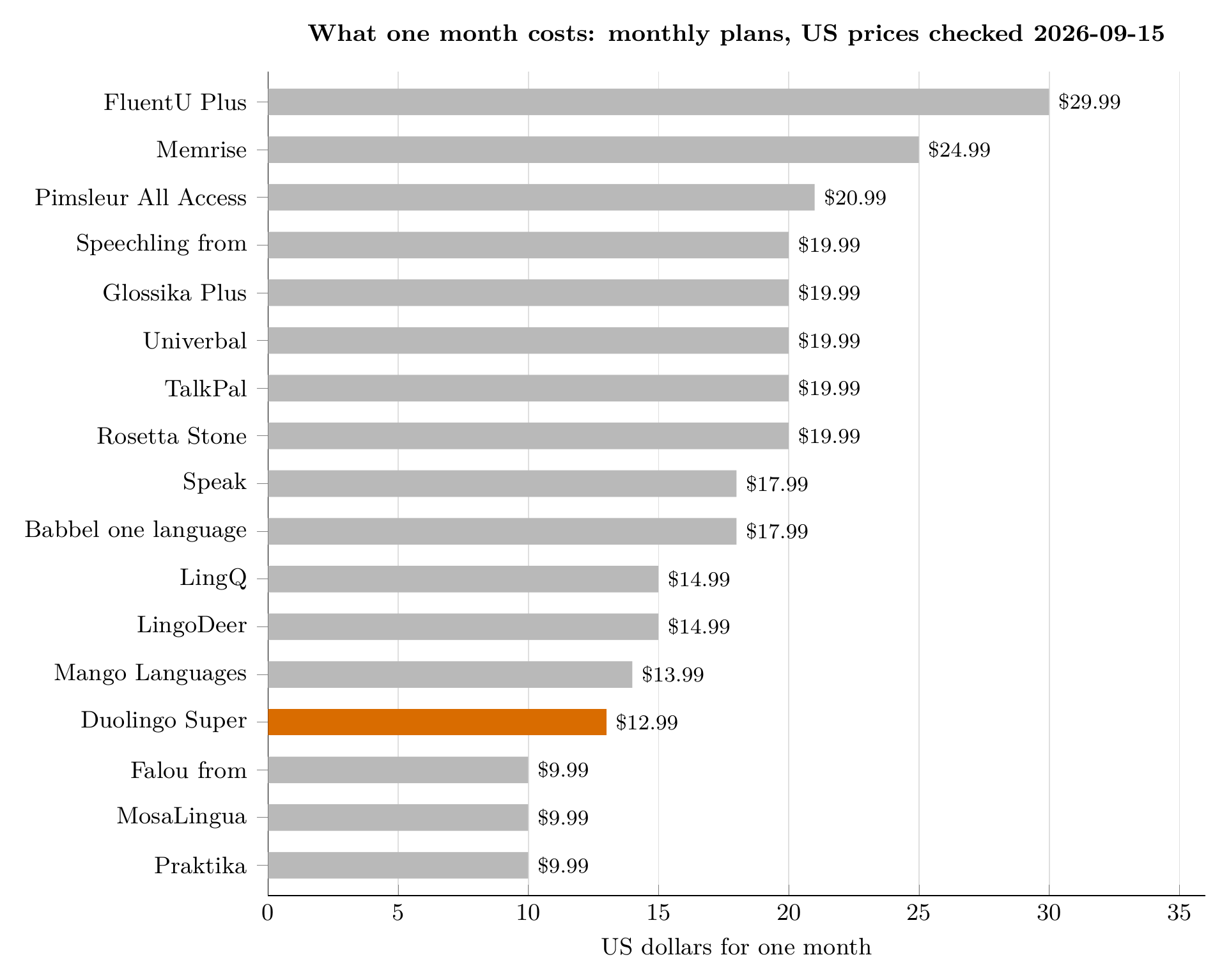
What one month costs: monthly plans of 16 Duolingo alternatives next to Super Duolingo. Prices from the US App Store in-app purchase lists and the companies' own pricing pages, checked 2026-09-15. Falou and Speechling are "from" prices. Chart by Mindomax.
What is actually free
If price is why you are leaving, five of these cost nothing at all: Language Transfer, Anki (except on iPhone), Renshuu, Tandem's exchange and Mango through a library card. Several more have a real free tier with a clear limit: Dreaming's free video library, Speechling's 10 coaching sessions a month, TalkPal's 10 minutes a day and Clozemaster's daily cap. LingQ's 20 saved words and single free lessons from Babbel or Falou are only tasters.
Which one for your language
Spanish has the most choice: Dreaming for listening, Language Transfer for structure, and Speak or a tutor for speaking. For building Spanish vocabulary, see our Spanish vocabulary app guide. French learners get the same trio in Dreaming, Language Transfer's introduction and Speak. German learners should start with Seedlang. For Japanese, Renshuu and LingoDeer cover most of what a beginner needs, and for Mandarin, HelloChinese. For a less common language, check TalkPal, Glossika and Mango, which each list 65 or more.
The honest verdict
Most people do not need to replace Duolingo. They need to add the one thing it does not give them. Keep the free Duolingo streak if you enjoy it, then add a speaking app or a tutor for conversation, and a review tool so the words stay. If you learn by listening to your own recordings, our list of flashcard apps with voice recording covers that side.
If vocabulary is the part that keeps slipping, the free Mindomax plan in entry 20 is one way to try spaced review on your own material.
Frequently Asked Questions
Is there a better option than Duolingo?
It depends on what is missing. For grammar, try Babbel or Busuu. For speaking, try Speak or a tutor on italki. For free learning, try Language Transfer or Mango through your library. Many learners keep Duolingo and add one of these.
What is Duolingo's biggest competitor?
By Google Play downloads, Babbel, Busuu and Memrise each show 50 million or more, the closest to Duolingo's 500 million or more (checked 2026-09-15). By approach, Babbel is the most direct rival for learners who want a structured course.
Why are people cancelling Duolingo?
The most common reasons are the Energy system that limits free users on the phone apps, the lack of real speaking practice, grammar taught mostly by example, and the price of Super. Some also left over the company's AI-first memo in April 2025.
Is there a free alternative to Duolingo?
Yes. Language Transfer is completely free, Anki is free everywhere except iPhone, Renshuu is free for Japanese, Tandem's language exchange is free, and Mango Languages is free if your public library subscribes.
Is Super Duolingo worth it?
Super costs $12.99 a month in the US App Store and removes the Energy limit and ads (checked 2026-09-15). If what you need is speaking practice, the same money buys a month of Praktika or one to three italki lessons.