
The short answer
There is no single best app to learn Spanish, because no app does every job. The big course apps give you structure. Some of the most useful tools, such as SpanishDict and Language Transfer, are free. And the apps that make you listen, speak and review are what turn a course into Spanish you can actually use.
So pick by job. For most beginners that means one course, one free tool and one way to hear real Spanish every day:
The rest of this page is the long version: 28 apps in eight groups, each with its price, its App Store rating and one honest limitation, then a table of all 28 and a chart of what a year costs.
How we checked these 28
We started with every app the top-ranking "best app to learn Spanish" pages recommend, then searched the US App Store for the ones they leave out: verb trainers, graded readers, song and video apps and Spanish-only AI tutors. An app made the list only if its US listing exists, it has real ratings and it was updated in the last 12 months. That rule removed some familiar names. The app behind SpanishPod101 was last updated in August 2025, and AnkiMobile, the iPhone version of Anki, in September 2025.
For each app we read the price list on its US App Store listing on 2026-10-24, its rating and number of ratings, and what the listing says about which Spanish it teaches. Many listings show several prices for one plan; when they do, we give the lowest and say "listed from". Mindomax, our own app, is on the list too. It sits in the vocabulary group, and we describe it the same way as the others. Learning another language as well? Our guide to the best app for each language covers the ten languages Americans study most.
Latin American or Spain Spanish?
Every course on this list that names its Spanish either teaches the Latin American variety or lets you choose it, and for most Americans Latin American Spanish is the right choice: it is the Spanish you hear in the US. Speakers of both varieties understand each other easily. The differences you notice first are small. Spain uses vosotros for "you all" where Latin America says ustedes, most of Spain pronounces the c in cielo and the z in zapato like the English "th", and some everyday words change, such as coche and carro for car.
If you are moving to Spain, pick apps that let you choose: Babbel, Pimsleur, Rosetta Stone, Mango, Drops and Superfluent all offer both, and ConjuGato and Ella Verbs drill vosotros if you ask them to. Duolingo's Spanish course for English speakers teaches ustedes, not vosotros, as Duolingo explains on its own blog. The "Spanish taught" column in the big table below shows what each app's listing says.
The courses: start with one
These six teach Spanish step by step, from your first words to full sentences. Pick one for structure, not all six. If you are stuck between the two biggest, our Babbel vs Duolingo comparison puts them side by side.
1. Duolingo. Short, game-like lessons, and the most-rated app on this list: 4.7 stars from 5.5 million ratings. Every course is free with ads. Super removes the ads and is listed from $9.99 a month or $83.99 a year (checked 2026-10-24). Limitation: the exercises are built around single sentences, so you will need other apps for real listening and conversation.
2. Babbel. Short lessons that explain the grammar in English, with Latin American or Spain Spanish to choose from. Spanish costs $17.99 a month, and the yearly plan listed for Mexican Spanish is $89.99 (checked 2026-10-24). Limitation: only the first lesson is free; the rest needs a subscription.
3. Busuu. A structured course with one extra: you get feedback and tips from Busuu's community of native speakers. Premium is listed from $6.99 a month or $70.00 a year (checked 2026-10-24). Limitation: its listing does not say which Spanish it teaches, and some features need Premium.
4. Pimsleur. Thirty-minute audio lessons in which you answer out loud, made for the car or a walk, in Latin American or Spain Spanish. Spanish is $19.99 a month; All Access, with every language, is $20.99 a month or from $131.99 a year (checked 2026-10-24). Limitation: you learn fewer words than in most apps, and there is little reading.
5. Rosetta Stone. Pictures and sound instead of translation, with speech recognition and a choice of Spain or Latin American Spanish. The current app, Rosetta Stone Sapphire, lists one plan at $19.99, and it covers all 25 of its languages (checked 2026-10-24). Limitation: the method is immersion, so grammar is shown through pictures and examples rather than explained in English.
6. Rocket Spanish. Audio lessons with drills and culture notes on Latin America, bought once and kept for life. Level 1 is $89.99, and all three levels are listed from $179.99 (checked 2026-10-24). Limitation: you pay for a whole level at once, a bigger first step than a monthly plan, although a free trial lets you test a few lessons.
Free and nearly free
7. SpanishDict. Probably the most useful free Spanish app: a dictionary that marks regional words, every conjugation of every verb, a translator and hundreds of video grammar lessons, and the dictionary works offline. It has 4.8 stars from 200,914 ratings. Premium adds offline quizzes and removes the ads for $12.99 a month or $59.99 a year (checked 2026-10-24). Limitation: it is a reference and grammar tool, not a course that gets you speaking.
8. Language Transfer. A free audio course that runs on donations, with no sign-up and no ads. In Complete Spanish, a teacher talks one student through building sentences by thinking rather than memorizing, in 90 short tracks. It has 4.9 stars from 1,575 ratings. Limitation: it is audio only, so you will want something to read and review with.
9. Mango Languages. Conversation-based lessons, with separate courses for Latin American and Castilian Spanish. On its own it costs $13.99 a month or $119.99 a year (checked 2026-10-24), but many US public libraries pay for it: you sign in with your library card at no cost and can share access with up to five family members. Limitation: not every library subscribes, so check yours on Mango's library page first.
Listening and watching
10. Dreaming Spanish. Videos in easy Spanish at your level, with no English and no drills, from teachers from Spain, Mexico, Colombia, Argentina, Venezuela and the Dominican Republic. The method, called comprehensible input, has you understand a lot of Spanish before you try to speak it. Free videos get you started; in the app, Premium is listed at $9.99 and Premium Double at $14.99 (checked 2026-10-24). Limitation: there are no grammar explanations at all, which suits some learners and frustrates others, and the iPhone app is new, with 231 ratings.
11. Parrot. A feed of short videos from native Spanish speakers: tap any word in the captions, save it, and it comes back later as a flashcard. Launched in November 2024, it already has 4.7 stars from 17,051 ratings. Plans start at $5.99 a week, and a year is listed from $44.99 (checked 2026-10-24). Limitation: the clips are short, so it trains your ear on snippets rather than long conversations.
12. Lingopie. TV shows, films and music videos with two sets of subtitles you can tap. You get 8 free minutes a week; after that it is listed from $11.99 a month or $59.99 a year (checked 2026-10-24). Limitation: at 4.4 stars from 2,187 ratings, it is the lowest-rated app on this list.
13. LyricFluent. Spanish through songs: full lyrics, translations, line-by-line playback and lyric games. It has the cheapest yearly plan here, listed from $29.99 (checked 2026-10-24), and 4.9 stars from 3,107 ratings. Limitation: song lyrics are full of slang and poetry, so use it next to a course, not instead of one.
Speaking practice
14. Speak. Lessons built around saying things out loud, with an AI tutor that gives feedback on your pronunciation and grammar. Premium is $17.99 a month or $83.99 a year, and Premium Plus $39.99 a month or $164.99 a year (checked 2026-10-24). It has 4.8 stars from 64,812 ratings. Limitation: there is no free plan beyond the trial, and its listing does not say which Spanish it teaches.
15. Praktika. Conversations with AI tutor characters, each with its own personality and accent, Latin American among them. With 166,647 ratings at 4.7 stars, it is the most-rated AI tutor here. Plans are listed from $6.99, and a year from $49.99 to $139.99 (checked 2026-10-24). Limitation: the price list mixes many promotional tiers, so check the exact plan on the payment screen.
16. Palteca. A Spanish-only app from a company in Spain that combines two ideas from this list: videos of real native speakers that teach the most important words first, and speaking from day one with instant feedback. It has 4.8 stars from 5,081 ratings, and its plans are listed from $7.99 to $95.99 (checked 2026-10-24). Limitation: the App Store list does not name the period of each plan, so read the price screen carefully.
17. Superfluent. Role-play conversations set in real places on a map, in Mexican or Spain Spanish, with a tutor that corrects your pronunciation and phrasing. There is a free version, and Pro is listed from $10.99 a month or $74.99 a year (checked 2026-10-24). It has 4.9 stars from 3,723 ratings. Limitation: the scenes are everyday situations, so it builds confidence more than grammar.
Reading and culture
18. LingQ. A reader for real Spanish: podcasts, books and articles with matching text, plus anything you import yourself, from YouTube to Netflix. Premium is $14.99 a month or $119.99 a year (checked 2026-10-24). Limitation: it assumes you can already read simple Spanish, so complete beginners will find it hard going.
19. Readle. More than 3,000 news stories and short texts in Spanish, graded from A1 to B2, each with audio. Plans are listed from $12.99, with a quarterly plan at $44.99 and lifetime access at $249.99 (checked 2026-10-24). Limitation: it has only 178 ratings so far, and the topics lean toward the news.
20. Unedo. For intermediate learners tired of beginner lessons: a daily word puzzle unlocks a short story about music, food, slang or places, written by authors from Spain and Latin America and read by them in their own accent. Plans start at $12.99, and a year is listed at $99.99 (checked 2026-10-24). Limitation: it is not for beginners, and we found it only on iPhone.
Verbs
Spanish verbs change with every person and tense, so a separate drill app pays off quickly. Start with the verbs you will meet most often; our list of the 100 most common Spanish verbs ranks them by how often they appear in real Spanish.
21. ConjuGato. Fast conjugation drills with spaced repetition, in Latin American or Spain forms, with or without vosotros, and even the vos forms of Argentina and Chile. It has no ads, works offline and has 4.9 stars from 4,201 ratings. Pro is $9.99, paid once (checked 2026-10-24). Limitation: verbs only.
22. Ella Verbs. Fifty levels that take you from the present tense to the subjunctive, with quizzes that bring back the patterns you get wrong, in both Spain Spanish (with vosotros) and Latin American Spanish. At 4.92 stars from 5,475 ratings, it is the highest-rated app on this list. Pro is $9.99 a month, $59.99 a year or $179.99 for life (checked 2026-10-24). Limitation: over a year it costs more than ConjuGato, which sells its drills once.
Vocabulary and review
Course apps introduce words faster than you can keep them. A review app brings each word back just before you would forget it. That is spaced repetition, and it is the cheapest way to make any course stick. To decide which words to learn first, start with our list of the most common Spanish words.
23. Clozemaster. Fill in the missing word in thousands of real sentences, sorted so the most frequent words come first. The basics are free, and Pro is listed from $8.99 a month or $69.99 a year (checked 2026-10-24). Limitation: it is made for A2 to C1 learners, not for day one.
24. Drops. Quick vocabulary games built around pictures, in Mexican or Spain Spanish. It has 4.7 stars from 71,695 ratings, and plans are listed from $7.99 a month (checked 2026-10-24). Limitation: it teaches single words and rarely full sentences.
25. Lingo Legend. A fantasy role-playing game in which you win card battles by answering flashcards, with more than 3,000 common words and phrases. It is $9.99 a month, $69.99 a year or $89.99 for life (checked 2026-10-24), with 4.9 stars from 4,840 ratings. Limitation: part of your time goes to the game rather than to Spanish.
26. Anki. The free, open-source standard for spaced repetition: you make or download decks, and Anki decides when you see each card again. It is free on Android, Windows, Mac, Linux and the web, and the iPhone app costs $24.99, paid once (checked 2026-10-24). Limitation: you build and look after your decks yourself, and the iPhone app was last updated in September 2025.
27. Mindomax. Our own app, so weigh this accordingly. It makes flashcards for you with AI from a word list, a photo, a PDF or an audio file, schedules reviews with spaced repetition, reads cards aloud in 14 languages and has millions of ready-made cards. Everything is free right now, and Premium is free until the end of 2027 (checked 2026-10-24). Limitation: it is not a course and will not teach you grammar, and it is new on the App Store, with no ratings yet.
A real person
28. italki. One-to-one video lessons with native Spanish teachers, and you can choose a teacher by accent. Each teacher sets their own lesson price; the optional italki Plus membership is $5.99 a month or $59.99 a year (checked 2026-10-24). It has 4.8 stars from 9,900 ratings. Limitation: every lesson costs extra, so it works best once an app has given you the basics.
All 28 at a glance
Ratings are US App Store averages with the number of ratings, read on 2026-10-24. "Not stated" means the app's own listing does not say which Spanish it teaches.
What a year costs
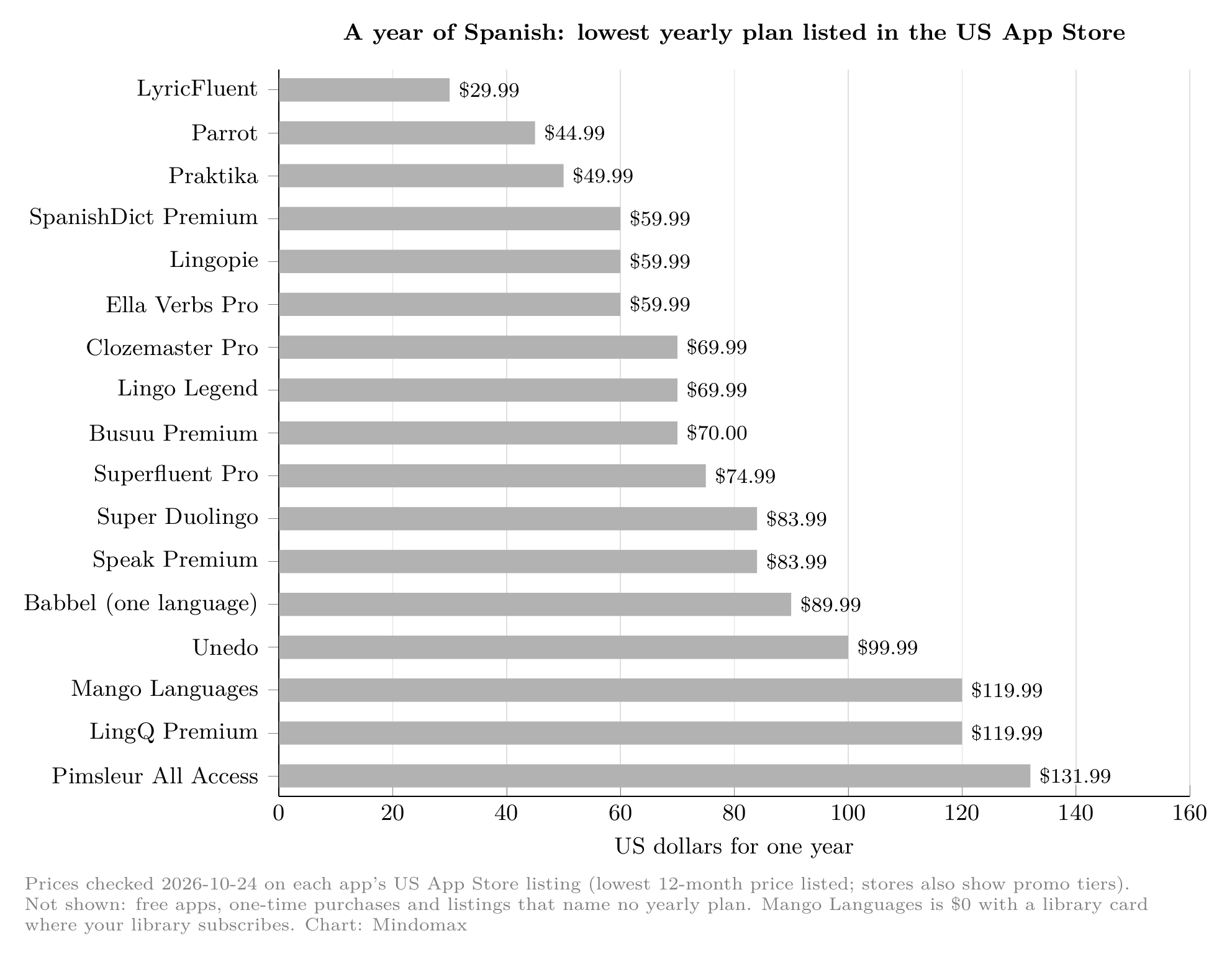
What one year costs: the lowest 12-month plan each app lists in the US App Store (checked 2026-10-24). Free apps, one-time purchases and listings that name no yearly plan are left out. Mango Languages is $0 with a library card where your library subscribes. Chart by Mindomax.
Most yearly plans cost between $44.99 and $89.99 (checked 2026-10-24). The cheapest complete setup costs nothing: Language Transfer and SpanishDict for structure, Dreaming Spanish's free videos for listening and Anki for review, plus Mango if your library pays for it. One-time purchases are worth a look too: ConjuGato is $9.99 and Rocket Spanish Level 1 is $89.99, both paid once (checked 2026-10-24).
Can an app alone make you fluent?
Not on its own, and the numbers show why. The US Foreign Service Institute, which trains American diplomats, plans 30 weeks of full-time study for Spanish to reach a professional level in speaking and listening: about 690 hours in class, plus 17 hours of homework a week. Fifteen minutes a day in an app adds up to about 91 hours a year. Our article on the hardest languages to learn explains these numbers for 59 languages.
That does not make apps useless. It means the mix matters: a course for structure, plenty of listening, regular speaking and a review app, so that the hours you put in are not lost.
Which one should you start with?
If you have no budget: Language Transfer or Duolingo for structure, SpanishDict for grammar and verbs, Dreaming Spanish's free videos for listening and Anki for review. Check your library for Mango before you pay for anything.
If you commute: Pimsleur or Language Transfer in the car, then ConjuGato for five minutes at lunch.
If you are past the basics and stuck: drop the course app. Spend the time on Dreaming Spanish, LingQ or Unedo, add speaking with Speak, Superfluent or an italki teacher, and keep the new words in a review app.
If you are moving to Spain: choose Spain Spanish in Babbel, Pimsleur or Mango, and turn on vosotros in ConjuGato.
Whatever you choose, keep the words you meet along the way. If you want one place for them, Mindomax is free to use.
Sources
US App Store listings of all 28 apps, including their in-app purchase lists, read on 2026-10-24. Each app's name above links to its listing or official site.
Duolingo, What is Spanish vosotros?, Duolingo Blog.
US Department of State, Foreign Service Institute, Foreign Language Training.
Mango Languages, Mango for Libraries, read on 2026-10-24.
Language Transfer, languagetransfer.org, read on 2026-10-24.
Dreaming Spanish, Dreaming Spanish teachers, read on 2026-10-24.
Frequently Asked Questions
What is the best free app to learn Spanish?
Language Transfer for a full audio course, SpanishDict for grammar, verbs and the dictionary, and Duolingo for a daily habit. All three are free. If your public library subscribes to Mango Languages, Mango is free too.
Is Duolingo good for learning Spanish?
It is a good free start and the most-rated app on this list, with 4.7 stars from 5.5 million ratings. It is weaker on listening and conversation, so pair it with a listening app such as Dreaming Spanish and some speaking practice.
Can you learn Spanish with just an app?
You can learn a lot, but not everything. The Foreign Service Institute plans about 690 classroom hours for Spanish, and 15 minutes a day in an app is about 91 hours a year. Mix a course with listening, speaking and review.
Which app teaches Latin American Spanish?
Every course here that says which Spanish it teaches covers Latin American Spanish. Duolingo teaches ustedes rather than vosotros, Rocket Spanish focuses on Latin America, and Babbel, Pimsleur, Rosetta Stone, Mango, Drops and Superfluent let you choose between Latin American and Spain Spanish.
What is the best app for speaking Spanish?
For practice with an AI tutor, Speak or Praktika. For Spanish-only practice built on videos of real speakers, Palteca. For real conversations with a person, book a teacher on italki.
Is Babbel better than Duolingo for Spanish?
Babbel explains the grammar in English and costs $17.99 a month (checked 2026-10-24); Duolingo is free and better for building a daily habit. Many learners start on Duolingo and switch when they want the rules explained.


