
The short answer
The ten most common Japanese words are する (suru, to do), いる (iru, to be), 私 (watashi, I), 彼 (kare, he), こと (koto, thing), ない (nai, not), ある (aru, to be, to have), 何 (nani, what), 言う (iu, to say) and いい (ii, good). Together they make up 8.8% of all the words in everyday Japanese.
They are still not the most frequent things in a Japanese sentence. That title belongs to the particles and verb endings: は, の, だ, た, に, を, て, が. These small pieces are 47.8% of everything said, almost half. The 30 most frequent items of all, 18 grammar pieces and 12 words, already make up 50.3%.
So this page has two lists: the 30 grammar words first, then the 100 most common real words. Learn both and you know 65.2% of all the words in everyday Japanese.
We counted the ranking ourselves in 21.4 million words of Japanese: film and TV subtitles plus the Tatoeba collection of everyday example sentences, split into words and grouped under their dictionary form with UniDic, the dictionary Japanese linguists use for this. How we did it, and where the method falls short, is at the end.
The 30 grammar words that hold every sentence together
Particles are the short words after a noun that say what it does in the sentence: は marks the topic, を the object, に the place or time. Endings such as ます, た and ない change a verb's tense or tone. You cannot translate them one by one, but you cannot build a sentence without them, and they are almost all written in hiragana.
"Share of all words" is how much of everything said in everyday Japanese each one makes up.
Two of them are read differently from how they are written: は is said wa and を is said o. A third, へ ("towards", number 34 on the full list), is said e. The 30 together are 44.1% of all words.
The 100 most common Japanese words
These are the content words: verbs, nouns, pronouns, adjectives and adverbs, without the particles above. Every verb is shown in its dictionary form, so 食べた, 食べます and 食べて all count as 食べる (taberu, to eat). Where a word is usually written in kanji, its reading follows in hiragana. "Per million words" is how often the word appears in every million words of everyday Japanese, all its forms together.
A few rows need a note. ください (kudasai, please) and なさい (nasai) are forms of the polite verbs くださる and なさる and almost always appear in these forms. つく ranks 85 mostly because of について (ni tsuite, about). And 語 (go) is in the list because the dictionary splits 日本語 (nihongo, Japanese) into 日本 + 語, and 日本語 and 英語 (eigo, English) are very common words.
Some rows also show where the text came from. 殺す (korosu, to kill) and 死ぬ (shinu, to die) are in the top 100 because films are full of crime and drama. 彼 (he) and 彼女 (she) rank high because many subtitles and example sentences are translated from English. In Japanese written for Japanese readers both are less common, as the pronoun section below shows.
How much Japanese do these words cover?
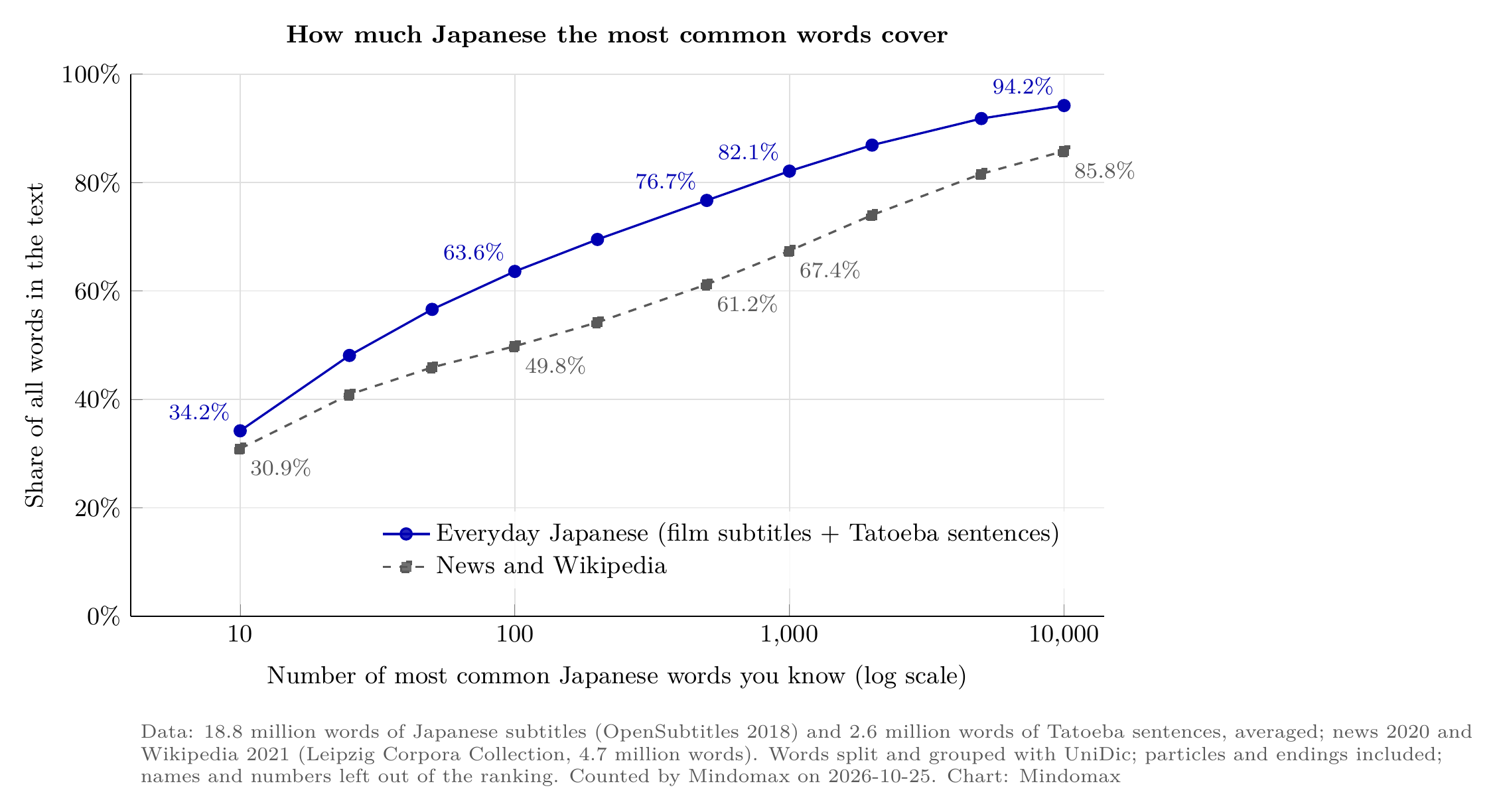
The 100 most common words cover 64% of everyday Japanese and 1,000 cover 82%. News and Wikipedia need far more: there, 1,000 words cover only 67%. Data: 18.8 million words of subtitles from OpenSubtitles 2018 and 2.6 million words of Tatoeba sentences, averaged; news 2020 and Wikipedia 2021 from the Leipzig Corpora Collection. Counted by Mindomax on 2026-10-25.
The curve rises fast and then slows down. The 100 most frequent items, grammar words included, cover 63.6% of everyday Japanese, 500 cover 76.7% and 1,000 cover 82.1%. After that every extra word buys less: 2,000 words cover 86.9%, 5,000 cover 91.8% and 10,000 cover 94.2%. Reaching 90% takes 3,426 words, and 95% takes 14,109.
If you learn the 30 grammar words first and then work down the list of real words, the 30 plus the top 100 cover 65.2% of all words, the 30 plus 1,000 words cover 79.8%, and the 30 plus 2,000 words cover 84.0%.
News and Wikipedia are much harder. There the 1,000 most frequent items cover only 67.4% of the text, because written Japanese uses more nouns, names and numbers. Names alone are 3.4% of the written text against 1.9% of everyday Japanese, and Latin letters and digits 5.8% against 1.3%.
One caution: these numbers count short words, the unit Japanese dictionaries use. 日本語 counts as two words (日本 + 語), and so does 勉強する (benkyō suru, to study: 勉強 + する). That makes coverage look a little higher than it would if every compound counted as one word.
What the top 100 is made of
• 34 nouns, but only one in the top ten: こと (koto, thing), at number 5. Then come 人 (hito, person), もの (mono, thing), 今 (ima, now), ため (tame, for), 時 (toki, time) and 自分 (jibun, oneself).
• 32 verbs. Verbs are 14.7% of all words, and the top ten (する, いる, ある, 言う, 行く, なる, 来る, 見る, できる, 思う) are 43.9% of all verb use. する alone is 2.2% of all words, because it turns hundreds of nouns into verbs: 勉強する (to study), 電話する (to phone).
• 17 pronouns and question words: 私, 彼, 何, 彼女, あなた, それ, 君, これ, 俺, 誰, ここ, 僕, お前, どこ, いつ, 我々, そこ.
• 9 adverbs: どう (how), そう (so), もう (already), まだ (still), すぐ (right away), とても (very), よく (well, often), なぜ (why) and ちょっと (a little).
• 3 words that stand before a noun: その (that), この (this) and そんな (such).
• 3 adjectives: ない (not), いい (good) and 好き (liked). The next ones are 早い (hayai, early), 悪い (warui, bad), 欲しい (hoshii, wanted), 大丈夫 (daijōbu, all right), 新しい (atarashii, new) and すごい (sugoi, amazing).
• 2 interjections: ああ (ā, ah) and ありがとう (arigatō, thank you).
Together the 100 words are 21.1% of all words, one word in five. The particles and endings do much of the rest.
I, you, he, she: the pronoun problem
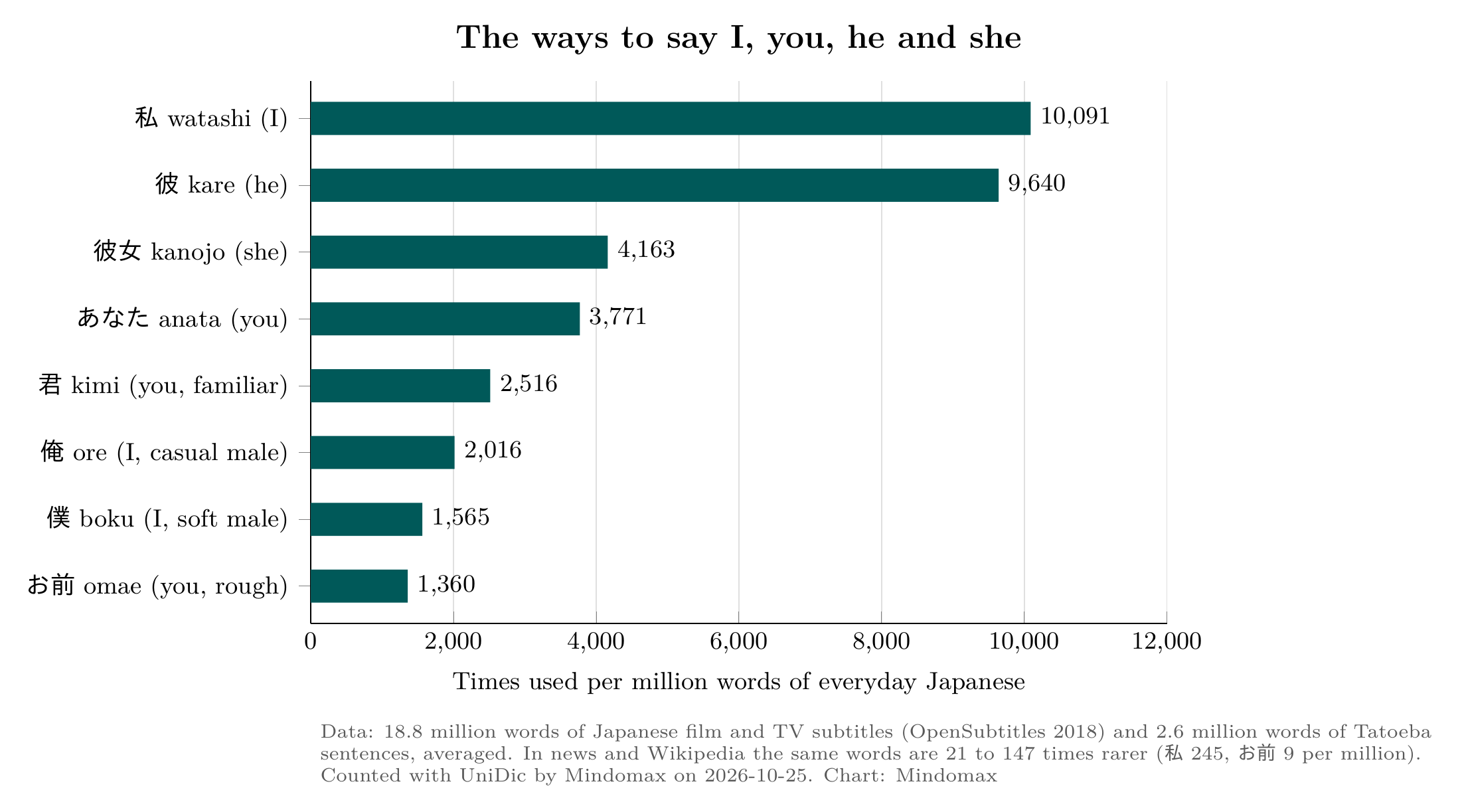
Japanese has many words for I and you. Films and example sentences use them all the time; news and Wikipedia almost never do. Data: the same 21.4 million words of subtitles and Tatoeba sentences; written rates from the Leipzig news and Wikipedia samples. Counted by Mindomax on 2026-10-25.
The list shows three words for "I": 私 (watashi), 俺 (ore) and 僕 (boku), and three for "you": あなた (anata), 君 (kimi) and お前 (omae). Which one a speaker picks says who they are and how they see the listener. 私 is neutral and safe, 僕 is a softer male "I", 俺 is casual and male, and お前 is rough.
The bigger surprise is how rarely written Japanese uses any of them. 私 appears 10,091 times per million words in films and example sentences, but only 245 times in news and Wikipedia. お前 drops from 1,360 to 9. Japanese leaves the subject out whenever the context makes it clear, and uses names and titles such as 田中さん (Tanaka-san) where English says "you".
彼 (kare, he) and 彼女 (kanojo, she) are a special case. In our everyday count they rank 4 and 14, partly because many subtitles and Tatoeba sentences are translations from English. In NINJAL's Balanced Corpus of Contemporary Written Japanese (BCCWJ), 104 million words of books, newspapers, magazines and blogs written in Japanese, 彼 ranks 101st and 彼女 217th among all words, particles included. Both also mean boyfriend and girlfriend.
In practice: say 私 (watashi), leave "you" out where you can, and use the person's name with さん (san). That is what the counts suggest, and it is what Japanese speakers do.
Speech or writing? The words that change
Everyday and written Japanese share most of their basic words: 89 of our top 100 are also among the 500 most frequent entries in the BCCWJ word list. Nine of the 11 that are not are speech or drama words: 君, お前, 我々, ああ, 奴, 死ぬ, 殺す, なさる and ありがとう. The other two, 本 (book) and 父 (father), just miss at 538 and 554.
The words that lean hardest towards speech are the ones you use with someone in front of you. お前 is 147 times more common in films and example sentences than in news and Wikipedia, 君 94 times, あなた 72 times, 俺 57 times, 私 41 times and ありがとう 30 times. 本当 (hontō, really), どう (dō, how) and もう (mō, already) are about 10 times more common in speech.
Written Japanese leans the other way, towards dates, places and procedures. 年 (nen, year) appears 4,381 times per million words in news and Wikipedia and 766 times in everyday Japanese. 月 (gatsu, month, as in 10月), 市 (shi, city), 円 (en, yen), 県 (ken, prefecture), 行う (okonau, to carry out) and 場合 (baai, case) are near the top of written Japanese but rank between 297 (月) and 2,918 (県) in everyday Japanese. If your goal is reading the news, add them early.
Where are konnichiwa and arigatō?
Textbooks start with greetings because you need them on the first day, not because they are frequent. Here is where the famous ones really rank among the content words of everyday Japanese. Phrases made of several words, marked "about", are placed where a single word with the same count would rank.
Konnichiwa, the word every course teaches first, is only number 707. In films and everyday sentences people rarely say "hello" to each other: they use a name, ohayō in the morning, or nothing at all. Sayōnara is rarer still, because it sounds final; between friends you will hear じゃあね (jā ne) or またね (mata ne), "see you". The useful ones are the small social words: ありがとう, 大丈夫, はい, すみません and ごめん. Learn those in your first week.
How to learn the 100 most common Japanese words
1. Learn hiragana first. Every word in the grammar table is written in hiragana, and so are 41 of the top 100 words.
2. Learn particles inside short sentences, never alone: 私は学生です (watashi wa gakusei desu, I am a student) teaches は, です and a word order at once.
3. Learn each verb in two forms: the dictionary form in the table (食べる) and the polite form you will say first (食べます).
4. Use flashcards with spaced repetition: one card per word, Japanese on one side, reading and meaning on the other, reviewed just before you would forget it. Ten new words a day takes you through the top 100 in ten days. Our guide on how to study with flashcards shows how to set up cards that stick.
5. Learn kanji through words. Learn 時間 as jikan (time), and 時 and 間 come with it.
6. Then listen and read. The list gets you to the point where a simple sentence is mostly familiar; only real Japanese takes you further.
Expect it to take a while. The US Foreign Service Institute puts Japanese in its hardest group, at 88 weeks of full-time study for an English speaker, as our ranking of the hardest languages to learn shows.
Apps that help you drill them
Any flashcard app can hold this list. These tools are built for Japanese, and each is good at one part of it. Prices are from the US App Store, Google Play and the developers' own sites.
For a longer comparison of flashcard apps for Japanese, with kanji workflows and JLPT preparation, see our pick of the best flashcard app for Japanese.
How we counted
Everyday Japanese: 3,170,155 lines of Japanese film and TV subtitles from OpenSubtitles 2018 (Lison and Tiedemann, 2016), 18.8 million words, and 248,941 Japanese example sentences from Tatoeba (CC BY 2.0 FR), 2.6 million words. Written Japanese: 100,000 sentences of news from 2020 and 100,000 of Wikipedia from 2021 from the Leipzig Corpora Collection (Goldhahn, Eckart and Quasthoff, 2012), 4.7 million words.
Every sentence was split into words with fugashi (McCann, 2020) and UniDic 2.1.2, and every word grouped under its dictionary form and reading. Punctuation and symbols were dropped. The everyday ranking is the average of each word's rate per million words in the subtitles and in Tatoeba, so that neither source dominates: films over-represent drama words, and example sentences over-represent textbook ones. Names, numbers, Latin letters and fillers such as えーと count in the total but are not ranked. The readings in the top 100 were checked by hand, because UniDic reads 私 as watakushi by default while most people say watashi.
As a cross-check we compared the ranking with the word list of NINJAL's BCCWJ (Maekawa et al., 2014), 104 million words of written Japanese.
Where it falls short: subtitles are scripted and many are translated from other languages, and Tatoeba sentences are often written by learners or translated from English. Both push up 彼, 彼女 and あなた. UniDic splits compounds into short units, and words with close counts can swap places in another corpus, so read the ranks as approximate.
We used the same approach for the most common Spanish words and the most common French words. If you would rather not type 100 cards by hand, you can paste this list into Mindomax and get flashcards with spaced review for free.
Frequently Asked Questions
What are 10 Japanese words?
The ten most common words in everyday Japanese are する (suru, to do), いる (iru, to be), 私 (watashi, I), 彼 (kare, he), こと (koto, thing), ない (nai, not), ある (aru, to be, to have), 何 (nani, what), 言う (iu, to say) and いい (ii, good). Together they are 8.8% of all words.
What are 20 basic Japanese words?
The ten above plus その (sono, that), 行く (iku, to go), なる (naru, to become), 彼女 (kanojo, she), あなた (anata, you), それ (sore, that one), この (kono, this), 来る (kuru, to come), 見る (miru, to see) and どう (dō, how). The 20 make up 12.5% of everything said.
How many Japanese words do I need to know?
The 1,000 most frequent items cover 82.1% of everyday Japanese in our count, 2,000 cover 86.9% and 5,000 cover 91.8%. News is harder: 1,000 cover only 67.4%. Treat the first 1,000 as the base, not the goal.
What is the most common word in Japanese?
The particle は (wa), which marks the topic, at 5.2% of all words, just ahead of の (no) at 5.1%. The most common real word is the verb する (suru, to do), at 2.2%.
How do you say "I love you" in Japanese?
愛してる (aishiteru), but it is rare: about 100 times per million words in our count, mostly in films. Japanese speakers far more often say 好き (suki, I like you), which is about nine times as common.
Is konnichiwa a common word?
Not very. こんにちは is number 707 among the content words of everyday Japanese. ありがとう (arigatō, thank you) is number 98 and 大丈夫 (daijōbu, all right) number 110.
Should I learn hiragana before these words?
Yes. Every particle in the grammar table is written in hiragana, and so are 41 of the top 100 words, including する, いる, こと and ない.


