
The short answer
The ten most common German words are der (the, in all its forms: die, das, den, dem, des), ich (I), sein (to be), du (you), sie (she, they, and Sie, the polite you), haben (to have), ein (a), nicht (not), es (it) and und (and). Together they make up 28.9% of all the words in spoken German.
Learn the 100 words in the table below and you know 60.7% of every word said on German screens. The 1,000 most common words cover 80.0%.
One thing surprises most learners: only four of the top 100 are nouns. Mann (man), Frau (woman), Zeit (time) and Tag (day) are the only ones. The rest are the small words that hold every sentence together, plus about twenty verbs. The nouns come later, and each one brings its own der, die or das.
We counted this ranking ourselves in 10.9 million words of German film and TV subtitles. Every word is counted under its dictionary form, so ist, bin and war all count for sein, and a split verb like "Ich rufe dich an" counts once for anrufen. How we did it, and where the method falls short, is at the end.
The 100 most common German words
"Per million" is how many times the word appears in a million words of spoken German, with all its forms. The forms in brackets are counted under the same word: mich and mir under ich, im and ins under in.
Two entries look odd at first. sein appears twice because German uses one spelling for two words: sein the verb (to be, number 3) and sein the possessive (his, number 63). And ihr is three words in one: "ihr" for you all, "ihr" for her and their, and the polite "Ihr" for your.
What the top 100 is made of
Sorted by type, the 100 words look like this:
47 small grammar words (articles, pronouns, prepositions, conjunctions, question words) make up 39.9% of all words.
21 verbs make up 13.0%.
21 adverbs such as hier, jetzt, noch and schon make up 5.2%.
4 answer words, ja, nein, bitte and danke, make up 1.4%.
3 adjectives, gut, andere and wirklich, make up 0.7%.
4 nouns make up 0.5%.
Verbs carry more weight than their count suggests. They are 22.7% of all words, and three of them do a third of that work: sein, haben and werden are 31.5% of all verb uses, because German builds its past and future tenses with them ("ich habe gesehen", "ich werde gehen"). The ten most common verbs (sein, haben, werden, können, wissen, wollen, sagen, müssen, machen, gehen) are 46.3% of all verb uses.
The modal verbs arrive early too: können at number 17, wollen at 29, müssen at 37, sollen at 51, möchten (would like) at 133 and dürfen (may) at 140. Learn them as a set, because they all send the second verb to the end of the sentence: "Ich muss jetzt gehen."
The most common German nouns, with der, die or das
Nouns are where German gets expensive. There are only 4 in the top 100, but 121 in the top 500 and 329 in the top 1,000, about a third of everything you learn after the first hundred words. Each one comes with an article you have to memorize.
There is no safe default. Of the 100 most common nouns, 40 take die, 33 take der and 26 take das (one takes either). Across the top 1,000 nouns it is 405 der, 354 die and 215 das, and the rest are mixed. Guess "der" every time and you are wrong more often than right. Das Mädchen (the girl) is neuter, because a noun made small with -chen always is.
That is why the best habit is to never learn a noun alone. Learn "der Tag", not "Tag", and put the article on the flashcard.
The articles themselves are everywhere. The six forms der, die, das, den, dem and des are 5.7% of all words, and the most common of them is das (34.8% of the six), not der, because "das" is also the word for "that": "Das ist gut", "Was ist das?"
Spoken German and written German are not the same list
We ran the same count on 4.5 million words of German news from 2024. The two lists start the same way but split fast.
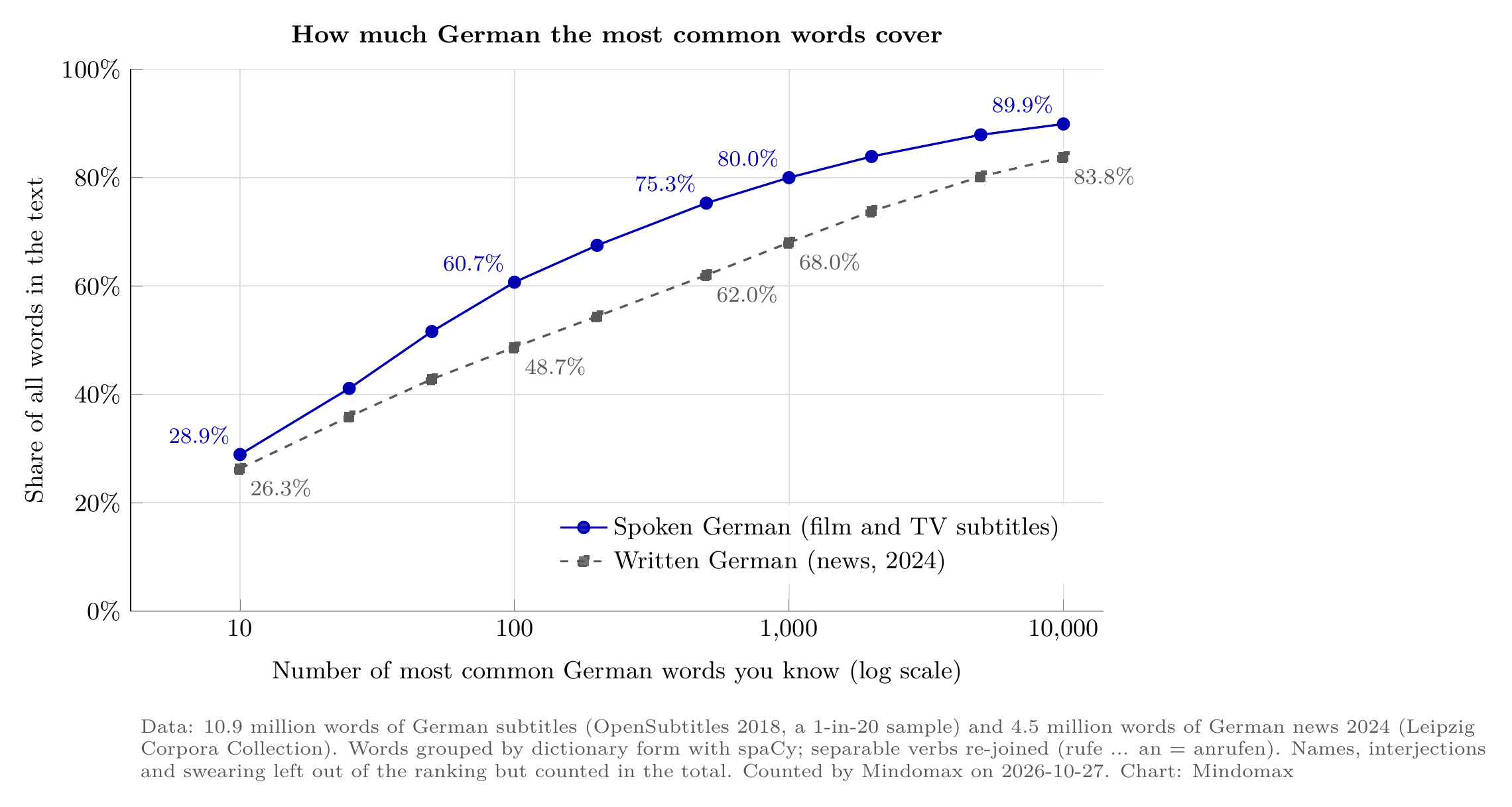
The 100 most common German words cover 61% of spoken German and 1,000 cover 80%. News needs more: there, 1,000 words cover 68%. Data: 10.9 million words of subtitles from OpenSubtitles 2018 and 4.5 million words of German news 2024 from the Leipzig Corpora Collection, counted by Mindomax on 2026-10-27.
The 100 most common words cover 60.7% of spoken German but only 48.7% of news. The 1,000 most common cover 80.0% of spoken German and 68.0% of news. And our spoken top 1,000 covers only 61.8% of news text, because newspapers run on words a film rarely needs. In the news count, ich drops to number 37 and du to 182. The first nouns are Jahr (year) at number 30, then Prozent and Euro at 72 and 73.
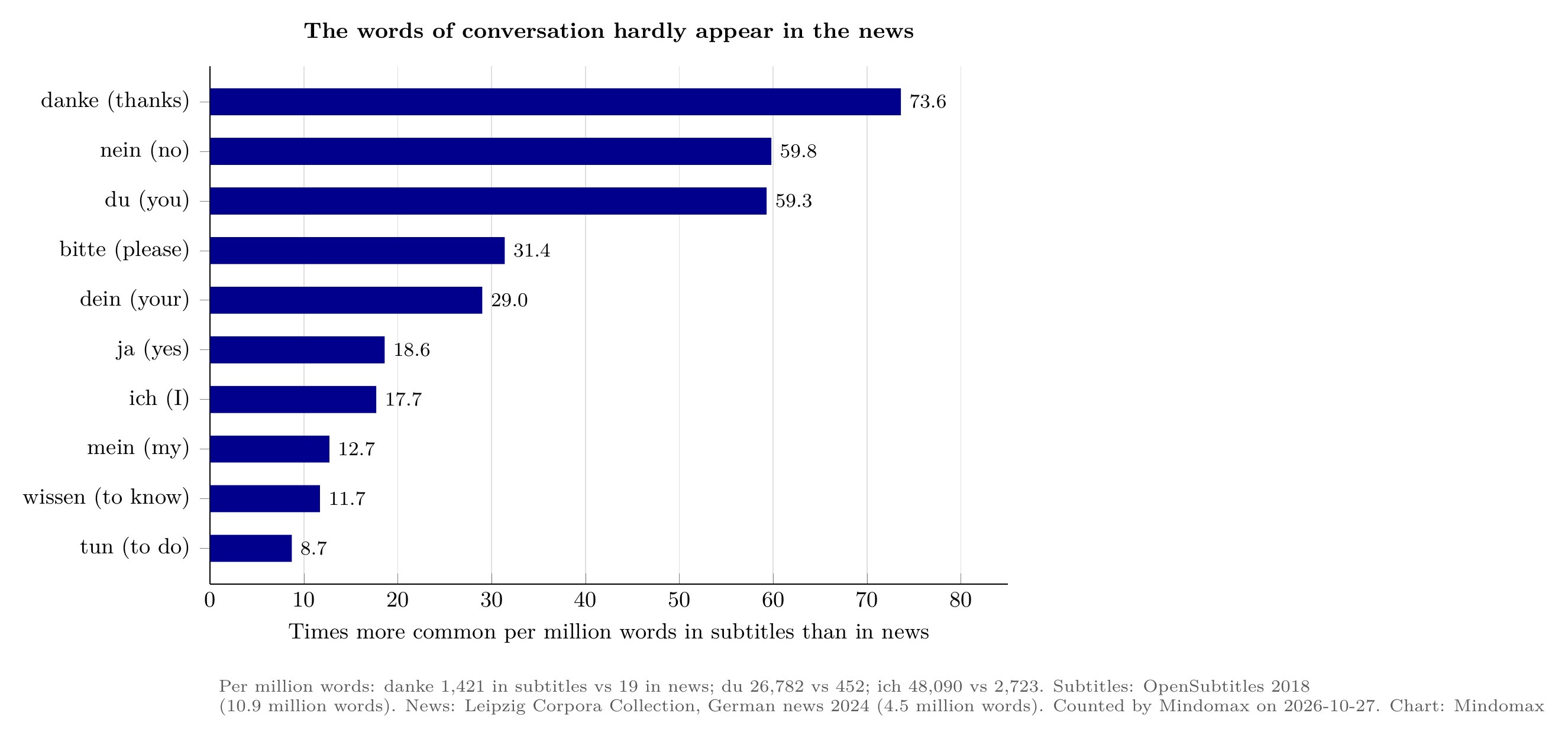
The words of conversation, like du, ja, danke and bitte, are 9 to 74 times rarer in newspaper German. Data: OpenSubtitles 2018 (10.9 million words) and Leipzig news 2024 (4.5 million words), counted by Mindomax on 2026-10-27.
The words of conversation are the ones a newspaper almost never uses: danke appears 1,421 times per million words in subtitles and 19 times in news. It runs the other way too. Euro is 90 times more common in news, Prozent (percent) 42 times, and jedoch (however) 22 times. If your goal is talking, start with the spoken list. If it is reading the news, you will need the written words sooner.
du or Sie?
German has two words for "you". du is for friends, family and children. Sie, always written with a capital S, is for strangers, customers and anyone you would address as Mr. or Ms. Smith.
On screen, du wins by a wide margin: it is the fourth most common word, at 26,782 per million. But Sie is far from rare. Sie looks exactly like sie (she, they), so we counted them together as number 5, and then checked every case in the middle of a sentence, where the capital letter tells them apart. 60.0% of those were the polite Sie.
The rule for a beginner: use Sie with any adult you do not know, and switch to du when the other person offers it. Learn both sets of forms, du with dich and dir, Sie with Ihnen and Ihr.
Greetings and phrases, and where they really rank
Textbooks open with hello and goodbye. Real German uses them less than you would expect. As single words, bitte is number 77 in our ranking, danke 84, hallo 127, Entschuldigung (sorry, excuse me) 417 and tschüss (bye) 715.
Two answers people search for most are in that table. "I'm sorry" is "Es tut mir leid", and on screen it is 3.7 times as common as "Entschuldigung", which is more of an "excuse me" or a quick "sorry". "I love you" is "Ich liebe dich", 140 times per million words. "Ich hab dich lieb" is the warmer, less romantic version for family and friends.
The "cool" German words are rare
Lists of beautiful German words always include Schadenfreude, Fernweh and Wanderlust. They are fun to know. They are also some of the rarest words you can learn. These counts come from the full list of 156 million words of German subtitles, each word counted in the form shown:
Danke is about 2,000 times as common as Schadenfreude. English borrowed Wanderlust and Zeitgeist, but they barely appear in German films and TV. Angst is the exception: it is an everyday word in German too, number 206 in our ranking.
How the list compares with the Goethe-Institut A1 list
The Goethe-Institut publishes the word list for its A1 exam, Start Deutsch 1: about 650 words a beginner should understand. We checked our most common content words against it.
The two agree at the top. 18 of our 20 most common nouns are on the A1 list (not Gott and Sache), and so are 18 of our 20 most common verbs (not lassen and denken). Further down they part ways: 65 of our top 100 nouns and 68 of our top 100 verbs are on it. Words like Sache, Ding, Idee, Geschichte and Angst, or lassen, denken, versuchen, vergessen and zeigen, come up all the time in conversation but are not on the A1 list.
It works the other way round as well. The A1 list is built for the situations of the exam, like forms, trains and the post office, and some of its words are rare in films: Formular (form) is number 4,673 in our ranking, Gleis (platform) 5,157 and Briefmarke (stamp) 8,665. If you are taking the exam, learn the official list. If you want to follow a conversation, the frequency list gets you there faster. Ideally, both.
How to learn these words
A list of 100 words is the perfect size for flashcards. A few rules make German cards work better:
1. Put the article on every noun card: "der Tag", "die Zeit", "das Jahr". Color-coding by gender helps some people.
2. Learn separable verbs as a whole and with an example: anrufen, "Ich rufe dich morgen an".
3. Learn the small words inside short sentences, not alone. doch, mal and schon mean little by themselves and a lot in "Komm doch mal!"
4. Review with spaced repetition: see each card again just before you would forget it, at growing gaps.
Our guide on how to study with flashcards explains the method step by step, and Anki for language learning shows how to set it up in Anki. If you want to know how long the whole journey takes: German needs 36 weeks of full-time study at the US Foreign Service Institute, more than French or Spanish, as our ranking of the hardest languages shows.
Apps that help you drill them
These are the tools we would use to learn the list. Each listing was checked in the US App Store or Google Play on 2026-10-27: still online and updated within the last year. All of them except our own already have ratings from real users.
App stores list several prices for the same plan (monthly, yearly, introductory offers), so we give the lowest price listed. For a longer comparison, see our list of flashcard apps for language learning.
How we counted
Subtitles: the German part of OpenSubtitles 2018, a collection of film and TV subtitles from opensubtitles.org published by the OPUS project. The full file has 41.6 million lines. We took every 20th line across the whole file, 2.1 million lines and 10.9 million words.
News: 300,000 sentences of German news from 2024 from the Leipzig Corpora Collection, 4.5 million words.
Counting: we tagged every word with spaCy's German model, which names each word's dictionary form and part of speech, and re-joined separable verbs, so "rufe ... an" counts once as anrufen. The model made mistakes on film German, mostly on du-forms and commands like "hast", "kannst" and "sieh". We fixed those in a second pass with simplemma and by hand, and checked the top 100 one by one. Names, interjections (oh, hey, okay), English words and swearing are left out of the ranking but counted in the total; together they are 6.1% of all words. Numbers written as digits and punctuation are not words here.
The rare words in the "cool words" table come from a full word count of the OpenSubtitles 2018 German subtitles, 156 million words, published as the FrequencyWords list.
Where this falls short:
Subtitles are scripted speech, and many are translated from English-language films. That pushes up du, Sie, okay and drama words: Gott is number 116, töten (to kill) 150 and sterben (to die) 162. Real everyday German has more dialect and filler words.
The tagger is good but not perfect. Below rank 1,000, small errors remain. Genders are the tagger's majority call over every use, and a few nouns really have two (der or das Teil).
German writes compounds as one word (Hauptbahnhof, Kindergarten), and each counts on its own. That is one reason German needs more words than French or Spanish for the same coverage: the 1,000 most common French words cover 85.2% of French subtitles, against 80.0% here.
We built the same kind of list for Spanish, French and Japanese.
If you would rather not type 100 cards by hand, you can paste this list into Mindomax and get flashcards with spaced review for free.
Frequently Asked Questions
What are the most common German words?
The ten most common German words are der (the), ich (I), sein (to be), du (you), sie (she, they) or Sie (polite you), haben (to have), ein (a), nicht (not), es (it) and und (and). Together they are 28.9% of all words in spoken German.
What are 20 basic German words?
The ten above plus wir (we), er (he), in (in), zu (to), was (what), werden (to become, will), können (can), ja (yes), mein (my) and mit (with). The 20 make up 38.3% of everything said.
How many German words do I need to know?
The 1,000 most common words cover 80.0% of spoken German, and 85% takes about 2,500 words. Reading the news needs more: there, 1,000 words cover 68.0%.
What are some cool words in German?
Schadenfreude (joy at someone else's bad luck), Fernweh (longing for faraway places), Feierabend (the end of the workday) and Ohrwurm (a song stuck in your head) are favorites. Most of them are rare: Schadenfreude appears less than once per million words.
How do Germans say "I love you"?
"Ich liebe dich." It appears 140 times per million words in German subtitles. For family and friends, "Ich hab dich lieb" is the softer version.
What is German for "I'm sorry"?
"Es tut mir leid", often shortened to "Tut mir leid". It is 3.7 times as common as "Entschuldigung", which is closer to "excuse me".
Do I need to learn der, die and das?
Yes. Of the 100 most common German nouns, 40 take die, 33 take der and 26 take das, so no article is a safe guess. Learn every noun with its article.
Should I learn du or Sie first?
Both, early. du is the fourth most common word in spoken German. Sie is needed with strangers: 60% of the sie/Sie forms in the middle of a sentence are the polite Sie.


