
Most "Kahoot alternatives" lists are written by a company that sells one, and it is always number one on its own list. We read the pricing page or help center of every tool below on 2026-10-03. Every price carries that date, and every tool gets one plain limitation.
Kahoot comes first as the baseline. The rest are grouped by what decides it in a classroom: devices, class size, and whether you want homework too.
The short answer
Free, big class, live game: Wayground (100 students on the free plan) or Gimkit (no player cap on free, but only about three game modes at a time).
Younger students who love collecting things: Blooket, 60 players free, no student accounts.
No student devices at all: Baamboozle, JeopardyLabs or Factile, all played from one projected screen.
You already teach from slides: ClassPoint (inside PowerPoint) or Pear Deck (Google Slides), both with a free tier.
You mostly want to check understanding, not run a game show: Socrative, Formative or Classtime.
Completely free, no accounts, nothing to sign up for: Flippity, built on a Google Sheet.
Why teachers look past Kahoot
Kahoot is still very good at what it does. Its free plan for teachers is called Kahoot! Go. The comparison table on Kahoot's own plans page gives it a limit of 40 players per live game, while the FAQ on the same page says "up to 10" (both checked 2026-10-03). If you teach more than 40 students at once, you are paying either way. The cheapest paid plan, Kahoot!+ Bronze, is $3 a month billed as $36 a year, or $9 billed monthly, and allows 50 players (checked 2026-10-03). Assigning a kahoot as homework with no deadline needs a higher tier.
The other reason is the game itself. A 2020 review of 93 studies on Kahoot by Wang and Tahir found it usually helps learning and mood in class. It also listed the problems students and teachers keep reporting: time pressure, answers you cannot change, falling behind after one mistake, and scoring based on speed that pushes some students to guess instead of think.
All 26 at a glance
Five vendors (Wordwall, AhaSlides, Slido, Genially and Educaplay) showed us euro prices because of where we checked from. We give the figure we saw rather than guess a dollar conversion.
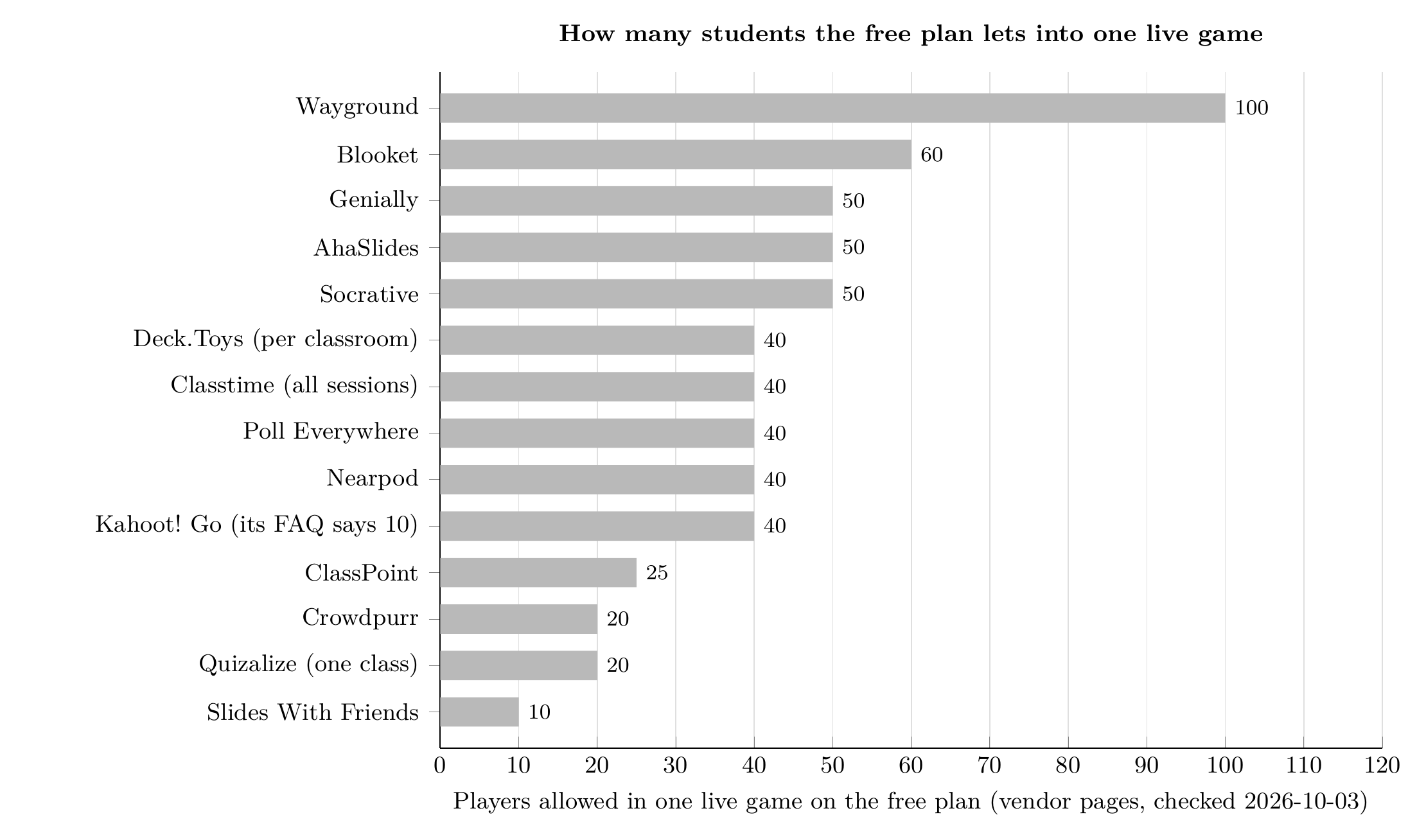
Players allowed in one live game on each free plan, from each vendor's own pricing or help page, checked 2026-10-03. Gimkit (no cap) and Mentimeter (50 per month, not per game) are left off. Chart by Mindomax.
Live game shows: closest to Kahoot
1. Blooket. The most direct Kahoot replacement for younger classes. Students collect characters called Blooks and play modes that feel like real games rather than a quiz with music. The free Starter plan hosts up to 60 players, and only the teacher needs an account. Plus raises that to 300 players and homework deadlines from 14 to 365 days. Limitation: Blooket does not show the Plus price until you log in, so we could not date one (checked 2026-10-03).
2. Gimkit. Gimkit lets players earn in-game money for right answers and spend it on upgrades, so a slow but accurate student can still win. The free plan lets you play with as many students as you want, but only about three game modes are available at a time. Pro is $14.99 a month or $59.88 a year (checked 2026-10-03). Limitation: homework assignments are Pro only.
3. Wayground (formerly Quizizz). Each student moves through questions at their own speed, which removes the race that Kahoot critics dislike. The free Basic plan covers 100 students, and its Paper Mode lets a class without devices answer with printed cards. Super costs $18 a month, billed $216 a year (checked 2026-10-03). Limitation: on the free plan, content expires after 14 days and you get 5 question types. Students also need an account to join.
4. Quizlet Live. If your class already has Quizlet sets, this turns them into a team game: students get split into groups and have to talk to each other to find the right answer. Teachers can run it for free; players go to quizlet.live and type a code and a name. Quizlet Teacher costs $35.99 a year on the US App Store (checked 2026-10-03). Limitation: you can only start a game from the website, not the app, and custom teams need the paid teacher plan (Quizlet Help).
5. Crowdpurr. A trivia platform from the events world that also sells a classroom plan. Players join at crowd.live with a code and no app. Its 24/7 mode keeps a trivia game open for homework-style play. Classroom is $24.99 a month billed $299.94 a year (checked 2026-10-03). Limitation: the free plan stops at 20 participants per game.
6. Slides With Friends. Live games and quizzes mixed into a slide deck, popular for remote classes. Starter is $8 a month billed $96 a year (checked 2026-10-03). Limitation: the free plan allows only 10 players, which is a demo rather than a class.
One screen, no student devices
7. Baamboozle. Teams take turns picking tiles on the projected board. It is made for a room with one screen and no student devices. Baamboozle+ is $4.99 a month billed $59.88 a year, or $7.99 monthly (checked 2026-10-03). Limitation: there is no free trial, only a 30-day money-back guarantee.
8. JeopardyLabs. A Jeopardy board in your browser, with no account needed to build one. Students shout or raise hands, so there is nothing to install. A lifetime membership is $20, paid once (checked 2026-10-03). Limitation: images, equations and private games need that membership, and it keeps no record of individual students.
9. Factile. Jeopardy-style with team scoring and a paid buzzer mode on phones. The free plan allows 3 games and 5 teams. Paid starts at $4 a month billed $48 a year (checked 2026-10-03). Limitation: in self-paced play, results are tracked in only one of its formats.
10. Wordwall. Templates like match-up, quiz and wheel, played at the board or sent as an assignment. The free Basic plan allows 3 activities and 12 templates. Standard was €40 a year when we checked from Europe (checked 2026-10-03). Limitation: 22 of the templates are paid only, and three activities is a small limit for regular use.
11. Flippity. A free site that turns a Google Sheet into flashcards, quizzes, a Jeopardy board or a random name picker. There are no paid plans and no student accounts (checked 2026-10-03). Limitation: there is no progress tracking at all; you cannot see what students did.
Slides with quizzes built in
12. Mentimeter. Polls, word clouds and quizzes inside a presentation. The free plan includes quiz slides but counts 50 participants per month, not per session. Basic for education is $8.99 per presenter per month, sold yearly only (checked 2026-10-03). Limitation: quizzes cannot be assigned as homework; its self-paced mode excludes them.
13. AhaSlides. Similar to Mentimeter with more quiz types. The free plan allows 50 players but only 5 quiz questions per presentation. The cheapest education plan was €33 a year when we checked from Europe (checked 2026-10-03). Limitation: 5 questions per deck makes the free plan a taster.
14. Slido. Made for Q&A and polls in lectures rather than games. Education plans start from €15 a month paid annually as shown to us (checked 2026-10-03). Limitation: the free version allows only 3 poll questions per session.
15. ClassPoint. Adds quiz questions, drawing and short-answer slides directly inside PowerPoint, so you never leave your deck. Pro is $8 a month billed $96 a year and raises the class size to 200 (checked 2026-10-03). Limitation: free stops at 25 students and 5 questions per presentation.
16. Pear Deck. The same idea for Google Slides. The free teacher plan includes unlimited sessions and a student-paced mode. Premium is $149 a year with the educator discount (checked 2026-10-03). Limitation: without Premium you cannot see answers by student name.
17. Nearpod. Interactive lessons with quizzes and video, plus a Front of Class mode that needs no student devices. The free Silver plan allows 40 students per lesson. Gold is $159 a year (checked 2026-10-03). Limitation: its iPhone app is rated 3.1 stars from 1,889 ratings, and downgraded lessons get archived out of reach.
18. Poll Everywhere. Students can answer by text message, which helps in schools with patchy Wi-Fi. The free education plan allows a class of 40. Lecture is $9 a month billed $108 a year (checked 2026-10-03). Limitation: there is no reporting below the Educator plan.
19. Wooclap. Live questions with SMS answers and up to 1,000 people per event on free. Basic is $8 a month, billed annually (checked 2026-10-03). Limitation: the free plan allows only 5 questions per month.
20. Genially. Interactive presentations and escape-room-style games, with a live mode that needs no student login. Pro was 6 € a month billed annually when we checked from Europe (checked 2026-10-03). Limitation: seeing individual responses starts at its higher Master plan.
Quiz-first tools for checking understanding
21. Socrative. A plain, fast quiz tool for checking a class. Students join with a room name, no account. Essentials is $10 per month billed $120 a year (checked 2026-10-03). Limitation: free keeps 5 quizzes and one room, and its student app is rated 2.1 stars on Google Play.
22. Formative. Students show their work while you watch live and give feedback. The free plan includes student-paced mode and 6 basic question types. The Classroom plan is $249 a year (checked 2026-10-03). Limitation: guest students cannot log back in, and their scores do not appear in the tracker.
23. Quizalize. Team quizzes with follow-up resources based on each student's score. Standard is $59.94 a year, shown as half price (checked 2026-10-03). Limitation: the free plan covers 20 students in a single class.
24. Classtime. Quizzes with many question types, joined with a code and a nickname, no registration. Premium is from $9 per teacher per month (checked 2026-10-03). Limitation: the free plan caps you at 40 students connected at once across all your sessions.
25. Deck.Toys. Builds lessons as a path students unlock step by step, with quizzes as locks. PRO is $8 a month billed $96 a year (checked 2026-10-03). Limitation: free keeps student data for only 7 days.
26. Educaplay. Crosswords, word searches, matching games and quizzes, free for unlimited players. Advanced was €4 a month on the annual plan as shown to us (checked 2026-10-03). Limitation: the live multiplayer mode works only with its Froggy Jumps game for now.
Checked and left out
Plickers is on almost every Kahoot alternatives list because students hold up printed cards and the teacher scans them with a phone. The service is alive, but the teacher app it depends on was last updated in November 2021 on the App Store and November 2023 on Google Play. We do not recommend a tool whose core app has not been touched in years. Brightful has no free plan at all, and its cheapest plan was $28 a month billed annually for 20 participants (checked 2026-10-03).
After the game: the part that makes it stick
A live quiz shows what a class remembers today. It does little to make them remember it in three weeks, and that is how memory works, not a flaw of any one tool.
In Roediger and Karpicke's 2006 study, students who took recall tests on a passage remembered substantially more of it two days and a week later than students who reread it the same number of times, even though the rereaders felt more confident. That is the testing effect, and it is why classroom quizzes work at all. Cepeda and colleagues' 2006 review pooled 839 results from 317 experiments and found that study spread over separate sessions beats the same study crammed together, and that the longer you need to remember something, the wider the best gap. A game on Friday is one retrieval. The spacing effect says the second and third ones, days apart, are where it sticks.
So the practical setup has two layers: one of the tools above for the live moment, and something students use on their own over the following days. Three that do that:
Quizlet. The same set from Quizlet Live works for solo study. Quizlet Plus appears at $9.99 and $44.99 in the US App Store's in-app purchase list (checked 2026-10-03). Limitation: its best study modes sit behind the subscription. If cost matters, here is a free Quizlet alternative list.
Anki. Free on computers and Android, $24.99 once on iPhone (checked 2026-10-03), and it schedules each card for review just before you would forget it. Limitation: it looks old and takes an evening to learn, which loses many younger students.
Mindomax. Our own app. It turns notes, photos, PDFs or audio into flashcards with AI and schedules the reviews for you, and it also has practice tests. It is free, and Premium is free until the end of 2027 according to its pricing page (checked 2026-10-03). Limitation: it is built for one learner reviewing on their own phone, not for a teacher running a room, and its App Store listing has no ratings yet.
How to choose in two minutes
1. Count your students. Over 60 on a free plan leaves Wayground and Gimkit.
2. Check the devices. No student devices: Baamboozle, JeopardyLabs, Factile or Wordwall at the board.
3. Decide if you want homework. Wayground, Formative, Pear Deck and AhaSlides all have a self-paced mode on their free plans.
4. Plan the review. Give students the same questions again a few days later. More free options are in our best free study apps list.
Frequently Asked Questions
What is the best free alternative to Kahoot?
For a large class, Wayground: its free plan allows 100 students and homework. Gimkit has no player cap on free but only about three game modes at a time. For a room without student devices, Baamboozle or JeopardyLabs.
How many players can join a free Kahoot game?
Kahoot's plans page lists 40 players per game for the free Go plan in its comparison table, while the FAQ on the same page says up to 10 (checked 2026-10-03).
What is like Kahoot but not based on speed?
Wayground and Formative let each student work at their own pace. Gimkit rewards correct answers with in-game money, so accuracy matters more than being first. Quizlet Live makes teams agree on answers.
Which Kahoot alternatives work without student devices?
Baamboozle, JeopardyLabs, Factile and Wordwall run from one projected screen. Nearpod has a Front of Class mode, and Wayground has a printed-card Paper Mode.
Do students need an account?
Not for Blooket, Gimkit, Socrative, Classtime, Genially or Educaplay. Wayground and Quizalize do.
If you want your class to keep what the game taught them, Mindomax is free to try.


