
The longest German word, in one answer
The longest German word most people mean is Rindfleischetikettierungsüberwachungsaufgabenübertragungsgesetz. It has 63 letters and it was the name of a 1999 law in the German state of Mecklenburg-Vorpommern. In English it means "law on delegating the supervision of beef labeling". The law was repealed on May 29, 2013, and the word went with it.
It is not the longest word on record. A land-sale ordinance from the same state, Grundstücksverkehrsgenehmigungszuständigkeitsübertragungsverordnung, has 67 letters and was in force from December 2003 to November 2007. Duden, the standard German dictionary, still lists it as the longest word in its corpus that was used at least five times in the last ten years. The longest word printed in the Duden dictionary itself is much shorter: Aufmerksamkeitsdefizit-Hyperaktivitätsstörung, 44 letters, which is German for ADHD.
And the longest word Germans actually write often enough to count? We checked almost 18 million words of 2024 German news. The longest word used 10 or more times was Geschwindigkeitsüberschreitungen, "speeding offenses", with 32 letters. None of the record words appeared even once.
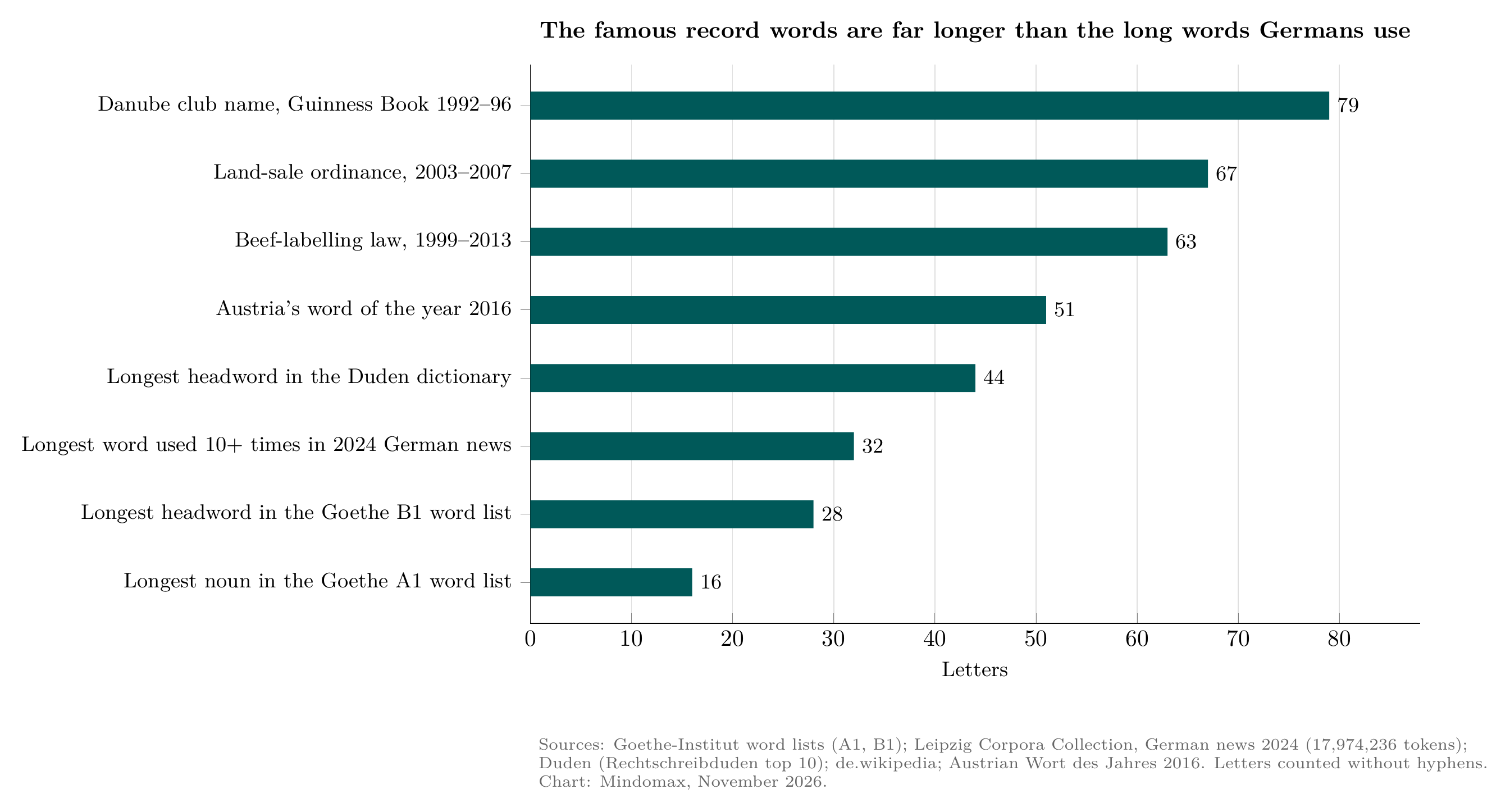
The record words against the long words people really meet: Duden's longest headword has 44 letters, the longest word used 10 or more times in a year of German news has 32, and the B1 exam list stops at 28. Chart: Mindomax.
The record holders and what they mean
German writes compound nouns as one word, and no rule limits how many parts a compound can have. So every few years a law, an office or a joke produces a new giant. These are the ones the record lists keep repeating, checked against their sources. Letters are counted without hyphens, the way Duden counts them.
One word you will see on other lists is missing here on purpose. Rinderkennzeichnungsfleischetikettierungsüberwachungsaufgabenübertragungsgesetz is often called the "official" longest German word. It never existed in that form. The law's official short title was Rinderkennzeichnungs- und Rindfleischetikettierungsüberwachungsaufgabenübertragungsgesetz: two words joined by "und" (and), abbreviated RkReÜAÜG. The 63-letter word is the second half of that title, and it is the half that became famous. When the bill reached the state parliament, agriculture minister Till Backhaus apologized for the length of its title.
The record words were never meant to be learned. They were names on paper. The Society for the German Language proposed the beef law for its 1999 word of the year, and Austria's 2016 winner was a joke about a presidential election that had to be repeated and then postponed. In German these are called Bandwurmwörter, "tapeworm words".
Do Germans actually use these words?
To find out, we counted two large collections of real German. The first is the Leipzig Corpora Collection's 2024 German news sample: one million sentences from news sites, almost 18 million words. The second is the German part of OpenSubtitles 2018, the subtitles of films and TV series: 156 million words. Together they cover written German and spoken German.
The record words did not appear once. Not the beef law, not the land-sale ordinance, not the Danube captain, not Duden's 44-letter word for ADHD. Even Kraftfahrzeug-Haftpflichtversicherung, an insurance every car owner in Germany must have, appears zero times. The news writes Kfz-Haftpflichtversicherung or simply Autoversicherung instead.
The long words that do appear look different. These are the longest words used 10 or more times in the 2024 news, plus the long words that came up most often:
Two things stand out. First, the real ceiling is about 30 letters. A long word in German news is half the length of the famous record words. Second, almost all of these are names of institutions, laws and procedures. The one an ordinary person is most likely to meet in daily life is Berufsunfähigkeitsversicherung, because insurance companies sell it.
Mark Twain saw the same thing in 1880. In "The Awful German Language" he wrote: "Some German words are so long that they have a perspective." His three examples were Freundschaftsbezeigungen, Dilettantenaufdringlichkeiten and Stadtverordnetenversammlungen. In the 2024 news the first two appear zero times. The third survives: Stadtverordnetenversammlung, in the singular, 45 times, because city councils in Hesse and Brandenburg still carry that name.
How much longer are German words than English ones?
Less than you would think, on average. In the 2024 news samples the average German word has 5.9 letters and the average English word 4.8. In film subtitles it is 4.7 against 4.0. Most German sentences are built from short words like der, die, das, und, ist and ich.
The difference is all in the long tail. In German news, 31.6 of every 1,000 words have 15 letters or more. In English news, 1.3 do, 24 times fewer. At 20 letters or more the gap grows to 74 times: 5.8 words per 1,000 in German against 0.08 in English. A word of 30 letters or more is rare even in German, about 1 in every 10,750 words of news.
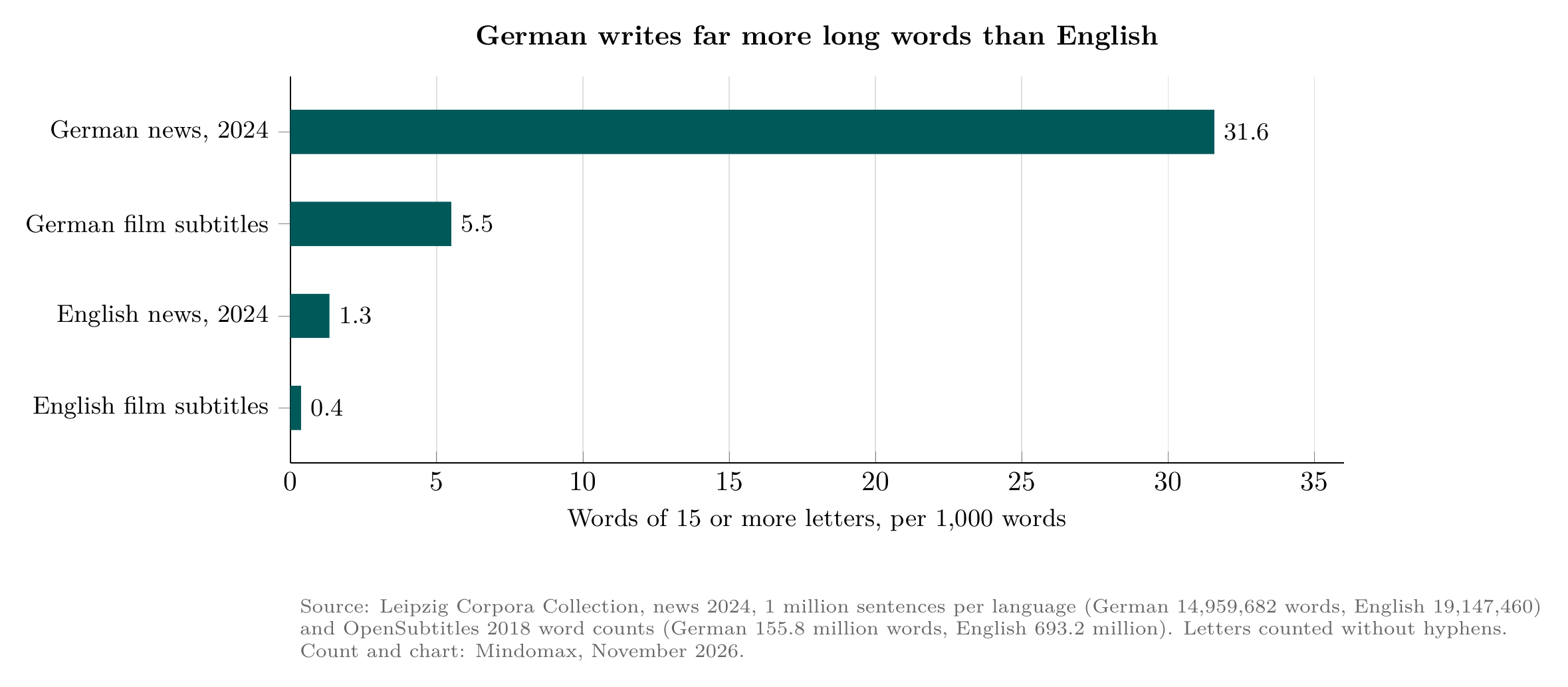
Words of 15 or more letters per 1,000 words, counted in 2024 news (Leipzig Corpora Collection, 1 million sentences per language) and in film and TV subtitles (OpenSubtitles 2018). Count and chart: Mindomax.
Spoken German has far fewer long words. In subtitles only 5.5 of every 1,000 words have 15 letters or more, about a sixth of the news rate. Long words belong to written and official German, not to conversation.
The reason is simple. German does not have more ideas than English. It leaves out the spaces. English writes "World Health Organization" with two spaces; German writes Weltgesundheitsorganisation with none. The same three parts, glued.
The long words you will actually meet
If you watch German films and series, these are the long words you will hear most. We counted every word of 20 letters or more in the German subtitles and kept the most frequent ones, plus the longest word that comes up often:
Much of this is crime and thriller vocabulary, a sign of how much American TV is watched in German. Wohltätigkeitsveranstaltung, a charity event, is the longest word in the subtitles that is used more than 40 times.
If you are learning German for an exam, the picture is even calmer. The Goethe-Institut publishes the word lists for its A1, A2 and B1 exams. At A1 the longest nouns have 16 letters: Sehenswürdigkeit, "a sight worth seeing", and Anrufbeantworter, "answering machine". At B1 the longest headword is Geschwindigkeitsbeschränkung, "speed limit", with 28 letters:
Numbers are the one place where beginners meet a really long word. German writes numbers under a million as one word, so the A1 list itself spells out the year 1999 as neunzehnhundertneunundneunzig, 29 letters. Times of the day join the same way: Donnerstagnachmittag, "Thursday afternoon", appears 175 times in the 2024 news.
The short forms Germans use instead
Germans do not love long words as much as the lists suggest. When a word gets too long for daily use, they shorten it. Here is how often each long form and its short form appear in the 2024 news:
Spoken German goes further. In the subtitles, Handy appears 16,337 times and Mobiltelefon 297 times, and Lkw beats Lastkraftwagen by 3,140 to 3.
The short form does not always win. In the news, Universität (1,222) is far more common than Uni (320), and Hauptbahnhof (558) beats Hbf (31), because papers write out official names. In the subtitles, Uni and Universität are almost level (2,880 and 2,710). Linguists have seen this pattern for a long time. The beef law itself prompted the linguist Gerhard Augst to study German multi-part compounds, and he found that these tapeworm words had not become more common in a hundred years, unlike short words and abbreviations.
How to read a long German word
A long German word is a short sentence with the spaces taken out. You can take it apart in four steps.
1. Start from the right. The last part is the head noun. It says what the thing is, and it decides der, die or das. Die Geschwindigkeitsbeschränkung is a kind of Beschränkung (restriction), so it is feminine.
2. Split after the linking s. Words ending in -ung, -heit, -keit, -schaft, -ion and -tät take an extra s when another word follows. In the 2024 news, 418 of the 1,000 most used words of 20 letters or more contain one of these joints, -ungs- alone 217 times. So Nachhaltigkeitsberichterstattung splits into Nachhaltigkeit, s, Berichterstattung: the reporting on sustainability.
3. Move left one part at a time. Each part narrows the meaning. Weltgesundheitsorganisation is an Organisation, then a health organization, then a world health organization.
4. Say it in parts. The stress usually falls on the first part. Say each piece on its own, then glue them together. Saying words out loud also helps you remember them, the production effect.
Here is the 63-letter word, decoded from the right:
Put back together, it is a law about delegating the duties of supervising the labeling of beef. Once you see the parts, the giant is just six ordinary words. Reading in meaningful pieces is what memory researchers call chunking; we explain why it works in our guide to chunking and memory, and how the eye handles long words in the neuroscience of reading.
Tools that help with long German words
You will never need the record words, so do not study them. What helps is a dictionary that shows the parts of a compound, some reading at your level, and a review system for the long words you meet. These are the tools we would use. Prices are from the US App Store.
For the words that matter most, start with our ranked list of the most common German words. To see how long German takes compared with other languages, read our ranking of the hardest languages to learn.
If you want to keep the long words from this page, you can paste them into Mindomax for free and let spaced repetition bring them back before you forget them.
Frequently Asked Questions
What is the longest German word?
The famous one is Rindfleischetikettierungsüberwachungsaufgabenübertragungsgesetz: 63 letters, the name of a beef labeling law in Mecklenburg-Vorpommern from 1999 to 2013. The longest in Duden's corpus is the 67-letter Grundstücksverkehrsgenehmigungszuständigkeitsübertragungsverordnung, a land-sale ordinance in force from 2003 to 2007.
What is the longest word in the German dictionary?
Aufmerksamkeitsdefizit-Hyperaktivitätsstörung (ADHD) is the longest headword in the Duden, with 44 letters not counting the hyphen. Next come Kraftfahrzeug-Haftpflichtversicherung (36 letters) and Donau-Dampfschifffahrtsgesellschaft (34).
What does Rindfleischetikettierungsüberwachungsaufgabenübertragungsgesetz mean?
It means "law on delegating the supervision of beef labeling". Read it from the right: Gesetz (law), Übertragung (delegation), Aufgaben (duties), Überwachung (supervision), Etikettierung (labeling), Rindfleisch (beef).
Is Donaudampfschifffahrtsgesellschaftskapitän a real word?
It is a correct German compound, and the Danube Steamship Company was a real Austrian firm. But it is an example word, not a word in use: it appears zero times in 18 million words of 2024 German news and 156 million words of German subtitles.
What is the longest German word people actually use?
In 2024 German news, the longest words used 10 or more times are Geschwindigkeitsüberschreitungen (speeding offenses) and Nachhaltigkeitsberichterstattung (sustainability reporting), both 32 letters. In German film and TV subtitles, the longest word used more than 40 times is Wohltätigkeitsveranstaltung (charity event), 27 letters.
Why are German words so long?
German writes compound nouns as one word, where English puts spaces between the parts. The average German word is only about one letter longer than the average English word, but German news has 24 times as many words of 15 letters or more.
How do you pronounce long German words?
Split the word into its parts, starting from the right, and say each part on its own. The stress usually falls on the first part. Then say the parts again without pausing.


