
The short answer
Pick Babbel if you want grammar explained in plain English, a cheaper year, or a plan you pay for once. A year of Babbel costs $107.40 on its website, or $89.99 for a single language in the iPhone app, and a lifetime plan costs $299.99 (all checked 2026-10-12). Babbel teaches 13 languages to English speakers and says exactly how far each course goes: up to C1 for Spanish from Spain, B2 for French, German and Italian.
Pick Rosetta Stone if you want to learn without translation from the first lesson, with feedback on your pronunciation, or if your language is one Babbel does not teach, such as Japanese, Korean, Chinese, Arabic or Hindi. It costs $19.99 a month or $159 a year for all 25 of its language courses (checked 2026-10-12), after a 7-day free trial.
Two things most comparisons still miss. In 2026 Rosetta Stone moved new customers to a new app, Rosetta Stone Sapphire, and stopped selling lifetime plans. And the "13 hours" and "21 hours" study claims you will see for these two apps come from the same two researchers, each time paid by the company being measured. Both are explained below.
Rosetta Stone vs Babbel at a glance
How much Rosetta Stone and Babbel cost in 2026
Babbel's web prices below come from the price service Babbel's own US website uses. Rosetta Stone's come from rosettastone.com/buy and the US App Store. On the web, both companies charge the whole period up front.
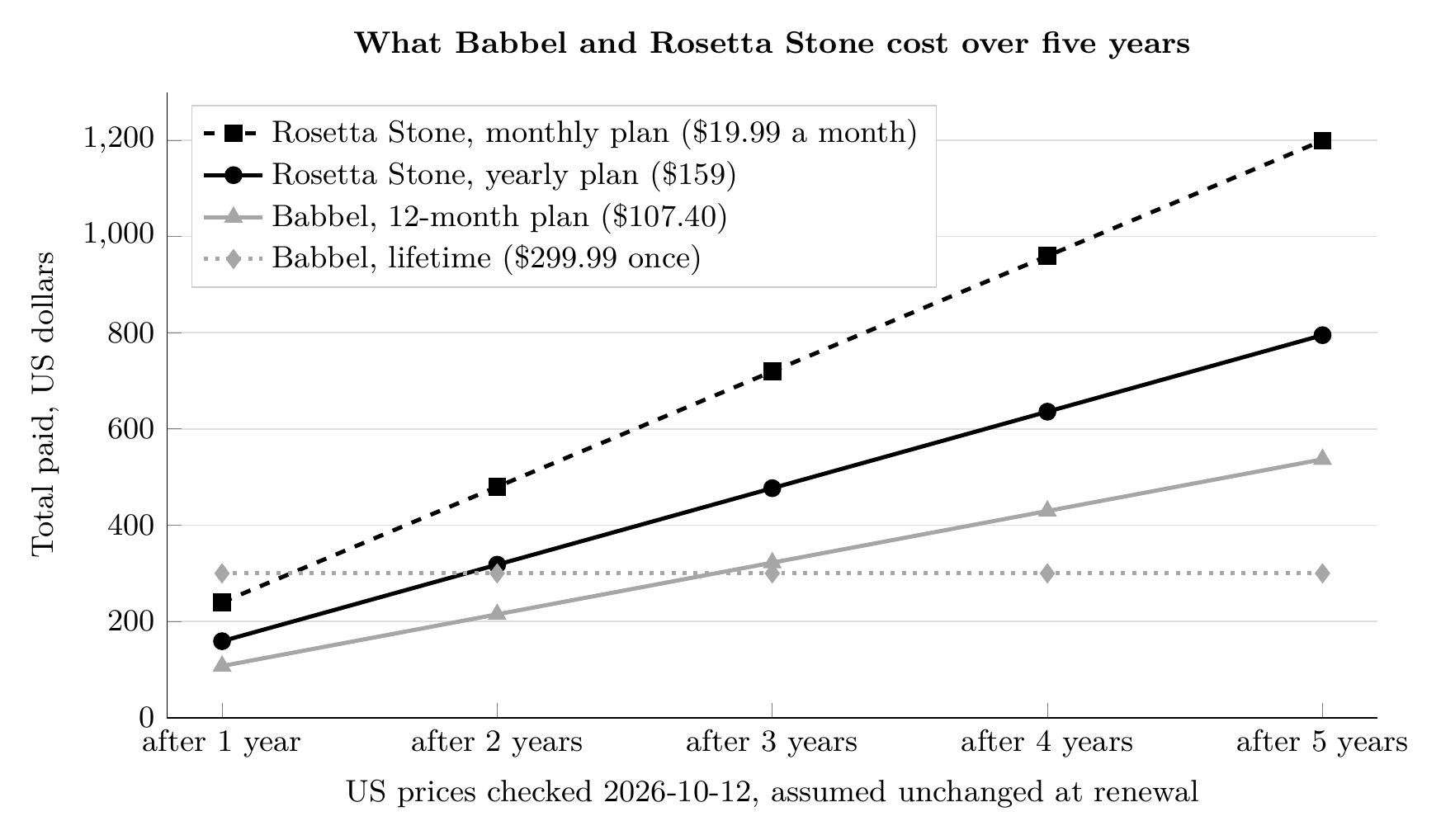
What each plan adds up to over five years at today's US prices (checked 2026-10-12): Babbel from its own price service, Rosetta Stone from rosettastone.com/buy. Renewal prices can change. Chart by Mindomax.
For one year, Babbel is the cheaper app: $107.40 on the web or $89.99 for one language in the iPhone app, against $159 for Rosetta Stone (checked 2026-10-12). Paying month by month costs more with both. Twelve months of Rosetta Stone at $19.99 add up to $239.88, and twelve months of a one-language Babbel plan at $17.99 add up to $215.88 (checked 2026-10-12). Babbel's website has no monthly plan at all; its shortest web plan is three months.
Rosetta Stone's price buys more languages. Every plan includes all 25 courses, so you can switch from Spanish to Japanese without paying again. Babbel's web plans also include every language it teaches, but that is 13, not 25.
Babbel's lifetime plan costs less than three years of its 12-month plan: the third yearly payment would bring you to $322.20, against $299.99 once (checked 2026-10-12). It also costs less than two years of Rosetta Stone, which come to $318 (checked 2026-10-12). Before you buy it, read the next section.
Lifetime plans: what Rosetta Stone's switch means for Babbel buyers
Rosetta Stone used to sell lifetime access, and many comparisons still quote it. That ended with the new app. Rosetta Stone Sapphire is now the only app new customers can buy. The old app, now called Rosetta Stone Classic, is "only available for current Rosetta Stone Classic subscribers", and new users choose a monthly or yearly plan (Forbes Advisor, 2026-09-16; Rosetta Stone's own reply on Facebook says the same). Owners of old lifetime plans report on Reddit and in App Store reviews that Sapphire is not part of what they bought. Rosetta Stone's support page says a lifetime plan gives access to the products you bought "for as long as they're available".
Babbel still sells lifetime access, and its terms describe the same kind of limit in writing. A Babbel lifetime license lasts for your life, but access to each language lasts only as long as Babbel offers and supports that language, and the license "does not extend to any future services" (Babbel terms, clause 13). It is personal and does not pass to heirs.
So a lifetime plan is a bet that the app you buy today is the app you will want for years. At $299.99 (checked 2026-10-12) the bet pays off in the third year if Babbel keeps its courses as they are. If you are not sure you will still be studying in 2029, the 12-month plan is the safer buy.
How the two apps teach
Rosetta Stone teaches with what it calls Dynamic Immersion. You see pictures, hear native speakers and work out the meaning yourself, without translation. Lessons can be as short as five minutes. TruAccent, its speech recognition, compares your voice with data from millions of native speakers and gives you instant feedback. Sapphire adds three newer tools: Chat Missions, typed conversations with a virtual partner in everyday situations; flashcard sets on more than 500 topics; and Sapphire Studio, which makes matching games, flashcards, word lists, texts adapted to your level, reading guides and email drafts on a topic you choose. Rosetta Stone also offers one-to-one tutoring with its own certified tutors.
Babbel teaches through short dialogues and exercises written for speakers of your language: an English speaker learning Spanish gets different lessons than a French speaker does. Grammar is explained in English, at the point where you need it. Babbel says you can learn in as little as ten minutes a day. Speech recognition checks what you say, Guided Conversations walk you through a dialogue, and Babbel Speak, an AI conversation partner still marked beta, lets you practice freely. Lessons can be downloaded for offline use.
What this means for you: if you like to know why a sentence is built the way it is, Babbel saves time. If you would rather absorb a language by hearing and guessing, and you care most about pronunciation, Rosetta Stone fits better. Neither approach is proven better than the other for every learner.
Languages and levels: which app teaches yours
Both apps teach Spanish, French, German, Italian, Portuguese (Brazil), Dutch, Swedish, Polish, Turkish and Russian. Only Babbel teaches Danish, Norwegian and Indonesian. Only Rosetta Stone teaches Arabic, Chinese, Japanese, Korean, Hebrew, Greek, Hindi, Vietnamese, Farsi, Tagalog, Irish and Latin.
Babbel's help center lists how far each of its courses goes on the CEFR scale, which runs from A1 (basic phrases) to C2 (near-native). Rosetta Stone does not give a CEFR level per course on its Sapphire pages (checked 2026-10-12).
Two details matter here. Babbel's Russian course stops at A1, so a Russian learner who wants more than basic phrases will outgrow it quickly. And Babbel's Mexican Spanish course only appears when the app's display language is American English. In Rosetta Stone's older Classic app, some languages were sold as five levels and others, such as Arabic, Dutch, Greek, Hebrew and Tagalog, as three, so the courses were not all the same length.
What the research says, and who paid for it
Both companies quote a number of study hours that matches one college semester of Spanish. Rosetta Stone's app says 13 hours. Babbel's 2016 report says 21 hours on average and 15 hours for true beginners. Both numbers come from studies by the same two researchers, Roumen Vesselinov of Queens College, City University of New York, and John Grego of the University of South Carolina, using the same design. Spanish learners took a college placement test, studied with one app for about eight weeks, then took the test again. Each report says the company paid for the study while the researchers collected and analyzed the data on their own.
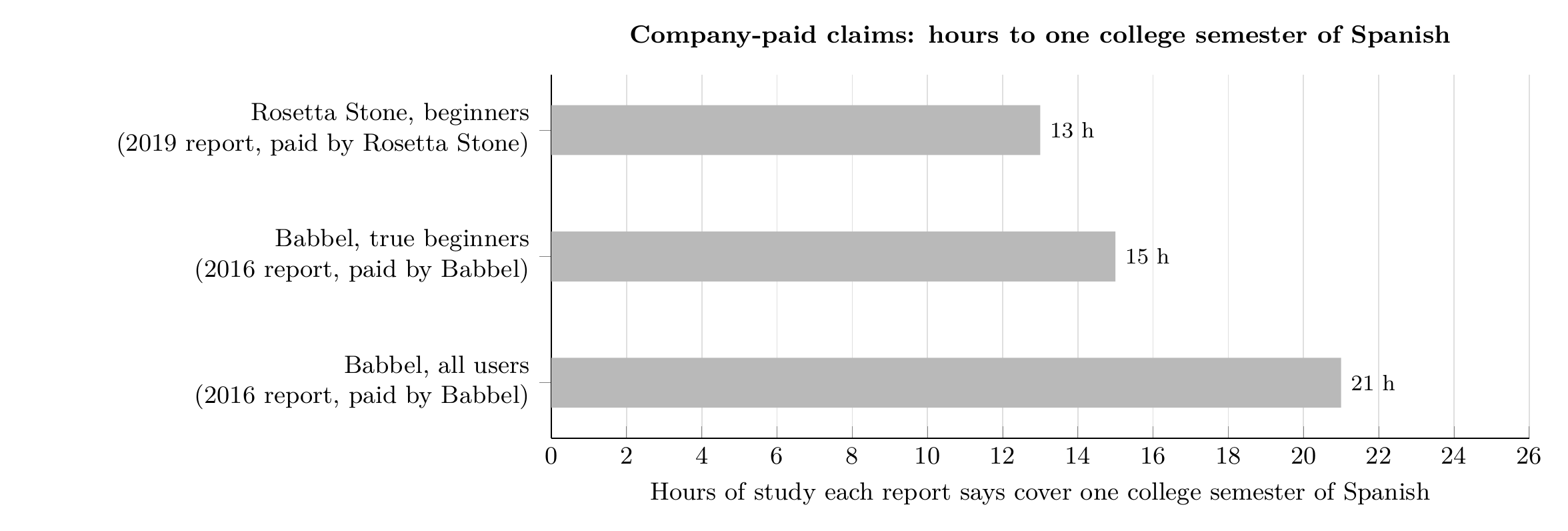
Hours to one college semester of Spanish, as each company-paid report states it. Data from Vesselinov and Grego (2016) and Vesselinov, Grego, Sacco and Tasseva-Kurktchieva (2019). Rosetta Stone's own range is 10 to 17 hours. Chart by Mindomax.
On paper Rosetta Stone wins, 13 hours against 21. Look closer and the gap mostly disappears.
The two groups were not alike. Almost everyone in the Rosetta Stone study started at the very beginning, while Babbel's sample included some people who already knew some Spanish. Babbel's own data shows how much that matters: complete beginners gained 18 test points per hour, more advanced users about 10. Compare beginners with beginners and Babbel's figure, 15 hours, falls inside the range Rosetta Stone's report gives for itself, 10 to 17 hours. The Rosetta Stone group also studied far less, about 7 hours on average against about 19, and both reports turn a two-month result into an hours-per-semester estimate.
The headline test was written. WebCAPE is a college placement test of grammar, vocabulary and reading; it does not test speaking. Babbel has two later studies that did test speaking, one of them peer-reviewed. Rosetta Stone's 2009 study included a speaking test too, but its own researchers wrote in 2019 that the 2009 results "cannot be scientifically compared" with the later studies, because that study required 55 hours of study and relied on self-reported time.
The rewards were generous. Babbel's participants who finished received a free lifetime subscription for themselves and a friend plus an Amazon gift card, and Rosetta Stone's received two free two-year subscriptions. Both studies removed anyone who studied under two hours or used other learning tools.
No independent study has compared Babbel and Rosetta Stone head to head. Even the 2019 report notes that research on these apps has mostly "been funded by the providers themselves". Choose on method, languages and price, not on hours.
Where both apps fall short
Neither app lets you review your own words on a schedule.
Babbel comes close. Its vocab workout uses spaced repetition: a word you answer correctly comes back the next day, then after 4, 7, 14 and 60 days, then after six months. But it only holds words from Babbel's lessons. Babbel's help center says it is "not possible to manually add random words or phrases". Rosetta Stone's flashcards are topic sets you can flip, quiz and customize, and Sapphire Studio can build a set on any topic, but Rosetta Stone does not describe any review schedule for them.
That leaves out the words you actually meet: in a TV show, on a trip, in an email from a colleague. They matter because memory research is clear on one point. Words you review several times, spread out over days and weeks, stay far longer than words you meet once or cram in one sitting. A meta-analysis of more than 300 experiments found this again and again (Cepeda and colleagues, 2006; our summary: the spacing effect).
The fix is cheap: keep the app you like for lessons, and put the words you need into a spaced-repetition flashcard app.
If you are new to spaced repetition, our guide to Anki for language learning shows how to set it up in an evening. Learning Spanish? Start with the 100 most common Spanish words.
Which one should you choose?
For most English speakers learning Spanish, French, German or Italian, Babbel is the better buy. It costs less, $107.40 a year against $159 (checked 2026-10-12), it explains grammar in English, and it tells you how far each course goes. Rosetta Stone is the better choice if you want to learn by immersion with feedback on your pronunciation, or if you need one of the twelve languages Babbel does not teach, and one plan lets you move between all 25 courses.
Still deciding between paid and free? Our comparisons of Babbel vs Duolingo and Rosetta Stone vs Duolingo use the same method, and our list of Duolingo alternatives covers 28 more apps with their prices.
Whichever you choose, add spaced review of your own words, because neither app does that part for you. If you want a free place to keep and review them, Mindomax is free to try.
Sources
Babbel: plans and prices; Babbel on the US App Store; help center articles Available languages, Vocab workout (Review), Try Babbel for free and Canceling a subscription; terms and conditions. Rosetta Stone: plans and pricing; Rosetta Stone Sapphire on the US App Store; Meet Rosetta Stone Sapphire (2026-09-01); Rosetta Stone Flashcards (2026-09-02); support pages Subscriptions and Getting Started. Forbes Advisor, Rosetta Stone Review 2026 (2026-09-16). Vesselinov, R. and Grego, J. (2016). The Babbel Efficacy Study. Vesselinov, R., Grego, J., Sacco, S. J. and Tasseva-Kurktchieva, M. (2019). The 2019 Rosetta Stone Efficacy Study. Loewen, S., Isbell, D. R. and Sporn, Z. (2020). The effectiveness of app-based language instruction for developing receptive linguistic knowledge and oral communicative ability. Foreign Language Annals, 53(2), 209-233. Babbel (2019). New academic study shows how learning with Babbel develops conversational skills. Cepeda, N. J., Pashler, H., Vul, E., Wixted, J. T. and Rohrer, D. (2006). Distributed practice in verbal recall tasks: a review and quantitative synthesis. Psychological Bulletin, 132(3), 354-380. Prices and app ratings checked 2026-10-12.
Frequently Asked Questions
Is Rosetta Stone better than Babbel?
Not for everyone. Rosetta Stone is better for immersion without translation and for pronunciation feedback; Babbel is better for grammar explanations and costs less. No independent study has compared the two apps directly.
Which is cheaper, Babbel or Rosetta Stone?
Babbel. A year costs $107.40 on Babbel's website, or $89.99 for one language in the iPhone app, against $159 for Rosetta Stone (all checked 2026-10-12). Rosetta Stone's yearly plan covers all 25 of its courses.
Can I still buy Rosetta Stone lifetime?
Not as a new customer. Since Rosetta Stone Sapphire launched in 2026, new customers choose a monthly or yearly plan. Older lifetime plans belong to the Classic app.
Is Babbel lifetime worth it?
It costs $299.99 once (checked 2026-10-12), less than three years of Babbel's 12-month plan. It is worth it if you will keep studying for three years or more, but Babbel's terms say it does not extend to future services.
Which is better for Spanish, Rosetta Stone or Babbel?
Babbel goes further in Spanish: its course for Spanish from Spain reaches C1 and its Mexican Spanish course B1. Rosetta Stone offers Spain and Latin America courses with speech feedback but does not state a level for them.
Can you become fluent with Babbel or Rosetta Stone alone?
Not with the app alone. The U.S. Foreign Service Institute estimate quoted in Rosetta Stone's 2019 report is about 600 hours for languages like Spanish and French and 2,200 for Japanese, Korean or Mandarin. An app covers part of that time; speaking with people covers the rest.


