
The short answer
The most common word in Chinese is 的 (de), the little particle that links words the way 's and "of" do in English: 我的 (wǒ de) is "my", 中国的 (Zhōngguó de) is "China's". It appears almost 49,000 times in every million words of everyday Chinese and more than 62,000 times per million in news and Wikipedia text. Right behind it come 我 (wǒ, "I"), 你 (nǐ, "you"), 了 (le, a particle for finished actions) and 是 (shì, "to be").
To build this list, we counted every word in 18.3 million words of real, simplified Chinese: 13.4 million from film and TV subtitles and everyday example sentences, and 4.9 million from news and Wikipedia. Written Chinese puts no spaces between words, so a segmentation tool (jieba) first split every sentence into words. Then we ranked the words by how often they appear, giving everyday speech and written text the same weight.
Three numbers from that count should shape how you study. First, the 100 most common words make up 47.9% of all the words in everyday Chinese, and 1,000 words take you to 70.4%. Second, more than one word in ten that you hear is a tiny particle such as 的, 了, 吗 (ma) or 吧 (ba), which phrase books barely mention. Third, the famous phrases are rarer than you think: 你好 (nǐ hǎo, "hello") ranks number 280, and 不客气 (bú kèqi, "you're welcome") is used about 39 times per million words.
Below are the top 100, the small words that hold every sentence together, the official HSK lists measured against real text, and the famous phrases that turned out to be rare.
The 100 most common Chinese words
The ranking blends everyday Chinese (subtitles and the Tatoeba example sentences) with written Chinese (news from 2020 and Wikipedia), each counting half. The two number columns show how many times the word appears per million words in each kind of text, so you can see at a glance which words belong to talk and which to print. Pinyin is the standard Mainland spelling with tone marks. HSK is the level of the word in the official HSK 3.0 standard from 2021, where 1 is the first and easiest level and 7-9 the highest.
Two entries need a note. 疫情 (yìqíng, "epidemic") is number 80 only because our news set is from 2020; in everyday text it barely exists. And 一个, 这个, 不是, 不能 and 不会 are counted as single words because the segmentation tool keeps them together, while the HSK lists split them into 一 + 个, 这 + 个 and so on.
How much Chinese do these words cover?
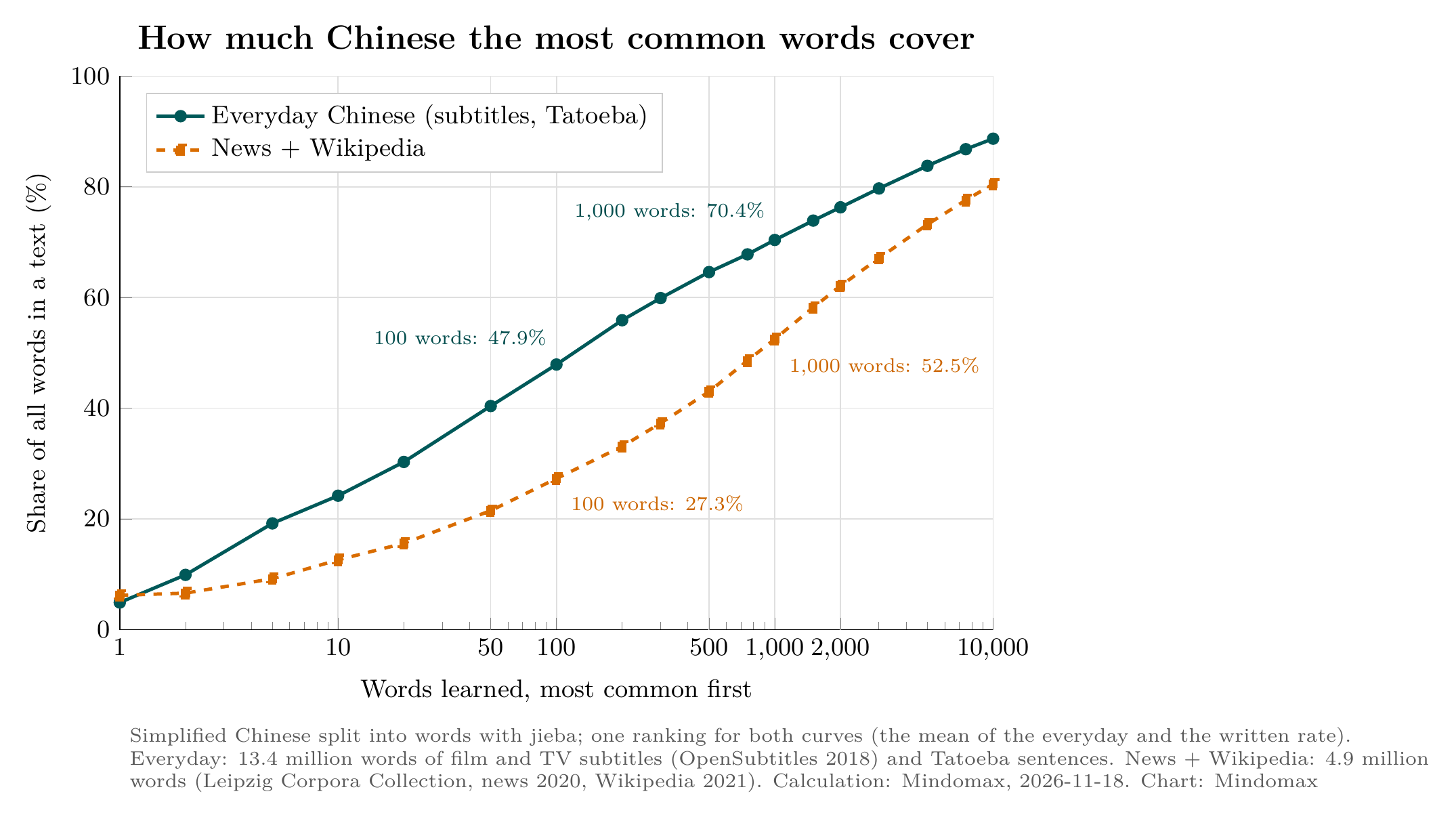
The 100 most common words make up almost half of everyday Chinese, but only about a quarter of news text. Count of 18.3 million words: film and TV subtitles and Tatoeba sentences (everyday), Leipzig news 2020 and Wikipedia 2021 (written). Calculation and chart: Mindomax.
The curve rises fastest at the start. In everyday Chinese, the top 10 words already make up 24.2% of everything said, the top 100 make up 47.9%, and the top 1,000 make up 70.4%. After that it slows down: 2,000 words cover 76.3% and 10,000 cover 88.7%. Counted on its own ranking, everyday Chinese reaches half of all words with just 105 words, 80% with 2,265 words and 90% with 8,983.
Written Chinese is a different climb. The same 100 words cover only 27.3% of news and Wikipedia text, and 1,000 words cover 52.5%. To understand half of the words in a news article you need about 694 words, and 90% takes more than 25,000. That gap explains a common experience: after a year of study you can follow a TV show with subtitles much more easily than a newspaper.
Coverage counts words, not meaning. Knowing 70% of the words in a sentence rarely means you understand 70% of it, because the missing 30% are the words that carry the content. Treat the curve as a map of where your effort pays most: the first few hundred words are the best investment you will ever make in Chinese.
Words are not characters
A Chinese word can be one character or several. In our top 100, 70 words are a single character (我, 你, 是, 不, 有) and 30 have two (我们, 什么, 知道, 没有, 现在). Further down the list the balance flips: of the top 1,000 words, 244 have one character, 729 have two, 21 have three and only 6 have four.
The good news is that those 1,000 words are built from just 712 different characters, and the top 2,000 words from 1,107. Characters repeat: 们 (men) turns 我, 你 and 他 into 我们, 你们 and 他们; 么 (me) appears in 什么 (what), 怎么 (how) and 那么 (so). Once you know a character, every new word that uses it is half learned. This is the same idea as chunking: two familiar pieces are easier to remember than one strange whole.
Speech and writing lean on different word lengths. In everyday Chinese, 50.3% of all words are one character long and 44.0% are two. In the news, one-character words drop to 32.1% and two-character words rise to 57.5%. Formal Chinese prefers two-character compounds such as 发展 (fāzhǎn, development) and 问题 (wèntí, problem), so a reader who only knows short spoken words hits a wall in the first paragraph of a news story.
The small words that hold every sentence together
Twelve particles (the ten below plus 嘛 and 呀) make up 10.35% of all words in everyday Chinese and 8.06% in writing. They have no translation of their own; they mark a question, a finished action, a suggestion or a state. Phrase books skip most of them, but you cannot say a natural sentence without them.
The talk particles are almost absent from print: 吗 appears 9,382 times per million words in everyday Chinese and only 250 times in the news, 吧 6,133 times against 260. If your reading practice is all articles, you will meet them far less than you will hear them.
Measure words are the other small words. Chinese cannot say "three books"; it says 三本书 (sān běn shū), "three [volume] books", with a measure word between the number and the noun. Textbooks often present a long list of them. Our count shows how lopsided that list really is: after a number or after 这 (this) and 那 (that), the general measure word 个 (gè) fills 55.5% of all slots in everyday Chinese and 45.4% in writing.
Learn 个 first and use it whenever you are unsure; it is the measure word native speakers fall back on too. Then add 次, 种, 件, 位 and 只: together with 个 they fill 77.8% of all measure-word slots in everyday Chinese.
Where are 你好 (hello) and 谢谢 (thank you)?
Phrase books open with greetings, so many learners assume these are the most common words in Chinese. In real use they rank much lower, and some barely appear at all. The table counts each phrase as it is written, per million words of everyday Chinese.
谢谢 is the clear winner, about one and a half times per thousand words, and as a word it ranks number 137 in our list. 你好 comes in at number 280 and 再见 at 433. Two results stand out. 没事 (it's nothing) is used more than three times as often as 没关系, the "it doesn't matter" that textbooks teach as the answer to 对不起. And 你吃了吗, still listed as a typical greeting on several beginner pages, appeared only 9 times in 2.7 million lines of everyday Chinese.
Single famous words tell the same story. One popular beginner list puts 猫 (māo, cat) and 微笑 (wēixiào, smile) in its top 10 most common words; in our count they rank number 2,252 and 2,761. 爱 (ài, love) is a real high-frequency word at number 198, and 朋友 (péngyou, friend) is number 186.
Speech or writing? The words that change
Most of the top 100 are common in both kinds of text, but some words live almost entirely in one of them. The table compares their rate per million words.
Everyday Chinese is full of "you", questions and reactions; written Chinese is full of countries, institutions and abstract nouns. Both lists are useful, but they suit different goals. If you want to talk and watch shows, start from the left column. If you need Chinese for business news or study, the written words climb your list much sooner.
What the HSK lists get right, and what they miss
The HSK is the official Chinese proficiency test. In 2021 China published a new standard for it, HSK 3.0, with nine levels and 11,092 words in total. Level 1 has 500 words, level 2 adds 772, level 3 adds 973. Most textbooks and apps now build their vocabulary around these lists, so we checked them against real text.
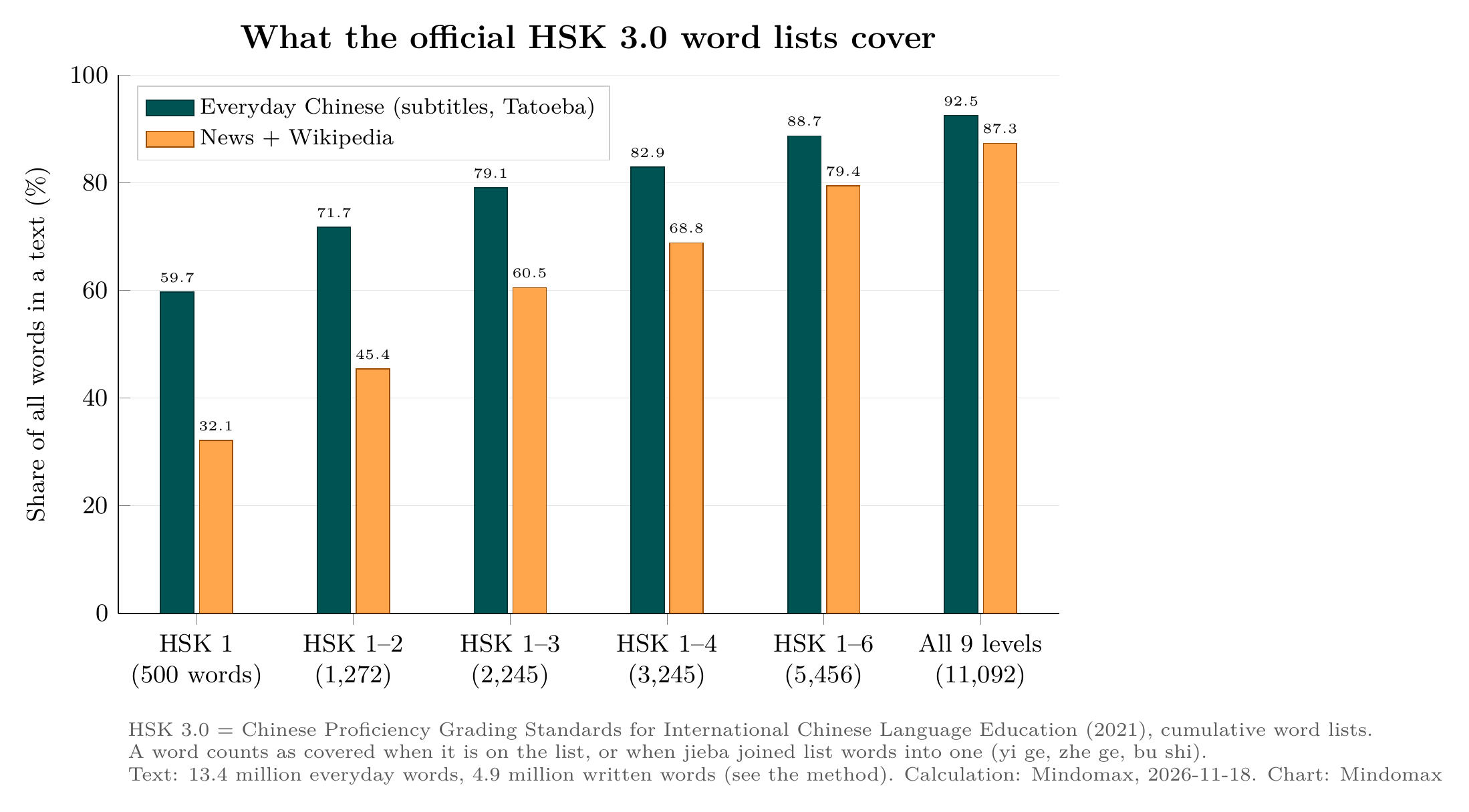
The 500 words of HSK 1 cover six in ten words of everyday Chinese and one in three words of the news. HSK 3.0 word lists (2021) measured against our count. Chart: Mindomax.
The lists hold up well. 66 of our top 100 words are HSK 1 words, 17 are HSK 2 and 7 are HSK 3. The 500 words of HSK 1 cover 59.7% of the words in everyday Chinese, and all levels up to HSK 3 cover 79.1%. In written Chinese the same lists cover much less: HSK 1 reaches 32.1% and HSK 1-3 reaches 60.5%.
The misses are instructive. HSK 1 teaches words a beginner needs in a classroom but that real text rarely uses: 午饭 (wǔfàn, lunch) ranks number 5,103 in our count, 星期天 (xīngqītiān, Sunday) 5,876, 洗手间 (xǐshǒujiān, restroom) 6,046 and 汉语 (Hànyǔ, the Chinese language) 10,558. In subtitles people say 中文 (Zhōngwén) more than twice as often as 汉语. In the other direction, the formal linking words of written Chinese rank high in real text but arrive late in the HSK: 与 (yǔ, and) is number 50 but an HSK 6 word, 而 (ér, and, but) is number 62 at HSK 4, and 以 (yǐ, with, by) is number 90 at HSK 7-9. If you read news, learn them early.
Simplified or traditional?
Everything on this page is in simplified characters, the official script of mainland China and Singapore. Taiwan, Hong Kong and Macau use traditional characters, and the difference is not cosmetic: 39 of our top 100 words are written differently in traditional script. 我们 becomes 我們, 什么 becomes 什麼, 说 becomes 說, 这 becomes 這, 个 becomes 個, 没 becomes 沒 and 问题 becomes 問題.
Pick one script and stay with it. Mixing them on the same flashcards, as some popular word lists do without telling you, doubles the work and confuses your memory. Most learners start with simplified because the HSK and most courses use it. If you are learning Chinese for Taiwan or for Cantonese-speaking Hong Kong, the picture changes; our comparison of Mandarin vs Cantonese explains what is different there beyond the script.
How to learn the 100 most common Chinese words
1. Learn pinyin and the four tones before the words. A word with the wrong tone is often a different word: mǎi is "to buy", mài is "to sell". A few days with the sounds saves months of correcting habits.
2. Start at the top of the table and take 10 to 15 new words a day. At that pace the top 100 take one to two weeks, and they will already cover almost half of everyday Chinese.
3. Learn words with their particles in short sentences, not alone: 你好吗?, 我知道了, 我们走吧. The particles only make sense in a sentence.
4. Learn measure words with nouns: 一个人, 一本书, 一杯水. Start with 个, then 次, 种, 件, 位 and 只.
5. Review on a schedule. Spaced repetition shows each word again just before you would forget it, which is the most efficient way to keep hundreds of words; our guide on how to study with flashcards explains how to set up a deck. Put the characters on the front and the pinyin, meaning and one example on the back.
6. Listen to real Chinese early. The everyday column of our list comes from film and TV subtitles, so shows with Chinese subtitles train exactly these words.
Apps that help you drill them
You can practise the list with paper cards, but these tools make the review schedule automatic. We checked every listing in the US App Store and Google Play on 2026-11-18; prices are the ones listed in the US App Store that day.
If you already use one of these, keep it: the list matters more than the app. If you want to drill the 100 words above, you can paste the table into Mindomax for free and let spaced repetition bring each word back before you forget it.
How we counted
Sources. Everyday Chinese: the first three million lines of the simplified-Chinese film and TV subtitles in the OpenSubtitles 2018 collection (OPUS) and the 89,315 Mandarin sentences of Tatoeba. Written Chinese: 300,000 sentences of 2020 news and 100,000 sentences of Wikipedia (2021) from the Leipzig Corpora Collection. HSK levels come from the HSK 3.0 standard of 2021 (Chinese Proficiency Grading Standards for International Chinese Language Education). Pinyin drafts come from CC-CEDICT; the pinyin of the top 100 was checked by hand.
Cleaning. We removed every line that contained Japanese kana, Korean Hangul, a traditional-only character or a Cantonese-only character such as 嘅 or 咗, so the count reflects simplified Mandarin. That kept 2,686,211 of the 3,000,000 subtitle lines, 49,475 of the Tatoeba sentences, 195,698 news sentences and 41,646 Wikipedia sentences: 13.4 million everyday words and 4.9 million written words. The jieba segmentation tool split the text into words. We removed 21 personal names from the ranking (such as 汤姆, Tom), because a name is not vocabulary.
Limits. Subtitles are scripted, and many are translated from foreign films, which pushes up words like 先生 (xiānsheng, Mr., number 102). The news comes from 2020, which explains 疫情. The segmentation tool decides what counts as one word: it keeps 一个 and 我爱你 together and splits 不客气 and 好的, which is why the phrase table counts phrases as written text instead. Numbers rank lower than they should, because the tool glues them to measure words: 一 alone is number 127, but it also hides inside 一个, 一起 and 一下. The same approach, open subtitles, news and Wikipedia counted by machine, produced our lists of the most common Japanese words and the most common Korean words.
Frequently Asked Questions
What are some basic Chinese words?
The most basic Chinese words are the ones you meet in almost every conversation: 我 (wǒ, I), 你 (nǐ, you), 是 (shì, to be), 不 (bù, not), 有 (yǒu, to have), 好 (hǎo, good), 去 (qù, to go), 知道 (zhīdào, to know), 什么 (shénme, what) and the particles 的, 了 and 吗. All of them are in the top 30 of our count of 18 million words.
What is the most common word in Chinese?
的 (de), the particle that links words like 's or "of" in English. It appears about 49,000 times per million words of everyday Chinese and more than 62,000 times per million in news and Wikipedia text. The most common words with a meaning of their own are 我 (I), 你 (you) and 是 (to be).
How many Chinese words do I need to know?
In our count, 100 words cover 47.9% of the words in everyday Chinese, 1,000 cover 70.4% and about 9,000 cover 90%. News is harder: 1,000 words cover 52.5% of a news text. The 500 words of HSK 1 cover 59.7% of everyday Chinese. To see how hard Chinese is overall, read our ranking of the hardest languages to learn.
How do you say 1 to 10 in Chinese?
一 (yī), 二 (èr), 三 (sān), 四 (sì), 五 (wǔ), 六 (liù), 七 (qī), 八 (bā), 九 (jiǔ), 十 (shí). Before a measure word, "two" is usually 两 (liǎng), not 二: 两个人, two people. Zero is 零 (líng).
How do you say "I love you" in Chinese?
我爱你 (wǒ ài nǐ). It appears about 159 times per million words of everyday Chinese (subtitles and example sentences) and almost never in the news. 爱 (ài, love) on its own is number 198 in our list of the most common Chinese words.
What are some cool Chinese words?
Words you hear a lot in real conversation include 加油 (jiāyóu, "come on, you can do it"), 厉害 (lìhai, awesome, impressive), 没问题 (méi wèntí, no problem) and 没事 (méishì, it's nothing). 没事 alone appears about 700 times per million words of everyday Chinese.
Are Chinese words the same as Chinese characters?
No. A word can be one character, like 我 (I), or several, like 我们 (we) or 知道 (to know). In our top 1,000 words, 244 have one character and 729 have two, and together they use 712 different characters.
Should I learn simplified or traditional characters?
Learn simplified if you are aiming at mainland China, the HSK exam or most courses; learn traditional for Taiwan or Hong Kong. 39 of the 100 most common words look different in the two scripts, so pick one and keep your flashcards in that script.


