
INTRODUCTION
You just spent two hours typing flashcards from a lecture. Now you have 80 cards. But you haven't studied a single one yet. Sound familiar?
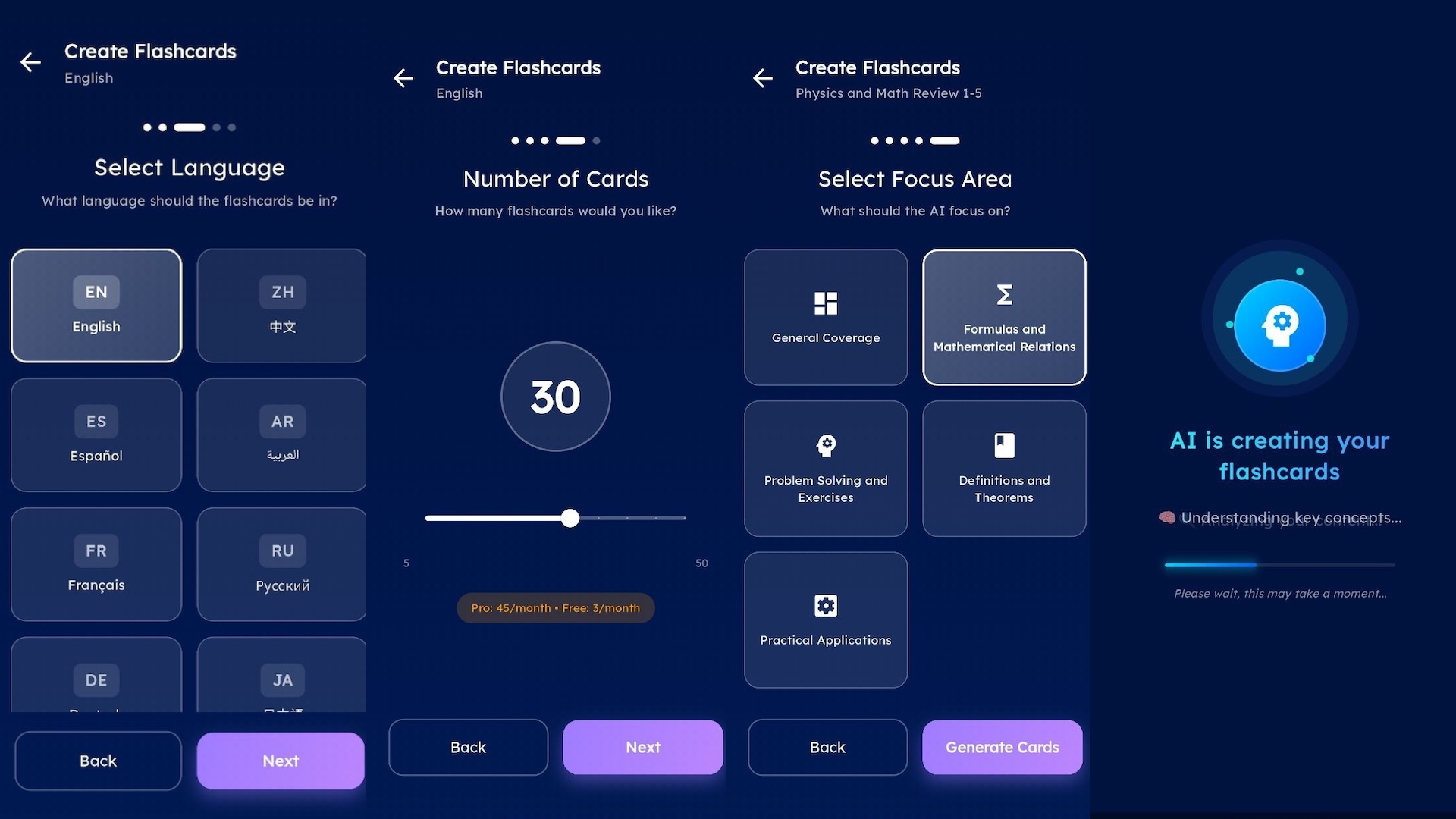
For most students, flashcards take too long to make — and the research confirms it. A 2023 study by Pan et al. in the Journal of Applied Research in Memory and Cognition found that flashcard creation can consume up to 52% of a study session. That means more than half your time goes to building the tool, not using it. And yet flashcards remain one of the most effective study methods available. So what's the answer? Not abandoning flashcards — but finding faster ways to create them without losing the learning benefits. Some methods cut creation time by 90% or more. Here's what the science says.
Why Do Flashcards Take So Long to Make?
Let's break this down. When you sit down to create flashcards from a lecture or textbook chapter, your brain is doing at least four things at once. Reading the source material. Deciding what's important enough to become a card. Writing a clear question. Typing or writing the answer. Each step takes mental effort. And when you multiply that by 50 or 100 cards per chapter, the hours add up fast.
This isn't just a feeling. It has a name in psychology. Cognitive load theory, updated by Sweller et al. (2019), explains that working memory can only handle about four to seven new items at a time. Creating flashcards forces you to juggle reading, filtering, formatting, and typing simultaneously. That's a heavy load — and most of it doesn't directly help you learn. Psychologists call this extraneous cognitive load. The energy spent on formatting and typing is energy not spent on understanding the material.
Medical students feel this more than anyone. A cohort study by Gilbert et al. (2023) at Wright State University found that 97.6% of Anki-using medical students relied on premade decks rather than creating their own. Not because premade cards are better — but because making flashcards takes too long when your lectures are eight hours a day and each lecture introduces hundreds of new terms. Another study by Levy et al. (2023) at Kirk Kerkorian School of Medicine found that students spent an average of 73.86% of their total study time inside Anki. Most of that time goes to reviewing — but a significant chunk goes to creating and editing new cards.

And it's not just medical students. Language learners building vocabulary decks, engineering students converting problem sets, law students preparing for the bar exam — anyone who uses flashcards regularly knows the frustration. Making flashcards takes too long relative to the actual studying that follows.
Is Making Your Own Flashcards Actually Worth the Time?
Here's where things get interesting. There's a real scientific debate about whether the time investment pays off.
On one side, the generation effect — first described by Slamecka and Graf (1978) — shows that information you produce yourself sticks in memory better than information you passively receive. A meta-analysis by Bertsch et al. (2007) confirmed this across 86 experiments, finding a moderate effect size of d = 0.40. And Pan et al. (2023) showed that students who created their own digital flashcards outperformed those using premade ones, with effect sizes of d = 0.45 for definitions and d = 0.29 for application questions.
So making your own cards does help. But here's the catch.
On the other side, the testing effect and spaced repetition produce much larger learning gains — and they happen during the review phase, not the creation phase. Karpicke and Blunt (2011) demonstrated that retrieval practice produced 50% more long-term retention than elaborative concept mapping. Dunlosky et al. (2013) rated practice testing and distributed practice as the two highest-utility learning techniques in their landmark review of ten methods. And a 2026 meta-analysis by Maye and Hurley across 21,415 medical learners found that spaced repetition produced an effect size of d = 0.78 — nearly double the generation effect.
Think about what that means. The benefit of creating your own cards (d = 0.40) is roughly half the benefit of reviewing those cards through spaced repetition (d = 0.78). If every hour you spend making flashcards is an hour you don't spend reviewing them, you might actually be losing ground. The math isn't complicated. When flashcards take too long to make, the opportunity cost is real.

The Real Problem: You're Trading Study Time for Typing Time
Here's something most study advice won't tell you. The generation effect only works when the difficulty is cognitive — when you're thinking deeply about the material. But typing flashcards from a PowerPoint slide? That's mostly mechanical. You're copying information from one place to another. That kind of effort doesn't trigger the deep processing that makes the generation effect work.
Bjork and Bjork (2020) made this distinction clear in their research on desirable difficulties. A difficulty is only "desirable" when it forces your brain to engage with the meaning of the material. If the difficulty is just tedious formatting and data entry, it doesn't improve learning — it just wastes time. This explains why so many students report spending three or four hours making cards and feeling like they learned almost nothing in the process. The frustration is real. The effort is real. But the learning benefit of mechanical card creation is smaller than most people assume.
A study by Price et al. (2025) across 26,258 physicians confirmed that spaced repetition itself — not the card creation step — drives the learning gains. When flashcards take too long to create, students either abandon the method entirely or burn out before reaching the review stage. Either way, the most powerful part of the flashcard workflow never happens.
How Long Should Flashcard Creation Actually Take?
There's no official benchmark, but the available data paints a clear picture. Pan et al. (2023) measured creation time across different methods. Simple copy-paste cards took about 13% of the study session. Paraphrased cards — where students rewrote definitions in their own words — took up to 52%. For complex subjects like pharmacology or organic chemistry, experienced students on medical forums report spending two to five minutes per quality card. That means converting a single one-hour lecture into a full deck can easily take two to three hours of manual work. It's no surprise that flashcards take too long to make for students with packed schedules.
Compare that to the review side. With a well-tuned spaced repetition system, reviewing 100 cards takes about 20 to 30 minutes. The ratio is obvious: if your flashcards take too long to make, you're spending three hours creating what takes 30 minutes to study. That's a six-to-one ratio of production to use. No other study method has this kind of imbalance.
The goal isn't to eliminate creation time entirely — some processing during creation helps learning. The goal is to bring that ratio closer to one-to-one. Ideally, you want to spend roughly equal time creating and reviewing. Anything beyond that is diminishing returns.
Seven Ways to Make Flashcards Faster Without Losing Quality
The solution isn't to stop using flashcards. The evidence foractive recall andspaced repetition is too strong to ignore. But when flashcards take too long to make, you need a different approach to creating them. The goal is to spend less time building cards and more time studying them.
First, follow the minimum information principle. Keep each card focused on one single idea. Don't try to pack an entire paragraph into one flashcard. Shorter cards are faster to create, faster to review, and easier to remember. If a concept needs multiple facts, split it into multiple cards.
Second, use cloze deletions instead of writing full question-and-answer pairs. A cloze deletion takes an existing sentence and blanks out the key term. It's faster to create because you're editing existing text rather than writing new questions from scratch. Most modern flashcard apps support this format natively.
Third, create cards while you study — not after. Don't read an entire chapter and then go back to make cards. Make each card as you encounter the concept. This saves a full pass through the material and keeps the content fresh in your mind while you write.

Fourth, start with premade decks and customize them. For subjects likeMCAT preparation or medical school coursework, high-quality community decks already exist. Download them, then add or edit cards based on your weak areas. This approach captures most of the generation effect through editing and personalizing while skipping the bulk of the creation work. Gilbert et al. (2023) found that students using premade decks still scored 6 to 13% higher on exams compared to non-Anki users.
Fifth, batch your creation sessions. Instead of making cards one at a time throughout the day, set aside a focused 20-minute block for creation and a separate block for review. This reduces the mental switching cost between creation mode and study mode.
Sixth, use AI-powered flashcard generators. This is the biggest time saver available right now. Modern AI tools can read a PDF, a set of lecture notes, or even audio recordings and generate study-ready flashcards in seconds. The research on AI-generated educational content is still early, but Bachiri et al. (2023) found that AI-generated flashcards achieved comparable quality to human-created ones in a MOOC setting. And Hutt and Hieb (2024) confirmed that AI-generated quiz items maintain instructional equivalence to human-created items. The key advantage isn't just speed — it's that AI handles the mechanical work while you focus on reviewing and editing the output. That review step still engages the generation effect at a fraction of the time cost.
Seventh, apply the 80/20 rule to your cards. Not everything in a lecture deserves a flashcard. Focus on the 20% of material that covers 80% of what you'll be tested on. This is especially important for digital flashcardusers who tend to over-create because the barrier to adding cards is so low.
What the Research Still Doesn't Know
Honesty matters here. As of early 2026, no large-scale randomized controlled trial has directly compared AI-generated flashcards to human-created flashcards for long-term retention. Hutt and Hieb (2024) flagged legitimate challenges with AI output, including occasional hallucination and accuracy issues. The technology is promising but not perfect. Students who use AI-generated cards should always review and edit them before studying. No AI produces flawless output every time.

There's also an important nuance about the generation effect itself. Pan et al. (2023) found that self-made flashcards outperformed premade ones — but students who made their own cards also spent significantly more total time with the material. The study couldn't fully separate the creation benefit from the extra exposure time. So part of the advantage of making your own cards might simply be that you engage longer with the content, not that the act of creation itself is uniquely powerful.
The practical takeaway? A hybrid approach — AI generates the initial cards, you review and edit them — likely captures most of the generation benefit while cutting creation time dramatically. But this hasn't been formally tested yet. It's a reasonable inference from the existing evidence, not a proven fact. What is proven is this: when flashcards take too long to make, students either quit or <a href="/flashcard-burnout">burn out</a>. Neither outcome helps you learn.

CONCLUSION
Flashcards take too long to make when you do everything by hand. The science is clear on this: the time spent typing and formatting cards produces a moderate learning benefit (d = 0.40), while the time spent actually reviewing those cards through retrieval practice and spaced repetition produces nearly double the effect (d = 0.78). For students under time pressure — which is most students — shifting effort from creation to review is a smarter use of limited hours. Tools like Mindomax, along with other AI-powered platforms, are making it possible to generate flashcards from notes and lectures in seconds rather than hours. The goal was never to spend your evening typing. It was to remember what you learned. The faster you get to studying, the more you'll retain.
Frequently Asked Questions
Is making flashcards a waste of time?
Not entirely. Research shows that creating your own flashcards produces a moderate memory benefit called the generation effect. But the time cost is significant — card creation can consume up to 52% of a study session. If that time could be spent on retrieval practice instead, the net learning outcome may actually be higher.
Should I make my own flashcards or use premade ones?
It depends on your available time. Self-made flashcards produce slightly better retention according to Pan et al. (2023), but 97.6% of medical students using Anki choose premade decks because manual creation is too slow. A practical middle ground is editing and personalizing premade or AI-generated cards.
How long does it actually take to make good flashcards?
For complex subjects like medicine or law, experienced students report spending two to five minutes per quality card. A single one-hour lecture can take two to three hours to convert into a full flashcard deck manually. AI-powered generators can reduce this to seconds per card.
Is making flashcards itself a form of studying?
Partially. Deciding what information matters and how to phrase it engages active processing, which helps memory. But much of the creation process — typing, formatting, copying text — is mechanical and produces limited learning benefit. The real study benefit comes from reviewing the cards through active recall afterward.
Can AI-generated flashcards match the quality of handmade ones?
Early research is encouraging. Bachiri et al. (2023) found AI-generated flashcards achieved comparable quality to human-made ones in online courses. However, AI can sometimes produce inaccurate or poorly phrased cards. Always review and edit AI output before studying to ensure accuracy.