Introduction
Pick up a pen. Write a word on a blank index card. Flip it over. Write the definition. That simple act fires neurons across your motor cortex, your parietal lobe, your visual cortex, and deep into the memory centers of your temporal lobe [1]. Now open an app. Type the same word. Type the same definition. Your brain barely notices.
This is not opinion. It is measurable. In 2024, Audrey van der Meer and Ruud van der Weel at the Norwegian University of Science and Technology strapped 256-channel EEG caps to thirty-six university students and recorded what happened when they wrote words by hand versus typing them on a keyboard. The difference was dramatic. Handwriting produced widespread theta and alpha coherence between parietal and central brain regions. Typing produced almost none [2]. The brain, it seems, treats writing and typing as fundamentally different activities.
And yet. Over seventy-seven percent of American college students now use digital flashcards [3]. They carry thousands of cards in their pockets. Their apps schedule reviews using algorithms trained on hundreds of millions of data points. They study on the subway, in the waiting room, between classes. Paper flashcard users carry a rubber-banded stack and guess when to review.
So which is actually better? The answer is not what either camp expects.
The Brain That Writes vs. the Brain That Types
The neuroscience argument for paper flashcards begins at the moment of creation. Not at review. At creation.
When you write a word by hand, your brain must plan a unique motor sequence for every single letter. The curve of a lowercase "g" is nothing like the straight lines of a "t." Each character demands a different combination of finger pressure, wrist angle, and stroke direction. This motor complexity activates a network of brain regions that keyboard typing simply does not require [4].
Typing is different. Every key requires the same motion. Press down. Release. The motor program is nearly identical whether you type an "a" or a "z." The brain can essentially run on autopilot.
Marieke Longcamp at Aix-Marseille University demonstrated this gap using functional MRI. In a series of studies between 2003 and 2008, she showed that perceiving letters previously learned through handwriting activated the left primary motor cortex and supplementary motor area far more strongly than perceiving letters learned through typing [5]. The brain had linked the visual form of the letter to the motor memory of writing it. Typing created no such link.
Karin James at Indiana University went further. In 2012, she scanned the brains of five-year-old children who had not yet learned to read. Some practiced letters by printing them with a pencil. Others typed them. Others traced them. Only the children who printed by hand showed activation in the "reading circuit" — the left fusiform gyrus, inferior frontal gyrus, and posterior parietal cortex — when they later saw those letters [6]. The act of handwriting had wired their brains for reading. Typing had not.
What does this mean for flashcard users? Every time you write a question and answer on a paper card, you are building a motor-visual-semantic memory trace. Three systems encoding the same information simultaneously. When you type the same content into an app, you get the semantic trace. Maybe the visual. But the motor trace is thin, generic, and quickly forgotten.

The Forgetting Curve and the Algorithm Problem
But creation is only half the story. The other half is review. And here, paper flashcards have a serious problem.
In 1885, Hermann Ebbinghaus sat alone in his apartment in Berlin and memorized lists of nonsense syllables — meaningless three-letter combinations like "DAX" and "BUP" and "ZOL." Then he tested himself at increasing intervals. What he found became one of the most replicated results in all of psychology: memory decays exponentially. Within twenty minutes, he had forgotten forty-two percent. Within an hour, fifty-six percent. Within a day, sixty-six percent [7].
In 2015, Jaap Murre and Joeri Dros at the University of Amsterdam replicated Ebbinghaus's experiment using modern methods. One subject memorized seventy hours of nonsense syllables following the original protocol. The curve matched Ebbinghaus's data with striking precision, with one interesting exception: a slight upward bump at the twenty-four-hour mark, probably reflecting sleep-dependent consolidation [7].
The forgetting curve creates a scheduling problem. If you want to remember something long-term, you need to review it at precisely the right moment — ideally just before you would have forgotten it. Review too early and you waste time. Review too late and you must relearn from scratch. Nicholas Cepeda and colleagues at York University tested this empirically with over 1,350 participants and found that the optimal gap between study sessions is approximately ten to twenty percent of the desired retention interval [8]. Want to remember something for thirty days? Your first review gap should be about three to six days. Want to remember for a year? The gap should be about five to seven weeks.
No human being can compute these intervals in their head. Paper flashcard users guess. They shuffle the deck and hope for the best. Or they use Sebastian Leitner's 1972 box system — a physical sorting method that approximates spaced repetition using compartments — but even the Leitner system offers only crude spacing compared to what an algorithm can achieve.
Digital flashcard systems solve the scheduling problem. The SM-2 algorithm, created by Piotr Wozniak in 1987 as part of his master's thesis, assigned each card an "ease factor" and computed the next review interval based on how easily the user recalled the answer. SM-2 became the default scheduler for nearly every open-source flashcard application for three decades [9].
In 2022, Jarrett Ye published the Free Spaced Repetition Scheduler (FSRS) at the ACM KDD conference. FSRS used machine learning trained on hundreds of millions of real review logs to build a personalized model of each learner's memory. Benchmarks showed it reduced the number of reviews needed to maintain a target retention level by roughly twenty to thirty percent compared to SM-2 [10].
Spaced repetition algorithms represent the single largest empirically demonstrated advantage of digital flashcards. This is not a marginal benefit. It is the difference between efficient long-term retention and wasteful guesswork.
When Paper Wins and When It Loses
What happens when researchers directly compare paper flashcards against digital ones? The answer is surprisingly nuanced.
In 2018, Robert Ashcroft, Sanja Cvitkovic, and Nicholas Praver tested 139 Japanese university students learning English vocabulary. Students used both paper flashcards and a digital flashcard platform in a counterbalanced design. The result: digital flashcards outperformed paper at lower proficiency levels. But for advanced learners, paper flashcards produced better delayed recall [11].
Kevin Sage and colleagues ran two careful studies at Western University. The first, published in 2019, compared paper, computer, and tablet flashcards. Learning outcomes were equivalent across all three formats. Cognitive load was equivalent. But students reported higher satisfaction with paper [12]. The second study, published in 2020, added smartphones. Again, paper, laptop, and smartphone flashcards produced equivalent learning gains. Students preferred paper and laptop over smartphone [12].
Gilbert Dizon and Nicole Tang at Himeji Dokkyo University compared digital and paper flashcards over twelve weeks with fifty-two Japanese EFL learners. Both groups made significant vocabulary gains. The difference between groups was not statistically significant [13].
A 2025 study by Najafi Karimi and Kheradmandi Amiri in Cogent Education examined ninety Iranian EFL learners and found that only digital flashcards produced statistically significant gains from pretest to delayed posttest. Paper flashcards improved scores descriptively but fell short of significance [14].
The pattern across roughly a dozen controlled studies from 2010 to 2025 is consistent: the modal finding is equivalent learning outcomes, with digital flashcards trending advantageous at lower proficiency levels and over longer retention windows. No high-quality study reports a large advantage for paper in pure review outcomes. The advantages of paper are confined to the encoding phase, to satisfaction, and to perceived control.

The Testing Effect: What Both Formats Get Right
Before declaring a winner, it is worth understanding what makes flashcards effective in the first place. And here, both paper and digital cards share the same fundamental advantage.
In 2006, Henry Roediger and Jeffrey Karpicke at Washington University in St. Louis published an experiment that changed how scientists think about studying [15]. Students read prose passages and then either re-studied them or took a practice test without feedback. Five minutes later, the re-study group performed better. But one week later, the testing group outperformed the re-study group by approximately fifty percent. The act of retrieving information from memory — even when retrieval is difficult and partially unsuccessful — strengthens the memory trace far more than passively re-reading the material.
Karpicke extended this work in a 2011 paper published in Science. He compared retrieval practice against elaborative concept mapping — a popular study technique where students draw diagrams connecting ideas. Retrieval practice produced approximately fifty percent better retention after one week [16]. This was a remarkable finding. Concept mapping is an active, generative strategy. Yet simple self-testing crushed it.
Robert Bjork at UCLA framed this as "desirable difficulty." The harder the retrieval attempt, the stronger the resulting memory — provided the difficulty is productive rather than pointless [17]. A flashcard forces you to generate the answer before seeing it. That generation creates the difficulty. That difficulty builds the memory.
Both paper and digital flashcards support this mechanism. The critical variable is not the format. It is whether the learner actually commits to a retrieval attempt before flipping the card. The UCLA survey by Pan, Zung, and colleagues found that many digital flashcard users flip cards rapidly without committing to a genuine retrieval attempt [18]. Paper flashcards, with their slower, more deliberate manipulation, may naturally discourage this shortcut.

The Generation Effect: Why Making Your Own Cards Matters More Than the Medium
In 1978, Norman Slamecka and Peter Graf published five experiments showing that information you produce yourself is remembered more reliably than information you merely read [19]. They called it the generation effect. Subsequent meta-analyses estimated the effect size at roughly d = 0.40 — a moderate but consistent advantage.
This has direct implications for flashcards. Handwriting a card forces generation. You must decide what to put on each side. You must summarize. You must select the most important information from a larger body of knowledge. This cognitive work — not the physical act of holding a pen — is what builds the memory.
But here is the twist that dissolves the false dichotomy between paper and digital. In 2022, Steven Pan, Inez Zung, and their colleagues at UCLA tested whether the generation effect survived in digital environments [18]. Students who generated their own digital flashcards from a text outperformed students given pre-made flashcards on delayed assessments. The generation advantage transferred from paper into the digital world.
The practical implication is significant. A student who downloads a pre-made deck of five thousand cards and reviews them passively is likely to learn less than a student who writes fifty cards by hand. But a student who types fifty cards into a digital app — actively choosing the content, phrasing the questions, writing the answers — captures most of the generation benefit while also gaining access to algorithmic spaced repetition.
The medium matters less than the method. Make your own cards, and both formats work. Use someone else's cards, and both formats suffer.
Dual Coding and the Multimedia Advantage
Allan Paivio proposed dual coding theory in 1971. The core idea: the brain processes verbal and visual information through two separate but interacting channels [20]. Information encoded in both channels — words paired with images — creates two retrieval routes instead of one, roughly doubling the probability of successful recall.
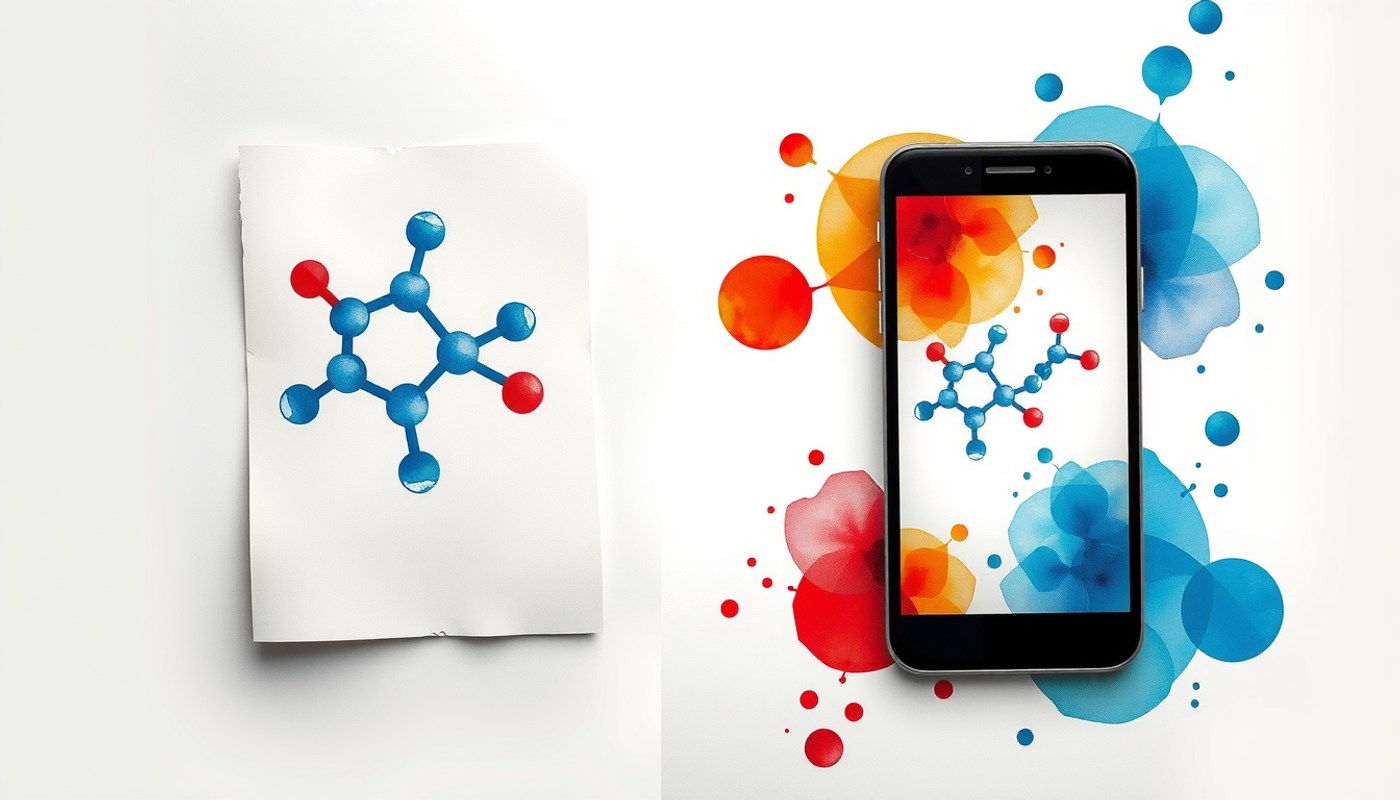
Digital flashcards trivially support multimedia. Adding an image, an audio clip, or even a short video to a digital card takes seconds. Paper flashcards support text and hand-drawn sketches. Both can achieve dual coding, but digital makes it far more convenient.
Richard Mayer at UC Santa Barbara spent decades building the cognitive theory of multimedia learning, culminating in twelve principles that govern how people learn from words and pictures [21]. Two of these principles are directly relevant to flashcard design.
The multimedia principle states that words plus pictures beat words alone. This favors digital, where adding images is effortless. The coherence principle states that extraneous material reduces learning. This cuts against digital — many flashcard apps surround study content with gamification elements, advertisements, streak counters, and social features that add cognitive noise. A paper card has zero extraneous load. It is just the question and the answer.
The split-attention effect, described by Chandler and Sweller in 1992, adds another wrinkle. When learners must integrate information from physically separated sources, extraneous cognitive load rises. On a small smartphone screen, the question, the answer, the image, and the interface controls compete for limited visual space. A full-sized paper card presents all information in a single, immediately graspable visual field.
The Hidden Cost of a Connected Device
Paper flashcards have zero notifications. Zero social media. Zero emails. Zero temptation to check anything other than the card in front of you.
This matters more than most students realize.
In 2015, Cary Stothart and colleagues at Florida State University demonstrated that merely receiving a smartphone notification — without responding to it — produced sustained attention decrements equivalent to actually using the phone [22]. The notification broke concentration. The mind wandered to thoughts about who sent the message. Focused study was disrupted.
Kaminske, Brown, Aylward, and Haller replicated this in 2022 using a Stroop task with 105 participants. Notifications increased reaction times regardless of whether participants owned the phone sending the notification [23]. The distraction was not about personal relevance. It was about interruption.
A 2022 experimental study of smartphone game push notifications found measurable reductions in lecture learning performance when students received notifications during study [24]. And a 2025 meta-analysis of attentional interference in digital reading reported a moderately large negative effect (Hedges' g = −0.64) on comprehension [25].
Paper flashcard users are immune to this entire class of distraction. No buzzing. No banners. No red notification badges calling from the corner of the screen. Just the card, the question, and the effort to retrieve the answer.
The practical solution for digital flashcard users is obvious but rarely followed: enable Do Not Disturb mode before every study session. Every session. No exceptions. The evidence is unambiguous. A connected phone during study is a leak in the attention pipeline that no algorithm can compensate for.
Reading on Screens vs. Reading on Paper
The paper vs digital debate extends beyond flashcards into reading comprehension itself, and the evidence here adds another layer.
Anne Mangen at the University of Stavanger tested seventy-two Norwegian tenth-graders reading identical texts either on paper or on screen. The paper group scored significantly higher on reading comprehension [26].
A large 2018 meta-analysis by Pablo Delgado and colleagues pooled fifty-four studies with over 171,000 participants. They found a small but reliable advantage for paper reading, with Hedges' g ≈ −0.21 [27]. The effect was strongest under time pressure and for informational rather than narrative texts. The "shallowing hypothesis" suggests that habitual screen reading trains the brain to skim rather than process deeply.
How relevant is this to flashcards? Partially. Flashcard interactions are brief — a few seconds per card — not sustained reading sessions. The screen-versus-paper reading deficit likely applies less to flashcard review than to reading a textbook chapter. But it adds to the general picture: paper engages deeper processing by default, while screens invite shallower engagement.
Levels of Processing and the Depth Question
Fergus Craik and Robert Lockhart proposed the levels of processing framework in 1972 [28]. Their central insight: memory durability depends on processing depth. Shallow processing — noticing what a word looks like — creates weak memories. Intermediate processing — noticing how it sounds — creates moderate ones. Deep processing — thinking about what it means — creates strong, lasting memories.
When you write a flashcard by hand, you are forced into deep processing. You must decide what belongs on the card. You must rephrase ideas in your own words. You must compress a paragraph into a sentence. This active summarization engages semantic processing at its deepest level.
When you type a flashcard, you can achieve the same depth. But typing is faster. Speed creates the temptation to transcribe rather than transform. And transcription is shallow processing disguised as productive activity.
The notorious Mueller and Oppenheimer study of 2014 illustrated this perfectly [29]. Students taking notes by hand during lectures performed better on conceptual questions than laptop note-takers, despite writing fewer words. The handwriters were forced by the slowness of handwriting to select and rephrase. The laptop users transcribed nearly verbatim. More words, less learning.
A caveat is necessary. Morehead, Dunlosky, and Rawson attempted a direct replication in 2019 and found only small, non-significant trends favoring handwriting [30]. The handwriting advantage for note-taking is real but modest. Calling it transformative overstates the evidence.
For flashcard creation specifically, the depth advantage of handwriting applies only when the user is actively generating content. A student who copies pre-written flashcard text by hand is performing shallow motor activity, not deep semantic processing. The pen is not magic. The thinking is.

The Retrieval Practice Paradox
Here is an uncomfortable truth for paper flashcard advocates. Active recall requires practice at spaced intervals. Roediger and Karpicke showed the testing effect is strongest after delays — one day, one week, one month [15]. Without spacing, even perfect retrieval practice produces suboptimal results.
Nate Kornell at Williams College demonstrated this directly with paper flashcards in 2009. He asked students to study vocabulary using either spaced practice (cards distributed across multiple stacks) or massed practice (all cards in one stack studied repeatedly). Spaced practice produced dramatically better retention [31].
But here was the twist: students rated massed practice as more effective. They felt like they were learning more by cramming. Their subjective experience directly contradicted their objective test performance. Spacing felt harder. Harder felt worse. But harder was better.
This finding has a clear practical implication. Paper flashcard users can implement spacing — the Leitner box does exactly this. But adherence is the problem. Without an algorithm reminding you which cards are due, without a daily review queue automatically generated, the temptation to skip sessions or revert to cramming is strong. Digital systems automate the discipline that most learners lack.
The paradox is clear: the strategy that feels less effective is actually the one that works. And digital systems enforce that strategy automatically.
The Environmental and Practical Equation
Both study formats carry costs that extend beyond cognition.
Paper flashcards consume paper. The pulp-and-paper industry contributes approximately one percent of global carbon dioxide emissions and accounts for about four percent of global energy consumption. For an individual student making a few hundred cards per semester, the environmental footprint is negligible. But multiplied across millions of students, it adds up.
Digital flashcards require devices. The global e-waste stream exceeds sixty million metric tonnes annually, with approximately seventy-five percent improperly managed even in regulated countries [32]. A student who purchases a new device primarily for flashcard study incurs a substantial embedded energy cost. A student who uses a device they already own for other purposes adds nearly zero marginal environmental impact.
On accessibility, digital flashcards offer clear advantages. Text-to-speech, adjustable font sizes, screen reader compatibility, and audio card creation support learners with visual impairments, dyslexia, and motor disabilities. Paper flashcards can be adapted with raised lettering or Braille, but the range of accommodations is limited.
On cost, the equation favors both formats depending on circumstance. A pack of one hundred index cards costs less than a dollar. Every major digital flashcard platform offers a free tier. Neither format requires significant financial investment for basic use.
Context-Dependent Memory and Why Variety Wins
In 1975, Duncan Godden and Alan Baddeley asked divers to memorize word lists either on land or underwater. Recall was better when the retrieval context matched the encoding context [33]. A 2001 meta-analysis by Steven Smith and Edward Vela estimated the average effect size at Cohen's d ≈ 0.25 — small but real.
The implication for flashcard study is straightforward. Studying exclusively in one context, one format, one location, and one posture may create memories that are tightly bound to that specific setting. Vary the context and the memory becomes more robust, more transferable, more exam-ready.
This is an argument for using both paper and digital flashcards. Create cards at your desk with pen and paper. Review them on the train with your phone. Quiz yourself from the paper stack in the library. Open the app before bed. Each context adds another retrieval route. Each format exercises a slightly different cognitive process.
The Honest Verdict
The research converges on a conclusion that satisfies no one completely and everyone partially.
Paper flashcards win at encoding. The motor-visual-semantic triple trace produced by handwriting creates richer initial memory than typing. The generation effect, the levels of processing advantage, and the neuroscience evidence all support this. But paper loses at scheduling. Human beings cannot compute optimal review intervals. They overestimate massed practice and underestimate spacing. They skip sessions without external prompts.
Digital flashcards win at review. Algorithmic scheduling, automated reminders, and data-driven personalization produce objectively better long-term retention. The testing effect works equally well in both formats, but digital ensures it happens at the right time. But digital loses at encoding depth, and the connected device introduces a distraction cost that is empirically documented and often ignored.
The optimal workflow, supported by converging evidence from neuroscience, cognitive psychology, and educational research, is a hybrid approach [34].
Create cards by hand. Write the question. Write the answer. Draw a sketch if it helps. Engage the motor cortex. Force deep processing. Trigger the generation effect.
Then digitize the deck. Type or photograph the handwritten cards into a spaced repetition system. Let the algorithm schedule reviews. Let the machine handle timing so the brain can focus on retrieval.
Review across contexts. Sometimes on paper. Sometimes on the phone. Sometimes at the desk, sometimes on the bus. Vary the environment. Build robust, transferable memories.
Disable notifications during every review session. Eliminate the documented attentional cost of a connected device.
And above all: make your own cards. Whether paper or digital, user-generated cards beat pre-made decks. The medium matters less than the method.
What the Science Has Not Yet Settled
Intellectual honesty requires acknowledging what remains unknown.
No fully randomized, large-scale, registered clinical trial has directly compared handwritten paper flashcards with self-generated digital flashcards using FSRS scheduling on identical material in a high-stakes academic course. The specific question most learners care about — "will I score higher on my exam if I use paper or digital?" — remains empirically open.
The Van der Meer and Van der Weel EEG study, while striking, involved only thirty-six participants. Pinet and Longcamp published a 2025 commentary in Frontiers in Psychology flagging methodological limitations including motor confounds and small-sample concerns [35].
The Mueller and Oppenheimer laptop note-taking finding — perhaps the most cited evidence for handwriting superiority — was only partially replicated [30]. The effect is real but smaller than the headlines suggested.
Many flashcard comparison studies confound modality with algorithm. When digital flashcards outperform paper, it is often unclear whether the advantage came from the screen, the spaced repetition scheduling, the gamification, or some combination. The Kornell 2009 study showing spacing benefits even with paper cards suggests that the algorithm — not the screen — does most of the work [31].
Effect sizes for modality differences in flashcard studies are typically small. Cohen's d in the 0.2 to 0.5 range when present. Effect sizes for spacing, retrieval practice, and generation are large — d > 0.6. A learner worrying about whether to use paper or digital should first ensure they are spacing, retrieving, and generating. The modality decision is secondary.
Conclusion
The paper vs digital flashcards debate, when examined through the lens of neuroscience and cognitive psychology, is not a competition with a single winner. It is a complementary system where each format excels at a different phase of learning. Paper excels at encoding depth through handwriting, motor-visual coupling, and forced generation. Digital excels at review efficiency through algorithmic spacing, automated scheduling, and multimedia support. The strongest evidence-based strategy combines both: create by hand, review by algorithm, and study across varied contexts with notifications disabled. The question is not which format is better. The question is how to use each format for the specific cognitive job it does best.
Frequently Asked Questions
Are paper flashcards more effective than digital flashcards?
Research from 2010 to 2025 shows that paper and digital flashcards produce roughly equivalent learning outcomes in controlled studies. Paper flashcards may offer an encoding advantage through handwriting, while digital flashcards provide better long-term review scheduling through spaced repetition algorithms. The most effective approach depends on whether you make your own cards and how consistently you review them.
Does handwriting flashcards help memory?
Neuroscience evidence from EEG and fMRI studies confirms that handwriting activates broader brain networks than typing, including motor cortex, parietal lobe, and the reading circuit. This creates a richer memory trace during the card creation phase. However, the advantage applies specifically to the act of creating cards, not to the act of reviewing them.
What is the best way to study with flashcards?
Cognitive science identifies three principles for effective flashcard use: generate your own cards rather than using pre-made decks, space your reviews over increasing intervals rather than cramming, and practice active recall by committing to an answer before checking. These principles matter more than whether you use paper or digital format.
Is spaced repetition better on paper or digital?
Digital spaced repetition is objectively more precise. Algorithms like SM-2 and FSRS compute personalized review intervals based on your performance history, something no human can match manually. Paper systems like the Leitner box approximate spacing but cannot achieve the same level of optimization. Research by Cepeda et al. with over 1,350 participants established specific optimal intervals that only algorithms can implement.
Do digital flashcards cause distractions?
Yes. Research by Stothart et al. (2015) demonstrated that even receiving a single smartphone notification without responding to it produces measurable attention decrements. A 2025 meta-analysis found moderately large negative effects of digital distractions on comprehension. Studying on a connected device without disabling notifications introduces a documented cognitive cost that paper flashcards avoid entirely.