Introduction
In 2021, a team of computer scientists ran one of the largest controlled experiments in the history of learning research. They recruited approximately 50,700 adults studying for the German driver's licence exam and split them into groups. One group studied on a schedule determined by machine learning. The other groups followed conventional spacing rules [1]. The results stopped researchers in their tracks. The machine learning group remembered the material roughly 69% longer. They were also about 50% more likely to return to studying within a week.
That single experiment captures something that decades of memory science have been building toward. The brain forgets on a curve, but not the same curve for everyone. Not for every piece of information. Not at every time of day. And definitely not at the pace that any fixed schedule assumes. Machine learning does what no textbook formula can: it watches how each individual learner forgets, models that forgetting in real time, and adjusts the schedule to catch each memory right before it slips away.
This is the story of how that became possible. It begins with a psychology student in the 1880s, passes through Bayesian probability and hidden Markov models, and arrives at neural networks that can predict your next mistake before you make it.
A Man Alone With Nonsense Syllables
Every algorithm that personalizes a study schedule owes a debt to Hermann Ebbinghaus. In 1885, this German psychologist published results from years of experimenting on himself. He memorized lists of meaningless syllables like "DAX," "BUP," and "ZOL," then tested himself at increasing intervals to measure how much he forgot [2]. No lab assistants. No subjects. Just one man, thousands of syllables, and obsessive record-keeping.
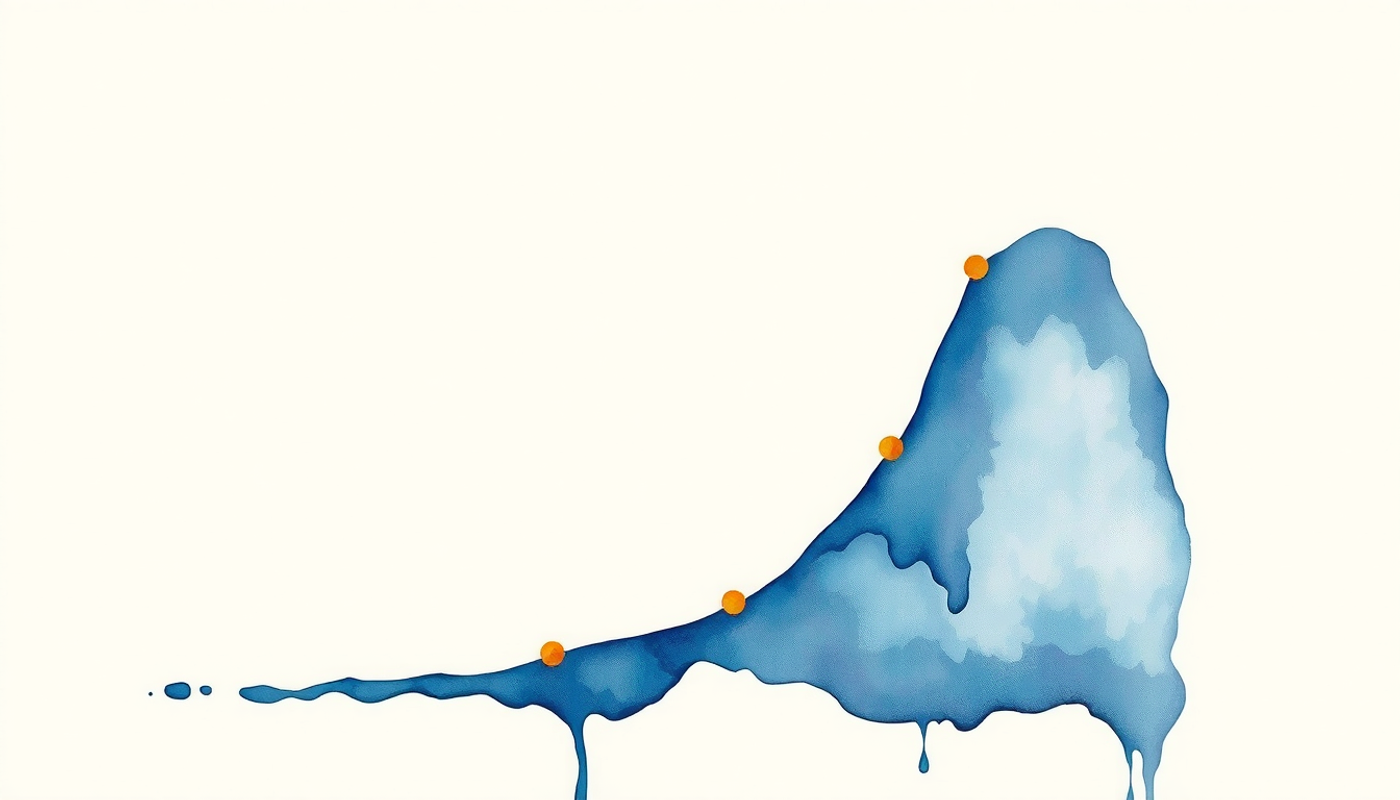
What he found became the forgetting curve. Memory decays rapidly at first, then levels off. Within an hour, roughly half of newly learned material is gone. After a day, about two-thirds has vanished. After a month, almost everything.
But Ebbinghaus also discovered something hopeful. Each time he re-studied and re-tested the same material, the curve flattened. The memory lasted longer before dropping. This was the first experimental evidence for what we now call the spacing effect, confirmed in 2006 by a massive meta-analysis of 839 effect sizes from 317 experiments [3].
In 2015, Jaap Murre and Joeri Dros at the University of Amsterdam replicated the original Ebbinghaus experiment over 31 days using modern methods [2]. The curve held up. It even revealed a small bump around the 24-hour mark, consistent with sleep-dependent memory consolidation [4].
So the basic science was clear more than a century ago. Space your reviews. Revisit before you forget completely. But there was a catch that would take another hundred years to solve: how much spacing? For whom? For which material?
The First Algorithms: Rules Without Eyes
The earliest attempt to automate spacing came in 1972, when German science journalist Sebastian Leitner published his cardboard box system. Place flashcards in a series of boxes. Get a card right, promote it to the next box. Get it wrong, send it back to box one. Review higher boxes less often. Simple. Elegant. And blind to the individual learner.
Fifteen years later, Piotr Woźniak took the next step. Working as a graduate student in Poland in 1987, he created an algorithm called SM-2. It tracked three values for each card: a repetition count, an "ease factor" that drifted up or down based on how well you recalled, and a growing interval. After a successful review, the interval multiplied by the ease factor. The whole system ran on a few lines of arithmetic [5].
SM-2 dominated self-study for over three decades. But it had a fundamental limitation. Its ease factor started at 2.5 for everyone and adjusted slowly. A medical student memorizing drug interactions and a language learner studying vocabulary got the same initial treatment. The algorithm could not see the difference between a word you almost remembered and one you never encoded properly. It had rules, but no eyes.
What does this mean for real life? If you have ever felt that a flashcard system kept showing you cards too early or too late, you were experiencing the consequence of fixed rules applied to a variable brain.

Teaching Computers to Read Minds
The leap from rules to learning began in the mid-1990s, not in the study-scheduling world but in intelligent tutoring systems.
In 1994, Albert Corbett and John Anderson at Carnegie Mellon University published a paper that would become one of the most cited in educational technology. They introduced Bayesian Knowledge Tracing, or BKT [6]. The idea was deceptively simple. For each skill a student is learning, maintain a hidden variable: does the student know this, or not? You cannot observe the answer directly. You can only observe whether they get questions right or wrong. But correct answers from someone who does not know (lucky guesses) and wrong answers from someone who does know (slips) blur the picture.
BKT used Bayes' theorem to cut through that blur. Given a prior probability of mastery, a guess rate, a slip rate, and a learning rate, the model updates its belief after every response. When the probability of mastery crosses a threshold (Corbett and Anderson set theirs at 95%), the system decides the student has learned the skill and moves on.
Four parameters per skill. That was the entire model. And it worked surprisingly well for tracking whether a student understood algebra concepts or physics principles. But it treated knowledge as binary: you either knew it or you did not. It had no sense of partial knowledge, no memory of how long ago you last practiced, and no way to predict when you might forget.
The field needed something that could handle sequences, time, and the messy reality of human memory.
Deep Learning Enters the Classroom
In 2015, Chris Piech and his colleagues at Stanford published a paper that sent a tremor through the educational data mining community. They called it Deep Knowledge Tracing [7].
The idea: replace BKT's hand-crafted probability model with a recurrent neural network. Specifically, a Long Short-Term Memory network, or LSTM. Feed the network a sequence of student interactions: which question was attempted, whether it was correct, how long the student took. Let the network learn its own internal representation of the student's knowledge state. No hand-tuned parameters. No binary mastery variable. Just raw data and gradient descent.
The original paper reported dramatic improvements in prediction accuracy over BKT on several datasets. Later replication work by Khajah, Lindsey, and Mozer in 2016 showed that much of the gap closes when BKT is properly extended [8]. But the door had been opened. Deep learning could model student knowledge.
Two years later, Jiani Zhang and colleagues introduced Dynamic Key-Value Memory Networks for knowledge tracing [8]. Their architecture used a static "key" matrix to represent underlying knowledge concepts and a dynamic "value" matrix that updated with each student interaction. This restored some of the per-concept interpretability that DKT had lost, while keeping the power of deep learning.
Then came the attention era. In 2019, Shalini Pandey and George Karypis introduced the Self-Attentive Knowledge Tracing model, reporting an average improvement of 4.43% in prediction accuracy across benchmark datasets [9]. Aritra Ghosh, Neil Heffernan, and Andrew Lan followed in 2020 with Attentive Knowledge Tracing, which added something clever: a monotonic attention mechanism with exponential decay that explicitly modeled forgetting [10]. The model did not just track what a student knew. It tracked how that knowledge faded over time.
But predicting whether a student will get the next question right is not the same as deciding when they should study next. Knowledge tracing tells you what the student knows now. Scheduling tells you when to review what. These are two different problems. And solving the second one required a different scientific tradition.
The Three Numbers That Describe a Memory
While knowledge tracing was evolving inside intelligent tutoring systems, a parallel revolution was happening in spaced repetition scheduling.
Woźniak did not stop at SM-2. By the mid-1990s, he had moved toward a theoretical framework that would prove far more powerful. He proposed that the state of any single memory in the human brain could be described by three numbers [11].
The first is Difficulty. Some facts are simply harder to retain than others. The capital of France is easier than the capital of Burkina Faso. This number captures that inherent resistance to memorization.
The second is Stability. Think of it as the half-life of a memory. High stability means the memory decays slowly. After your tenth successful review of a fact, its stability might be measured in months or years. After your first encounter, it might be measured in hours.
The third is Retrievability. This is the probability that you can recall the fact right now, at this moment. It starts at 100% right after a review and decays over time according to the forgetting curve. How fast it decays depends on the stability.
This Difficulty-Stability-Retrievability model, known as DSR, became the theoretical backbone of modern scheduling algorithms. The scheduling problem reduces to a simple question: given the current DSR state of each card, when should the next review happen to keep retrievability above some target while minimizing total reviews?
SM-2 could not answer this question well because it did not track these variables separately. It lumped everything into a single "ease factor." But once you have DSR, you can write mathematical equations that describe exactly how memory behaves. And once you have equations, you can train them with machine learning.
When a Student Became the Teacher
The breakthrough that connected memory science to machine learning came from an unexpected place.
In 2016, Burr Settles and Brendan Meeder, working at a language learning company, published a paper at the Association for Computational Linguistics conference. They called their model Half-Life Regression, or HLR [12]. Instead of using fixed rules to determine review intervals, HLR estimated the half-life of each item in a learner's memory by running a regression on the learner's practice history. Features included how many times the item had been seen, how many times it had been recalled correctly, and properties of the item itself.
Trained on more than 12 million practice sessions, HLR cut prediction error by over 45% compared to Leitner-style scheduling [12]. When deployed, it improved next-day retention by approximately 12%.
The real earthquake hit in 2022. Jarrett Ye, then an undergraduate researcher at a Chinese vocabulary-learning company, realized that the DSR model's parameters could be trained directly with gradient descent on real review data. He published his findings at ACM SIGKDD, one of the top machine learning conferences [13].
Ye's algorithm, called FSRS (Free Spaced Repetition Scheduler), implements the DSR model directly. Each card carries a Difficulty score from 1 to 10, a Stability value measured in days, and a Retrievability that decays over time via a power-law forgetting curve. The model uses 17 to 21 trainable weights (depending on version) that are fit to a learner's review history by minimizing prediction error with gradient descent [14].
The open-source benchmark maintained by Ye and contributors evaluates these algorithms on over 727 million reviews from 10,000 users. On this dataset, the latest version of FSRS achieves lower prediction error than the classic SM-2 algorithm for roughly 99% of user collections [15]. Simulations indicate it reduces daily reviews by 20 to 30% at matched retention levels.
Think about what that means practically. Same amount of knowledge retained. Twenty to thirty percent less time spent reviewing. Across millions of cards and thousands of users. Not because of a cleverer rule, but because the algorithm learned to see each learner individually.
The Experiment That Settled the Debate
Claims about algorithmic superiority are easy to make and hard to prove. Simulations show one thing. Real learners in real conditions show another.
That is why the experiment by Utkarsh Upadhyay, Daniel Lancashire, Torsten Moser, and Manuel Gomez-Rodriguez matters so much. Published in npj Science of Learning in 2021, it remains the largest randomized controlled trial comparing machine-learning-based scheduling against heuristic baselines in a real learning environment [1].
The setup: approximately 50,700 adult learners studying for the German driving licence exam between December 2019 and July 2020. One group received study sequences optimized by a machine learning model. The control groups received sequences based on conventional heuristic schedulers.
The findings were striking. Learners in the machine learning group retained content approximately 69% longer than those in the heuristic groups. They were also roughly 50% more likely to return to the app within four to seven days [16].
Earlier theoretical work by Behzad Tabibian, Upadhyay, and colleagues at the Max Planck Institute had laid the mathematical foundation. Their 2019 paper in the Proceedings of the National Academy of Sciences framed scheduling as an optimal control problem on marked temporal point processes and proved, for two standard memory models, that the optimal review intensity is proportional to recall probability [17]. The 2021 experiment confirmed that the theory worked in practice at scale.
A separate classroom study by Robert Lindsey, Jeffery Shroyer, Harold Pashler, and Michael Mozer, published in Psychological Science in 2014, had shown a 16.5% improvement in cumulative exam performance when using a personalized multiscale memory model over a generic review schedule [18].
What does this mean for anyone who studies? The evidence is no longer theoretical. Machine learning scheduling is measurably better than fixed-interval approaches, and the gains are large enough to matter in practice.

Beyond Flashcards: ML in the Wider Classroom
Spaced repetition is just one corner of a much larger picture. Machine learning personalizes study schedules in several other ways, each targeting a different aspect of the learning process.
Knowledge Space Theory, developed by Jean-Claude Falmagne and Jean-Paul Doignon at UC Irvine in the 1990s, takes a different approach entirely [19]. Instead of tracking memory strength for individual items, it infers the learner's current "knowledge state," a subset of a partially ordered set of skills. If a student understands multiplication, they probably understand addition. If they can solve quadratic equations, they probably understand variables. The system maps these prerequisite relationships and delivers targeted instruction at the frontier of what the student can learn next.
Reinforcement learning offers yet another angle. Siddharth Reddy, Igor Labutov, Shirley Anggara Banerjee, and Thorsten Joachims modeled reviewing as a queueing network and used Trust Region Policy Optimization to find scheduling policies that outperformed human-designed heuristics [20]. Benjamin Clement, Didier Roy, Pierre-Yves Oudeyer, and Manuel Lopes applied multi-armed bandit techniques to sequence numeracy activities for approximately 400 French primary school children. Their system matched the performance of curricula designed by expert teachers [21].
Graph neural networks represent the newest frontier. Alexis Vassoyan, Jill-Jênn Vie, and Thomas Lemberger published a paper at Educational Data Mining 2023 that frames learning-path personalization as reinforcement learning over a graph of educational resources [22]. This architecture allows the system to incorporate new content without retraining from scratch, solving one of the major practical challenges of deployed educational ML.
A meta-analysis by SRI International in 2022 examined the overall impact of adaptive learning systems across K-12 and higher education. The results: effect sizes ranging from roughly 0.3 to 0.7 standard deviations depending on subject, duration, and student level [23]. To put that in perspective, 0.4 standard deviations is roughly the difference between a B and a B+ student. Meaningful, but not miraculous. The largest gains appeared for previously low-performing students in math and science.
Why One Schedule Cannot Fit All Brains
The neuroscience behind personalized scheduling is not just about the forgetting curve. It is about individual differences in how that curve behaves.
Hedderik van Rijn and his colleagues at the University of Groningen published a finding in 2016 that cut to the heart of the matter. Individual forgetting rates are stable within each person across sessions but differ substantially between people [24]. Your rate of forgetting is like your resting heart rate: consistent for you, but different from your neighbor's. This means that any fixed-interval schedule will be too aggressive for some learners and too relaxed for others.
The testing effect adds another layer. Henry Roediger III and Andrew Butler published a landmark review in 2011 showing that active recall produces larger gains in long-term retention than simply re-reading the material, often by a factor of two on multi-day delays [25]. John Dunlosky and colleagues confirmed this in their 2013 review of ten study techniques, ranking retrieval practice and distributed practice as the two highest-utility strategies [26].
Sleep matters too. Matthew Walker and Robert Stickgold documented in their 2004 review in Neuron that both procedural and declarative memories benefit from intervening sleep, with effects that are not just stabilizing but actively enhancing [4]. The practical implication: an interval that spans at least one sleep cycle is qualitatively different from a same-day review. The latest versions of modern scheduling algorithms actually encode this distinction, using different update rules for same-day and across-day reviews [14].
Even the time of day may play a role. Studies in both mice and humans show diurnal modulation of hippocampus-dependent memory, with consolidation being the phase most sensitive to circadian timing [27]. These effects are smaller in humans than in nocturnal rodents, but they add to the growing case that when you review matters, not just whether.
All of these findings point in the same direction. Memory is not a single mechanism with a universal speed dial. It is a constellation of processes, each with its own tempo, shaped by sleep, retrieval, spacing, difficulty, and individual biology. A machine learning model that tracks these variables simultaneously has an inherent advantage over any fixed schedule.
The Math Under the Hood
The mathematics of modern scheduling algorithms is surprisingly accessible once you strip away the notation.
The forgetting curve, in its simplest form, is an equation: R equals e raised to the power of negative t divided by S. R is retrievability, the probability you can recall something right now. The variable t is the time since your last review. S is stability, the memory's resistance to decay. When t equals zero, R equals one: you just reviewed, so you remember perfectly. As t grows, R drops [2].
Modern algorithms use a slightly different parameterization. They define stability as the time needed for retrievability to drop from 100% to 90%. So if a card has stability of 30 days, you have a 90% chance of remembering it after 30 days. This gives you a concrete knob to turn: do you want 90% retention (more reviews), or are you comfortable with 80% (fewer reviews, more forgetting)?
Training these models works through gradient descent. Each card's review history produces a sequence of predictions: "I predicted you had a 85% chance of remembering this, and you got it right" or "I predicted 70%, and you forgot." The algorithm adjusts its weights to minimize the gap between predictions and outcomes, measured by a quantity called log-loss [28]. Over millions of reviews, the model converges on parameter values that describe how each learner's memory actually behaves.
The evaluation metric matters more than most people realize. Older systems were judged by whether they correctly predicted "right or wrong." But calibration is what scheduling actually needs. A well-calibrated model does not just say "you will probably get this right." It says "there is an 82% chance you will get this right" and is correct 82% of the time. That precision is what makes it possible to schedule the review at exactly the right moment.
What Machines Still Cannot See
The evidence for ML-based scheduling is strong. But the field has genuine limitations that deserve honest discussion.
The cold-start problem is the most immediate. When a new user opens a learning app for the first time, the algorithm knows nothing about them. It must rely on population averages until it accumulates enough data to personalize. Research by Bhattacharjee and Wayllace published in 2025 showed that leading knowledge tracing models exhibit substantially lower prediction accuracy on entirely new students compared to students with existing data [29]. Few-shot meta-learning can help, and sensible default parameters mitigate the worst effects, but the first few sessions of any adaptive system are necessarily less personalized than later ones.
Algorithmic bias is a deeper concern. Ryan Baker and Aaron Hawn published a systematic review in 2021 documenting disparities in adaptive learning systems across race, gender, native language, socioeconomic status, and parental education [30]. If the training data comes disproportionately from one demographic, the algorithm's "average" student may not represent everyone. In the worst case, an adaptive system could route disadvantaged learners to easier material, reinforcing the exact gaps it was supposed to close.
There is also the problem of what these models actually optimize. Most knowledge tracing models predict next-trial accuracy: will the student get the next question right? But getting a question right on a flashcard is not the same as understanding a concept deeply, transferring knowledge to new situations, or retaining information for years. Shayan Doroudi, Vincent Aleven, and Emma Brunskill made this critique explicit in their 2019 review of reinforcement learning for instructional sequencing [31]. Optimizing the wrong reward function can produce systems that look good on dashboards but fail on delayed transfer tests.
Privacy adds another dimension. In the United States, FERPA constrains how educational platforms handle student data. In the European Union, GDPR imposes strict consent, portability, and erasure requirements. Adaptive learning systems that train on millions of review logs sit in legal tension with these frameworks, particularly as behavioral data becomes granular enough to risk re-identification [32].
Finally, there is the "filter bubble" risk. A model that always selects the next item to maximize predicted short-term correctness will naturally narrow the curriculum toward what the learner already partially knows. This feels efficient. But it may come at the cost of exposure to challenging material that produces the productive struggle necessary for deeper learning.
What Comes Next
The trajectory of this field points toward convergence. Knowledge tracing (what does the student know?) and spaced repetition scheduling (when should they review?) are merging into unified models that simultaneously estimate knowledge state and decide what to show next.
Newer LSTM architectures are being trained not just on correctness data but on response times, confidence ratings, and even keystroke patterns. These richer input signals let models detect the difference between a confident correct answer and a lucky guess, or between genuine forgetting and momentary distraction [33].
The mathematics of forgetting is also being refined. Current models treat each memory as independent, but real knowledge is interconnected. Knowing the word "photosynthesis" makes it easier to remember "chloroplast." Future algorithms will likely model these semantic relationships, scheduling reviews not just for individual items but for clusters of related concepts.
The market reflects this momentum. Fortune Business Insights valued the North America adaptive learning software market at approximately 1.43 billion dollars in 2024, projecting it to reach 5.47 billion by 2032 at an 18% compound annual growth rate [34]. These are forecasts, not measurements, and different research firms use different scope definitions. But the direction is unmistakable.
The deeper question is not whether ML will personalize learning. It already does. The question is whether the research community will solve the harder problems: cold start, bias, privacy, and the gap between predicting accuracy and producing understanding. The algorithms are getting better at watching how you forget. The challenge is making sure they help you truly learn.

Conclusion
The story of machine learning in study scheduling spans more than a century. It starts with Ebbinghaus alone in his study, measuring forgetting by brute force. It passes through Leitner's cardboard boxes and Woźniak's simple arithmetic. It accelerates with Corbett and Anderson's probabilistic models, Piech's neural networks, and Settles's regression on millions of practice sessions. And it arrives at FSRS and the randomized experiments that proved, on tens of thousands of real learners, that data-driven scheduling produces measurably longer retention with fewer reviews.
The science is clear on three points. First, forgetting is steep and begins immediately. Second, spacing and retrieval practice counteract forgetting powerfully. Third, the optimal spacing is different for every person and every piece of knowledge. Machine learning solves the third point in a way that no fixed rule ever could.
But the field is not finished. Cold-start problems, algorithmic bias, privacy constraints, and the gap between predicting quiz accuracy and producing genuine understanding remain open challenges. The most responsible path forward combines the precision of machine learning with the wisdom of cognitive science, building systems that not only predict when you will forget but help you build the kind of deep, transferable knowledge that lasts.
Frequently Asked Questions
How does machine learning improve study schedules compared to traditional methods?
Machine learning analyzes individual review history and performance patterns to predict when each specific piece of information will be forgotten. Unlike fixed-interval schedules, ML models adjust spacing based on personal forgetting rates, item difficulty, and response patterns, producing schedules that maintain the same retention with 20 to 30 percent fewer reviews.
What is the forgetting curve and why does it matter for study scheduling?
The forgetting curve, first described by Hermann Ebbinghaus in 1885, shows that memory decays rapidly after learning, with roughly half of new information lost within an hour. Modern replications confirm this pattern. Understanding the curve is essential because effective scheduling must time reviews to intercept this decay before information is lost completely.
What is the DSR model in spaced repetition algorithms?
The DSR model describes memory using three variables: Difficulty (how hard an item is to retain), Stability (how long before recall probability drops to 90%), and Retrievability (the current probability of successful recall). Modern algorithms like FSRS use this framework to predict forgetting precisely and calculate optimal review intervals for each card and each learner.
Can machine learning study schedules work for new users with no data?
New users face a "cold-start problem" where the algorithm lacks personal data for accurate predictions. Systems handle this by starting with population-average parameters and rapidly adjusting as the user provides responses. Research shows that prediction accuracy improves significantly after several dozen interactions, though the first few sessions rely on general estimates.
What evidence supports machine learning study scheduling over traditional approaches?
The strongest evidence comes from a 2021 randomized controlled trial with approximately 50,700 learners published in npj Science of Learning. The machine learning group retained information roughly 69 percent longer than heuristic groups. Additional benchmark studies show modern ML algorithms outperform classic scheduling rules for over 99 percent of user collections tested.