
Most lists of ADHD study tips give you the same advice: use a timer, remove distractions, try body doubling, reward yourself. Some of it is good. But almost none of those pages tell you which tips were ever tested on people with ADHD, and that is the question that matters when your attention is limited and you cannot afford to waste a study session on something that only sounds helpful.
So we went through the studies. Below, each tip carries one of three labels: tested on people with ADHD, tested on students in general, or not properly tested at all. The good news is that the method with the strongest evidence for students with ADHD is also one of the simplest.
The short version
- Test yourself instead of rereading. This is the one tip tested on college students with ADHD, and they remembered as much as everyone else a week later.
- Space your reviews over several days instead of one long session.
- Take breaks on a fixed timer, not when you feel tired.
- Let yourself move. In one study, children with ADHD did better working-memory tasks while moving more.
- Try white or pink noise at a low volume. It helped a little with ADHD and hurt a little without it.
- Write if-then plans for the moment you usually get stuck.
- Body doubling is popular but untested. Try it, just do not expect proof.
- Medication can make you more productive, but in one trial it did not make children learn more of what was taught.
How we sorted the tips
The table shows every tip in this guide, who it was tested on, and what the study found.
1. Test yourself instead of rereading
Rereading your notes feels productive because the page looks familiar. Familiar is not the same as remembered. Retrieval practice means closing the notes and trying to recall the answer first, then checking it. Flashcards are the easiest way to do this.
The key study here was done with students who have ADHD. Knouse, Rawson and Dunlosky (2020) had 58 undergraduates with ADHD and 121 without learn key-term definitions on a computer. They studied each definition, tried to recall it, and judged their own answer against the correct one. One group decided for themselves how much to practice. The other group had to recall each definition correctly three times.
One week later, the students with ADHD remembered the definitions as well as the students without ADHD, in both groups. When they were free to choose, they also used retrieval and feedback about as much as their peers. The authors conclude that retrieval practice to a criterion, such as three correct answers, can be recommended for college students with and without ADHD.
In practice: turn every heading in your notes into a question, answer it from memory, then check. Keep a card in the pile until you have got it right three times. Our guide on how to study with flashcards covers the rest of the routine, and the testing effect explains why it works.
2. Space it out over several days
Spacing means reviewing the same material across several days instead of in one long block. It has been tested many times on students in general, though not specifically on students with ADHD. Cepeda and colleagues (2008) tested more than 1,350 people and found that the best gap between reviews depends on when you need the material: for a test one week away, about 20% to 40% of that week, so a review every two days or so.
For ADHD, spacing has a second benefit that has nothing to do with memory. Four sessions of 20 minutes are easier to start than one session of 80 minutes. If starting is your problem, short and spaced is the format that gets you to start. Read more on the spacing effect.
3. Take breaks on a timer, not when you feel tired
This is the idea behind the Pomodoro technique, and here the evidence comes from ordinary university students, not from ADHD samples. Biwer and colleagues (2023) followed 87 Dutch students through a real study session. Some took breaks whenever they chose. Others took a fixed 6-minute break after every 24 minutes, or a 3-minute break after every 12 minutes.
The students who chose their own breaks studied longer and took longer breaks, and they reported more fatigue and distraction, and less concentration and motivation. They did not get more done. Both fixed-break groups finished the same amount of work in less time.
If 24 minutes feels impossible, start with the 12-and-3 version. That rhythm was tested too. A timer that decides for you also removes one more decision from the session.
4. Let yourself move
Many people with ADHD are told to sit still. One study suggests that can backfire. Sarver and colleagues (2015) watched 29 boys with ADHD and 23 boys without ADHD, aged 8 to 12, while they did working-memory tasks. When the boys with ADHD moved more, they did better. When the boys without ADHD moved more, they did slightly worse. Movement did not change how attentive either group looked.
This was a small study of children doing short memory tasks, so treat it as a hint rather than a rule. Still, the low-cost version is easy: a fidget toy, a wobble cushion, standing at a counter, or walking while you recite your flashcards out loud.
5. Try white or pink noise, at a low volume
White noise sounds like static. Pink noise has more low tones and sounds more like steady rain. Both are popular on social media as ADHD study aids, and this is one of the few trends that has been measured.
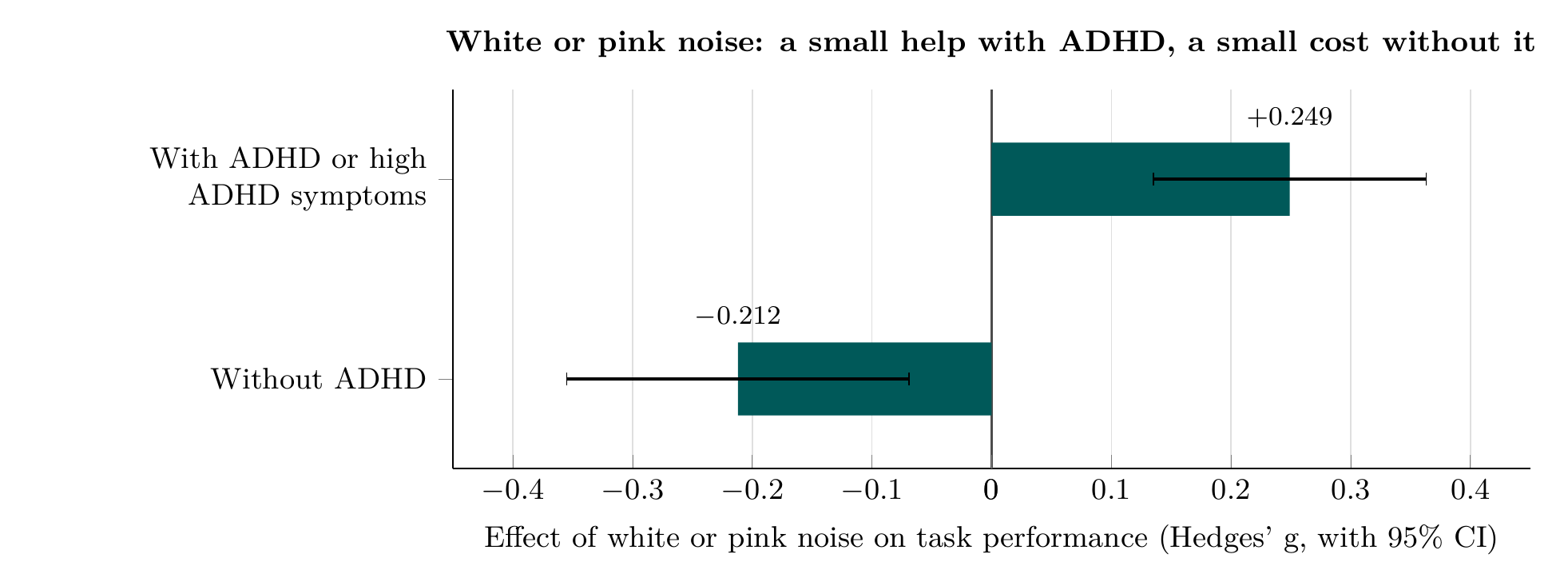
Effect of white or pink noise on task performance. Data from Nigg et al. (2024), Journal of the American Academy of Child and Adolescent Psychiatry 63(8): meta-analysis of 13 studies (N = 335) of people with ADHD or high ADHD symptoms and 11 comparison groups (N = 335) without ADHD, on lab attention tasks. Bars show Hedges' g with 95% confidence intervals. Chart by Mindomax.
Nigg and colleagues (2024) combined 13 studies with 335 children and college-age adults who had ADHD or high ADHD symptoms. White or pink noise gave a small but real boost on lab attention tasks. In 11 comparison groups of people without ADHD, the same noise made performance a little worse.
Three limits are worth knowing. The effect is small. It was measured on lab tasks, not on grades. And the review found no studies of brown noise at all, despite its popularity. The authors also note that safe volume levels have not been established, so keep it quiet. If you share a room, remember that the noise that helps you may hurt your roommate.
6. Write if-then plans for the moment you get stuck
An if-then plan names a situation and what you will do in it: "If I pick up my phone during a study block, then I put it in the other room." Gawrilow and Gollwitzer (2008) found that plans like this helped children with ADHD stop an automatic response in a lab task, which is exactly the skill a distracted study session needs.
Write two or three of these for your own weak spots, such as starting, checking your phone, or switching to an easier task. More on the method in our article on implementation intentions.
7. Body doubling: popular, but untested
Body doubling means working next to someone else, in person or on a video call, so their presence keeps you on task. It appears on almost every ADHD study list. We searched for controlled trials of body doubling on learning or grades and found none. The research so far is exploratory, such as a small 2025 study that recorded brain activity during body doubling.
That does not mean it fails. It means nobody has checked. It is cheap to try: study with a friend, join a library session, or use a virtual coworking service. If you finish more with someone beside you, keep doing it. Just combine it with a method that has been tested, such as self-testing.
8. Medication helps you work, but not with everything
Medication decisions belong to you and your doctor, and nothing here is advice to start, stop or change anything. But one trial is worth knowing about because it changes how to think about studying.
Pelham and colleagues (2022) ran a masked crossover trial with 173 children aged 7 to 12 with ADHD in a summer program. For three weeks each, the children received either extended-release methylphenidate or a placebo while being taught science, social studies and vocabulary. On medication, they got much more seatwork done and behaved better in class, every day. But they learned the same amount of the taught material whether they were on medication or placebo.
For college students without ADHD who borrow stimulants as study drugs, the picture is similar. Arria and colleagues (2017) followed 898 undergraduates and found that those who used stimulants without a prescription gained no detectable GPA advantage. Only the students who never used them improved their GPA.
The takeaway: medication can make it easier to sit down and do the work, but the study method still decides how much sticks.
Putting it together: one 40-minute session
- Minutes 0 to 2: write one if-then plan for today and put your phone in another room.
- Minutes 2 to 14: self-test on yesterday's cards, standing or moving if that helps.
- Minutes 14 to 17: fixed break.
- Minutes 17 to 29: turn today's notes into questions and test yourself on them.
- Minutes 29 to 32: fixed break.
- Minutes 32 to 40: one more round on anything you missed, until each card is right three times.
Quiet white or pink noise in the background is optional. Repeat the review two days later.
Tools that make this easier
None of these apps has been tested on students with ADHD. They are here because each one makes one of the tested methods easier to keep up.
A free white-noise track does the same job as a paid soundscape for the purposes of the study above. For more timer and focus options, see our list of focus apps for studying.
Use the support you are entitled to, and still change how you study
Gormley and colleagues (2019) found that first-year college students with ADHD earned significantly lower GPAs than their peers, and that the usual campus academic services were not on their own linked to better GPAs. Accommodations such as extra test time are worth having, but they work best alongside a study method that has evidence behind it.
Frequently Asked Questions
What is the best study method for ADHD?
Retrieval practice, meaning testing yourself instead of rereading. It is the only common study method tested on college students with ADHD, and in that study they remembered as much as students without ADHD one week later. Spacing your reviews over several days adds to the effect.
How long should someone with ADHD study at a time?
There is no ADHD-specific trial on this. In a study of university students, fixed breaks of 6 minutes after 24 minutes, or 3 minutes after 12 minutes, led to less fatigue and distraction than breaks taken at will, with the same amount of work done. Start with 12 minutes if 24 feels too long.
Does white noise help with ADHD studying?
A 2024 meta-analysis found a small benefit from white or pink noise for people with ADHD on lab attention tasks, and a small cost for people without ADHD. Keep the volume low. Brown noise has not been studied.
Does body doubling work for ADHD?
It has not been tested in a controlled trial on learning or grades. Many people find it helpful, and it costs little to try, but pair it with a tested method such as self-testing.
Do ADHD medications help you learn?
In a 2022 trial with children, methylphenidate greatly increased the amount of work done in class but did not increase how much of the taught material they learned. Talk to your prescriber about your own treatment, and use study methods with evidence either way.
The bottom line
The most repeated ADHD study tips are often the least tested. The one with the best evidence for students with ADHD is also the least exciting: close the book, try to recall the answer, check it, and come back to it two days later. Add fixed breaks, some movement and quiet noise if they help you, and treat body doubling as a bonus rather than a plan.
If you want an app that turns your notes into flashcards, schedules the reviews and runs the break timer in one place, Mindomax is free to try.
References
Arria, A. M., Caldeira, K. M., Vincent, K. B., O'Grady, K. E., Cimini, M. D., Geisner, I. M., Fossos-Wong, N., Kilmer, J. R., & Larimer, M. E. (2017). Do college students improve their grades by using prescription stimulants nonmedically? Addictive Behaviors, 65, 245-249. doi:10.1016/j.addbeh.2016.07.016
Biwer, F., Wiradhany, W., oude Egbrink, M. G. A., & de Bruin, A. B. H. (2023). Understanding effort regulation: Comparing 'Pomodoro' breaks and self-regulated breaks. British Journal of Educational Psychology, 93(S2), 353-367. doi:10.1111/bjep.12593
Cepeda, N. J., Vul, E., Rohrer, D., Wixted, J. T., & Pashler, H. (2008). Spacing effects in learning: A temporal ridgeline of optimal retention. Psychological Science, 19(11), 1095-1102. doi:10.1111/j.1467-9280.2008.02209.x
Gawrilow, C., & Gollwitzer, P. M. (2008). Implementation intentions facilitate response inhibition in children with ADHD. Cognitive Therapy and Research, 32, 261-280. doi:10.1007/s10608-007-9150-1
Gormley, M. J., DuPaul, G. J., Weyandt, L. L., & Anastopoulos, A. D. (2019). First-year GPA and academic service use among college students with and without ADHD. Journal of Attention Disorders, 23(14), 1766-1779. doi:10.1177/1087054715623046
Knouse, L. E., Rawson, K. A., & Dunlosky, J. (2020). How much do college students with ADHD benefit from retrieval practice when learning key-term definitions? Learning and Instruction, 68, 101330. doi:10.1016/j.learninstruc.2020.101330
Nigg, J. T., Bruton, A., Kozlowski, M. B., Johnstone, J. M., & Karalunas, S. L. (2024). Systematic review and meta-analysis: Do white noise or pink noise help with task performance in youth with attention-deficit/hyperactivity disorder or with elevated attention problems? Journal of the American Academy of Child and Adolescent Psychiatry, 63(8), 778-788. doi:10.1016/j.jaac.2023.12.014
Pelham, W. E., Altszuler, A. R., Merrill, B. M., et al. (2022). The effect of stimulant medication on the learning of academic curricula in children with ADHD: A randomized crossover study. Journal of Consulting and Clinical Psychology, 90(5), 367-380. doi:10.1037/ccp0000725
Sarver, D. E., Rapport, M. D., Kofler, M. J., Raiker, J. S., & Friedman, L. M. (2015). Hyperactivity in attention-deficit/hyperactivity disorder (ADHD): Impairing deficit or compensatory behavior? Journal of Abnormal Child Psychology, 43(7), 1219-1232. doi:10.1007/s10802-015-0011-1


