
The longest word in any major English dictionary is pneumonoultramicroscopicsilicovolcanoconiosis. It has 45 letters, it names a lung disease caused by breathing in very fine volcanic dust, and it was made up in 1935 for one reason: to be the longest word.
That is the quick answer. The more useful one is that almost nobody uses it, or any of the other famous record words. We counted them in 18.9 million words of 2024 news and 693 million words of movie and TV subtitles, and looked them up in Google Books. The longest word people actually write turns out to be a 20-letter word you have probably used yourself. And the "189,819-letter word" that gets passed around online? We took it apart, one building block at a time. It is not what it claims to be.
The longest word in English, in one answer
It depends on what you count as a word. Here are the honest answers, one per definition:
Longest word in a major dictionary: pneumonoultramicroscopicsilicovolcanoconiosis, 45 letters. Oxford's dictionaries include it and describe it, honestly, as "an artificial long word".
Longest word that was not invented to be long: pseudopseudohypoparathyroidism, 30 letters, a real medical term for an inherited condition.
Longest non-technical word: floccinaucinihilipilification, 29 letters, "the act of estimating something as worthless".
Longest word in Merriam-Webster's Collegiate Dictionary: electroencephalographically, 27 letters. The Collegiate leaves out pneumono... and even antidisestablishmentarianism.
Longest word people actually use: uncharacteristically, 20 letters. It is the only word of 20 or more letters that shows up 10 or more times in our 2024 news sample.
Longest chemical name: there is no limit. The famous 189,819-letter "name of titin" is in no dictionary, and the version online is not even titin (more on that below).
The record holders and what they mean
These are the words every "longest words" list repeats. We added where each one really comes from, because the stories are better than the words.
A few more records that show up in quizzes: strengths is the longest word with only one vowel letter, euouae (a medieval music term) is the longest word made only of vowels, and schmaltzed and strengthed (10 letters each) are usually given as the longest one-syllable words in the Oxford English Dictionary.
For long words that are hard to say rather than just long, see our list of hard words to pronounce.
Does anyone actually use these words?
Almost never. We looked each record word up in three places: Google Books (millions of books, averaged over 2010 to 2022), a sample of 18.9 million words of English news from 2024, and 693 million words of movie and TV subtitles.
The famous records appear about once in every billion words of books, and almost always in a sentence about long words. In our 2024 news sample they barely exist. In film and TV, supercalifragilisticexpialidocious lives on because of Mary Poppins, and antidisestablishmentarianism gets its 18 lines mostly as a joke about big words.
Compare that with uncharacteristically. It turns up in books about 650 times as often as the 45-letter record, and it shows up 15 times in our news sample and 133 times in the subtitles.
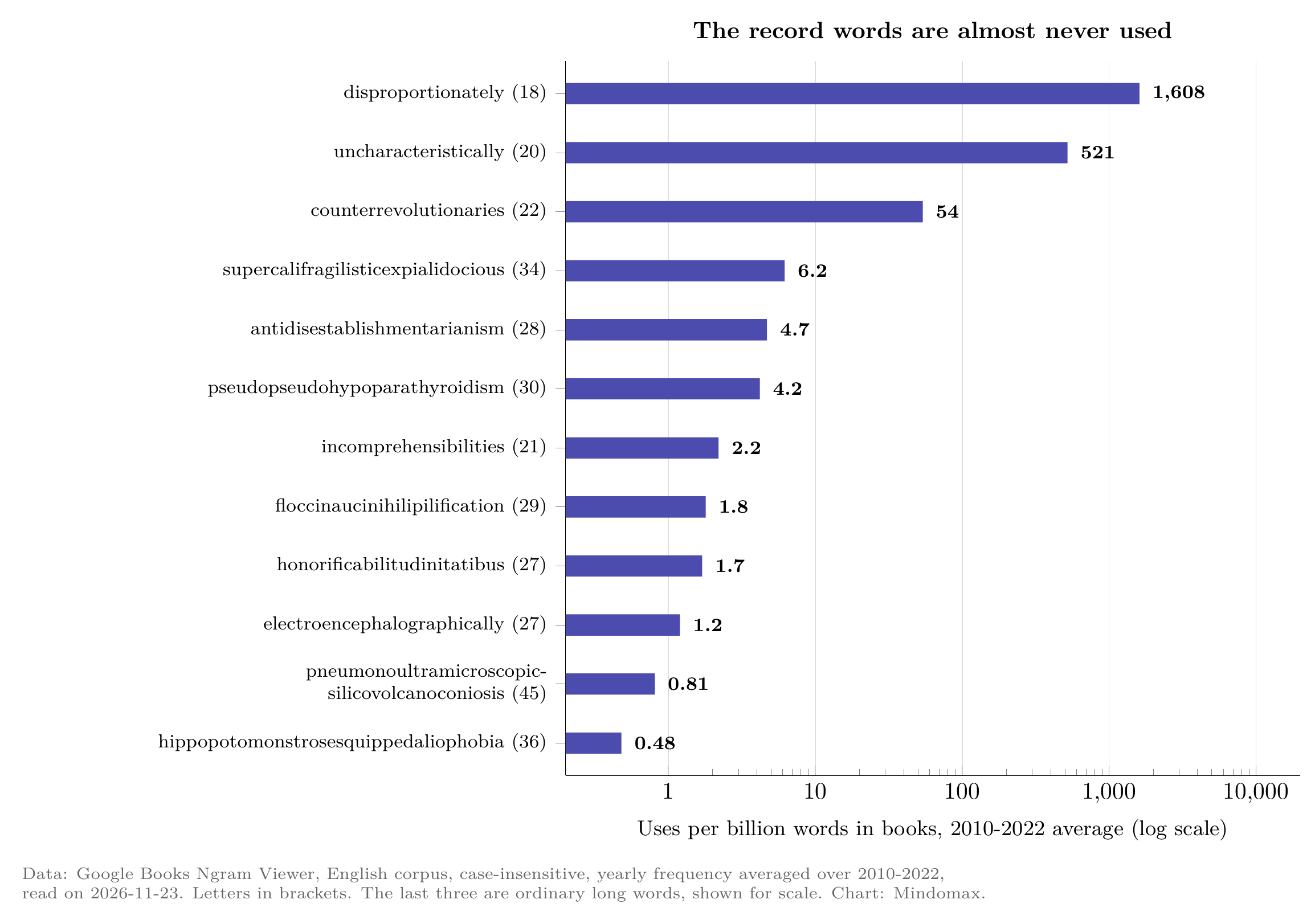
The famous record words appear about once per billion words of books; uncharacteristically, at 20 letters, is used about 650 times as often as the 45-letter pneumonoultramicroscopicsilicovolcanoconiosis. Data: Google Books Ngram Viewer, English corpus, case-insensitive, yearly frequency averaged over 2010-2022, read on 2026-11-23. Chart: Mindomax.
The longest words people actually write
To find the longest words in real use, we sorted every word in the 2024 news sample by length and kept the ones used at least 5 times. We counted only words that are normally written in lowercase, which leaves out names.
A computer study cited by Wikipedia once scanned more than a million samples of ordinary English prose and found the same winner: uncharacteristically. Our 2024 count agrees with it exactly. Ross Eckler suggested two 22-letter words, counterrevolutionaries and deinstitutionalization, as the longest you might meet in general reading. Both exist in our samples, but rarely: counterrevolutionaries has 13 uses in the subtitles and none in the 2024 news sample, and deinstitutionalization has one use in each.
Long words are rare in general. Only 1.33 of every 1,000 words in the 2024 news sample have 15 letters or more, and in subtitles it is 0.37. A word of 20 letters or more appears about once in every 13,000 words of news. The average word is 4.8 letters long in news and 4.0 in dialogue.
The long words you meet most often are much shorter than the records:
In 2024 news: representatives (873 uses), recommendations (531), responsibilities (330), internationally (257) and straightforward (211).
In movie and TV dialogue: congratulations (50,847 uses), misunderstanding (8,203), responsibilities (4,670), extraterrestrial (2,337) and straightforward (2,305).
German is a different story. With the same method, German news has 31.6 words of 15+ letters per 1,000, about 24 times as many as English. We measured that for our page on the longest German word.
The 189,819-letter "word", taken apart
The biggest number on most lists is 189,819 letters, the supposed chemical name of titin. Titin is the largest known protein. It helps muscles stretch and spring back, and most versions of it are built from about 27,000 to 36,000 amino acids. A chemical name of this kind simply lists every amino acid in order: methionyl, threonyl, threonyl, glutaminyl, and so on, with the last one written out in full.
Nobody uses this as a word. No dictionary prints it, and the Chemical Abstracts Service, which printed the longest names of this kind in the 1960s, started discouraging them in 1965. But the long text that circulates online, including the copy that ranks on Google's first page for "longest word in the world" (a 2020 PDF on a TV station's website), deserved a closer look. So we split it into its building blocks with a short script and compared them with titin's real sequence in UniProt, the standard protein database.
So the famous text is a collage of two older record words, padded out to the famous length. What about the number itself? We ran titin's real sequences through the same naming rule. The standard version in UniProt, with 34,350 amino acids, would need about 241,600 letters, and the longest known version (35,991 amino acids) about 252,200. A shorter heart version called N2-B, with 26,926 amino acids, comes out at 189,766 letters, within 53 letters of 189,819. The number most likely describes that heart version. The text people copy and paste describes something else entirely.
How long is the longest word you'll actually need?
If you are learning English, here is the good news: you will almost never need a word longer than 15 letters. We checked the official word lists that learners and teachers use.
No word in the whole Oxford 5000 is longer than 15 letters. Congratulations is the longest word on Cambridge's A2 and B1 exam lists, and it is also the most used word of 15 or more letters in film and TV dialogue. Past about 20 letters, you have left the language people write and entered the world of dictionary records.
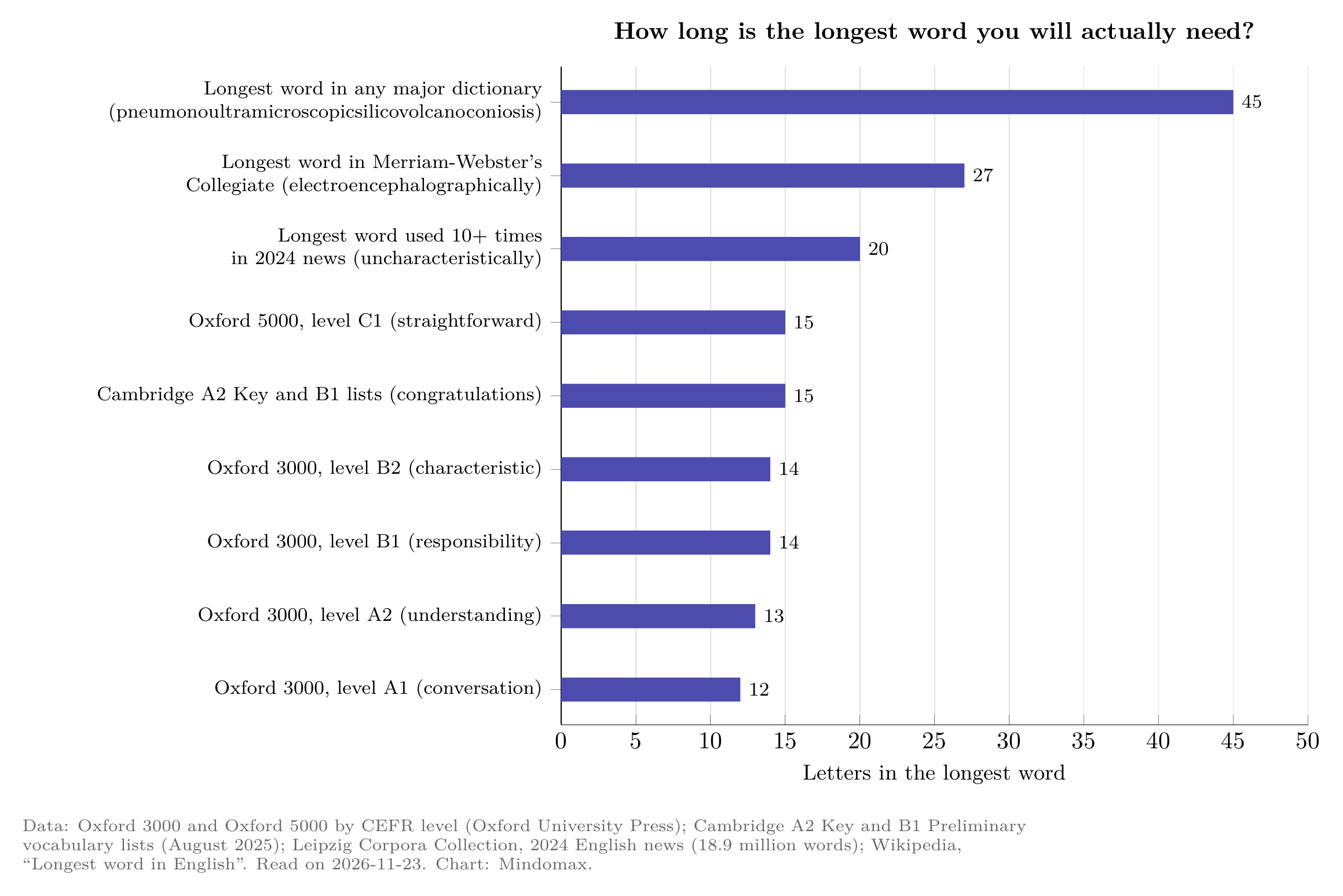
No word in the Oxford 5000 is longer than 15 letters. Past 20 letters you are in dictionary-record territory, not in anything people write. Data: Oxford 3000 and Oxford 5000 by CEFR level (Oxford University Press); Cambridge A2 Key and B1 Preliminary vocabulary lists (August 2025); Leipzig Corpora Collection, 2024 English news; Wikipedia. Read on 2026-11-23. Chart: Mindomax.
The longest words in other languages
When people search for the longest word in the world, they usually mean one of these. Languages that glue words together, like German, Finnish and Turkish, can build words of almost any length, so each record comes with a story.
The German word is the one we know best: we checked it, and the words Germans really use, in our article on the longest German word.
How to read, say and remember a long word
Long words look scary, but most are built from small parts you already know. Here is the method that works, whether you need antidisestablishmentarianism for a quiz or electroencephalography for a nursing exam.
1. Split it into parts. Anti-dis-establish-ment-arian-ism is "against" + "undoing" + "establish" + three endings. Pneumono-ultra-microscopic-silico-volcano-coni-osis is "lung" + "very small" + "silica" + "volcano" + "dust" + "disease". Your brain reads in chunks anyway; chunking just makes it deliberate.
2. Say each part out loud, then join them. Saying a word aloud makes it easier to remember than reading it silently, a result known as the production effect.
3. Learn the common endings once. -tion, -ment, -ity, -ism and -ically turn up again and again. Once you know them, a 20-letter word is often a 9-letter word with extras: un-character-istic-ally.
4. Write it from memory, then check. Spelling a long word without looking is the fastest way to find the part you keep getting wrong.
5. Review it a few days later. A word you looked up once is easy to lose within days. Spreading your reviews out is what makes it stick; this is spaced repetition, and a flashcard with the word on one side and its parts on the other is the simplest way to do it.
Tools that help with long words
These apps help you look up, hear, take apart and remember long words. Prices are from the US App Store (checked 2026-11-23). For a wider test of everyday vocabulary apps, see our list of the best vocabulary apps.
If you want the long words you care about to come back just before you forget them, you can try Mindomax for free.
Frequently Asked Questions
What is the longest word in English?
The longest word in any major English dictionary is pneumonoultramicroscopicsilicovolcanoconiosis, with 45 letters. It means a lung disease caused by breathing in very fine volcanic dust, and it was invented in 1935 to be the longest word. The longest word in everyday use is uncharacteristically, with 20 letters.
What is the longest word in the dictionary?
Oxford's dictionaries include pneumonoultramicroscopicsilicovolcanoconiosis (45 letters), the longest word in any major dictionary. In Merriam-Webster's Collegiate Dictionary it is electroencephalographically (27 letters), because its editors leave out words without real, lasting use.
What is the longest word in the world?
No language has a fixed longest word, because some languages can join words together without limit. Famous examples are an 85-letter hill name in New Zealand, a 70-letter Turkish word and a 63-letter German law name. The often-quoted 189,819-letter chemical name of titin is not a word anyone uses, and the version online is mostly made of other proteins' names.
How do you pronounce pneumonoultramicroscopicsilicovolcanoconiosis?
Say it in parts: NEW-muh-noh-ul-truh-my-kruh-SKOP-ik-SIL-ih-koh-vol-KAY-noh-koh-nee-OH-sis. The parts in capitals are the ones you say louder.
Is supercalifragilisticexpialidocious a real word?
It is in some dictionaries, but only as the title of the song from Mary Poppins (1964), meaning something to say when you don't know what to say. An earlier spelling appeared in a student newspaper column in 1931.
Is antidisestablishmentarianism a real word?
Yes. It names the 19th-century British movement against removing the Church of England's status as the state church. It is so rarely used today that Merriam-Webster left it out of its Collegiate Dictionary.
What is the longest word with no repeated letters?
Subdermatoglyphic, with 17 letters. Uncopyrightable (15 letters) is the best-known example in everyday English.
Sources
Leipzig Corpora Collection, eng_news_2024_1M (English news, 2024; 18,917,723 words counted). wortschatz.uni-leipzig.de
Hermit Dave, FrequencyWords, 2018 English list from OpenSubtitles (692,884,855 words counted). github.com/hermitdave/FrequencyWords
Google Books Ngram Viewer, English corpus, case-insensitive, 2010 to 2022, read on 2026-11-23. books.google.com/ngrams
UniProt, Titin (Q8WZ42, human, all isoforms); tryptophan synthase alpha chain (P0A877); tobacco mosaic virus capsid protein (P69687), read on 2026-11-23. uniprot.org
Longest word in English. Wikipedia
Pneumonoultramicroscopicsilicovolcanoconiosis (1935 coinage, New York Herald Tribune, February 23, 1935). Wikipedia
Supercalifragilisticexpialidocious (Mary Poppins, 1964; the 1931 Syracuse University Daily Orange column). Wikipedia
Antidisestablishmentarianism. Wikipedia
Honorificabilitudinitatibus. Wikipedia
Pseudopseudohypoparathyroidism. Wikipedia
Titin. Wikipedia
Longest words (other languages). Wikipedia
Merriam-Webster, The Longest Long Words List. merriam-webster.com
Oxford University Press, The Oxford 3000 and the Oxford 5000 by CEFR level. oxfordlearnersdictionaries.com
Cambridge English, A2 Key and B1 Preliminary vocabulary lists (August 2025). A2 Key, B1 Preliminary
App prices: App Store US, checked 2026-11-23.


