
The hard words to pronounce that people actually look up are often not the ones the usual lists lead with. We took 437 words that get called hard, from menus, maps, dictionaries and the usual "hardest words" lists, and checked how often Americans type "how to pronounce" plus that word into Google. The numbers come from Google's Keyword Planner for the United States, November 2025 to October 2026.
150 of the 437 pass 1,000 searches a month: 118 words, plus 18 place names and 14 brands. The top is not what you would guess: gnocchi, gyro, pho and açaí each pass 10,000, and almost half of the 118 words are food and drink. Some popular lists are full of book words like phlegmatic, grandiloquent and neophyte. No more than 100 Americans a month ask how to say each of those.
Below you will find all 118 words with a simple respelling (capital letters show the stressed syllable), the four reasons English words trip people up, how Americans really split on words with two right answers, and a practice routine that makes a new pronunciation stick.
The 25 hard words Americans look up most
Google reports searches in ranges, not exact counts. We sorted by the range first, then by how many other phrasings ("how do you say gnocchi", "how do you pronounce gnocchi") also pass 1,000 searches, then by how many of the 12 months stayed in the top range. Words that are still tied are in alphabetical order.
Two places also pass 10,000 searches a month, Qatar and Curaçao. They are in the place-name table further down, next to the brand names people look up.
Why English words are hard to pronounce: four traps
English spelling is unusually unhelpful. When researchers tested how fast children learn to read in English and 12 other European languages, English came out more than twice as slow as languages with regular spelling, such as Finnish or Spanish (Seymour, Aro and Erskine, 2003). Adults run into the same gap every time they meet a word in print before they hear it. Nearly every word in this article falls into at least one of four traps.
Letters you never say. Worcestershire has 14 letters and only 7 sounds. Colonel is spelled with an l and said with an r. Queue is said like the letter Q, so its last four letters are silent. The chart below counts letters against sounds, using the Carnegie Mellon University Pronouncing Dictionary of American English.
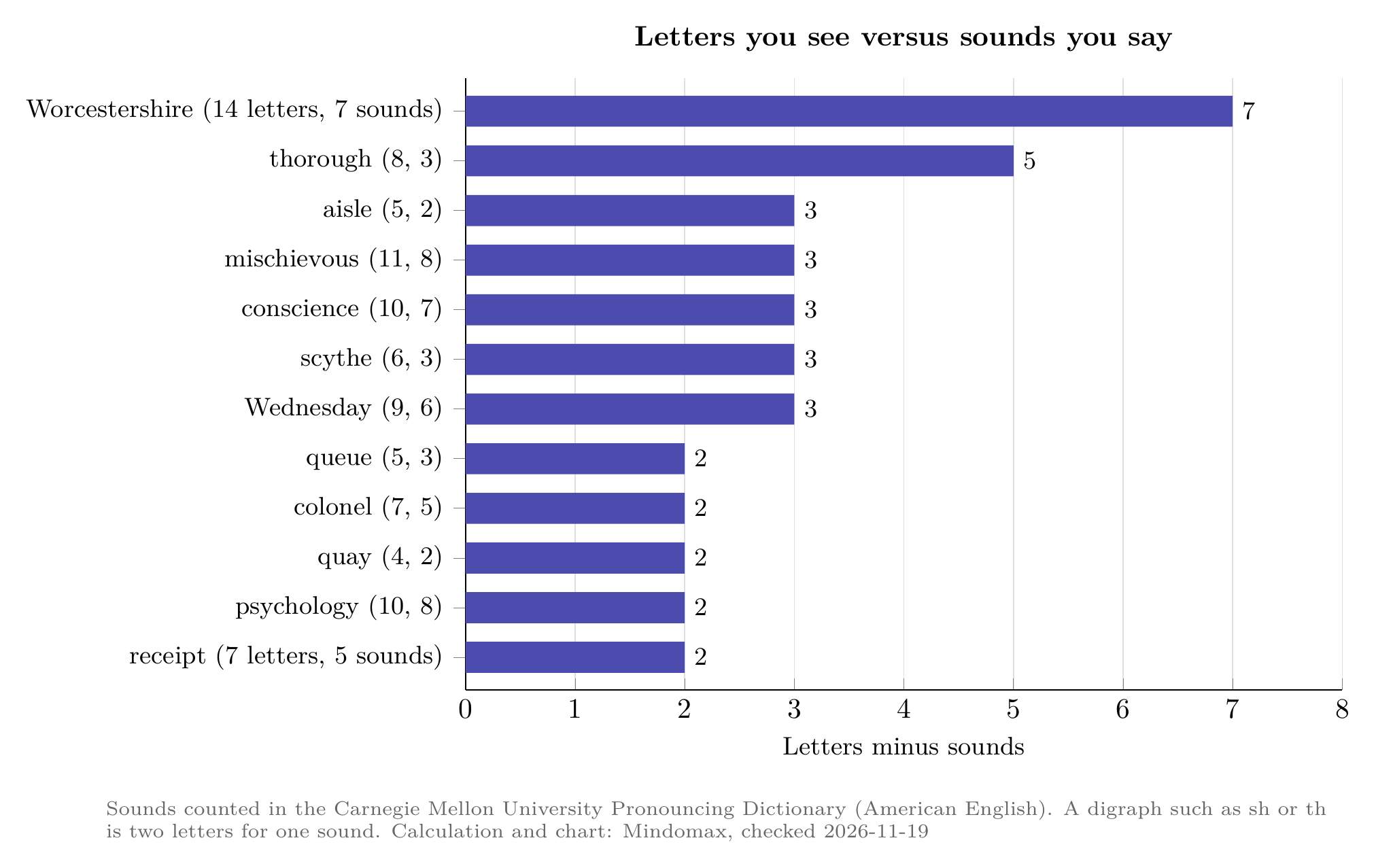
Letters versus sounds in 12 words that hide their pronunciation. Worcestershire has 14 letters but only 7 sounds. Source: Carnegie Mellon University Pronouncing Dictionary. Calculation and chart: Mindomax.
Spelling from another language. In gnocchi, the gn is the "ny" of canyon. The ç in açaí and façade is an s. Quinoa comes from Quechua through Spanish, so it is KEEN-wah. Korean and Japanese food names (gochujang, tteokbokki, edamame) are spelled in an English-friendly system, but the vowels follow the original language.
Stress in a surprising place, or a syllable that disappears. Epitome and hyperbole end in a spoken e because they come from Greek. Comfortable is usually said with three syllables, February and library often lose an r, and mischievous has three syllables, not four.
Mouth twisters. Rural and squirrel pack r and l sounds close together, anemone swaps n and m, and sixth ends in three consonants in a row (k, s, th). If you want to train exactly these sounds, tongue twisters help; our list of Spanish tongue twisters works the same muscles in another language.
One more thing the search data shows: people only look up words they know they don't know. Prescription, triathlon and twelfth each get no more than 100 searches a month for how to say them, yet "perscription" and "triathalon" are common slips. The words you get wrong without noticing never make it into a search box.
Menu words: 56 foods and drinks
Food names are borrowed with their original spelling, and most of us meet them first on a menu, not out loud. All 56 below pass 1,000 searches a month.
Two traps hide in this table. Macaron (mah-kuh-ROHN) is the colorful French sandwich cookie; macaroon (mak-uh-ROON) is the coconut one. And poke has two syllables, POH-kay, because it is a Hawaiian word, not the English verb.
Everyday words that don't sound like they look
These are ordinary words, many of them first learned at school, that still send people to Google. All 40 pass 1,000 searches a month.
Words with two right answers: how Americans really say them
For many of the words above there is no single correct pronunciation, and that is not a guess. The Harvard Dialect Survey asked about 11,000 Americans per word how they say it (Vaux and Golder, 2003). Pecan splits at least five ways, and its most common version is used by fewer than three in ten people.
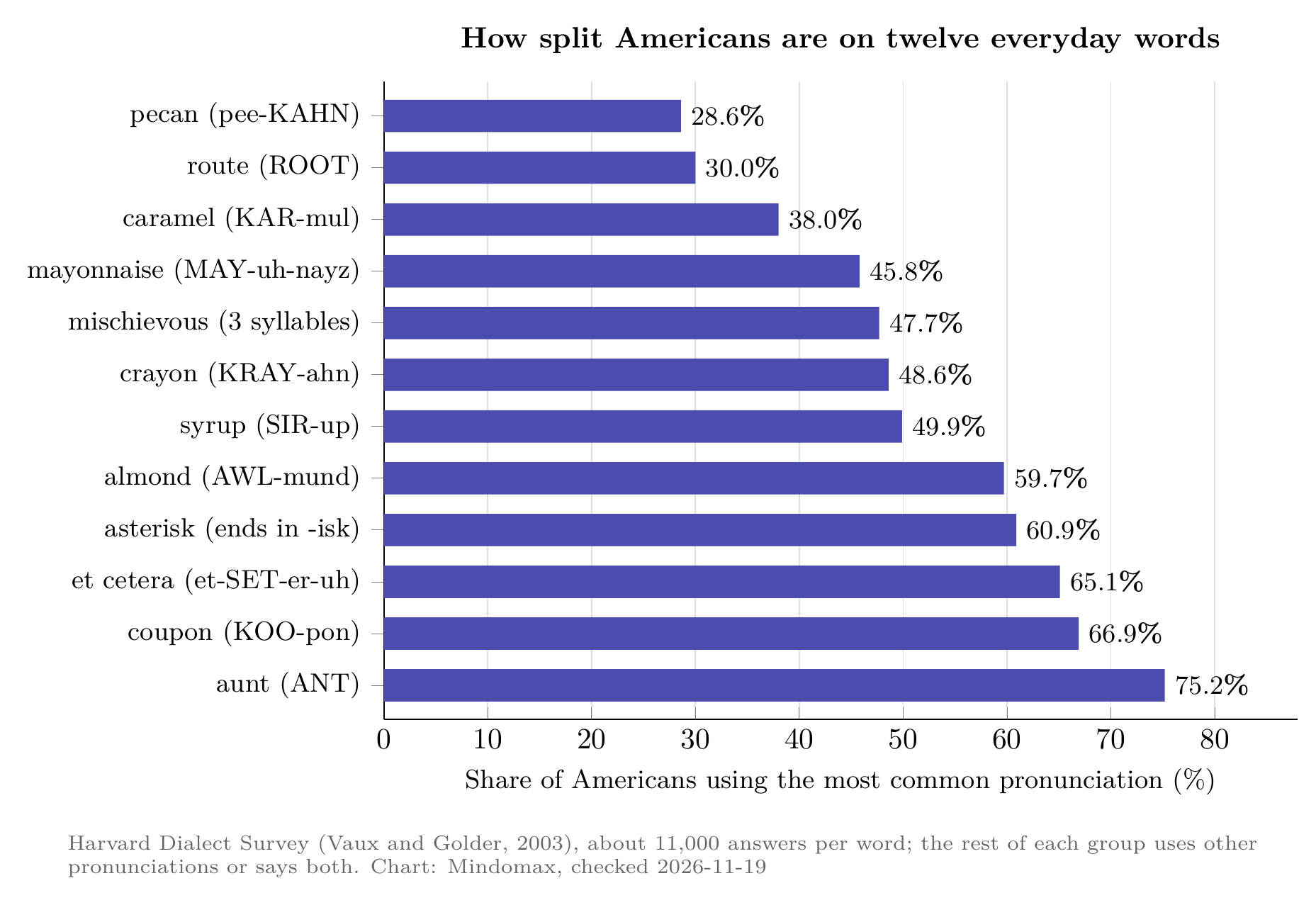
How split Americans are: share using the most common pronunciation of each word. Source: Harvard Dialect Survey (Vaux and Golder, 2003), about 11,000 answers per word. Chart: Mindomax.
The survey ran online in the early 2000s and people chose to take part, so treat the shares as a picture of who answered, not an exact census. But the pattern is clear: for these words, the way you say it is an accent, not a mistake.
Book words and the famous long ones
Book words are the ones you read long before you hear them. These 22 pass 1,000 searches a month. Many other classic list words do not: demagogue, espouse, grandiloquent, neophyte, phlegmatic, protean and accede each get 100 searches a month or fewer. If you collect words like these, our list of fancy words has the ones worth using.
Long words are easier than they look: say them one chunk at a time, then join the chunks.
Place names and brand names people look up
Proper names follow their own history, not spelling rules, so a bigger share of them sends people to Google: 18 of the 28 places and 14 of the 23 brands we checked pass 1,000 searches a month, against about three in ten of the words. Qatar and Curaçao pass 10,000.
How to practice a hard word so it sticks
Reading a respelling once helps for the moment. Making a pronunciation automatic takes a few deliberate repetitions, and research says which ones work.
Hear it from a real source first. A dictionary recording or a clip of a native speaker beats your inner voice, which will happily keep the wrong version.
Break it into chunks. Say each syllable slowly, put the stress where the capital letters are, then speed up.
Say it out loud, not in your head. Words spoken aloud while studying are remembered better than words read silently, across eight experiments in one well-known study (MacLeod and colleagues, 2010). We explain why in our article on the production effect.
Record yourself and compare. A meta-analysis of 86 studies found pronunciation practice has a large effect, and it was larger when learners got feedback and practiced over a longer period (Lee, Jang and Plonsky, 2015). Your own recording next to the dictionary's is free feedback.
Come back to it on a schedule. Practice spread over days beats the same practice in one sitting; a review of 317 experiments found the best gap grows with how long you want to remember (Cepeda and colleagues, 2006). Here is how the spacing effect works.
Put it on a flashcard. Word on the front; respelling, the trap and a recording on the back. Our guide to studying with flashcards shows how to set the cards up. And if your problem is writing these words rather than saying them, the spelling bee words list is the better place to start.
Apps and tools that help with pronunciation
You do not need an app to say quinoa correctly, but the right tool shortens the "hear it, say it, check it" loop. Prices are from the US App Store and Google Play.
If one of these already works for you, keep it. If you want the words above to come back at the right moment, you can paste a table into Mindomax for free and let spaced repetition schedule the reviews.
How we counted
We collected 437 words: the ones that keep appearing on the top-ranking "hard words to pronounce" pages, plus food and drink names, place names, brand names and words with more than one accepted pronunciation. For each word we asked Google Keyword Planner for the monthly searches of "how to pronounce" plus the word (United States, English, November 2025 to October 2026) and noted which other phrasings also passed 1,000. Google only shows ranges for this kind of account, so we report the range and never a made-up exact number.
Pronunciations follow American dictionaries, and we checked the sounds against the Carnegie Mellon University Pronouncing Dictionary and Wiktionary. Where a word has two common pronunciations, we give both. The survey shares come from the Harvard Dialect Survey.
Two limits: a word can be looked up in other ways ("gnocchi pronunciation", a voice search, a dictionary app), so a low count does not prove a word is easy. And the counts measure doubt, not difficulty. That is the point: they show which words people actually stop and check.
Frequently Asked Questions
What is the hardest word to pronounce in English?
By search data, the single words Americans most often ask how to say are GIF, gnocchi, gyro, pho and açaí, each with more than 10,000 "how to pronounce" searches a month. Among classic hard words, Worcestershire (WUSS-ter-sher) is the usual winner: 14 letters, but only 7 sounds.
What are 20 tricky words to pronounce?
Gnocchi, gyro, pho, açaí, quinoa, Worcestershire, colonel, salmon, quay, queue, chamomile, charcuterie, croissant, cumin, epitome, hyperbole, mischievous, anemone, February and Qatar. All 20 pass 1,000 "how to pronounce" searches a month in the US, and each one is respelled in the tables above.
What are the most mispronounced words in English?
Often they are words people never look up because they don't notice the slip: prescription (not "perscription"), espresso (not "expresso"), triathlon (not "triathalon") and mischievous (three syllables, not four). In the Harvard Dialect Survey, about a quarter of Americans said mischievous with four syllables.
How do you pronounce gnocchi?
NYOH-kee. The gn at the start is said like the "ny" in canyon, and the ch is a k sound. NOH-kee is also common in the US. Gnocchi passes 10,000 "how to pronounce" searches a month.
How do you pronounce Worcestershire sauce?
WUSS-ter-sher. The "rce" in the middle is silent and the "shire" ending shrinks to "sher", which leaves 7 sounds from 14 letters. The sauce is named after the English county of Worcestershire.
Is it GIF or JIF?
Major dictionaries list both. Steve Wilhite, who led the team that created the format in 1987, said JIF; many people say it with a hard g, as in "gift". Whichever you pick, people will understand you.
How can I improve my English pronunciation?
Hear the word from a real recording, say it slowly in chunks, say it out loud, record yourself and compare, and review it again over the next few days. A meta-analysis of 86 studies found pronunciation practice works best with feedback and when it continues over time.


