
Here are 101 riddles with answers: easy riddles for kids, funny ones, hard riddles for adults, word riddles, logic puzzles and the famous trick questions. For most of them you'll also find the trick that makes them work, because a riddle is much easier to remember (and to tell) once you see how it fools you.
We also did three things the other riddle lists don't. We read the 18 riddle lists that rank on Google's first page for riddle searches in the US and counted which riddles they actually share. We looked up the first year each classic shows up in print. And for the trick riddles that people love to call "impossible", we found the studies that measured how many people really get them right.
The 18 riddles the top lists agree on
These are the riddles that appear on at least 7 of the 18 lists. Even the three most popular ones are on only 10 of the 18, and only those three make it onto more than half. Of the 90 riddles we tracked, 81 turned up on at least one list, but 42 of them on four lists or fewer. Beyond that short core, every list is its own mix.
"First seen in print" is the first year the riddle's exact wording appears in a book Google has scanned (Google Books Ngram Viewer). A dash means the wording is too common to date: "head and a tail" also turns up in books about coins and animals.
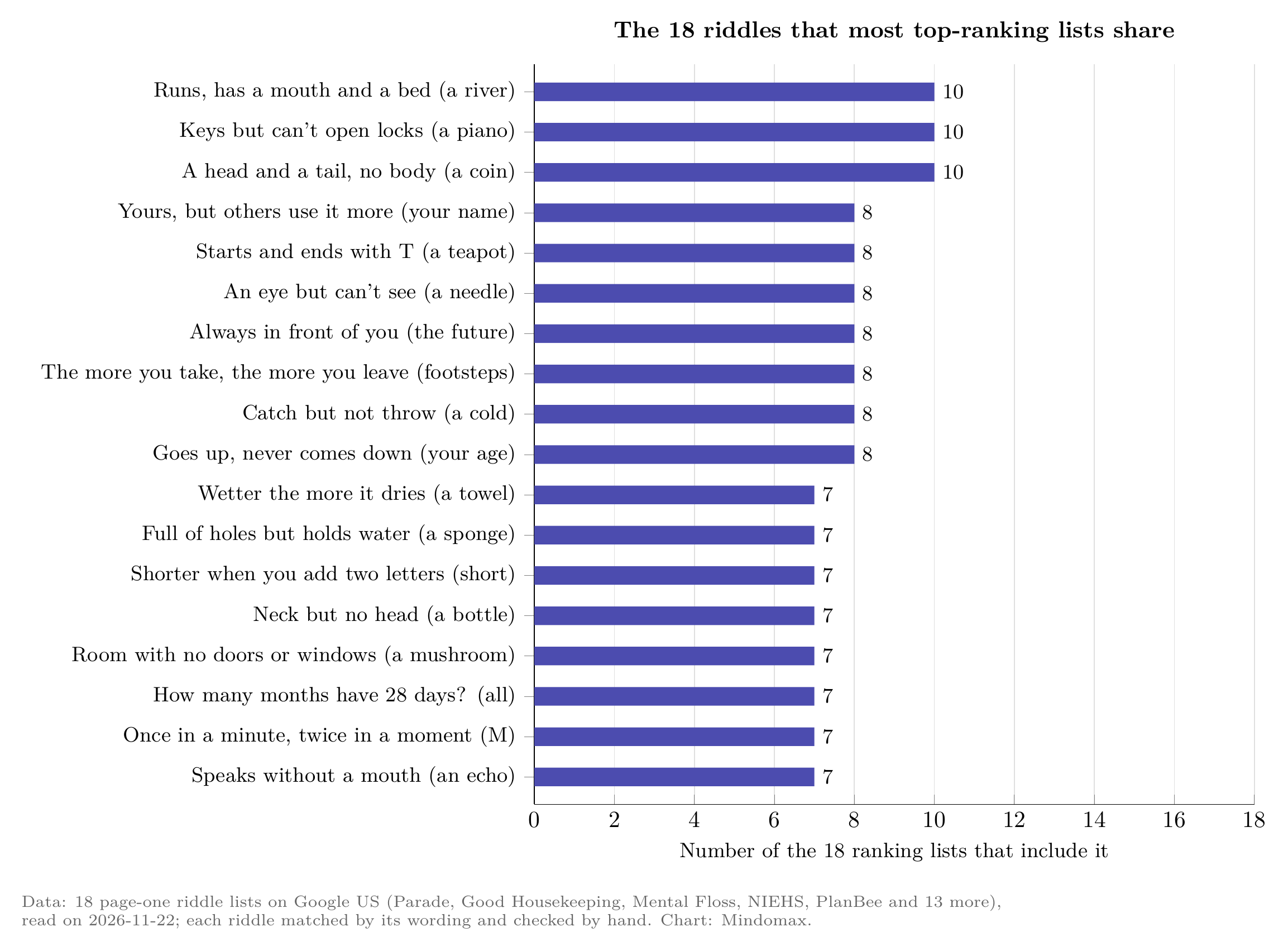
The 18 riddles that appear on at least 7 of the 18 riddle lists on Google's first page in the US. Data: 18 page-one lists, read on 2026-11-22; each riddle matched by its wording and checked by hand. Chart: Mindomax.
Easy riddles for kids
Most kids' riddles work the same way: one everyday word has two meanings, and the riddle uses the one you aren't thinking of. Clocks have hands, combs have teeth, books have words. That is also why teachers like them, more on that below.
Funny riddles
Funny riddles are closer to jokes: the answer is a pun, so the fun is in the groan. Folklorists call this kind a conundrum, as opposed to an enigma, which describes something in a metaphor.
Hard riddles for adults
The hard ones describe something you can't touch: light, silence, a promise. Your brain looks for an object, and the answer isn't one. When the answer finally clicks, that sudden jump is what psychologists call an insight or "aha" moment.
"What am I?" riddles
These are the oldest kind: a thing describes itself as if it were a person or an animal. The candle riddle below is at least 180 years old. In an 1843 book of English nursery rhymes it went "Little Nancy Etticoat, in a white petticoat, and a red nose; the longer she stands, the shorter she grows."
Number 74 is the riddle of the Sphinx from Greek myth, in the form ancient writers recorded. Oedipus answered it, and the Sphinx threw herself off her rock.
Word and letter riddles
Word riddles ask you to look at the spelling, not the meaning. They are good practice for kids learning to read and for anyone learning English, because they make you see words as strings of letters. If you like these, our list of spelling bee words is the same kind of fun.
Number 85 comes from a manuscript written around 1600, and number 86 from the same nursery-rhyme collection as the candle riddle.
Math and logic riddles
The St Ives riddle is in a manuscript from about 1730, and it has never had one agreed answer. If the speaker simply overtook the family, they were all going to St Ives: 2,800 kits, cats, sacks and wives, plus the man and the speaker.
Trick riddles most people get wrong (with the real numbers)
Lists love to say "only 2% of people can solve this", and they rarely give a source. For these five, researchers actually counted.
The first three are the Cognitive Reflection Test, published by Shane Frederick in 2005. A review of 118 studies with 44,558 people found that 37.54% got none of the three right and only 18.17% got all three. The quick answer simply arrives first, and most of us say it before we check it.
The surgeon riddle shows something else. In a 2021 study of 152 US university students, fewer than a third said the surgeon could be a woman. More students (36%) answered that the boy had two dads. Having a working mother, female doctors or feminist views didn't make people more likely to think of the mother; only being female did.
The Moses question works because Moses and Noah are both Old Testament figures, so the wrong name feels close enough to slip past. It was first tested in 1981; in a 2022 repeat with 87 students, only 37% to 43% noticed the wrong name.
How old are the classic riddles?
Older than you'd think, and in another way much younger. The oldest written riddles come from ancient Sumer, on clay tablets from around 2000 BCE. Their answers weren't written down, but one of them ("my knees hasten, my feet do not rest") may describe a river, the same answer as today's most popular riddle. The Sphinx's riddle (number 74) comes from Greek myth. Around the 4th or 5th century a Latin poet called Symphosius wrote 100 verse riddles, and the Exeter Book, copied in England around 960 to 990, holds about 94 riddles in Old English.
English nursery riddles are mostly 18th and 19th century. "As I was going to St Ives" is in a manuscript from about 1730. "Humpty Dumpty" was most likely a riddle too, its answer an egg; the earliest known version was printed in 1797. James Orchard Halliwell's The Nursery Rhymes of England (first published in 1842; we read the 1843 edition) has a whole chapter of riddles: the candle (Little Nancy Etticoat), the teeth (thirty white horses), the four girls with one name (number 90) and the man on the stool (number 96). In The Hobbit (1937), J. R. R. Tolkien gave Bilbo riddles from nursery books for his contest with Gollum, the thirty white horses among them.
The riddles on today's lists are much younger. We looked up the first year the exact wording of each one appears in Google's scanned books. Eight of the 14 modern classics in the chart first appear between 1871 and 1906. "What gets wetter the more it dries?" first shows up in 1950, "What can you catch but not throw?" in 1988, and "What is so fragile that saying its name breaks it?" not until 2014.
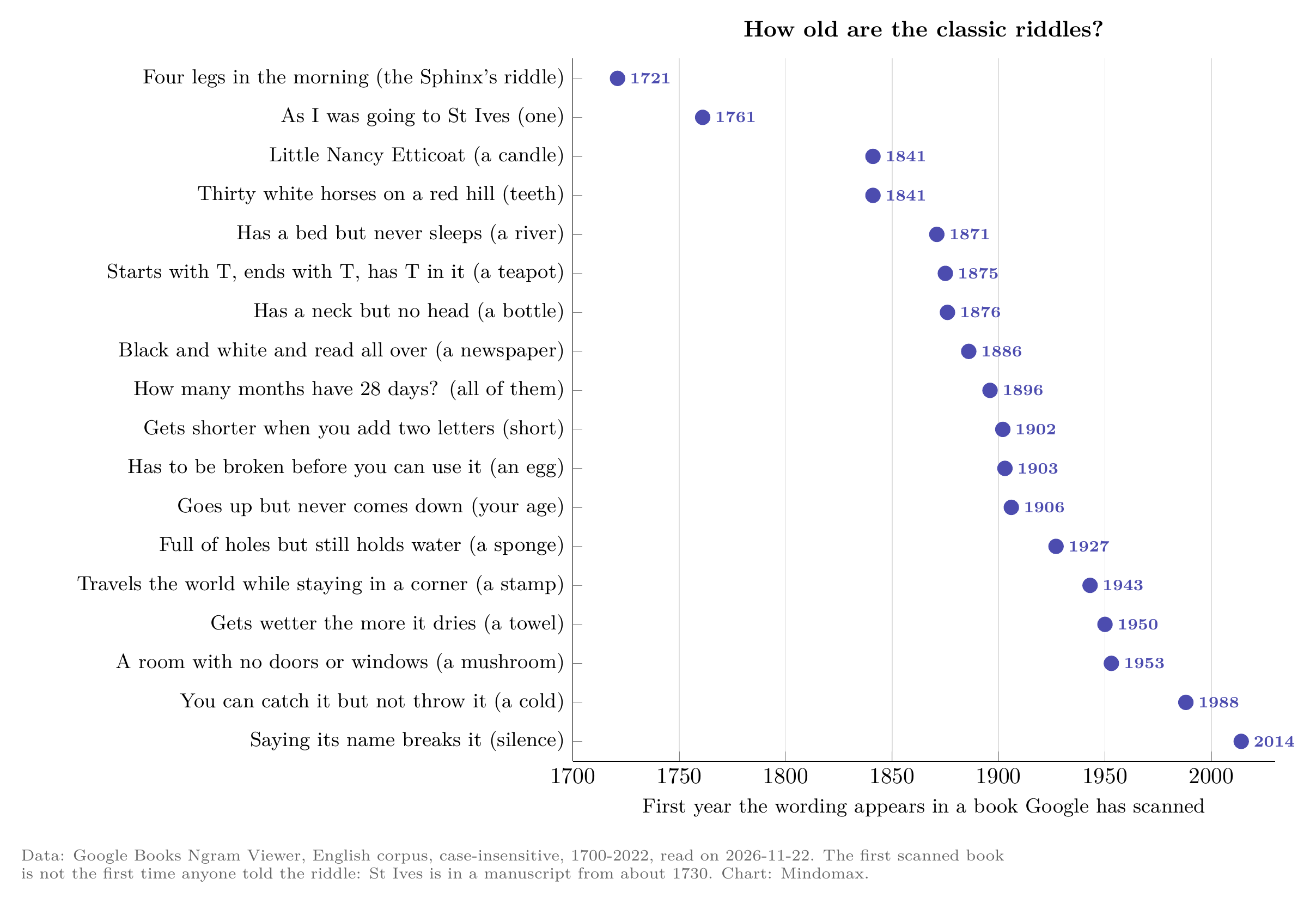
The first year each riddle's wording appears in a book Google has scanned. Data: Google Books Ngram Viewer, English corpus, case-insensitive, read on 2026-11-22. The first scanned book is not the first time anyone told the riddle. Chart: Mindomax.
A first year in Google's books isn't the first time anyone told the riddle: many riddles are told for years before anyone prints them. But the dates show which riddles are real folk riddles and which are 20th-century inventions that lists now call classics.
Why riddles work (and why teachers use them)
Look at the 18 shared riddles again. Six of them turn on one word with two meanings: keys, an eye, a neck, a head and a tail, catching (a ball or a cold), and a river's bed and mouth. Four play with letters or sounds (teapot, short, the letter M, mush-room). Four have an answer you can't touch: your name, the future, footsteps, your age. Two describe an object backwards (a towel that gets wetter as it dries, a sponge full of holes that holds water), one hides behind a literal reading (every month has 28 days) and one gives a sound a body (the echo).
That double-meaning trick is exactly what makes riddles useful in a classroom. In a 2009 study by Nicola Yuill, 24 children aged 7 to 9 worked in pairs to explain joking riddles. Their reading comprehension improved significantly more than that of 24 children who didn't take part, and the gains went hand in hand with explaining both meanings of a riddle at once. Researcher Marcia Zipke reports the same pattern: in a short program for 7 to 9 year olds, the session on understanding and writing riddles was one of the most successful parts, and reading comprehension scores went up.
For English learners, riddles are a painless way to learn multiple-meaning words (key, ring, bark, story, coat, palm), and much more fun than a word list.
How to remember riddles you want to tell
Knowing a riddle and being able to tell it at dinner are two different things. A few habits help:
Say the riddle out loud the first time you read it. Words you say are easier to remember than words you only read; it's called the production effect.
Write your own. Change one word of a classic and make it yours: things you make up yourself stick better (the generation effect).
Make a card for each riddle you like: the riddle on the front, the answer and the trick on the back. Here is how to make flashcards that actually work.
Look at the cards again after a day, then after a few days, then after a week. That growing gap is spaced repetition, and it's the reason you'll still know the riddle at the party.
Paper index cards work fine for this. So do flashcard apps such as Anki or Mindomax, which bring each card back just before you would forget it.
Riddle apps worth trying
There are hundreds of riddle apps on the App Store, nearly all free with ads. These are the ones that fit this list best, with US App Store prices. Note that the biggest ones (Brain Test, Brain Out, Who is?) are picture puzzles with a twist rather than word riddles; if you want plain riddles with answers, look at the three DH3 Games apps and A Year of Riddles.
If you want your favorite riddles to come back on their own schedule, you can try Mindomax for free.
Frequently Asked Questions
What is a good riddle?
A good riddle has an answer that is obvious once you hear it and hidden until then. The best ones, like "What has a neck but no head?", use an everyday word in a meaning you weren't expecting.
What is the hardest riddle?
Of the riddles that have been measured, the bat and ball question: in 118 studies, only 31.75% of people answered "five cents". The surgeon riddle trips up even more people: in a 2021 study, only 30% of students said the surgeon could be the boy's mother.
What is the oldest riddle?
The oldest written riddles are Sumerian, from clay tablets of around 2000 BCE. The oldest one still told in English is probably the riddle of the Sphinx from Greek myth: what walks on four feet, then two, then three? A person.
What is the most common riddle?
On the 18 riddle lists that rank highest on Google in the US, three riddles tie: the river (it runs but never walks), the piano (keys but no locks) and the coin (a head and a tail but no body). Each is on 10 of the 18 lists.
What is the difference between a riddle and a joke?
A riddle asks you to work out the answer; a joke gives you a punch line. Puns like "Why is six afraid of seven?" sit in between: they're called conundrums.
Are riddles good for kids?
Yes, especially for reading. In a 2009 study by Nicola Yuill, children aged 7 to 9 who talked through joking riddles in pairs improved their reading comprehension more than children who didn't, and Marcia Zipke reports similar gains from a short riddle-based program.
Sources
Riddle lists counted: Parade, Good Housekeeping (two lists), Mental Floss, NIEHS Kids' Pages, Mommy Poppins, riddles.com, PlanBee, Loquiz, Savage Legend, BabyCenter, Homemade Gifts Made Easy, Bored Teachers, the Teachers Pay Teachers blog, New Wave Events, ABCmouse, Prodigy and Nibble, as ranked on Google US on 2026-11-22. Reader's Digest could not be read and is not counted.
Google Books Ngram Viewer, English corpus, read on 2026-11-22. books.google.com/ngrams
Halliwell, J. O. (1842). The Nursery Rhymes of England. 1843 edition (Munroe & Francis), riddles CLXXIII to CLXXXVII. archive.org
As I was going to St Ives. Wikipedia
Humpty Dumpty. Wikipedia
Riddle (Sumerian riddles, Symphosius, enigmas and conundrums). Wikipedia
The Hobbit (Bilbo's riddles from nursery books). Wikipedia
Sphinx (the riddle of the Sphinx). Wikipedia
Exeter Book Riddles. Wikipedia
Brañas-Garza, P., Kujal, P. & Lenkei, B. (2015). Cognitive Reflection Test: Whom, how, when. MPRA Paper No. 68049; published 2019 in the Journal of Behavioral and Experimental Economics. mpra.ub.uni-muenchen.de/68049
Frederick, S. (2005). Cognitive Reflection and Decision Making. Journal of Economic Perspectives, 19(4), 25-42. aeaweb.org
Belle, D., Tartarilla, A. B., Wapman, M., Schlieber, M. & Mercurio, A. E. (2021). "I Can't Operate, that Boy Is my Son!": Gender Schemas and a Classic Riddle. Sex Roles, 85, 161-171. doi.org/10.1007/s11199-020-01211-4
Janouskova, A. et al. (2022). The effect of font readability on the Moses illusion: A replication study. Consciousness and Cognition. doi.org/10.1016/j.concog.2022.103284
Yuill, N. (2009). The relation between ambiguity understanding and metalinguistic discussion of joking riddles in good and poor comprehenders. First Language, 29(1), 65-79. doi.org/10.1177/0142723708097561
Zipke, M. (2008). Teaching Metalinguistic Awareness and Reading Comprehension With Riddles. The Reading Teacher, 62(2), 128-137. doi.org/10.1598/RT.62.2.4
App prices: App Store US, checked 2026-11-22.


