
"I before E, except after C" is the best-known spelling rule in English, and the short version is wrong about a third of the time. We checked it against 1,108 common English words that contain ie or ei, weighted by how often each word appears in American books. The short rhyme picks the right spelling 64.7% of the time. Writing "ie" every single time, with no rule at all, does slightly better: 69.9%.
The version that works is the one most people never learned: "I before E, except after C, when the sound is ee." On words where ie or ei sounds like the ee in see, it is right 87.5% of the time. Below you will find the full rhymes, our numbers, the exceptions you will actually meet (ranked by how often you see them, not alphabetically), a simple way to choose ie or ei by sound, and a short practice plan for the words no rule can save.
The full rhyme: three versions
There is not one rule but three, and they give different answers.
The short rhyme: "I before E, except after C." It was in print by 1866, in a footnote of James Stuart Laurie's Manual of English Spelling (Michael Quinion, World Wide Words).
The American school version adds a second line: "I before E, except after C, or when sounded as A, as in neighbor and weigh." It goes back to Ebenezer Cobham Brewer's Rules for English Spelling from 1880 (Wikipedia).
The sound version: "When the sound is ee, it's I before E, except after C." Henry Fowler's Modern English Usage limited the rule to the ee sound in its first edition in 1926, and later editions of the book kept that limit.
And the joke version: "I before E, except when it isn't."
The short rhyme calls eight an exception. The American version says eight is fine because it sounds like A. The sound version does not rule on eight at all, because there is no ee in it. So before you can ask whether the rule works, you have to ask which rule.
Does "i before e except after c" work? We counted
Here is how we tested it. We took the 50,000 most frequent words in English film and TV subtitles (OpenSubtitles 2018, from the FrequencyWords lists) and kept the 1,956 that contain ie or ei. We removed names such as Charlie, Keith and Einstein, plus foreign words, and looked up how each of the remaining 1,108 words is pronounced in the CMU Pronouncing Dictionary of American English. Those 1,108 words hold 1,116 ie or ei spellings, because a few, such as societies and friendlier, have two. Then we scored each version of the rhyme in three ways: per word, by how often the word is said in film and TV, and by how often it is printed in American books (Google Books Ngram, US English, 2010 to 2019).
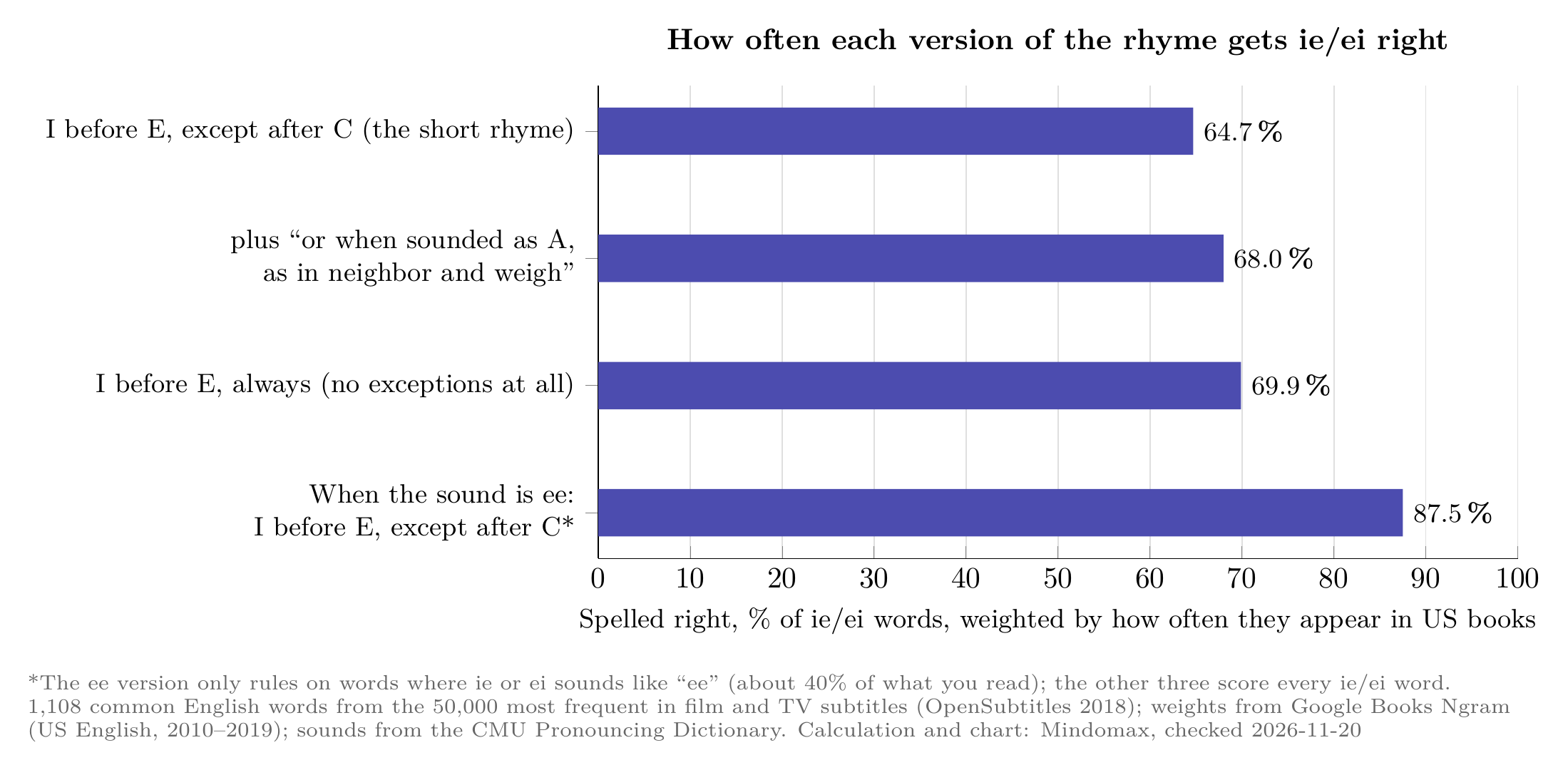
Spelled right, share of ie/ei words weighted by how often they appear in US books. The ee version only rules on words where ie or ei sounds like ee, about 40% of what you read. Data: 1,108 common words from OpenSubtitles 2018, Google Books Ngram (US, 2010-2019), CMU Pronouncing Dictionary. Calculation and chart: Mindomax.
Three things stand out.
The short rhyme is weakest on the words you read most. It gets 79.5% of the word list right but only 64.7% of what you actually read, because a few very common words break it. Mark Liberman, a linguist at the University of Pennsylvania, got the same grade in 2006 when he ran the rhyme over a month of New York Times newswire: 65% right, "a D" (Language Log).
"Always ie" beats the rhyme. The "except after C" part makes the short rule worse, not better, because most words with a c in front of the pair are spelled cie (science, society, species, efficient), not cei.
Only the ee version works well, but it covers only half the words. It is right 87.5% to 93.4% of the time, but it only rules on 574 of the 1,116 ie and ei spellings, about 40% of what you read. Liberman wrote in 2006 that the sound-based versions are harder to score, because you need to know how every word is pronounced. With a pronunciation dictionary that is possible, and this is the answer. Even inside the ee version, "except after C" earns its place only barely: writing ie for every ee sound would score 85.9% in books instead of 87.5%.
How many words break the rule?
In our list of 1,108 common words, 229 spellings break the short rhyme, 164 break the "neighbor and weigh" version and 38 break the ee version. You may have seen far bigger numbers, such as 923 words spelled cie (a figure from the BBC quiz show QI, as Wikipedia notes). Those counts include rare dictionary words. For everyday spelling, what matters is how often you meet a word, and there the picture is lopsided: their and theirs alone cause 40% of the short rhyme's misses in American books.
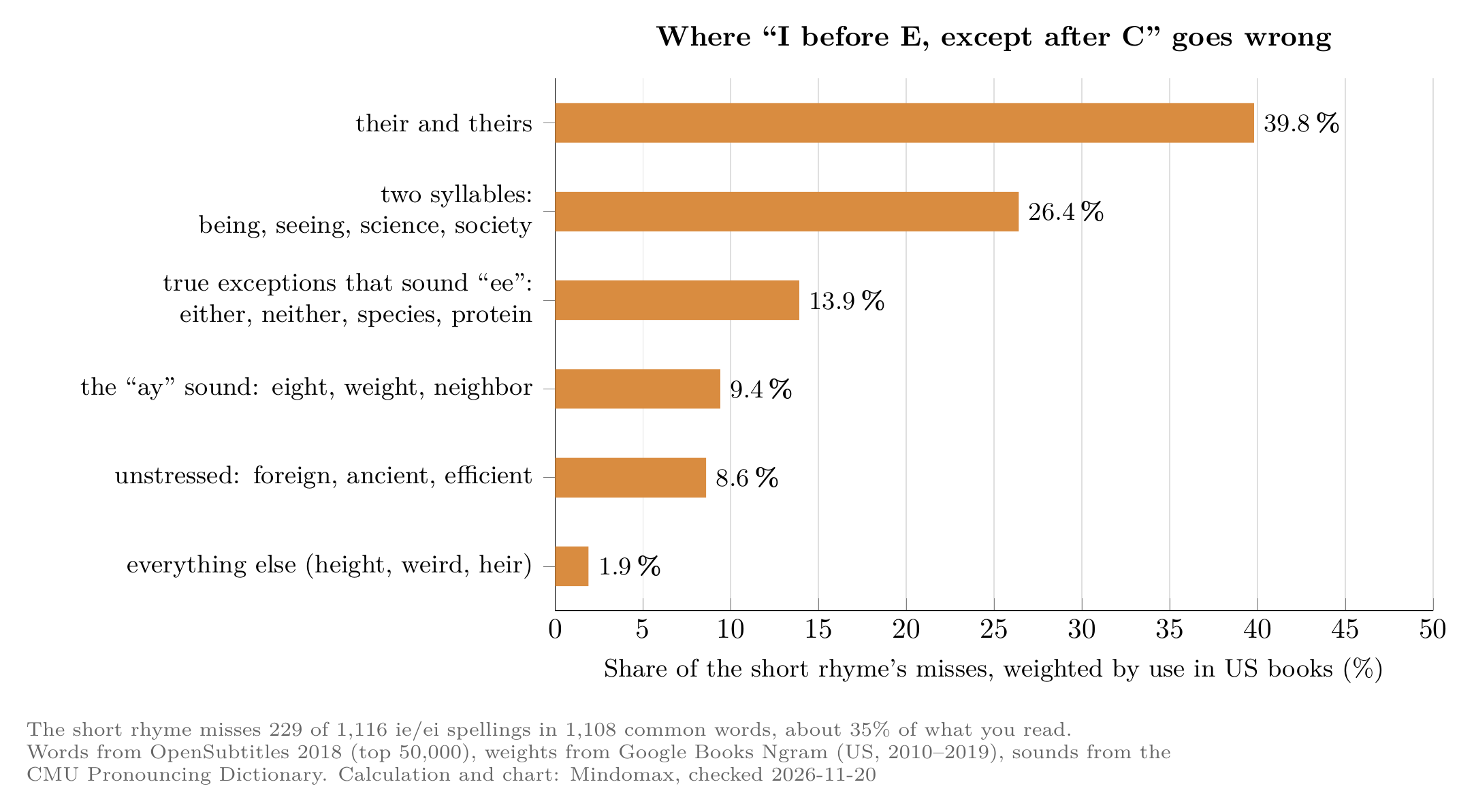
Share of the short rhyme's misses, weighted by use in US books. It misses 229 of 1,116 ie/ei spellings in 1,108 common words. Same data as above. Calculation and chart: Mindomax.
The misses fall into five groups.
Their and theirs. The ei sounds like "air". Heir and heirloom work the same way.
Two syllables. In being, seeing, science and society, the i and the e belong to different syllables, so the rhyme was never meant for them. Spell them by their parts: be + ing, see + ing, sci + ence.
The "ay" sound. Eight, weight, neighbor, surveillance, vein and reign. The American version of the rhyme covers these.
Weak syllables. In foreign, the ei is only a weak "uh". In ancient, efficient, sufficient and conscience the ci says "sh", so the ie does not really come after a c sound.
Real exceptions. Either, neither, seize, protein, caffeine, leisure, species and the plurals of words that end in -cy (policies, agencies, emergencies). These break even the ee version.
The exceptions you will actually meet
These are the 24 rule-breaking word families that show up most often in film and TV, with how often each appears per million words. For scale: their appears about 2,000 times per million words of American print, roughly once every 500 words.
Six of the 24 families are real exceptions in every version of the rule: either, neither, seize, protein, species and the -cies plurals. Everything else on the list breaks the short rhyme only because the short rhyme ignores sound.
What about "except after C"?
We found 87 spellings with a c right before the pair. 60 are spelled cie and only 27 are spelled cei. Weighted by use in American books, cie makes up 75% of them. And all 27 cei words come from just five families: receive (received, receipt, receiver), deceive (deceit), perceive, conceive (conceit, inconceivable) and ceiling.
Merriam-Webster makes the same point: the rhyme reliably covers only that one group of words that came into English from French (Merriam-Webster). So learn receive, deceive, perceive, conceive and ceiling by heart, and you can forget the "except after C" part entirely.
Spell it by the sound you hear
Say the word out loud and listen to what the ie or ei sounds like. Each sound has a spelling that wins most of the time.
The counts in brackets come from our list of 1,108 common words, using standard American pronunciation. One caution: people who say either and neither with "eye" (EYE-ther) move them into the eye group, where they are still exceptions.
20 words to learn instead of the rhyme
If you learn these 20 words by heart, the ee rule and the sound table handle nearly everything else you will write:
their, theirs, heir, either, neither, seize, protein, caffeine, leisure, weird, foreign, sovereign, forfeit, height, species, receive, deceive, perceive, conceive, ceiling.
Add one pattern: words that end in -cy keep the c and switch to -cies in the plural (policy and policies, agency and agencies, emergency and emergencies).
That is a far shorter list than the alphabetical ones you will find elsewhere, because we cut the words you are unlikely to ever write, such as cheiromancies or seiche, and kept the ones that come up every day.
How to stop misspelling them: a 15-minute plan
Knowing the rule is not the same as writing the word right under time pressure. Spelling sticks when you produce the word from memory, again and again, with growing gaps in between.
Make one card per word. On the front, a sentence with a gap: "___ car is parked outside." On the back, the spelling and the reason: "their, ei, sounds like air." Our guide to making flashcards shows other ways to set cards up.
Write the answer before you turn the card. Recognizing a spelling is much easier than producing it, and only producing it trains the memory you need when you write.
Say it as you write it. Reading a word aloud makes it more memorable than reading it silently, an effect psychologists call the production effect.
Come back on a schedule: today, tomorrow, after three days, after a week, after two weeks. Longer gaps feel harder but last longer (the spacing effect). Retire a card once you have got it right three times in a row with a week's gap.
Any of these can run that plan:
Want more practice words? Our list of spelling bee words by grade marks the ie and ei traps in every list, and hard words to pronounce covers the words people say wrong.
Why the rule fails: a short history
English spelling settled long after most of these words arrived. Receive and its relatives came from Latin through French and kept their ei; eight, weigh and neighbor come from Old English and kept the older spelling. In the 1600s, printed books still used ie and ei interchangeably for many words.
The rhyme came later, as a teaching aid. Laurie printed the short form in 1866, Brewer added the neighbor-and-weigh line in 1880, and by 1926 Fowler's usage guide had narrowed it to the ee sound.
In 2009, England's education department sent a guide called Support for Spelling to more than 13,000 primary schools. It called the rule "not worth teaching" (BBC News). The linguist Geoffrey Pullum answered that people who teach it properly always teach the ee version, and that version is a useful guide (Language Log). Our count supports both of them: the short rhyme really is weak, and the ee version really is strong, but it only covers half of the words you need to spell.
If paper cards or Anki already work for you, keep them; if you would rather have the 20 words above come back on their own schedule, you can add them to Mindomax for free.
Frequently Asked Questions
Is "i before e except after c" true?
Only partly. In 1,108 common English words, the short rhyme gives the right spelling 64.7% of the time in American print. The version "when the sound is ee" is right 87.5% of the time on the words it covers.
How many words break the i before e rule?
In our list of 1,108 common words, 229 spellings break the short rhyme, 164 break the "or when sounded as A" version and 38 break the "when the sound is ee" version. Their and theirs alone cause 40% of the short rhyme's misses in American books.
What is the full "i before e" rhyme?
The American school version is "I before E, except after C, or when sounded as A, as in neighbor and weigh." The British version is "When the sound is ee, it's I before E, except after C."
Why is "weird" an exception?
The ei in weird sounds like "eer", not ee, so the short rhyme gets it wrong. Words with that sound usually take ie (pierce, fierce, pier), so weird, weirdo and weirder are simply words to learn.
Does "receive" follow the rule?
Yes. Receive, deceive, perceive, conceive and ceiling are the words the "except after C" part was made for. In our count, every common word spelled cei belongs to one of those five families.
Is "science" an exception to i before e?
To the short rhyme, yes, because it has ie right after c. But the i and the e are in different syllables (sci-ence), so the ee version does not apply to it. The same goes for society, and for ancient, where ci says "sh".


