
The short answer
If you are studying something you need to remember in six months, choose Anki. If you need cards for a quiz on Thursday and you would rather not make them yourself, choose Quizlet.
That much you can read on any of the pages ranking for this question. Here is the part they leave out, and it is the part that should decide it for you: the cards you build on Quizlet can leave, and most of the cards you study on Quizlet cannot. Quizlet's own help centre says so in one line, which we quote further down. If you are choosing a place to keep years of work, that matters more than any feature table.
We also checked the price everyone quotes. "Anki costs $24.99 on iPhone" (checked 2026-09-09) is true in the United States and in almost nowhere else.
Where the two actually differ
Both apps show you a card, ask you to remember, and show you the answer. Everything past that is different.
Anki schedules every single card on its own timetable. The current algorithm is FSRS, the Free Spaced Repetition Scheduler; Anki's manual now calls the older SM-2 "the legacy SuperMemo 2 (SM-2) algorithm" and lets you set a Desired Retention target directly, so you can tell it what percentage of cards you want to get right when they come due. When you answer, the next interval is printed on the button before you press it. We explain the two algorithms in FSRS vs SM-2.
Quizlet's equivalent is Learn, which works in rounds inside a study session. It reorders the questions you get wrong, but it does not hand you a schedule and it does not tell you when a card is next due. There is no queue waiting for you tomorrow.
The other difference is where the cards come from. On Anki you type them, or you download a shared deck from AnkiWeb. On Quizlet you search a very large library of sets other students have already made, and the app will also build cards for you. That library is the honest reason most people pick Quizlet, and it is worth being clear that Anki has nothing as convenient.
The third difference is difficulty. Anki's first hour is genuinely unpleasant. Deck options, note types, card templates, and a vocabulary of its own that includes burying cards and suspending them, which are different things. Quizlet's first hour is typing a list.
What they cost
Anki is free on Windows, macOS, Linux, Android and in a browser, including mobile Safari. The only thing that costs money is AnkiMobile, the official iPhone and iPad app, and it is bought once, not rented.
Quizlet is free to start and charges a subscription for its study modes.
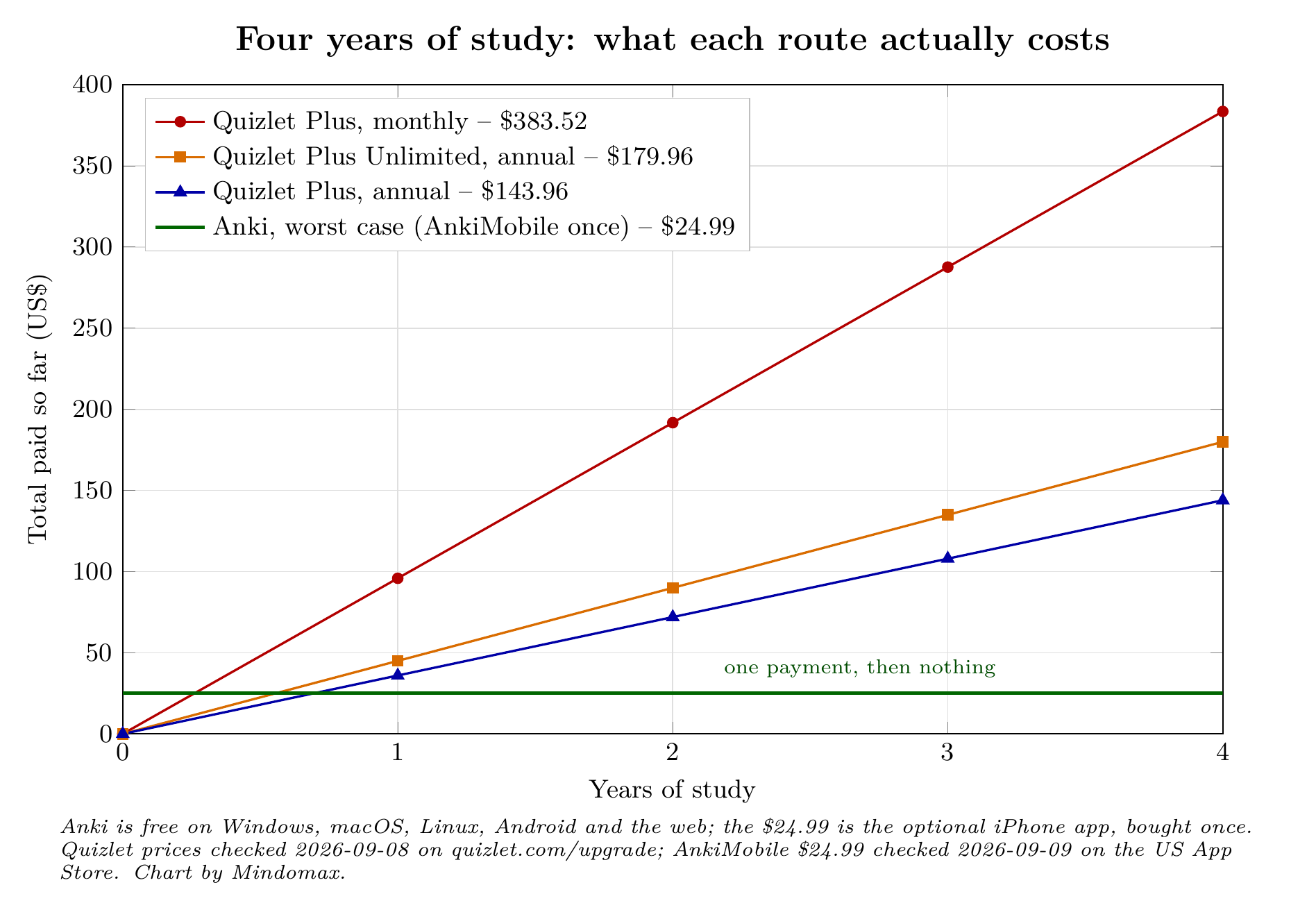
×
Anki's worst case is one payment. Quizlet's cheapest plan passes it before the first year is out. Anki is free on Windows, macOS, Linux, Android and the web; the $24.99 is the optional iPhone app, bought once. Quizlet prices checked 2026-09-08 on quizlet.com/upgrade; AnkiMobile $24.99 checked 2026-09-09 on the US App Store. Chart by Mindomax.
Two things fall out of that table that no competing article states. The first is that Anki's worst case, the one where you buy the iPhone app and pay full US price, costs less than eight months of Quizlet Plus Unlimited billed monthly. The second is that Quizlet's monthly plan costs $95.88 across a year against $35.99 for the same plan billed annually, a difference of $59.89 for choosing the wrong button. There is a seven-day free trial, and Quizlet's own small print says "Monthly plan is not eligible for a free trial" (checked 2026-09-08). Anki has no trial at all, because there is nothing to try: the free versions are the full program.
The full breakdown of Quizlet's tiers is in Quizlet Plus cost, and Anki's is in is Anki free.
The $24.99 is an American price
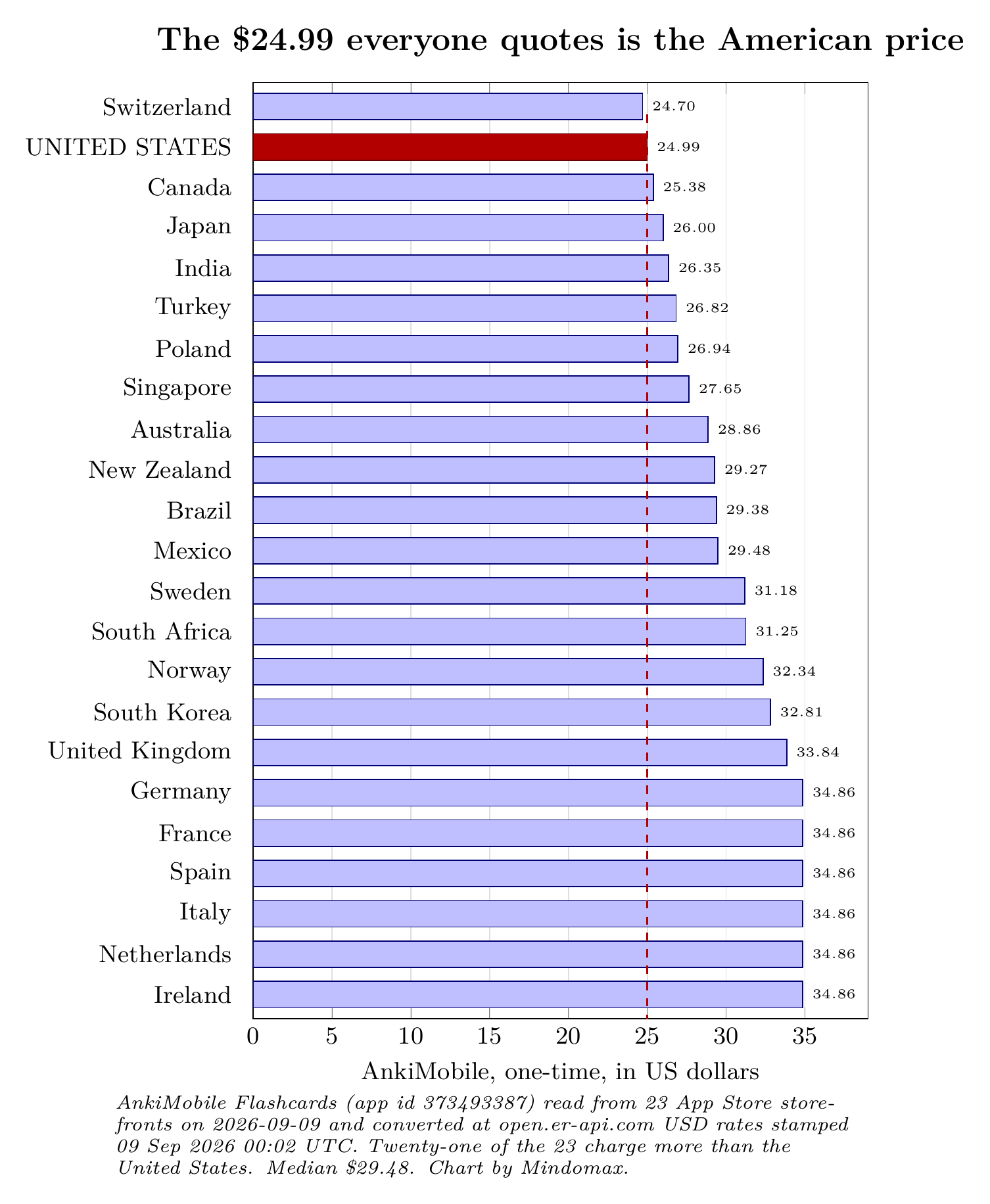
Every article ranking for this question prints $24.99 as though it were the price of AnkiMobile. We read the App Store listing for AnkiMobile Flashcards in 23 storefronts on 2026-09-09 and converted each one at that morning's exchange rates.
×
AnkiMobile Flashcards (app id 373493387) read from 23 App Store storefronts on 2026-09-09 and converted at open.er-api.com USD rates stamped 09 Sep 2026 00:02 UTC. The median is $29.48. Chart by Mindomax.
Twenty-one of the 23 charge more than the United States does. The only cheaper one is Switzerland, by 29 cents. The median is $29.48. The eurozone pays 29,99 euro, which came to $34.86 on the day we checked, 39 percent above the number everyone quotes. And Britain has the best trap in the set: GBP 24.99 is the same digits as $24.99 and, at 2026-09-09 rates, $33.84 of actual money.
So if you are reading this outside America, budget the local number, not the American one.
What "free" and "Plus" actually allow on Quizlet
This is where the comparison usually goes wrong, because writers treat Quizlet as having a free tier and a paid tier. It has a free tier and two paid tiers, and the cheaper paid tier is still metered.
Quizlet's help centre, read on 2026-09-09, says it plainly: "Quizlet Plus provides extended access to premium study tools with monthly usage limits." Its plan page puts the allowance at ad-free access to 3 practice tests, 20 rounds of Learn questions, and 3 textbook solutions per month (checked 2026-09-08). Plus Unlimited removes the meters. The nine dollars a year between the two tiers is the difference between an account with a monthly allowance and one without.
There is one thing Quizlet does not make clear, and we are not going to resolve it for them. The help centre lists Learn among the features a subscription unlocks, alongside Study Guides, Test, Expert Solutions and offline studying. The plan page describes Plus as getting 20 rounds of Learn a month, which implies the free plan gets fewer rather than none. Both statements are Quizlet's. Assume the free plan will run out of Learn before you run out of studying.
Note also what is on that subscription list: offline studying. Quizlet's help centre says "Studying and creating sets offline is currently only available on the iOS app and the Android app" (checked 2026-09-09), so there is no offline on the web at all, and it is a paid feature on mobile. Anki's desktop and Android apps work offline by default and only need a connection to sync. If that is the deciding factor for you, we compared the field in best offline flashcard app.
The part nobody mentions: can you take your cards with you
Here is the finding that changed how we would answer this question.
Quizlet lets you export a set as text. Its help centre article "Exporting your sets", read on 2026-09-09, describes the route: open the set, use the more menu, choose Export, pick how the terms and definitions are arranged, and copy the text. It also sets three conditions, quoted exactly:
"If you are the creator, you can export the terms and definitions from your own sets."
"If you copied a set from another user, you won't be able to export it."
"Image exports aren't currently available due to copyright restrictions."
Anki's side is open. Its manual says "Any plain text file that contains fields separated by commas, semicolons or tabs can be imported into Anki, provided some conditions are met", with the file saved as plain text in UTF-8 (checked 2026-09-09). So Quizlet's copied text pastes into a .txt file and imports.
Read those two columns together. The single best reason to choose Quizlet is the library of sets other people made. That is exactly the material that cannot be exported. The feature that makes Quizlet worth choosing is the feature that makes it expensive to leave.
This is not an argument against Quizlet. If you are revising for a test next week from a set someone else built, portability is irrelevant and Quizlet is the faster tool by a distance. It is an argument about time horizon. The longer you expect to keep your cards, the more the export column matters, and the more Anki's plain text file looks like the safer place to put four years of work.
What the four store listings say
We read all four listings on 2026-09-09.
Three things are worth pulling out of that.
Quizlet is five times the size on Android by downloads, and its rating holds up at that scale, which is harder than it sounds. Anyone telling you Quizlet is a bad app is arguing with 912,000 reviewers.
AnkiDroid carries no advertising and no in-app purchases at all. On a free Android study app that is close to unheard of.
And the Google Play listing for Quizlet shows in-app purchases running to $44.99 per item, which is an independent confirmation, read on 2026-09-09, of the Plus Unlimited annual price we read on quizlet.com the day before.
The one that costs money is the one standing still
The most awkward number we found is in Anki's own family.
AnkiMobile, the $24.99 app, is on version 25.09, released on 2025-09-08. That is 366 days before we checked. In the same period the free desktop app moved to version 26.08.1 and the free AnkiDroid app was updated on 2026-05-04 (all checked 2026-09-09). The paid app is the least-maintained of the three, and it is also the lowest-rated: 4.0 from 2,325 ratings, against 4.8 for the free Android version.
If you are on iPhone and that bothers you, there is a free route that Anki's own developer recommends: use AnkiWeb in mobile Safari. It is free, it syncs with the desktop app, and it is genuinely worse than the paid app for daily reviewing. It is still the honest answer for someone who wants Anki's scheduling and does not want to pay for the iPhone app.
Who should pick which
Pick Anki if you are a medical, law or language student with a multi-year horizon, if you intend to keep your cards after the exam, if you want the scheduling to be something you can inspect and tune, or if you want to pay nothing on Windows, macOS, Linux or Android. Our medical-student comparison goes further into why Anki dominates that group.
Pick Quizlet if the deadline is this month, if the material is a vocabulary list or a set of definitions somebody has already made, if you are studying with classmates who are already on it, or if you know you will not use a tool that takes an hour to set up. A tool you actually open beats a better tool you avoid.
Pick both, honestly, if you are a first-year undergraduate. Use Quizlet's library to find the material and Anki to keep the parts you need next year. The export route above is exactly how you move the second group across, and it works for the sets you build yourself.
If neither fits
Neither app is the only option, and if the sticking point is that Anki is too fiddly and Quizlet is too expensive, the middle of this market is crowded and worth ten minutes.
RemNote puts spaced repetition inside a note-taking app, which suits people who write notes first and make cards second. Mochi is the closest thing to a well-designed Anki. Brainscape sells a confidence-rating system rather than an interval algorithm. Knowt is built explicitly as a free Quizlet replacement. Noji is the polished commercial take on Anki's format.
Mindomax, which publishes this blog, is a sixth option in that group: an AI flashcard app with a scheduling engine, a library of ready-made cards, and CSV export available on the free plan, which is the thing this article has spent five hundred words explaining that Quizlet does not do for copied sets. Its free plan is limited to one box, so a student with six subjects will meet that ceiling quickly, and the premium tier is currently listed as free until 2028 (checked 2026-09-09), which means the price after that is not published and you should not plan around it. If you want the whole field rather than one recommendation, we keep a dated list at best flashcard apps.
The verdict
Quizlet wins the first week. Anki wins the fourth year.
The reason is not the algorithm, although the algorithm is better. It is that Anki charges you once and lets your cards leave, and Quizlet charges you every year and keeps most of them. If your studying has a deadline, that is a fair trade and Quizlet is the faster tool. If your studying has a career at the end of it, spend the unpleasant first hour on Anki.
And if you would rather not spend that hour, Mindomax is free to start and its cards export to CSV from day one.
Frequently Asked Questions
Is Anki better than Quizlet?
For long-term retention, yes. Anki schedules every card individually with FSRS and prints the next interval on the button, while Quizlet's Learn mode works in rounds inside a session and does not publish a schedule. For speed and convenience Quizlet wins clearly: its library of sets made by other students is something Anki has no equivalent for.
Is Anki free and is Quizlet free?
Anki is free on Windows, macOS, Linux, Android and in a browser. Only the official iPhone and iPad app costs money, at $24.99 once in the United States (checked 2026-09-09). Quizlet has a free plan with advertising and monthly limits, and charges from $7.99 a month or $35.99 a year for Quizlet Plus (checked 2026-09-08).
Can I move my Quizlet sets to Anki?
Sets you created yourself, yes. Quizlet's help centre says "If you are the creator, you can export the terms and definitions from your own sets", and Anki imports any plain text file with fields separated by commas, semicolons or tabs. Sets you copied from another user cannot be exported at all, and images cannot be exported from any set (all checked 2026-09-09).
Why do medical students use Anki instead of Quizlet?
Volume and horizon. A preclinical deck runs to tens of thousands of cards reviewed over years, and Anki is built for that: it handles decks of 100,000-plus cards, schedules each one separately, and costs nothing on desktop. Quizlet's limits and its per-session round structure are not designed for that workload.
Is Quizlet Plus or Plus Unlimited better value?
Plus Unlimited, if you are paying at all. Quizlet's own wording is that Plus gives "extended access to premium study tools with monthly usage limits", metered at 3 practice tests, 20 rounds of Learn and 3 textbook solutions a month. Unlimited removes the meters for $9.00 more a year, at $44.99 against $35.99 annually (checked 2026-09-08).
Does Quizlet work offline?
Only in the mobile apps, and only on a subscription. Quizlet's help centre says "Studying and creating sets offline is currently only available on the iOS app and the Android app" and lists offline studying among the features a subscription unlocks (checked 2026-09-09). Anki's desktop and Android apps work offline by default.
How much does Anki cost outside the United States?
More, almost everywhere. Across 23 App Store storefronts read on 2026-09-09, 21 charged more than the US $24.99. The median was $29.48, the eurozone paid 29,99 euro which converted to $34.86, and the UK price of GBP 24.99 converted to $33.84.
Can I use both Quizlet and Anki together?
Yes, and for a first-year undergraduate it is the sensible answer. Use Quizlet to find material other students have already typed up, then export the sets you build yourself into Anki for anything you need to still know next year. The export only covers your own sets, so build rather than copy anything you intend to keep.


