INTRODUCTION
Pharmacy school throws roughly 300 new drug names at you every semester. Brand names, generics, mechanisms of action, adverse effects, drug interactions, dosing — the list never ends. And the NAPLEX waiting at the end of year four? That covers all of it. This is why finding the right flashcard app for pharmacy students matters more than most people realize. Research published in Curricular Insights found that pharmacy students who used spaced repetition and active recall scored significantly higher than those relying on passive methods like rereading notes. Yet most students still default to highlighting textbooks. The tools exist. The science is settled. The question is which app actually fits the way pharmacy students need to study.

What Makes a Good Flashcard App for Pharmacy Students?
Before jumping into specific apps, it helps to understand what pharmacy students actually need from a study tool. This is not the same as what a language learner or a history student needs. Pharmacy education is built around memorizing thousands of specific facts — drug names, classifications, mechanisms, side effects, black box warnings, dosing adjustments — and then applying those facts in clinical scenarios.
A good flashcard app for pharmacy students should do a few things well. First, it needs spaced repetition — the scientifically proven method of reviewing cards at increasing intervals to move information into long-term memory. Second, it should either come with pre-built pharmacology content or make it easy to create and import cards from lecture materials. Third, drug pronunciation support is a real advantage since pharmacy students need to say drug names correctly in clinical settings. And fourth, cross-platform access matters because students study everywhere — at home, in the library, on the bus, during rotations.
The problem many students face is that flashcards take too long to make manually, especially when your pharmacology lectures generate dozens of new drugs per week. This is where AI-powered tools have started changing the game. With those criteria in mind, here are the best options available in 2026.

1. Anki — Best for Power Users Who Want Full Control
Anki is the most widely used spaced repetition tool among healthcare students. A 2026 systematic review published in Medical Science Educator confirmed that Anki use is positively associated with improved exam scores in medical education. The app uses the SM-2 and newer FSRS algorithms to schedule reviews at optimal intervals. What makes Anki particularly strong for pharmacy students is the community deck ecosystem. The AnKing Overhaul Deck includes thousands of tagged pharmacology cards. Standalone Top 200 and Top 300 drug decks are freely available. And Sketchy Pharmacology decks pair image-based mnemonics with spaced repetition for visual learners.
Pros:
- Completely free on desktop (Windows, Mac, Linux) and Android
- Most powerful and customizable spaced repetition algorithm available
- Massive library of community-created pharmacy and pharmacology decks
- Works fully offline and syncs across devices through AnkiWeb
Cons:
- Steep learning curve with a dated user interface that feels overwhelming at first
- iOS app (AnkiMobile) costs $24.99 — a common surprise for new users
- No built-in AI features for automatic card generation
- Quality of shared decks varies widely since there is no expert verification
Download: iOS (AnkiMobile — $24.99) · Android (AnkiDroid — Free) · Web App
Pricing: Free (desktop/Android), $24.99 one-time (iOS)
2. RxFlip — Best Pharmacy-Specific App for Drug Memorization
RxFlip was built from the ground up by Sean P. Kane, a board-certified pharmacist and professor of pharmacy practice. Launched in February 2025 as the successor to the popular FlashRX, this app focuses exclusively on what pharmacy students need most — learning the top 250 prescribed medications. Each card covers brand name, generic name, drug class, indications, adverse effects, and typical dosing. The adaptive Leitner learning system prioritizes cards you struggle with. And built-in audio pronunciation for every drug name is a feature most general flashcard apps simply do not offer.
Pros:
- Created and curated by a board-certified pharmacist and pharmacy educator
- One-time $4.99 purchase with no subscription or in-app purchases
- Audio pronunciation of both brand and generic drug names throughout the app
- Fully customizable drug database — add, remove, or modify any drug entry
Cons:
- Limited to 250 outpatient drugs — no injectables, OTC, or specialty medication sets
- Very new app with limited user reviews so far
- No web app — mobile only on iOS and Android
- No AI-powered card generation from study materials
Download: iOS ($4.99) · Android ($4.99)
Pricing: $4.99 one-time purchase
3. UWorld RxPrep — Best for NAPLEX Exam Preparation
UWorld RxPrep is the industry standard for NAPLEX preparation. Used by over 80 pharmacy schools nationwide, the platform offers more than 3,400 practice questions, video lectures, and a comprehensive course book. The flashcard feature lets students create custom cards from question explanations and clinical content. For MPJE preparation, UWorld provides 110 pre-built state-specific flashcards covering pharmacy law. The 2025 first-time NAPLEX pass rate rebounded to 86.8%, and a significant portion of successful candidates credit RxPrep as their primary study resource.
Pros:
- Gold standard for NAPLEX preparation with 20+ year track record
- Comprehensive ecosystem combining questions, videos, flashcards, and course book
- State-specific MPJE flashcards for pharmacy law preparation
- High-quality explanations with clinical reasoning and visual aids
Cons:
- Expensive — full course packages range from $700 to over $1,000
- NAPLEX flashcards are user-created from question bank, not pre-built
- Subscription-based with expiring access periods
- Primarily designed for P4 students, not early coursework
Download: iOS · Android · Web App
Pricing: $225–$1,000+ depending on package and subscription length
4. Knowt — Best Free AI Alternative to Quizlet
Knowt has grown to over 4 million users by positioning itself as the free alternative to Quizlet — and for pharmacy students, it delivers. The AI can generate flashcards from uploaded PDFs, pasted notes, lecture videos, and even YouTube links. Upload a pharmacology chapter and Knowt produces a complete flashcard set in under a minute. The free plan includes Learn mode, practice tests, spaced repetition, and Quizlet import — features that Quizlet now locks behind a paywall. For students on a tight budget who need AI-generated flashcards without paying $36 a year, Knowt is the strongest option right now.
Pros:
- Generous free plan with Learn mode, practice tests, and spaced repetition included
- AI generates flashcards from PDF, notes, videos, and web pages
- One-click import of existing Quizlet sets without losing content
- 5 million+ shared resource library including pharmacy and pharmacology sets
Cons:
- Free version becoming more limited with increasing ads and feature restrictions
- Some users report syncing issues and flashcards not saving properly
- No pharmacy-specific pre-built content curated by experts
- Newer platform — less proven track record than Anki or Quizlet
Download: iOS · Android · Web App
Pricing: Free (core features), Ultra ~$3.99–$7.99/month
5. Mindomax — Best for AI-Powered Card Creation From Any Source
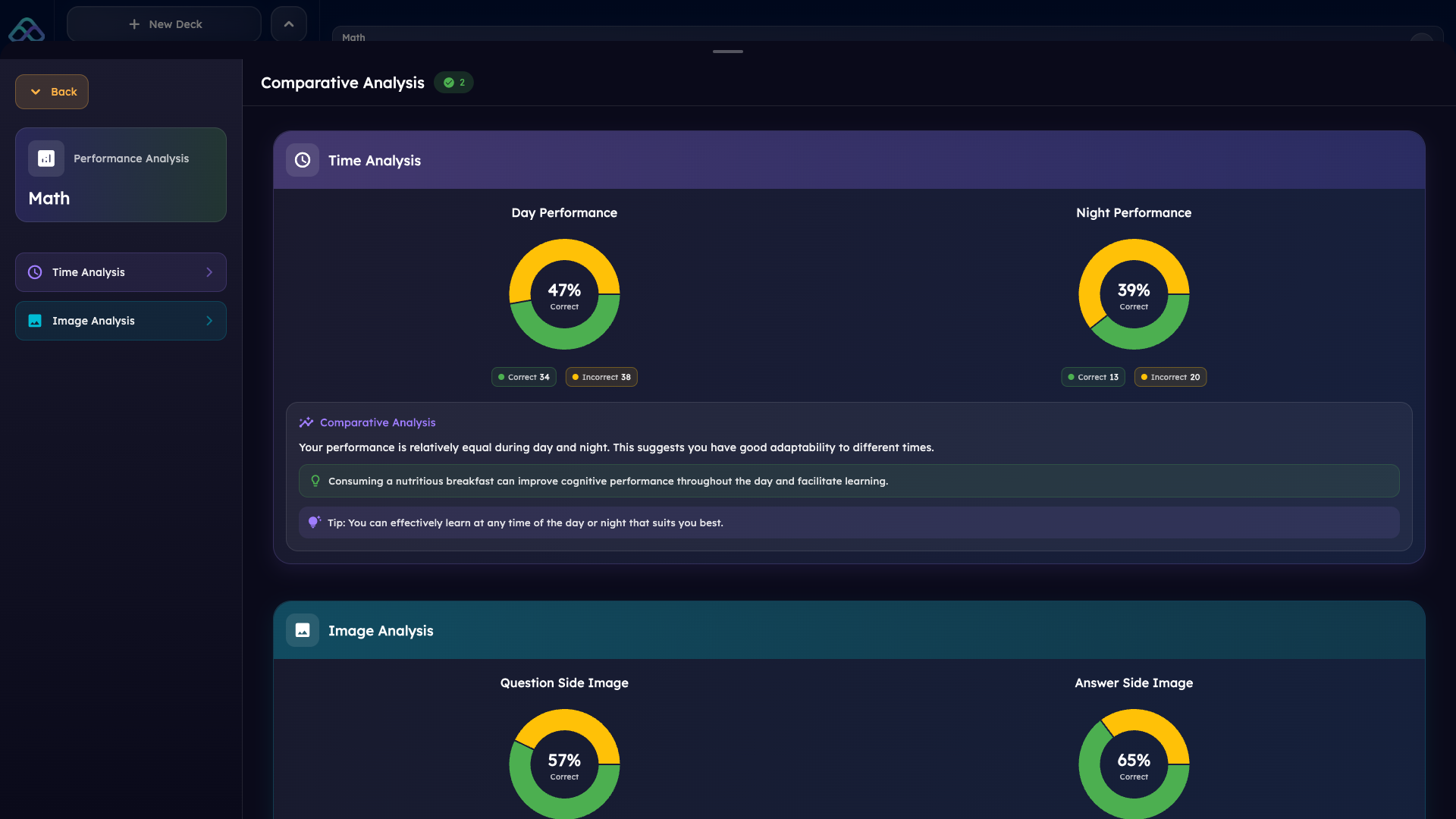
Mindomax takes a different approach from traditional pharmacy flashcard apps. Instead of relying only on pre-built decks, it uses AI to generate flashcards from PDFs, audio recordings, images, and text — which is particularly useful for pharmacy students who want to convert recorded lectures into flashcards without spending hours on manual entry. The platform includes over 450,000 pre-made flashcards including 10,000+ USMLE Step 1 cards that cover pharmacology extensively, plus dedicated Chemistry and Biology decks relevant to pharmacy coursework. A built-in spaced repetition algorithm personalizes review intervals based on performance, study time preferences, and subject difficulty. Audio pronunciation is available in 14 languages, and the AI tutor can explain individual cards in depth — useful when you are stuck on a drug mechanism and need a quick explanation.
Pros:
- AI generates flashcards from PDF, audio, images, and text — converts lecture materials automatically
- 450,000+ pre-made flashcards including USMLE, MCAT, and science content
- AI tutor provides card-by-card explanations for deeper understanding
- LaTeX formula editor with AI assistance for chemistry and pharmacokinetics equations
Cons:
- Newer platform with a smaller user community compared to Anki or Quizlet
- No dedicated NAPLEX-specific flashcard deck at this time
- AI features require Premium for full access (Free plan = 3 AI requests/day)
Download: iOS · Android · Web App and MacOS
Pricing: Free Forever (one box with unlimited cards), Premium $5/month
6. Brainscape — Best for Expert-Certified Pharmacy Content
Brainscape uses a Confidence-Based Repetition system where you rate your knowledge on a 1-to-5 scale and the algorithm adjusts review timing accordingly. What sets it apart from other general flashcard apps is its certified pharmacy content — expert-curated decks covering NAPLEX material, Top 200 drugs, pharmacy law, clinical pharmacokinetics, and all major drug classes. Unlike Anki or Quizlet where community content has no quality guarantee, Brainscape's certified decks are reviewed by pharmacy professionals. The AI Flashcard Copilot can also transform lecture notes into study cards.
Pros:
- Expert-certified pharmacy flashcard decks with professional quality control
- Intuitive confidence-based spaced repetition that feels natural to use
- AI Copilot generates flashcards from uploaded notes and documents
- Clean modern interface with strong collaboration features for study groups
Cons:
- Pro subscription ($7.99–$19.99/month) required to access certified content
- Smaller pharmacy-specific community than Anki or Quizlet
- No text-to-speech or audio pronunciation for drug names
- Limited customization compared to Anki's open-source flexibility
Download: iOS · Android · Web App
Pricing: Free (basic), $7.99–$19.99/month (Pro), $199.99 (Lifetime)
7. RemNote — Best for Students Who Want Notes and Flashcards in One Place
RemNote combines note-taking and flashcard creation into a single workflow — which is something pharmacy students actually need. During a pharmacology lecture, you take notes in RemNote and flashcards are generated directly inside your notes as you write. No separate card-creation step. The spaced repetition system then schedules reviews automatically based on when you are likely to forget each concept. RemNote also supports PDF annotation, so you can highlight a textbook chapter and turn those highlights into flashcards. For students who are tired of switching between a note app and a flashcard app, this integration is genuinely useful.
Pros:
- Notes and flashcards live in the same document — no separate creation step
- Strong spaced repetition with exam date scheduling that adjusts review urgency
- PDF annotation with flashcard generation from highlights
- Free plan includes core features including spaced repetition and unlimited flashcards
Cons:
- Steeper learning curve than Quizlet or Knowt — the interface takes time to master
- No pharmacy-specific pre-built content
- Mobile app is functional but less polished than the web experience
- AI features require the paid plan
Download: iOS · Android · Web App
Pricing: Free (core features), Pro ~$8/month
8. Quizlet — Best for Quick Study Sessions and Massive Library
Quizlet is the most popular flashcard platform in the world, with over 700 million study sets. For pharmacy students, the advantage is simple — someone has almost certainly already created flashcards for whatever you need to study. Top 200 drugs, pharmacology mechanisms, NAPLEX review, pharmacy law for every state. The AI-powered Q-Chat feature acts as an adaptive tutor that quizzes you conversationally, and Magic Notes can convert photos of handwritten notes into flashcards. The Learn mode includes spaced repetition that identifies weak areas automatically.
Pros:
- Largest library of pre-made pharmacy and pharmacology study sets
- Most intuitive interface with almost zero learning curve
- AI features including Q-Chat tutor and Magic Notes for photo-to-flashcard conversion
- Quizlet Live enables collaborative classroom study sessions
Cons:
- Free version increasingly limited with caps on Learn mode and practice tests
- Weaker spaced repetition algorithm compared to Anki or Brainscape
- No quality control on user-generated content — errors are common in shared decks
- Ad-heavy free experience that interrupts study flow
Download: iOS · Android · Web App
Pricing: Free (limited), Quizlet Plus $35.99/year, Plus Unlimited $44.99/year
How to Pick the Right Combination
Here is the honest truth. No single flashcard app for pharmacy students covers everything. The strongest approach most successful PharmD students use is a combination of two or three tools matched to their study phase.
During the first three years of pharmacy school, Anki with pharmacology community decks provides the strongest long-term retention through its gold-standard spaced repetition algorithm. Students who find Anki's interface overwhelming can get excellent results with Brainscape's certified pharmacy content or Knowt's AI-powered study modes instead. For converting lecture materials into flashcards quickly, tools that support AI-powered generation from audio and PDF sources save significant time during heavy coursework periods. And for students who prefer an integrated note-and-flashcard workflow, RemNote eliminates the friction of switching between apps.
For NAPLEX preparation in the final year, UWorld RxPrep is the non-negotiable core resource. Supplement it with RxFlip at $4.99 for focused Top 250 drug memorization with audio pronunciation — arguably the best value in the entire pharmacy flashcard market.
The science behind all of this is clear. A comprehensive review by Dunlosky et al. (2013) rated practice testing and distributed practice as the only two learning techniques with HIGH utility out of ten methods evaluated. Flashcards with active recall and spaced repetition deliver both. The only question is which tool makes it easy enough for you to actually show up and study every day.
CONCLUSION
The flashcard app landscape for pharmacy students in 2026 is surprisingly fragmented. Pharmacy-dedicated tools like RxFlip offer focused drug content but limited flexibility. General platforms like Anki and Quizlet bring powerful algorithms and massive libraries but require more effort to curate quality content. And newer AI-powered tools like Knowt, Mindomax, and RemNote are making it faster to convert lecture materials into study-ready cards without the tedious manual work that causes so many students to give up on flashcards entirely. The best choice depends on where you are in your PharmD program, how much time you are willing to invest in setup, and what your budget looks like. But the underlying principle does not change — active recall through flashcards combined with spaced repetition remains the most effective study method available for the kind of fact-dense memorization pharmacy school demands.
Frequently Asked Questions
What is the best free flashcard app for pharmacy students?
Anki is the strongest free option with the most powerful spaced repetition algorithm and thousands of community pharmacy decks. Mindomax is a strong alternative with AI card generation from PDFs and notes included free. Both are available on iOS, Android, and web but Mindomax has Desktop App too.
Can flashcards really help me pass the NAPLEX?
Yes. Research consistently shows that active recall through flashcards combined with spaced repetition significantly improves long-term retention. Most NAPLEX preparation strategies recommend flashcards alongside question banks like UWorld RxPrep.
How many drugs do pharmacy students need to memorize?
Most PharmD programs require students to learn the Top 200 to Top 300 most prescribed medications. The NAPLEX covers a broader range including injectables and specialty drugs. During clinical rotations, students encounter additional medications specific to their practice site.
Is Anki or Mindomax better for pharmacy school?
Anki has a stronger spaced repetition algorithm and is free on most platforms, but has a steep learning curve. Mindomax is easier to use with AI features and a larger library, but its free version is increasingly limited. Many pharmacy students use both depending on the task.
Are there flashcard apps that can create cards from my lecture PDFs?
Yes. Several apps now use AI to generate flashcards from uploaded PDFs, audio recordings, and notes. Knowt, Mindomax, and RemNote all support this workflow. This saves significant time compared to creating cards manually from lecture materials.