
The Short Answer
An active recall app is any app that hides the answer and makes you produce it before you see it. That sounds like every flashcard app, but it is not. Some apps make you type the answer and check it. Some ask you to explain a whole topic out loud and grade what you left out. Most show you the answer and trust you to grade yourself honestly. A few mostly give you multiple choice, which tests recognition, not recall.
That difference matters more than the brand. So instead of ranking 29 apps from "best" to "worst", this list sorts them by what they actually ask your memory to do. Pick the group first, then the app.
Quick picks, if you only read this far:
If you want the app to check what you type, start with Fresh Cards on Apple devices or Knowt anywhere.
If you study essay subjects, try an "explain it from memory" app like Blurt.
If you want the strongest free scheduler and do not mind a learning curve, Anki is still the default.
All prices below were checked on 2026-09-19. Where an app publishes no price on its own site, we quote Apple's in-app purchase list and say so. That list includes old and regional prices, so treat it as a range, not a quote.
How We Sorted Them
Research on retrieval practice is clear that pulling an answer out of memory beats rereading it (we cover the evidence in how active recall works). It is less clear that every kind of "testing" is equal. Recognising the right option among four is easier than producing it, and easier practice usually sticks less well. Grading yourself works, but only if you are honest when you almost knew it.
So each app below is placed in the group of the strongest kind of recall it offers, based on its own store listing or help pages:
Type the answer, the app checks it (12 apps)
Explain it from memory, graded by AI or by you (4 apps)
Flip and grade yourself (10 apps)
Mostly multiple choice (1 app)
Ready-made courses, answer format not published (2 apps)
Every app passed a liveness check: the store listing resolves, and it was updated in the last 18 months. We left out apps that were abandoned (Zorbi, Tinycards), web tools with no app, and apps that only quiz you on their own courses unless they are clearly marked as such.
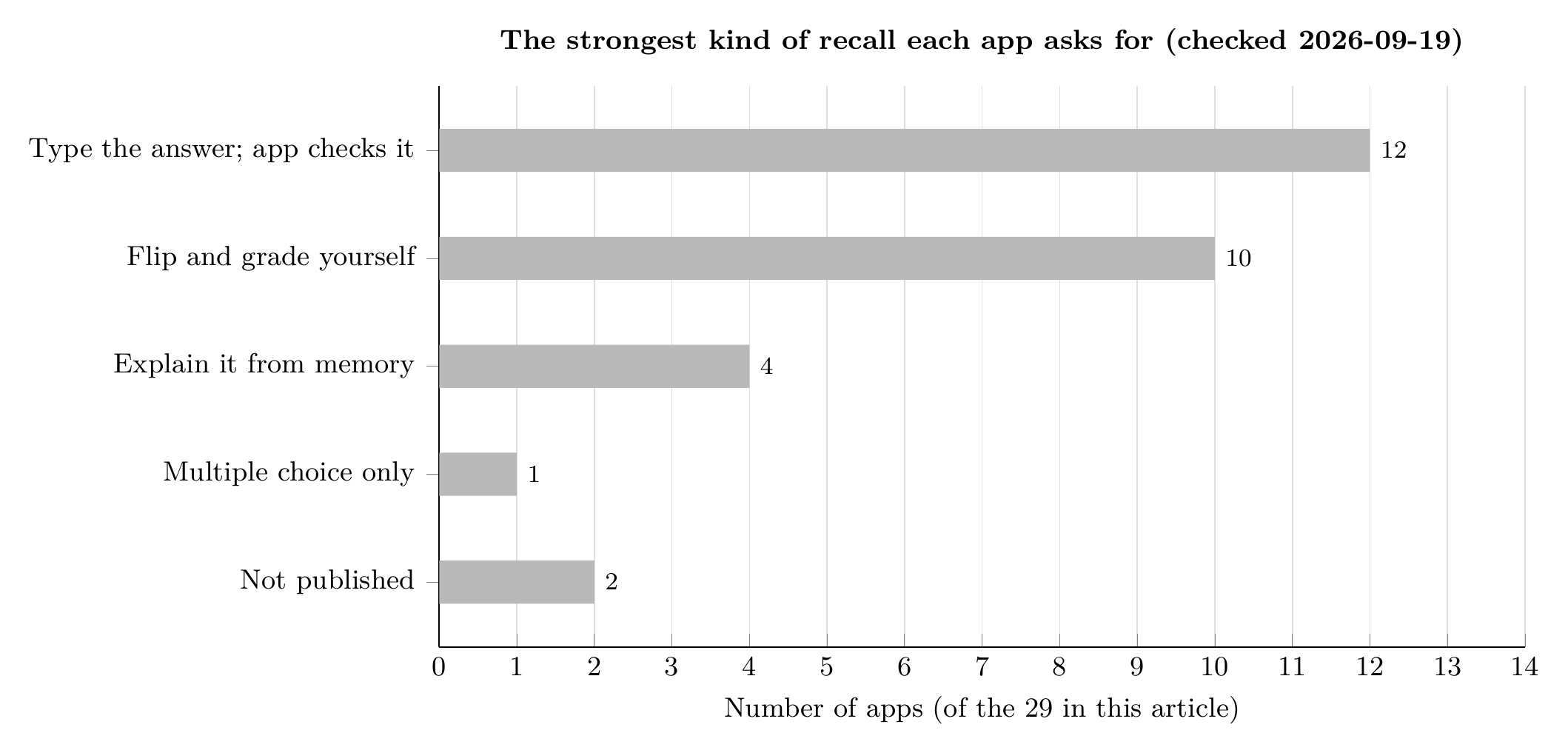
The strongest kind of recall each of the 29 apps in this article asks for, from each maker's own store listing or help pages. Checked 2026-09-19. Chart by Mindomax.
Apps That Make You Type the Answer
This is the strictest group. You cannot tell yourself "I basically knew it" when the app compares your spelling to the answer.
1. Fresh Cards - Typed Answers With No Self-Grading
Fresh Cards gives you three ways to answer: flip the card, arrange word tiles, or type the answer. It schedules reviews itself with no manual ratings, which removes the temptation to grade yourself kindly. Price: free up to 100 cards, Premium $20 one-time (checked 2026-09-19). Limitation: Apple only, and the free plan runs out at 100 cards.
2. Azri - Typing Checked Down to the Accent
Azri, formerly Simple Anki, checks what you type character by character and even catches a missing accent, which makes it a strong choice for language learners. It runs FSRS. Price: free with unlimited manual cards; Pro $19.99 a year (checked 2026-09-19). Limitation: iPhone and iPad only, and sync needs Pro.
3. MintDeck - Free FSRS With Three Answer Formats
MintDeck mixes multiple choice, fill in the blank and type the answer, so the same card gets harder as you go. The core app is free with unlimited decks, and AI is pay-as-you-go: $4.99 for 400 credits (checked 2026-09-19). Limitation: iPhone only, with a small user base so far.
4. Qsets - Offline, No Account, Typing Mode
Qsets is one of the few apps that literally calls itself an active recall app. It offers flashcards, multiple choice or typing, works fully offline and publishes no price (free on its site, checked 2026-09-19). Limitation: it tracks progress per deck, not per card, and it has only a handful of ratings.
5. SmartCards+ - A Long-Running iPhone SRS App
SmartCards+ asks you to type during reviews and has more than 2,000 ratings. App Store list: Premium $7.99 a month, $29.99 a year or $69.99 lifetime (checked 2026-09-19). Limitation: iPhone only, last updated March 2026.
6. Knowt - Free Written Answers in Learn Mode
Knowt lets you pick multiple choice, written, true/false or plain flashcards, and its Learn mode is free with unlimited rounds. Ultra costs $24.99 a month or $149.99 a year (checked 2026-09-19). Limitation: the scheduler is not documented, and Ultra is one of the priciest plans here.
7. Quizlet - The Biggest Library, Recognition First
Quizlet is where you find a ready-made set for almost any class. Learn mode starts with multiple choice and moves to written answers. Its upgrade page blocked us, so the price is from the App Store list: Plus $9.99 to $44.99 (checked 2026-09-19). Limitation: the early rounds test recognition, not recall. See our spaced repetition app comparison if scheduling matters to you.
8. Anki - Flip by Default, Typing If You Want It
Anki shows you the question, you answer in your head, then grade Again, Hard, Good or Easy. A type-in field and cloze cards are built in if you want to be checked. Free on desktop and Android; the iPhone app is $24.99 once (checked 2026-09-19). Limitation: the iOS app has not been updated since 2025-09-08, and the setup is famously steep. More in is Anki free.
9. Discito - One Price, No Subscription
Discito runs FSRS-6 and keeps flip and cloze cards free. Type-the-answer, multiple choice and true/false quizzes come with Pro, $14.99 once (checked 2026-09-19). Limitation: the free plan stops at 200 cards, and the app is new with very few ratings.
10. Ovido - Built for Classes Quizzing Each Other
Ovido offers multiple choice, typing and self-correction, and it is popular with teachers who share vocabulary sets. App Store list: $5.99 a month (checked 2026-09-19). Limitation: it describes no spaced repetition scheduler.
11. Clozemaster - Fill the Gap in Real Sentences
Clozemaster hides one word in a real sentence and you either pick it or type it. App Store list: Pro $8.99 to $12.99 a month (checked 2026-09-19). Limitation: languages only.
12. Quizgecko - A Quiz From Any PDF
Quizgecko turns a PDF or web page into short-answer, fill-in and multiple choice questions. App Store list: $17.99 to $274.99 (checked 2026-09-19). Limitation: it is a quiz generator first, not a place to manage decks for months.
Apps That Make You Explain It From Memory
This is the closest thing to a blank page. You write or say everything you remember, and the app shows what you missed. It is slower than flashcards and closer to what an essay exam asks of you.
13. Blurt - Say Everything You Remember
Blurt is built on the "blurting" study method: speak or type all you know about a topic, and its AI compares that to your notes and scores what is missing. App Store list: $6.99 a week or $79.99 a year (checked 2026-09-19). Limitation: no spaced repetition, and the Android app has not been updated since July 2025.
14. Feynman AI - Explain It Like a Teacher
Feynman AI: Explain to Learn asks you to record or write an explanation, then gives it a clarity score and points out the gaps. App Store list: $9.99 a month or $59.99 a year (checked 2026-09-19). Limitation: iPhone only, with few ratings. Do not confuse it with a similarly named app from another developer.
15. LearnBack - A Recall After Every Chapter
LearnBack asks you to put what you just read or watched into your own words, by text or voice, then brings it back later with Again, Hard, Good and Easy. App Store list: from $0.99 a month (checked 2026-09-19). Limitation: no cloud sync at all, by design.
16. Recall (IIRC) - Quiz Yourself on What You Just Read
Recall by IIRC works from the share sheet: send it an article, get a short quiz, and write a summary it rates. App Store list: $3.99 to $79.99 (checked 2026-09-19). Limitation: its website did not load when we checked, and the quiz format is not documented.
Apps Where You Flip and Grade Yourself
This is the classic flashcard loop. It works well if you grade honestly, and it is the group with the best schedulers. If you are unsure whether plain flashcards count as active recall, we answer that in are flashcards active recall.
17. RemNote - Notes That Turn Into Cards
RemNote turns lines in your notes into flashcards, with four grades and cloze cards. Free; Pro $8 a month billed yearly; Pro with AI $18 a month billed yearly (checked 2026-09-19). Limitation: AI grading of your answers only comes with the $18 plan, and App Store prices are higher than the website's.
18. Mindomax - AI-Made Cards and Spoken Practice
Mindomax is our own app, so read this entry with that in mind. It makes cards from PDFs, text, images and audio, has 450,000+ ready-made cards, and adds tests and Talk Me, a spoken practice mode built from your own cards. Reviews use Again, Hard, Good and Easy. Price: free plan with one box; Premium "$0 free until 2028" (checked 2026-09-19), though the App Store still lists a $5.99 monthly purchase. Limitation: the core review is flip and grade, nothing checks a typed answer, and the app has no public store ratings yet.
19. Mochi - Markdown Cards, Clean and Fast
Mochi keeps it simple: remembered or forgot. It has its own scheduler with FSRS as an option. Free with unlimited cards offline; Pro $5 a month billed yearly (checked 2026-09-19). Limitation: syncing between devices needs Pro.
20. Space - Free FSRS-6 on Every Platform
Space gives you FSRS-6, unlimited decks, Anki import and cross-device sync for free. Pro is EUR 5.99 a month or EUR 49.99 a year (checked 2026-09-19). Limitation: unlimited AI is Pro only, and the site does not spell out how answers are checked.
21. AlgoApp - Formerly AnkiApp, Not Anki
AlgoApp uses FSRS and four grades on every platform. Free with unlimited cards; Unlimited $29.99 a year in the US (checked 2026-09-19). Limitation: the free plan limits daily reviews and devices.
22. NeuraCache - Cards From Your Notes App
NeuraCache pulls questions from Notion, Obsidian, Logseq, Roam or Evernote and runs SM-2. Usable for free; $3.99 a month or $35.99 a year (checked 2026-09-19). Limitation: no Windows or web app.
23. Brainscape - Rate Your Confidence 1 to 5
Brainscape asks how confident you were on a 1 to 5 scale and shows cards you rate low more often. Free basic plan; Pro $7.99 a month billed yearly (checked 2026-09-19). Limitation: nothing checks whether your answer was right.
24. Retain - Plans Reviews Back From Your Exam Date
Retain supports cloze and image occlusion and plans your daily load from an exam date. App Store list: Ultra $12.99 a month (checked 2026-09-19). Limitation: no pricing page, and its algorithm is not named.
25. Obsidian Spaced Repetition - For Notes You Already Have
The Spaced Repetition plugin reviews flashcards written inside your Obsidian notes with FSRS or SM-2. Free (checked 2026-09-19). Limitation: it is a plugin, not an app, and setup takes some reading.
26. Flashcards Deluxe - Every Setting, One Price
Flashcards Deluxe supports up to five sides per card, a Leitner mode and an optional multiple choice mode. $4.99 once on the App Store (checked 2026-09-19). Limitation: the interface looks its age.
Mostly Multiple Choice
Choosing the right answer from a list is the gentlest form of testing. It is a good first pass on new material and a weak last one.
27. Jungle - Practice Questions From Your Slides
Jungle, formerly Wisdolia, turns lecture slides into multiple choice questions with AI feedback on each answer. App Store list: $7.99 a month or $59.99 a year (checked 2026-09-19). Limitation: choosing from options is recognition, not recall; use it as a warm-up.
Ready-Made Courses
These two quiz you on their own content, not yours. They suit general learning, not a specific exam.
28. Loxie - Two Minutes a Day on Books and Topics
Loxie asks you questions on non-fiction books and topics at spaced intervals. App Store list: $7.99 a month or $59.99 a year after a 7-day trial (checked 2026-09-19). Limitation: you cannot add your own material, and the answer format is not published.
29. Polym - Audio Recall for Walks
Polym works like audio flashcards for subjects such as statistics, logic and economics. $9.99 a month (checked 2026-09-19). Limitation: ready-made courses only.
Which Active Recall App Should You Pick?
If you study vocabulary or anything with one right answer, pick an app that checks what you type: Azri, Fresh Cards or MintDeck on iPhone, Knowt on Android and the web.
If your exams are essays or oral exams, flashcards will not be enough. Add Blurt or Feynman AI once a week on each topic.
If you already have hundreds of cards and want the best scheduling, stay in the flip group: Anki, Space or AlgoApp for FSRS, RemNote or Obsidian if your notes live there. The difference between schedulers is real but smaller than people think; we compare them in FSRS vs SM-2.
If making cards is what stops you, choose an app that builds them from your files, such as Mindomax, Knowt or Quizgecko, then check the cards before you study them.
Whatever you choose, the rule is the same: answer before you look. An app only helps if you try to remember first.
Frequently Asked Questions
What is an active recall app?
It is an app that hides the answer and makes you produce it from memory before showing it. The strongest ones check what you type or say; many simply let you flip the card and grade yourself.
Is Anki an active recall app?
Yes. Anki shows the question first and you answer before revealing the back. By default you grade yourself; you can add a type-in field if you want Anki to compare your answer.
Are multiple choice quizzes active recall?
Only partly. Picking the right option is recognition, which is easier than producing the answer yourself. Use multiple choice as a warm-up, then move to typed or spoken answers.
What is the best free active recall app?
Anki on desktop and Android, Space on every platform, and MintDeck or Azri on iPhone are free with unlimited cards (checked 2026-09-19). Knowt's Learn mode with written answers is also free.
Can AI grade my recall?
Some apps do. Blurt and Feynman AI score a spoken or written explanation against your material, and RemNote grades answers on its $18 a month plan (checked 2026-09-19). AI grading is useful for spotting gaps, but check its verdict against your notes.
If you want to try one that builds cards from your own PDFs and audio, Mindomax Premium is free until 2028.


