
Introduction
Go and look at yourself in a mirror. That face is the one you know best, and you have never seen it. What you see is reversed, left for right, and it is the only version of you that you have ever looked at properly.
Now find a photograph of yourself. Something about it is slightly wrong. Most people describe the feeling as the camera being unkind, or the angle being bad, or the lighting doing something unflattering.
In 1977 Theodore Mita, Marshall Dermer and Jeffrey Knight worked out what is actually happening [1]. They showed people two prints of the same photograph of their own face, one normal and one mirror-reversed, and asked which they preferred. The people in the photographs preferred the reversed image, the one that matched the mirror. Their close friends, shown the same pair, preferred the true photograph. Same face. Two audiences. Two different histories of looking.
Nobody in that study was making an aesthetic judgement, although everyone involved thought they were. They were reporting familiarity and calling it preference. That substitution has a name, and it is one of the most reproduced findings in the whole of social psychology.
It is also, in 2026, one of the least accurately reported. Search for the mere exposure effect and you will get the same paragraph on page after page. Repeated exposure increases liking. Zajonc proved it in 1968. Advertisers use it. Then a tidy closing line about how you should be careful what you let yourself see.
Every sentence in that summary is roughly true, and the article that stops there has skipped the interesting half. The research on what happens when the effect breaks down is large, well designed and almost entirely absent from what gets written for general readers. It fails when you already dislike the thing. It weakens when you notice you are being exposed. It fails when you feel pressured, when you feel threatened, and when you have simply had enough.
This piece is about the conditions. Where the popular version is right, we will say so and give you the numbers. Where the field is still arguing, and it is arguing in at least four places, we will name who is on which side rather than pretending the question is closed.
The Experiment That Named It, and the Two That Came First
Robert Zajonc did not discover this. He named it, which is a different and in some ways larger contribution, because naming it made it testable.
The observation is much older. Gustav Fechner, working on experimental aesthetics in Leipzig, ran the earliest known studies on repeated exposure and preference in 1876, published in his Vorschule der Aesthetik with Breitkopf und Haertel. Edward Titchener described the phenomenon directly in his 1910 Textbook of Psychology with Macmillan, calling it a glow of warmth that attaches to things you recognise.
Titchener's explanation was that the warmth comes from the act of recognising. That is the obvious account, it lasted for decades, and it turned out to be wrong in a way that reorganised the whole field.
Zajonc's 1968 monograph in the Journal of Personality and Social Psychology did three experiments with three different kinds of material [2]. Nonsense words. Chinese-like characters that his American students could not read. Photographs from a college yearbook. In each case some items were shown more often than others, and in each case rated liking tracked the number of exposures. The material did not matter. The frequency did. Twelve years later he pushed the theoretical claim as far as it would go, arguing in American Psychologist in 1980 that preferences need no inferences, and that affect can operate independently of, and ahead of, the cognition that supposedly produces it [3]. That paper is still being argued about. We will come back to it.
Notice what the timeline does not show. There is no point at which anyone establishes why the effect happens. The founding work established that it happens, the meta-analyses established how reliably, and the mechanism has been argued over for nearly 60 years without resolution.
The Number Everyone Quotes, and the One That Replaced It
If you have read anything about this effect you have met a single statistic, usually without a source attached.
Robert Bornstein published a meta-analysis in Psychological Bulletin in 1989 covering 208 experiments from the two decades after Zajonc's monograph [4]. The overall relationship between exposure and liking came out at r = 0.26 [4]. That is small to moderate, and it is the number that has been repeated ever since.
What almost nobody mentions is that it has been superseded, and that the replacement is considerably less comfortable.
In 2017 Matthew Montoya and colleagues re-examined the literature in the same journal, estimating parameters from 268 curve estimates drawn from 81 articles [5]. They did not find a rising line. They found a positive slope with a negative quadratic term, which is a curve that goes up and then comes down. They also found it was present for visual stimuli and not for auditory ones. The inverted shape appeared at exposure durations shorter than 10 seconds and longer than 1 minute and behaved differently in between [5].
Then they wrote the sentence that should be in every summary of this topic and is in almost none. The authors concluded that "existing models for the mere exposure effect do not adequately account for the findings" and offered a framework to guide future work instead of a mechanism.
Read that carefully, because it changes what kind of thing this is. The phenomenon is not in doubt. The explanation is. A field can have a result it can reproduce at will and no agreed account of why it happens, and this is one of those fields.
The Part That Sounds Backwards
Here is the finding that most reliably surprises people, and it is the reason the effect matters at all.
On the best-known measurement of this, the effect is stronger when you do not know it is happening. Not merely present without awareness. Stronger. That measurement is disputed, and the dispute comes later in this section.
Richard Moreland and Zajonc asked the direct question in 1977, testing whether recognising a stimulus is a necessary condition for the exposure effect, and answered no [6]. Three years later William Kunst-Wilson and Zajonc published a short paper in Science that made the point unavoidable [7]. Irregular octagons were flashed too briefly to be identified. On a later test, participants could not say which shapes they had seen. Asked instead which they preferred, they chose the previously shown ones at above chance rates. In the authors' words, preferences develop "even when the exposures are so degraded that recognition is precluded".
The measure that should have been easier, saying whether you had seen a shape before, was the one people could not do.
The version of that finding you usually read stops there, as a curiosity about the subliminal. The important part came later.
In 1992 Bornstein and Paul D'Agostino compared recognised and unrecognised exposures directly and found the effect was larger, not smaller, for the stimuli people could not recognise [8]. Their 1994 model explains why, and it is worth understanding because it generalises well beyond this effect [9]. Repetition makes a stimulus easier to process. That ease feels like something. If you have no idea why the thing feels easy, you attribute the feeling to the thing itself, and the thing seems likeable. If you remember seeing it before, you have somewhere else to put the feeling, and you discount it.
Awareness does not protect you from the mechanism. It gives you a place to file the evidence, which is not the same thing. This is the same architecture that runs underneath the illusion of knowing, where fluent reading gets mistaken for understanding.
Awareness is a brake on the effect, not a switch.
There is a real objection to all of this and it deserves naming. Ben Newell and David Shanks argued in 2007 that the case for recognition-independence rests on weak recognition measurement, and that when you measure recognition properly the independence tends to shrink [10]. They are not fringe and the argument has not been settled. Anyone telling you flatly that mere exposure is unconscious is skipping a live dispute.
Not every attempt to push exposure below awareness works either. Giulia Pugnaghi, Daniel Memmert and Carina Kreitz used an inattentional blindness design with 240 participants in 2019 and found the preconscious version harder to produce than the literature implies [11].
Two further results tighten the picture without resolving it. Bornstein, Dean Leone and Donna Galley showed in 1987 that stimuli presented below awareness changed how participants behaved toward a person, not just how they rated a shape [12]. Jennifer Monahan, Sheila Murphy and Zajonc found in 2000 that repeated subliminal exposure produced a general lift in mood that spilled onto stimuli that had never been shown at all [13]. One caution belongs with all of it. These are laboratory findings that depend on tightly controlled presentation timing, and none of them licenses any claim about subliminal advertising in the world.
Why Easy Feels Good
The leading account is called processing fluency, and its best evidence does not involve repetition at all.
In 1998 Rolf Reber, Piotr Winkielman and Norbert Schwarz manipulated how easy a picture was to process without showing it more often [14]. They primed it, or raised the contrast against its background, or lengthened the presentation. Liking went up anyway. That is the causal test, and it is why fluency became the default explanation: you can produce the affect without any exposure history whatsoever.
That experiment removes something important. If liking rose only after repetition, you could still argue that people were recognising something and enjoying the recognition. Removing repetition shows that recognition is not needed to produce the affect, which is weaker than showing recognition plays no part when repetition is there.
Winkielman and John Cacioppo then measured the affect on people's faces in 2001, recording activity in the zygomaticus muscle, the one that pulls the corners of the mouth [15]. Easier processing produced more of it. People were very slightly smiling at pictures that were easier to see.
Jiwon Song, Yuna Kwak and Chai-Youn Kim traced the same trade-off in art in 2021, though with only 21 participants, finding that repeated viewing raised liking for abstract paintings at Cohen's d = 1.22 while novelty mattered more for the visually complex scenes [16]. Rolf Reber, Schwarz and Winkielman extended the argument to aesthetic experience generally in 2004, proposing that a substantial part of what we call beauty is the perceiver's own processing experience read as a property of the object [17]. Adam Alter and Daniel Oppenheimer pulled the scattered fluency literatures together in 2009 and showed how many separate effects share this shape [18].
The account, then, is not about familiarity at all. Ease produces a small good feeling, and you have no reliable way of telling where that feeling came from. The object is standing in front of you when it arrives, so the object gets the credit.
Two refinements matter here. Michaela Waenke and Jochim Hansen argued in 2015 that fluency is judged in relation to what you expected, not on some absolute scale, which is why the same stimulus can feel effortless in one context and ordinary in another [19]. And Sascha Topolinski and Fritz Strack found in 2009 that the effect for words depends on motor simulation: block subvocal articulation by having people chew, and the exposure effect for spoken word forms goes away [20]. Whatever fluency is, it is partly in your mouth.
Something similar happens at the front of the visual system, where a familiar pattern is recognised in roughly 150 milliseconds. That is a different measurement from fluency attribution and it does not settle the timing question here. It does show that a great deal happens before you have anything you would call an opinion.
The Arguments That Are Still Open
The mechanism is not settled, and the disagreements are worth knowing because they change what you can honestly claim.
Zajonc's 1980 position was that affect comes first and needs no cognitive work under it [3]. Justin Storbeck, Michael Robinson and Mark McCourt pushed back hard in 2006, reviewing the neurological evidence and arguing that semantic processing precedes affect retrieval rather than following it [21]. That exchange has never closed.
None of those positions is obviously silly, which is why the argument has lasted. What is at stake is whether liking is a fast reflex that reasoning later dresses up, or the end of a short chain of processing that happens too quickly to notice. Those two stories predict almost the same behaviour and very different insides.
Angela Lee revisited a rival account in 2001, in which repeated exposure works by reducing uncertainty rather than by producing pleasure [22]. Xiang Fang, Surendra Singh and Rohini Ahluwalia tested the competing explanations against each other in 2007 and found the fluency account did better than the alternatives in a consumer setting, without eliminating them [23].
Notice that these are not really competing predictions so much as competing descriptions of the same curve. That is a familiar situation in psychology and it is uncomfortable, because it means the data cannot easily choose between them.
A newer entrant reframes the whole thing. Kellen Mrkva and Leaf Van Boven proposed a salience theory in 2020 in which what matters is exposure relative to everything else on offer, and in which repeated exposure increases not just liking but extremity and emotional intensity in both directions [24]. On that account the effect is fundamentally about attention rather than about affect.
And then there is a result that no purely perceptual account absorbs comfortably. Pieter Van Dessel and colleagues ran seven experiments in 2017 in which participants were never repeatedly exposed to anything [25]. They were simply told that one stimulus would appear frequently and another rarely. That instruction alone shifted both implicit and explicit evaluations, and the size of the shift depended on whether participants remembered which stimulus was supposed to be the frequent one. Being told about repetition did some of the work that repetition does.
If you can move somebody's evaluation by telling them about a repetition that never happened, then at least part of what looks like a perceptual effect is running on beliefs about exposure rather than on exposure itself.
Erik Gustafsson and colleagues asked the most awkward question of all in 2021, examining whether what is measured in these paradigms is mere exposure, plain habituation, or a move toward an optimal level of arousal [26]. They did not settle it. Nobody has.
The Peak, and Why Nobody Can Tell You Where It Is
You will see the claim that seven exposures is the magic number. Sometimes three. Sometimes twenty. Every one of those numbers is advertising folklore and none of them comes from this literature.
The reason is structural, and Daniel Berlyne set it out in 1970 in a paper on novelty, complexity and hedonic value [27]. Two things happen when you meet something repeatedly, and they run on different clocks. Early repetition reduces uncertainty and makes the thing comfortable, which pushes liking up. Continued repetition produces tedium, which pushes it down. The curve you observe is the sum of two processes, so its peak sits wherever those two happen to cross.
That is why the number moves. Bornstein, Amy Kale and Karen Cornell demonstrated the downslope directly in 1990, showing boredom operating as a limiting condition rather than as a vague caveat [28]. John Cacioppo and Richard Petty had already found the same shape for persuasive messages in 1979, where repetition first increased and then decreased the favourability of responses [29]. Advertising wearout is not a marketing superstition. It is this curve, measured.
Montoya and colleagues put numbers on where the shape appears in 2017, finding the inverted curve for all visual stimuli but not for auditory ones, and at exposure durations shorter than 10 seconds and longer than 1 minute [5]. The peak depends on the modality, the duration, the complexity of the thing and how novel it was when you started. There is no single count, and any source that gives you one has stopped reporting and started guessing.
This is the same reason repetition builds automatic behaviour at wildly different rates for different actions. Repetition is not a dose. It interacts with what is being repeated.
Where It Stops Working
Everything above describes the effect running normally. The more useful question is when it does not, and the answer is that there are several well documented ways out.
Start with the one that has the cleanest evidence. Sylvain Delplanque and colleagues presented odours varying in how pleasant they were to begin with, across sessions spaced over time, in a 2015 study [30]. Everything became more familiar. Neutral and mildly pleasant odours became more pleasant. Unpleasant odours did not move at all, and neither did the very pleasant ones. The relationship between the size of the effect and initial pleasantness was itself an inverted curve. Correct identification of the odours ran at about 38 percent throughout [30]. This was not people reasoning about what they had smelled.
The authors were blunt about what this means. They wrote that "these data underline the limits of mere exposure effect", which is not a sentence you find quoted anywhere in the popular coverage.
That is already the pattern the rest of this section follows. The effect is less a law about repetition than a rule about what your brain does with an unexplained good feeling.
Pressure breaks it too. Richard Miller showed in 1976 that exposure which feels like an attempt to persuade you can produce reactance and move attitudes in the opposite direction [31]. Threat breaks it in a more specific way. Richard Crisp, Russell Hutter and Bryony Young ran two experiments in 2009 in which exposure to artwork attributed to an out-group increased liking under ordinary conditions and failed to under identity threat [32]. In their second experiment the relationship went negative outright. More exposure, less liking, with reported emotion mediating the reversal.
Both of those failures work the same way. Something in the situation gives you a reason to distrust the good feeling, and once you have that reason the feeling stops being read as a fact about the object.
Some people are simply harder to move. Anouk Hendriks-Hartensveld, Hannah Reutelsterz and Chantal Nederkoorn tested picky eating and food neophobia as moderators in 2023 and found they change how much repeated exposure to a food shifts liking [33]. Individual differences are the least developed corner of this literature, and it shows. Most of what exists tests one moderator at a time. Mikael Molet and colleagues went at a different question in 2021 across four experiments, inducing positive and negative moods before or after exposure [34]. The exposure effect appeared reliably and mood moved it not at all, which none of the three accounts they were testing predicted: Zajonc's neophobia story, uncertainty reduction, and perceptual fluency.
The boundary about unpleasant material is real but it is not absolute, and one 2024 study shows where it bends. Irina Masselman, Klaske Glashouwer and Peter de Jong worked with 272 women who varied in how much they disliked spiders [35]. When the spider pictures were masked, presented below the threshold of clear identification, repeated exposure raised the ratings, and pairing them with smiling faces did no better than exposure alone.
Put that beside the odours and the picture sharpens. Delplanque's participants smelled the unpleasant odours consciously and knew exactly what they disliked. Masselman's participants did not see the spiders clearly enough to bring that dislike to bear. The starting attitude blocks the effect when it is available to be applied, which is another way of saying the same thing as the recognition finding.
Familiarity also biases what you think of an idea rather than an object. Anne Greul, Tim Schweisfurth and Christina Raasch tested this in 2023 with 210 participants drawn from the engineering and marketing departments of a large car manufacturer [36]. Prior familiarity with an idea shifted how favourably employees evaluated it, in a setting where the whole point of the exercise was to judge ideas on their merits.
Look at that table as a whole rather than row by row. Every failure has the same shape underneath it. The effect needs the repeated thing to stay neutral or better, and it needs you not to have a competing explanation for why it feels the way it does. Give people a reason to attribute the ease elsewhere, whether that reason is disgust, pressure, threat or plain boredom, and the machinery stops converting familiarity into preference.
What It Does to People Rather Than Objects
The octagon studies are the ones that get quoted. The studies with people in them are the ones that matter.
Richard Moreland and Scott Beach ran the cleanest of these in 1992 [37]. Four women attended a large university lecture course different numbers of times, 0, 5, 10 or 15, and they never spoke to anybody. At the end of the term students rated them. Ratings of attraction and similarity rose with the number of times the woman had been in the room. No conversation. No interaction of any kind. Just presence.
That result gets repackaged online as a strategy for making people like you. It is not a strategy, it is a finding, and turning it into advice misses the interesting part, which is how little it took.
Leslie Zebrowitz, Benjamin White and Kristin Wieneke pushed it somewhere less comfortable in 2008 [38]. In their first experiment, rapid exposure to a set of Asian faces increased White participants' liking for a completely different set of Asian faces they had never seen. The second experiment repeated it with subliminal exposure to Black faces and got the same generalisation. Exposure to individuals moved evaluation of a category.
That is a hopeful-sounding result and it is usually reported on its own. Reporting it on its own is a mistake.
The same generalisation runs in the other direction, and the honest thing is to report it as published. Pamela Smith, Ap Dijksterhuis and Shelly Chaiken found in 2008 that subliminal exposure to White faces made White participants like Black people less [39]. Eliot Smith and colleagues had already shown in 2006 that familiarity can increase stereotyping rather than soften it [40]. Familiarity does not have a moral direction. Which way the generalisation runs depends on the faces and the perceiver, and both directions have been measured.
That is the uncomfortable version of the same mechanism, and it is the reason this is worth writing carefully. Nothing about processing ease knows or cares what it is attaching itself to.
Two further results show how far this reaches. Anthony Greenwald, Jacqueline Pickrell and Shelly Farnham found in 2002 that people take sides for no reason, developing implicit loyalty to arbitrary groups they were merely assigned to [41]. Letty Kwan, Suhui Yap and Chi-yue Chiu found in 2015 that repeated exposure changes what people believe everyone else thinks is normal, and that shifted perception of the norm then feeds back into their own preference and trust [42].
If that sounds like it should interact with other biases, it does. Familiarity feeds the halo effect by making one easy positive impression colour everything else, and it feeds confirmation bias by making the claims you have already met feel more solid than the ones you have not.
The Brain Does It Without Asking You
You can watch the two systems come apart in people whose brains have separated them for you.
Kevin Greve and Russell Bauer worked in 1990 with a patient who had prosopagnosia and could not consciously recognise faces [43]. This is a single case, so it shows what is possible rather than what is typical. Shown new faces repeatedly, the patient still preferred them afterwards. The recognition system was gone. The preference system was not.
Andrea Halpern and Margaret O'Connor found the equivalent for music in patients with Alzheimer's disease in 2000, where implicit memory for melodies survived the loss of explicit memory for them [44]. Fatima Felisberti tested hedonic preferences for audio and visual stimulation in a 2021 study of 212 participants with cognitive impairment [45]. Preference remains available when recall does not.
Two patient groups, two different losses, and the same dissociation in both. That is the kind of convergence that makes a distinction worth taking seriously, even when each individual study is small.
Imaging supports the split. Rebecca Elliott and Raymond Dolan scanned people making preference and memory judgements about subliminally presented shapes in 1998 and found the two judgements recruited different patterns [46]. Anders Green and colleagues found dorsolateral prefrontal involvement in the music version in 2012 [47]. Andrew Leynes and Richard Addante reported electrophysiological evidence in 2016 that the brain signature of perceived fluency tracks the liking shift, which is consistent with the fluency account without settling it [48].
None of this makes the effect a brain fact rather than a psychological one. It does mean that the part of you that decides what you like is not the part that decides what you remember, and the two can be pulled apart by damage, by masking, or by a fast enough presentation.
Music is where you feel this most directly, because the exposure schedule is usually somebody else's. Nicholas Kathios and colleagues studied how new musical preferences form in 2023 with a sample of 1,185 participants, mapping how expectations and their violation build reward [49]. Yingying Hou and colleagues found in a 2024 study of 48 participants that acquiring analytical knowledge about a piece increased liking at Cohen's d = 2.86 [50].
Apply the same caution to that number as to the patient studies above. An effect that large from 48 participants is a demonstration, not an estimate. Knowing more about a piece and hearing it more often are not the same intervention, and both raise liking, which should make you slightly suspicious of your own taste. That is also the ground where music and memory work on each other.
When Something Else Sets the Schedule
Everything so far assumes exposure happens to you at random. For most of what you now look at, it does not.
Hyunjung Kim measured the mere exposure effect of tweets on vote choice in 2021 and found exposure moving preference outside the laboratory [51]. Roland Pfister and colleagues then built a cleaner test of the same idea.
The design matters here, because the obvious worry about any field study is that people who see a name more often also seek it out more often. A controlled version removes that.
Their 2023 paper reports four pre-registered online experiments in which people browsed newspaper pages while the names of politicians who do not exist appeared in the layout [52]. Nobody was asked to read the names. In the first experiment 81.8 percent of 88 participants then voted for the frequently seen name in a mock election [52].
The follow-ups closed off the obvious objections one at a time. A version with a balanced stimulus set still produced 63.2 percent from 144 participants [52]. A further experiment withheld the infrequent name until the ballot paper itself and produced 69.2 percent from 143 participants [52]. When the coverage was decidedly negative the bias vanished, falling to 41.6 percent of 89 participants, which did not differ from chance [52].
The authors drew a practical conclusion and put it plainly. They wrote that "news outlets should therefore be mindful to cover political candidates as evenly as possible", which is a sentence about editorial responsibility rather than about psychology.
Robert Epstein, Amanda Newland and Li Yu Tang went further in 2025, running three randomised controlled experiments on simulations of a search engine, a social feed and a voice assistant, with 1,488 participants in total, all of them undecided eligible American voters [53]. Their measure was the percentage increase in people inclined to vote for a candidate after seeing content favouring that candidate. On the search simulation it rose from 14.3 percent to 20.2 percent to 22.6 percent across three successive biased searches [53]. It compounded with each additional exposure rather than saturating.
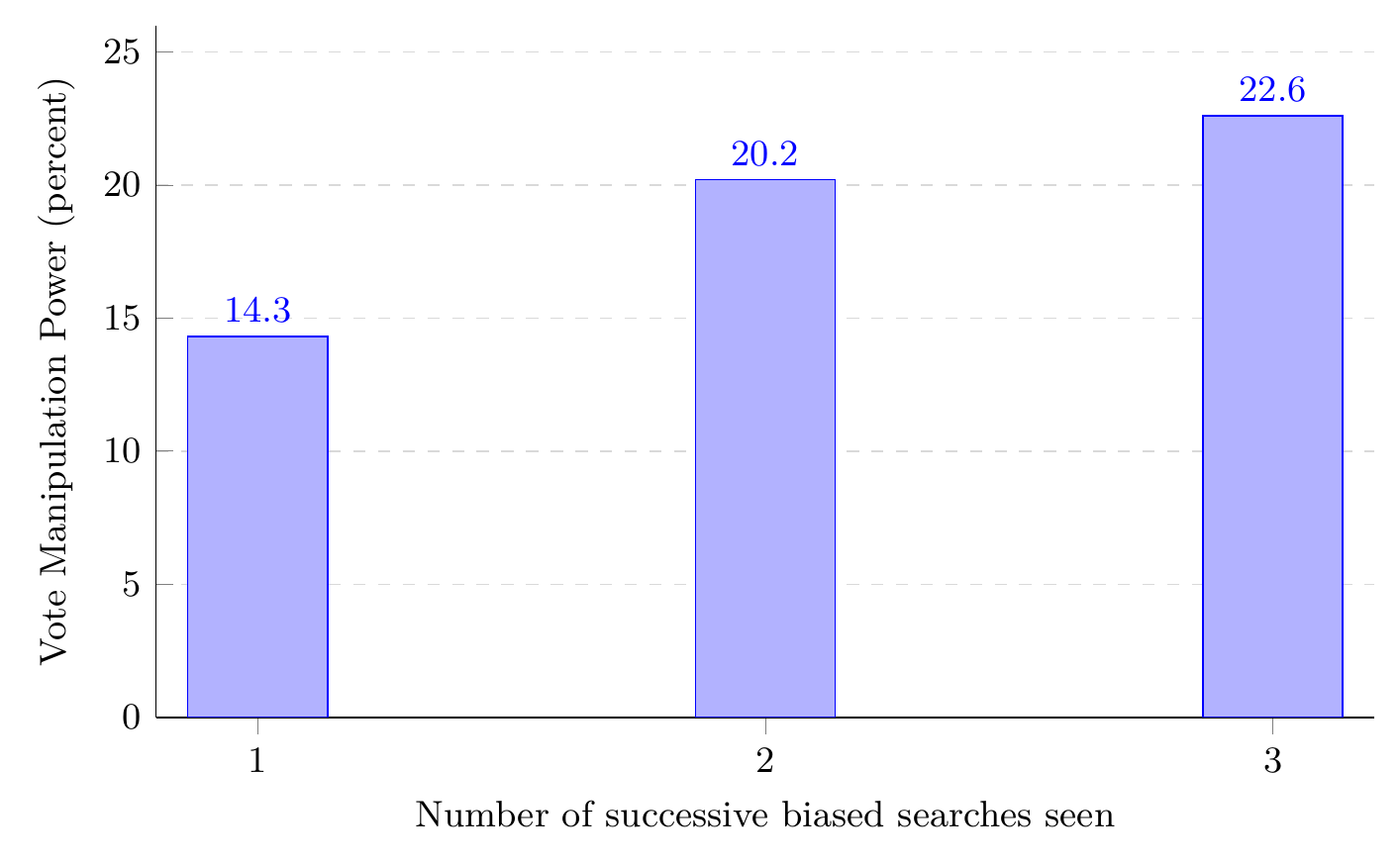
Data from Epstein Newland and Tang 2025 Experiment 1. Chart by Mindomax.
Those are the numbers from one simulator. The other two ran higher.
The equivalent figures for the social feed simulation were 49.7 percent then 61.8 percent then 69.1 percent [53]. For the voice assistant they ran from 72.1 percent to 98.6 percent [53].
The pattern held on all three platforms and it climbed on all three. Now the caveat, because it is a large one. Those are simulations with undecided voters and a forced viewing schedule, so do not read them as estimates of what any real platform does to any real electorate. What they establish is the shape: with repeated similarly biased exposure, the shift compounds.
The effect is not confined to politics. Ariana Deboo, Jazmyn Donovan and James Szalma examined how technology now sets the exposure schedule for music in 2026, which decides which songs get the repetitions that turn into liking [54]. Evan Rieder and Kavita Mariwalla described in 2021 how photo-editing software produces a mere exposure effect for an edited version of your own face [55]. That is the mirror study again, with the mirror now under your own control and adjustable.
Be careful about what any of this licenses. None of these studies shows that a recommendation system is engineering your taste on purpose. What they show is narrower and still worth knowing: when something other than the world decides what you see repeatedly, it is deciding an input to your preferences.
Liking Is Not Learning
There is one more consequence, and for a site about how people learn it may be the most important one.
Repetition raises liking. It also raises how true something feels, and it does that independently of whether the thing is true. Lynn Hasher, David Goldstein and Thomas Toppino demonstrated this in 1977 with repeated statements, and the illusory truth effect has been reproduced steadily ever since [56]. Kyoshiro Sasaki and colleagues tested in 2023 whether subliminal and supraliminal exposure both drive it, using a design with 130 participants per group and powering it to detect an effect around Cohen's d = 0.45 [57]. Madeline Jalbert and Raunak Pillai extended it in 2024 with a total of 180 participants, showing that repetition also raises your estimate that other people already believe the claim [58].
That last finding is worth sitting with. Repetition does not only change what you believe. It changes what you assume everybody else already believes, which is how a repeated claim starts to feel like common knowledge rather than a claim at all.
Simone Mattavelli and colleagues found in 2024 with 240 participants that repetition can make even positive stereotypes feel both more true and more morally acceptable [59]. None of that is about liking any more. It is about what a repeated claim does to your sense of what is established.
Alice Dechene and colleagues had shown in 2009 that context moderates the truth effect and the mere exposure effect in parallel, which is one of the better reasons to think they share machinery [60].
David Stang went at the learning question directly in 1975 across three experiments, separating what repeated exposure does to affect from what it does to learning [61]. The two do not move together.
So, plainly. Liking is not learning. Material you have reread until it feels easy has become fluent, and fluency is exactly the signal the studies above show your brain converting into liking and into confidence. Neither of those is retrieval. That gap is the whole subject of familiarity versus true understanding, and the mere exposure effect is its emotional half.
These are separate effects with overlapping machinery, and the table is there because the words get used interchangeably online in ways that make all four harder to think about.
What Follows From This
The honest summary of all of this is fairly short. Repeated exposure to something you do not already dislike will make you like it more, by an amount that is small on average and real, and the process runs whether or not you are watching it. Noticing it does not switch it off. Noticing gives you somewhere else to put the feeling, and the research says that shrinks the effect rather than removing it.
Part of what makes the account credible is that it does not stay inside a single sense. Patricia Pliner showed in 1982 that repeated tasting increases liking for foods [62], and Martina Jakesch and Claus-Christian Carbon demonstrated the same thing in 2012 for objects that participants explored only by touch and never saw [63].
The effect also crosses between the senses. Sarah Knight, Jonathan Flavell and Sven Mattys found in 2025 that fluency created in hearing transfers across to preference for objects you look at [64]. Even attention without repetition does some of it: Martin Egger and Arnd Florack showed in 2022 that products participants had merely attended to were preferred 55.7 percent of the time against 50.9 percent for distractors [65]. And the traffic runs both ways, because Rocco Palumbo and colleagues found in 2021 across two experiments that the extra liking for repeated items then feeds back into how well those items are remembered [66].
There is one practical asymmetry worth keeping. The effect needs the thing to be neutral or better to begin with, and it needs you to have no competing explanation for the ease. You cannot control the first of those in advance. You can sometimes supply the second.
What you can actually do with this is narrow, and it is worth being honest about how narrow. You cannot audit your own preferences for exposure history, because the studies show the effect survives not remembering the exposure. What you can do is notice the situations where somebody else controls the schedule, and treat the resulting sense of comfortable rightness as information about the schedule rather than about the thing.
Go back to the mirror. The reason your reflection looks right and your photograph looks slightly wrong is not vanity and not the camera. It is a count. One of those faces you have seen tens of thousands of times, and the other you have not, and your brain has quietly converted that difference into a preference and handed it to you as an aesthetic judgement. It does that all day, with faces, with songs, with words, with brands, with ideas. The effect is not that familiar things are good. The effect is that the feeling of ease is indistinguishable, from the inside, from the feeling of quality.
Frequently Asked Questions
What is the mere exposure effect?
The mere exposure effect is the tendency to like something more simply because you have encountered it before. Robert Zajonc named it in a 1968 monograph after showing that liking for nonsense words, unfamiliar characters and yearbook photographs all tracked how often the item had been presented. Robert Bornstein's 1989 meta-analysis of 208 experiments put the average relationship between exposure and liking at r = 0.26, which is small to moderate but very consistent. That figure is the one usually quoted, and a larger re-examination by Matthew Montoya and colleagues in 2017 found the relationship rises and then falls rather than simply rising. The effect has since been demonstrated for faces, music, foods, odours, objects explored by touch and even for preferences that transfer across the senses. It is sometimes called the familiarity principle.
Does the mere exposure effect work if you do not remember seeing the thing?
Yes, and this is the part that surprises people most. William Kunst-Wilson and Zajonc published a study in Science in 1980 in which shapes were flashed too briefly to be identified, and participants who could not say which shapes they had seen still preferred them. Bornstein and Paul D'Agostino then found in 1992 that the effect was actually larger for stimuli people could not recognise. Their explanation is that repetition makes a stimulus easier to process, and if you remember the earlier exposure you have somewhere to attribute that ease other than the thing itself. There is a real dispute here. Ben Newell and David Shanks argued in 2007 that recognition is measured too crudely in these studies for the independence claim to be as strong as it looks.
How many exposures does it take before you start to like something?
There is no number, and any source that gives you one is guessing. Daniel Berlyne set out the reason in 1970: repetition reduces uncertainty, which raises liking, and it also builds tedium, which lowers it, and those two processes run on different clocks. The peak sits where they cross, and where they cross depends on the modality, how long each exposure lasts, how complex the thing is and how novel it was to begin with. Matthew Montoya and colleagues found in 2017 across 268 curve estimates from 81 articles that the shape appears for visual stimuli but not auditory ones, and at exposure durations shorter than 10 seconds and longer than 1 minute. That is a moving target, not a magic count.
Can too much exposure make you like something less?
It can, and this has been measured rather than assumed. Bornstein, Amy Kale and Karen Cornell demonstrated boredom operating as a limiting condition in 1990, and John Cacioppo and Richard Petty had already found in 1979 that repeated persuasive messages first became more favourable and then less so. Advertising wearout is the commercial name for the same curve. Exposure can also reverse for reasons other than tedium. Richard Crisp and colleagues found in 2009 that under identity threat, more exposure to out-group material produced less liking rather than more.
Is the mere exposure effect the same as familiarity bias or the illusory truth effect?
They are related and they are not the same. The mere exposure effect changes how much you like something. The illusory truth effect, demonstrated by Lynn Hasher and colleagues in 1977, changes how true a repeated statement feels regardless of whether it is true. Processing fluency is the mechanism thought to sit under both, and Rolf Reber and colleagues showed in 1998 that you can raise liking by manipulating fluency directly with no repetition at all. Alice Dechene and colleagues found in 2009 that context moderates the truth effect and the mere exposure effect in parallel, which is one reason to think they share machinery. Habituation, where repetition reduces your response rather than changing your evaluation, is a third and separate thing.


