
Introduction
You got the offer. You passed the viva. The paper was accepted, the promotion came through, the client said yes. And somewhere in the following week, quietly, you worked out how it happened. They were short of candidates. The reviewer was distracted. You are good at seeming capable, which is a different skill from being capable, and one day somebody is going to check.
Almost everyone who reads that recognises it. Which is why the topic has become an industry.
Search for impostor syndrome and you get a definition, a list of signs, five types with names like Perfectionist and Soloist, and eight things to do about it. You also get a number. Seventy percent of people experience impostor syndrome, or eighty-two percent, depending on the page. The number is always presented as a fact about human beings.
It is not. It is a fact about a questionnaire.
That sounds like a technicality. It is not, and by the end of this you will be able to see exactly how a single line drawn on a scoring sheet turns 23 percent of a room into more than 90 percent of the same room.
The seventy percent figure comes from a 1985 paper by Gail Matthews and Pauline Clance, and the people it describes were psychotherapy clients [1]. Not a random sample of the public. People who had already walked into a therapist's office. The eighty-two percent is the ceiling of a range that runs all the way down to nine, and the systematic review that produced that range says in its own abstract that the spread depends largely on which screening tool a study used and where it set the cutoff [2].
That is a seventy-three point spread. It is not measurement noise. It is what happens when a field measures several different things and gives them all the same name.
This article is about both halves of that. The experience is real, it is well described, and it costs people things that matter. It also sits on a measurement base that two systematic reviews, six years apart, have described as having no gold standard [3] [4]. Researchers were still arguing in print in 2026 about whether the construct survives once you control for self-esteem, anxiety and perfectionism. None of that makes the feeling fake. It makes almost everything confident anyone has told you about it overconfident.
We will go through the founding study and what it actually found, the word that got swapped and what that swap did, the four questionnaires and why they disagree, who really has it, what it costs, the one large study that found an upside, the argument about whether the problem is you or the room you are standing in, and the short list of things that have actually been tested. Where the field is still fighting, you will get the names on both sides.
1978: Two Clinicians and a Hundred and Fifty Women Who Would Not Believe Their Own Records
The term was born in a therapy practice, not a laboratory. That matters more than almost anything else in this story.
Pauline Rose Clance and Suzanne Imes were clinical psychologists in Georgia. Over five years they saw more than 150 high-achieving women in therapy and counselling, and they kept meeting the same thing [5]. These were women with doctorates, with professional standing, with the kind of record that settles the question. They did not believe it. They attributed the record to luck, to timing, to having charmed an interviewer, to an administrative error nobody had spotted. They expected to be found out.
Clance and Imes gave the pattern a name. They called it the impostor phenomenon.
The name was good. It described the specific texture of the thing, which is not feeling bad about yourself in general but feeling that a particular claim about you is false.
Read the 1978 paper and what strikes you is how carefully hedged it is. They are describing something they observed in their own clients. They say so.
They do not claim a prevalence rate, they do not claim it is a disorder, and they do not use the word syndrome. They describe an internal experience of intellectual phoniness that persists in the face of evidence, and they propose mechanisms: family dynamics that assigned the child a role, and a set of behaviours that keep the belief alive by never testing it properly.
That last part is the piece that has survived best. Clance and Imes noticed that the experience was self-sustaining. Success did not fix it. If anything, success fed it, because each new achievement raised the stakes of the eventual exposure and had to be explained away like all the ones before.
Nine years later Clance restated the idea as an internal barrier to achievement rather than a clinical entity [6]. By 1993 she and Joe Langford were reviewing fifteen years of research and reporting that the pattern had turned up in men, in students, in people who were not in therapy at all [7]. The construct had escaped the sample it was born in. That is normal and healthy in science. What went with it, quietly, was the caution.
Every step of that expansion was defensible on its own. Nobody was being sloppy. But a description of a hundred and fifty people in a therapy room ended up as a claim about the general public, and no single step in the chain is where that happened.
The Word That Changed the Thing
Nobody decided to call it a syndrome. It just happened, in magazines and then everywhere.
You can watch the word do its work in almost any article on the subject. Somewhere in the second paragraph, an experience quietly becomes a condition, and nobody flags the change.
The difference is not cosmetic. A phenomenon is something that occurs. A syndrome is something you have. One sits between a person and their circumstances; the other sits inside the person, like an infection, and implies there is a version of you without it that treatment could reach.
Once the noun changed, everything downstream changed with it. A syndrome needs a prevalence rate. It needs a diagnostic threshold. It needs a cure, and a market for the cure.
So it is worth being blunt about the status. Impostor syndrome is not in the Diagnostic and Statistical Manual of Mental Disorders. It is not in the International Classification of Diseases. There is no clinical threshold that a professional body has agreed on, and there is no diagnosis anyone can give you.
Researchers noticed the drift early. In 1991 John Kolligian and Robert Sternberg published a paper in the Journal of Personality Assessment whose title asked the question outright: is there an impostor syndrome [8]. They built their own instrument, the Perceived Fraudulence Scale, to test the idea rather than assume it. The question mark in that title is thirty-five years old and it has never quite been removed.
It is a strange thing to notice. The field kept the concept and dropped the question, while the popular version kept neither.
Dana Simmons later wrote the history of the label itself, tracing how a description of a private experience became a thing people are told they suffer from [9]. It is a useful corrective. The concept did not stay still. It was carried, by popular writing and then by workplace training, into a shape its authors never gave it.
Here is why this is not a pedantic point about vocabulary. When something is located inside a person, the fix is also located inside the person. Change how you think. Keep a wins file. Say the affirmation.
That framing has consequences, and around 2020 a serious argument broke out about them. We will come back to it, because it is the liveliest fight in the field and it deserves more than a sentence.
What the Experience Actually Is, Once You Measure It
Strip away the branding and there is a real thing underneath, and it has been characterised with reasonable precision.
Three components keep turning up across independent research groups. Take them one at a time.
The first component is an attribution pattern. When something goes well, the cause is outside you and temporary. When something goes badly, the cause is inside you and permanent. Ted Thompson and colleagues demonstrated this directly in 1998, giving participants academic success and failure outcomes and recording how they explained them [10]. People scoring high on impostor measures showed the asymmetry cleanly. It is not modesty. Modesty is a performance for other people. This is what the person genuinely believes when nobody is listening.
Catherine Cozzarelli and Brenda Major had probed the construct's validity eight years earlier, in 1990, and found something more interesting than a debunking [11]. Impostor scores were not simply low self-esteem wearing a costume, though they were related to it. Something was left over after you accounted for the obvious.
That leftover is what the whole field has been arguing about ever since. If impostor feelings were just low self-esteem with better vocabulary, there would be nothing here to study and nothing to name. If they are something else, we should be able to say what.
The second component is where it gets genuinely distinctive, and it is the part popular writing almost always drops. In 2000 Mark Leary and colleagues showed that impostor feelings involve a belief about other people's beliefs [12]. It is not just that you doubt yourself. It is that you think everyone else has a higher opinion of you than you deserve, and that the gap between those two things is a debt coming due. Leary's participants also used self-presentation strategies to manage the gap, hedging their claims about themselves in ways that would soften an eventual fall.
That distinction is what separates the impostor phenomenon from ordinary self-doubt, and if you take one mechanism away from this article, take that one. Self-doubt is a private matter. Impostor feelings are a theory about an audience.
Rory McElwee described the phenomenology in 2010, which is a useful complement to all the scale-score correlations [13]. Kathryn Oleson and colleagues had already mapped a neighbouring construct they called subjective overachievement, in which chronic self-doubt sits alongside an exaggerated concern with performing well [14]. The two overlap heavily, and the fact that psychology kept inventing slightly different names for the same neighbourhood is itself part of why the measurement is a mess.
The third component is behavioural, and it is the engine. Julie Want and Sabina Kleitman showed in 2006 that impostor feelings travel with self-handicapping [15]. Self-handicapping is the practice of arranging an excuse in advance. You leave the work until the night before, so that if it goes badly the reason is obvious and not about you. And if it goes well, that is not about you either, because look at the conditions.
Put those together and you get a loop that cannot be exited by evidence, because evidence is what it consumes. Langford and Clance described the shape of it in their 1993 review [7]. A task arrives. Anxiety spikes. You respond either by over-preparing far beyond what the task needs, or by putting it off until the pressure does the work for you. The result is usually fine. There is a short period of relief. Then the explanation arrives: it was the extra hours, or the deadline adrenaline, or the fact that this particular task happened to suit you. The belief is untouched. The next task arrives.
This is where the impostor experience stops looking like a mood and starts looking like a system. If you want the wider version of the same problem, it is a failure of metacognition: the model you hold of your own competence is wrong while the competence itself is fine, and the model is protected from correction by the very behaviour it produces.
There is a version of this loop you have probably run this month. Notice that at no point does it require you to be wrong about anything except yourself.
The Number Everyone Quotes
Now the arithmetic, because the arithmetic is the story.
You are about to see four numbers, all peer reviewed, all describing the same phenomenon, and none of them agreeing with any other. Try to hold them at once.
Start with the famous one. In 1985 Gail Matthews and Pauline Clance published a paper in Psychotherapy in Private Practice on treating the impostor phenomenon in psychotherapy clients [1]. The seventy percent figure that circulates today traces back to that work. The sample was people in therapy. That is not a criticism of the paper, which was doing exactly what it said. It is a criticism of forty years of people quoting it as though it described the population of the earth.
Now the serious estimate. In 2019 Dena Bravata and eight colleagues published a systematic review in the Journal of General Internal Medicine covering 14,161 participants across 62 studies, and reported prevalence running anywhere from 9 percent to 82 percent [2]. Half of those studies had appeared in the previous six years, which tells you how fast the field was growing. Their explanation for the spread was the screening tool and the cutoff.
They found other things worth carrying forward. Impostor feelings were common in men as well as women and across ages from adolescents to late-career professionals.
They were comorbid with depression and anxiety. They were associated with impaired job performance, lower job satisfaction and burnout. And there was one more finding, which is the single most under-reported sentence in this entire literature: no published study had evaluated any treatment for it.
Read that again. In 2019, after four decades of books, workshops and eight-step guides, the number of published evaluations of any treatment for impostor syndrome was zero.
Two more recent meta-analyses have tried to pin down a figure and have produced different ones. Nader Salari and colleagues pooled 30 studies covering 11,483 participants working in health services in 2025 and reported a prevalence of 62 percent, with a 95 percent confidence interval running from 52.6 to 70.6 [16]. They also reported something that should make you cautious about the estimate itself: prevalence went down as sample size went up. That is the classic signature of small-study bias, where the little studies that find dramatic results are the ones that get published.
In 2026 Yusof Mohamed Omar and colleagues pooled 34 studies covering 9,550 students in medicine and got 49 percent, with a 95 percent confidence interval of 43 to 54 [17]. The heterogeneity was extreme. Their I-squared statistic was 95.6 percent, which in plain terms means almost all of the variation between studies was real disagreement rather than sampling error, and it survived every sensitivity analysis they threw at it. Prevalence differed by gender, with women at 51 percent and men at 40. It differed by region. And it differed significantly by which measurement tool the study used.
That last subgroup finding is the one that matters. The authors drew the obvious conclusion: researchers may not be consistently measuring the same construct.
Data from Bravata 2019, Salari 2025 and Omar 2026. Chart by Mindomax. Four bars, all from peer-reviewed sources, all describing the same thing. If a topic in medicine produced that chart, nobody would print a single headline number from it.
And yet a single headline number is exactly what gets printed. It usually appears without a source, in the first line, as though it were the population of Portugal.
One Picture of Why the Number Moves
The abstract version of this argument is easy to nod along to and hard to feel. Here is the concrete version.
In 2025 Anna Jansson and colleagues surveyed 968 students across five programmes at a Swedish university: medicine, nursing, dentistry, clinical psychology and law [18]. That is a large single-institution sample by the standards of this literature. They used the Clance Impostor Phenomenon Scale, which produces a score from 20 to 100, and they reported the distribution rather than a single percentage.
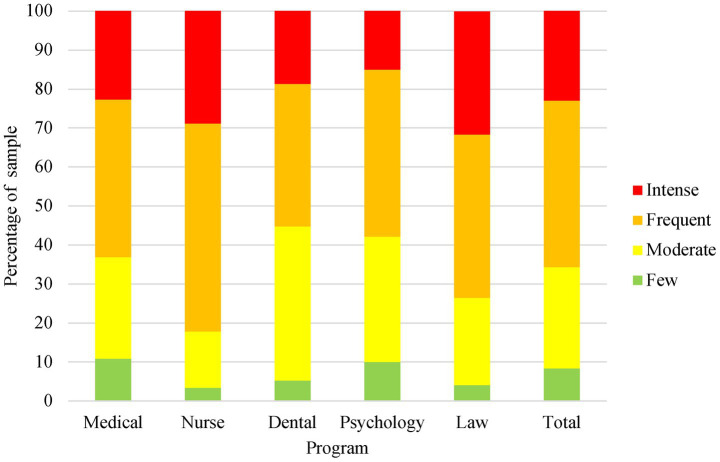
Jansson A, Boman J, Schéle I, Holmström S, Rozental A, Semb O, Fahlström M, Stenman L, Bitar A, Lindquist D. Impostor phenomenon and its association with perceived stress and anxiety among students in medical and social sciences at a Swedish university. Front Med (Lausanne). 2025 Oct 29; 12:1623792. https://doi.org/10.3389/fmed.2025.1623792. Figure 1. Licensed CC BY, https://creativecommons.org/licenses/by/4.0/.
Look at the Total column on the right. Clance's own intensity bands split it four ways: 8.4 percent scored 40 or below, which she called few impostor characteristics. Twenty-six percent landed in the moderate band from 41 to 60. Frequent, from 61 to 80, took 42.6 percent. Intense, from 81 to 100, took 23 percent.
Now decide where the line goes, and watch the headline change.
Draw it above the intense band only, and 23 percent of Swedish healthcare and law students have impostor syndrome. Use the Holmes cutoff of 62 that many studies use, and it is 64 percent. Count frequent and intense together and it is 65.6 percent. Count everyone above the lowest band and it is 91.6 percent.
Nothing about the students changed between those four sentences. The only thing that moved was an arbitrary line on a questionnaire, and the resulting figures span nearly seventy points. This is what Bravata's nine-to-eighty-two range is made of. Not different populations. Different lines.
The paper also found real associations, which is the other thing this figure is good for. Across all 968 students, impostor scores correlated with perceived stress at r = 0.444 and with anxiety at r = 0.383 [18]. In regression terms the impostor score accounted for roughly 19.6 percent of the variance in perceived stress and 15.2 percent of the variance in anxiety. Those are not small relationships. Something real is being measured. The question is whether everyone is measuring the same real thing.
Four Questionnaires, and No Agreement About Which One Is Right
There are four instruments in general use, they were built at different times for different purposes, and they do not produce interchangeable answers.
That last clause is the important one and it is worth stating slowly. Two people can take two impostor questionnaires on the same afternoon and end up in different categories.
In 2019 Karina Mak, Sabina Kleitman and Maree Abbott published a systematic review of exactly this question in Frontiers in Psychology [3]. They assessed the validation evidence behind all four. Their conclusions were not encouraging.
They could not identify a gold standard. The multidimensional scales were being scored as though they were unidimensional, which means researchers were adding up subscales that their own factor analyses said measured different things. Reporting was patchy, with many studies omitting the descriptive statistics needed to interpret a score at all.
And no study, in four decades, had examined test-retest reliability or responsiveness over time.
That last gap deserves a moment. Nobody had checked whether the score is stable when nothing has changed, or whether it moves when something has. Those are the two properties you need before a score can be used to say a person improved.
It is not that nobody looked. The scales have been probed individually for three decades. Patrick Edwards and colleagues put the Harvey scale through a formal validation in 1987 [19]. Six years later Sarah Holmes and colleagues ran Clance's scale head to head against Harvey's and reported that the two identified overlapping but not identical groups of people as impostors [20]. That result should have been a warning shot. Two instruments claiming the same construct were disagreeing about who had it.
Sabine Chrisman and colleagues published the CIPS validation in 1995 [21], and Brian French and colleagues went back to its psychometric properties in 2008 [22]. Beth Levant and colleagues ran an item analysis on third-year medical students in 2020 to find out which of the twenty questions were actually carrying the construct and which were along for the ride [23].
You can see the shape of the problem in that last sentence. Thirty-five years after a questionnaire went into general use, somebody was still checking whether all of its questions were doing anything.
More recent work has tried validating two scales in one sample, which is the sensible design if you want to know whether they agree. Kirsty Freeman and colleagues did that with the CIPS and the Leary scale in healthcare simulation educators in 2022 [24]. Fabio Ibrahim and colleagues brought in a separate German instrument the same year, along with a learned-helplessness account of where the whole pattern comes from [25].
Plenty of work. No convergence.
It is tempting to read that as a failure of effort. It is closer to a failure of definition. You cannot converge on a measurement of something whose boundaries nobody has agreed.
Six years after Mak and colleagues, in 2025, Mia Gisselbaek and colleagues ran an umbrella review for Medical Education, pooling sixteen systematic and scoping reviews and appraising them formally [4]. On measurement their verdict was the same four words: no gold-standard assessment tool. They found a lack of conceptual consistency, difficulty comparing studies, and prevalence varying widely for reasons that are conceptual rather than epidemiological.
The response to all this has been to build more scales, which tells you something on its own. Deanna Walker and Donald Saklofske published an entirely new instrument in 2023, the Impostor Phenomenon Assessment, with its own factor structure [26]. Bo Wang and colleagues cut the twenty-item CIPS down to ten in 2024 [27].
Shortening a scale is not a neutral act. Every item you remove is a decision about what the construct is, made by whoever is holding the scissors.
Then Zuzanna Schneider and colleagues published a brief scale of their own in 2025 [28], and Kay Brauer and René Proyer re-analysed the original CIPS through a bifactor model the same year to work out how much of it is one general factor and how much is separable subfactors [29]. Four instruments in three years. A field that had a settled measure would not keep building new ones.
And then, in 2026, the argument became explicit. Viktória Bodó and colleagues published a factor-structure study concluding that the impostor phenomenon is essentially unidimensional, with a dominant general factor, and reported its links to low self-esteem, anxiety and socially prescribed perfectionism [30]. Brauer and Proyer filed a technical comment in the same journal challenging the analysis [31]. Róbert Urbán and colleagues replied [32]. Brauer and Proyer answered again.
Four items in one journal, arguing about the structure of the thing and about what it adds once you have accounted for self-esteem, anxiety and perfectionism. Nobody has won. If you have read a page that told you confidently what impostor syndrome is, that page was written without reference to any of this.
The Five Types, and Where They Actually Come From
You will have met these. The Perfectionist, who cannot accept a result with any flaw in it. The Expert, who feels fraudulent for any gap in their knowledge. The Natural Genius, for whom needing to work at something is proof of not being good enough.
The Soloist, who treats asking for help as an admission. The Superhuman, who needs to excel in every role at once.
They are memorable and they map onto people you know. They also come from a trade book by Valerie Young, not from a journal, and no peer-reviewed validation of the five-type structure turned up in the source pool behind this article.
That is worth saying because the five types are, by some distance, the most repeated factual claim about this topic on the open internet, and they are repeated by hospital websites and workplace training decks that carry every visual signal of clinical authority. They are a useful vocabulary. They are not a validated typology, and nothing in the peer-reviewed literature establishes that people sort into exactly five kinds.
There is empirical work on subtypes, and it looks different. In 2017 Mona Leonhardt, Myriam Bechtoldt and Sonja Rohrmann took 183 individuals in leadership positions who all scored high on impostor measures and ran cluster analysis to see whether they were one group or several [33]. They were not one group. Two types came out. The first, which the authors called true impostors, carried the whole unfavourable package: self-doubt, anxiety, low self-esteem. The second, which they called strategic impostors, produced impostor-like statements while looking largely unencumbered underneath. Their title is a good summary: all impostors are not alike.
Two data-derived groups is a less satisfying story than five named characters. It is also the one with a study behind it.
This is a small example of a much bigger pattern in how psychology reaches the public. The version that travels is the version that is easiest to see yourself in, and being easy to see yourself in is not evidence.
Who Actually Has It
The original sample was all women, and for about a decade the assumption held that this was a women's experience. It is not, and the evidence on that is clear.
The correction matters in both directions. It matters because men who feel like frauds have spent decades reading that this is not their problem, and it matters because the gender difference that does exist is real and should not be waved away either.
Bravata's review found impostor feelings across genders, across age groups from adolescence to late career, and across professions [2]. The question is not whether men have it. They do. The question is whether there is a difference in degree, and that took until 2024 to answer properly.
In 2024 Paul Price, Brandi Holcomb and Makayla Payne meta-analysed 115 effect sizes covering more than 40,000 participants and found women scoring higher than men at a mean effect size of d = 0.27 [34]. That is a small to moderate difference. To translate it: the distributions overlap heavily, and if you picked one woman and one man at random, the woman would score higher a bit under sixty percent of the time. Real, consistent, and much smaller than the popular framing implies. They also found no evidence the gap has narrowed over time, and found it was smaller in studies run in Asia than in Europe and North America.
That regional difference is easy to skip past and worth sitting with. If the size of a gender gap in a private feeling depends on which continent you measure it on, the feeling is not purely a property of the person having it.
The professional pattern is striking mostly for where the research has gone rather than for what it found. Michael Gottlieb and colleagues searched nine databases in 2019 for everything published on impostor feelings in physicians and physicians in training, and the whole world literature came to 18 papers [35]. Yanyan Wang and Wanhe Li scoped doctoral students in 2023 and found 30 empirical studies covering four domains [36].
Dana Ménard and Laura Chittle reviewed the post-secondary student literature the same year [37], and Shi Min Chua and colleagues covered the span from medical undergraduate to qualified professional in 2025 [38]. Notice the pattern in that list. Medicine and academia are enormously over-represented, which is worth remembering when you read a prevalence figure: those are also the fields most likely to fund the survey and most likely to have a captive population to hand it to.
Almost nothing in this literature comes from plumbers, chefs, warehouse workers or software engineers outside academia. When you read that impostor syndrome affects high achievers, part of what you are reading is that the researchers had access to universities.
On personality, the picture has been stable for two decades. Naijean Bernard, Stephen Dollinger and Nerella Ramaniah mapped the construct onto the Big Five in 2002 and found it sitting with neuroticism and against conscientiousness [39]. Scott Ross and colleagues had reported the same shape a year earlier in a study of achievement dispositions [40].
That location matters for how you read everything else. Neuroticism is a stable disposition, which means a meaningful share of impostor scores is measuring something that was there before the job, the degree or the promotion that supposedly caused it. Jasmine Vergauwe and colleagues examined exactly how trait-like it behaves in a work context in 2014 [41], and Monika Fleischhauer and colleagues produced the fullest available map of its relationships with neighbouring traits in 2021 [42].
None of that makes the feeling less real to have. It does mean that when someone tells you their new job gave them impostor syndrome, the honest reading is usually that the job revealed a disposition rather than created one.
The perfectionism link is the one people expect, and a 2026 meta-analysis by Moritz Breit and colleagues makes it more interesting by splitting it in half. Across 26 records and 91 effect sizes, perfectionistic concerns correlated with impostor feelings at a Fisher z of 0.747, with a 95 percent confidence interval of 0.632 to 0.863 [43]. Perfectionistic strivings managed 0.159, with an interval of 0.051 to 0.268.
Data from Breit 2026. Chart by Mindomax. Those two bars are the same construct split in half, and they behave completely differently. Wanting to do excellent work is barely related to feeling like a fraud.
Fearing that your work is not good enough, and that this will be discovered, is related to it very strongly. If you have ever wondered why some demanding, driven people are perfectly comfortable in their own skin and others are not, that gap is where the answer lives.
Kevin Cokley and colleagues found self-esteem mediating the perfectionism route in 2018 [44]. The family origins have their own literature. Denise Castro and colleagues linked parentification, the pattern where a child takes on adult emotional responsibilities, to later impostor feelings in 2004 [45]. Carina Sonnak and Tony Towell found parental rearing style, self-esteem and socioeconomic status all predicting it in British university students in 2001 [46].
Goal orientation matters too, and this is a lever rather than a life history. Rebecca Noskeau and colleagues traced a path in 2021 from mindset through fear of failure and goal orientation into impostor feelings in working adults [47]. Julie King and Eileen Cooley had found the achievement-orientation link in college students back in 1995 [48]. The practical version of this is the difference between mastery goals and performance goals: when the point of the work is to get better at it, there is no verdict to fear, and when the point is to be judged favourably, there is nothing but verdicts.
That is the most actionable thing in this entire article, and it is worth stating flatly. What you are trying to do with a piece of work changes how exposed you feel while doing it.
Kris Henning and colleagues put the topic on the map for health professions education in 1998, studying perfectionism and impostor feelings across medical, dental, nursing and pharmacy students [49]. Mary Thomas and Silvia Bigatti synthesised two decades of that work in 2020 [50].
What It Costs
This is the part where the evidence is strongest and the language has to be most careful, so here is the caveat once, in full, and then we move on.
You will notice the phrase "associated with" a great deal in the next few paragraphs. That is deliberate.
Almost every study in this section is cross-sectional and self-report. That means one questionnaire, at one moment, capturing both the impostor score and the outcome. Such a design can show that two things travel together. It cannot show which one moved first. When you read "associated with" below, that is not hedging. It is the strongest claim the design supports.
With that said, the associations are consistent and they are not small.
Bravata's review of 14,161 participants found comorbidity with depression and anxiety, and associations with impaired job performance, reduced job satisfaction and burnout across employee populations including clinicians [2].
In 2019 Patricia Leach and colleagues surveyed 88 participants across two teaching hospitals, general surgeons and surgical residents, and found the trainees scoring higher than the faculty on the Clance scale, 61 against 51, p = 0.017 [51]. When they ran the regression, burnout was the only variable significantly associated with clinical-level impostor scores, at OR = 3.95. And contrary to the assumption, the women in that sample were no more likely than the men to show the pattern.
Hold on to that last detail. It is a single sample and it should not be over-read, but it is a useful corrective to the assumption that this is a women's problem that happens to occur in men.
In 2022 Rachel Liu and colleagues surveyed 269 participants training across four medical specialties and found impostor feelings in 62.7 percent of them [52]. The mean Clance score was 66.4, which sits in the band Clance herself labelled frequent. Women were at higher risk, at RR = 1.27. Most usefully, impostorism came out as an independent risk factor for both anxiety, at RR = 3.64, and burnout, at RR = 1.82. It was not simply anxiety wearing a different label.
In 2021 Susan Rosenthal and colleagues surveyed 257 students on the day they arrived at medical school and found that 87 percent already reported high or very high impostor feelings before a single class had been taught [53]. When 182 of them were retested at the end of the first year the scores had gone up, not down. Higher scores went with lower self-compassion, lower self-esteem and higher neuroticism. Whatever medical school does, it did not fix this.
There is a reading of that finding which is more uncomfortable than the obvious one. If most people arrive already feeling like frauds, then the institution is not creating the feeling. It is selecting for the kind of person who has it, and then confirming them in it.
In 2021 Emma Brennan-Wydra and colleagues surveyed 226 students at a single medical school and used mediation analysis to examine the relationship between maladaptive perfectionism, impostor feelings and suicidal ideation [54]. The association was there. That finding is stated here plainly and once. It is a correlation in a student population, not a prediction about any individual, and it is included because leaving it out would misrepresent the seriousness of the literature.
The career consequences have been mapped mostly in work psychology, and they are quieter than the clinical findings. In 2016 Mirjam Neureiter and Eva Traut-Mattausch ran two studies, one on 212 students in the laboratory and one on 110 adults already in work, and found the same thing in both [55]. Impostor feelings were fed by fear of failure, fear of success and low self-esteem, and they reduced career planning, career striving and the motivation to lead. The damage was heaviest on planning and striving in the students and on the motivation to lead in the professionals.
That last split is worth noticing. In the young the feeling costs you plans. Later it costs you the willingness to be in charge of anything, which is a different and more expensive loss.
Their follow-up a year later complicated it usefully, finding that career adaptability resources cut both ways rather than simply protecting people from impostor feelings [56]. Karen Tao and Alberta Gloria examined what role impostor feelings play in whether women stay in STEM in 2018 [57]. Holly Hutchins and colleagues traced stress, coping strategies and job outcomes in 2017 [58].
Notice what these have in common. The cost is not usually a breakdown. It is a series of small declines: the application not sent, the question not asked in the meeting, the promotion not pursued, the field left quietly at the end of a degree. Nothing dramatic happens. A career simply becomes smaller than it would have been.
That is the part that never makes it into a wellbeing poster. There is no incident. There is only a slow narrowing that nobody, including you, will ever be able to point at.
The physiological side has not been studied directly in this literature, but the association with chronic stress is well documented, and what sustained cortisol does to memory and thinking is a known quantity. The plausible loop is unpleasant: the anxiety about being exposed as incompetent degrades exactly the cognitive functions the person is anxious about. That loop is plausible rather than demonstrated, and this article is not going to pretend otherwise.
There is one more discomfort worth naming, and it is why the belief is so hard to shift. Holding "I succeeded" and "I am not capable" at the same time is uncomfortable in a specific, well-studied way.
It is cognitive dissonance, and dissonance gets resolved. The overwork, the discounting, the excuses assembled in advance are not irrational. They are the cheapest available way to make two incompatible beliefs sit together, and they work, which is exactly the problem.
The Finding That Complicates All of That
If the story ended there it would be tidy, and the field would not still be arguing.
What follows is the finding that most people who write about this topic have either not read or have quietly left out, presumably because it does not fit.
In 2022 Basima Tewfik published a paper in the Academy of Management Journal that went the other way, running four studies with 3,603 participants in total using survey data, video-recorded assessments and pre-registered experiments [59]. What she found was that people who more frequently had workplace impostor thoughts were rated as more interpersonally effective, not less. The mechanism she proposed and tested was other-focus: someone who suspects their competence is being overestimated pays more attention to the people around them, and that attention shows up in how colleagues rate them.
Be careful with what that does and does not say. It does not say impostor feelings are good for you. The distress in the previous section is real and it is documented in much larger literatures.
It says the construct is not a pure deficit, and that the effects run in more than one direction depending on what exactly you measure and what outcome you look at.
Tewfik's own review, published with Jeremy Yip and Sean Martin in 2025, offers the cleanest available fix for the mess [60]. They separate impostor thoughts, which are cognitions that can occur in anyone on a given afternoon, from impostor feelings, which are affective states, from impostorism, which is a stable trait. Much of the apparent contradiction in the field dissolves once you notice that different studies have been measuring different members of that family and reporting all of them under one word.
Daniel Gullifor and colleagues reviewed the workplace literature systematically in 2023 and reached similar conclusions about conceptual drift [61]. Ronit Kark, Alyson Meister and Kim Peters built a conceptual model of leader impostorism in 2021, which is the same problem one level up: what happens when the person who feels like a fraud is the one everyone else is taking their cues from [62].
That question has an uncomfortable edge. A leader who suspects they are overestimated will either work harder to deserve the estimate or spend energy managing the gap, and the two look identical from the outside for a surprisingly long time.
Kevin Cokley and colleagues, writing in the Annual Review of Clinical Psychology in 2024, name whether the experience is ever beneficial as one of three open controversies in the field [63]. It is not settled. Anyone who tells you it is has picked a side.
Is It You, or Is It the Room?
Here is the fight, and it is a good one.
It is also, unusually for an academic argument, one where both sides are making a claim you can check against your own experience.
The framing this whole topic inherited is individual. The feeling is in you, the distortion is in your thinking, and the fix is something you do to your own head. Every element of the popular version follows from that: the wins file, the affirmations, the reframing exercises, the coaching.
In 2020 Sanne Feenstra and five colleagues published a perspectives piece in Frontiers in Psychology arguing that this framing is a research error with consequences [64]. Their argument is precise. Impostor feelings show up disproportionately in people from marginalised groups. The field has responded by studying what is different about those individuals. It has largely not studied what is different about the environments those individuals are in. If a workplace signals to someone repeatedly that they do not belong, and that person then feels like they do not belong, describing the feeling as a distortion inside the person is a description that has left out the cause.
Their proposal is not to abolish the construct. This is the part that gets lost in the shouting. They argue for contextualising it: keep the individual experience, which is real and measurable, and add the environment that elicits it, which has barely been studied.
In February 2021 Ruchika Tulshyan and Jodi-Ann Burey made a sharper version of the argument in Harvard Business Review, under the title "Stop Telling Women They Have Imposter Syndrome". It went on to become one of the most read articles in that publication's history.
Their claim was that the label takes a structural problem, systemic bias and exclusion, and hands it back to the individual as a personal deficiency to work on. The article has no DOI, because business magazines do not have them, and it is cited here as what it is: a widely read argument that changed the conversation, not a study.
The empirical work underneath that argument is substantial, and it predates the popular version by nearly a decade. Kevin Cokley and colleagues established the link with minority status stress in 2013 [65], and in 2017 showed impostor feelings acting as both moderator and mediator of the relationship between perceived discrimination and mental health [66]. That is a specific and testable claim. Discrimination does not simply sit alongside impostor feelings. It works partly through them.
Donte Bernard and colleagues examined the same territory in African American emerging adults in 2017 and found the pattern was not uniform [67]. Gender and reported discrimination interacted with impostor scores, so that the people most vulnerable to poor mental health outcomes were not simply the ones with the highest scores. A year later the same group used a profile approach, sorting people by their combinations of racial identity and impostor feelings rather than treating everyone as a point on one line [68].
Profile methods matter here for a reason that goes beyond statistics. A single score treats everyone with the same number as having the same experience, and that assumption is exactly what this line of research keeps failing to reproduce.
Steven Stone and colleagues built a culturally informed model specifically for Black graduate students in 2018, on the argument that a construct developed on one population does not transfer unmodified to another [69]. Ebony McGee and colleagues did the qualitative work with Black doctoral students in engineering and computing in 2019, and gave the paper a title taken from a participant's own sentence about having to work twice as hard and hope that makes you good enough [70]. That sentence is not a cognitive distortion. It is a description of an incentive structure.
The single cleanest piece of evidence that the environment does real work came in 2022. Melis Muradoglu and colleagues surveyed more than 4,000 individuals working in academia across nine research universities and more than 80 fields, and found that the more a field was thought to require raw brilliance, the more impostor feelings its women reported, with the effect strongest for women from racial and ethnic groups underrepresented in academia and for people early in their careers [71]. Same people, different field culture, different rate of feeling like a fraud. That is not something you can locate inside an individual.
It is also, unlike almost everything else in this article, a lever somebody could actually pull. Fields decide what they say about themselves. A department that talks constantly about who is naturally brilliant is running an experiment on its own students, and the results are in.
Emma Cohen and Will McConnell found the same thing at the level of the graduate programme in 2019: the environment predicted impostor feelings, not just the student in it [72]. Holly Hutchins and Hilary Rainbolt used critical-incident interviews with academic faculty in 2016 to find out what actually triggers an episode, and the triggers were largely situational [73]. Jarrod Haar and Kirsty de Jong asked in 2022 what role organisations play in employee mental health where impostor feelings are involved [74].
Cokley and colleagues' 2024 review lays out the state of the argument without pretending to close it [63]. Does the label blame the victim. Should the construct be in the DSM. Is the experience ever beneficial. Three live questions, named as live. They note that roughly half of all papers on the impostor phenomenon were published between 2020 and 2022, which is a field expanding faster than it is consolidating.
One thing nobody serious argues is that the experience is fake. The disagreement is entirely about where to locate it, and therefore about who should be doing the work of fixing it.
Keep those two questions apart when you read anything on this topic. Is the feeling real, and where does it come from, are separate questions with separate answers.
Adam Neufeld and colleagues offered a bridge in 2022 by reading impostor feelings through self-determination theory [75]. In that framework, competence, autonomy and relatedness are basic psychological needs, and impostor feelings are close to what a thwarted competence need feels like from inside. The useful thing about that reading is that it points in both directions at once: the feeling is genuinely internal, and needs are thwarted by environments. If you want the framework itself, self-determination theory is the place to start.
It Is Not Reverse Dunning-Kruger
This comparison is everywhere and it is wrong, and unpicking why is more useful than the comparison ever was.
It is a satisfying comparison, which is most of why it spread. Two effects, pointing in opposite directions, one for the overconfident and one for the underconfident. Neat, symmetrical, and not what either literature says.
In 1999 Justin Kruger and David Dunning published a paper about the relationship between measured skill and self-assessment [76]. They tested people on humour, logic and grammar, asked them to estimate their own percentile ranking, and found that the lowest scorers overestimated most. The popular version compresses this into "stupid people think they are smart", which is not what the paper says and not what the data show. The claim is statistical and it is about a whole sample.
Now line that up against impostor feelings. The Dunning-Kruger claim concerns the gap between measured performance and self-assessment, across a group. The impostor claim concerns how a single person explains their own success to themselves, and it applies to people who are, by definition, performing well. One is a pattern in a scatter plot. The other is an attribution about a specific outcome.
They are not opposite ends of one scale, because they are not on one scale. You can be highly competent, accurately aware that you are competent relative to your peers, and still convinced that your particular successes came from luck and hard work rather than ability. Those beliefs are not contradictory. Plenty of people hold both.
If anything genuinely connects the two, it is that expertise changes what you can see. The more you know about a field, the more precisely you can identify what you do not know, which is why the psychology of expertise is more relevant here than any curve.
Competence expands the visible frontier of your own ignorance. That is not a bug in your self-assessment. It is what learning feels like. For the fuller account of what Kruger and Dunning did and did not demonstrate, including the statistical objections to the original analysis, our piece on the Dunning-Kruger effect covers the ground.
What Actually Reduces It
Start from the awkward fact. When Bravata and colleagues reviewed the field in 2019, across 62 studies and 14,161 participants, they found no published evaluation of any treatment [2]. Not a failed treatment. None.
That has begun to change, and the evidence base is now two randomised trials and a scattering of smaller studies. Two. It is worth knowing how thin the ground is before anyone tells you what works.
Compare that with the volume of advice available. Whole shelves of books exist on fixing impostor syndrome. Two of them describe something that was tested against a control group.
The first is the better designed. In 2020 Mirjam Zanchetta and colleagues randomised 103 young adults in work into three groups, with 36 people receiving coaching, 33 receiving training and 34 receiving nothing at all [77]. The coaching produced a sustained reduction in impostor scores. The training did not, though it was better at teaching people about the concept. The mediation analysis is the interesting part: what the coaching moved was fear of negative evaluation, and the drop in impostor scores followed from that. It also improved self-enhancing attributions and self-efficacy, and reduced the tendency to cover up errors.
Read that mechanism against Leary's finding from 2000 and it fits. If the core of the experience is a belief about how you are being appraised, then reducing the fear of appraisal is exactly the lever you would expect to work.
The second trial came in 2023, when Shuyi Liu, Meifen Wei and Daniel Russell randomised 227 students at a large midwestern university to a four-week brief self-compassion course or to no intervention [78]. The intervention significantly reduced both impostor phenomenon scores and maladaptive perfectionism. Their moderator analysis found that people who were more afraid of self-compassion benefited more, which is counterintuitive and worth flagging as a single finding rather than a rule.
Self-compassion had shown up in this literature before. Alexandra Patzak and colleagues found it mediating the relationship between gender-role orientation and impostor feelings in 2017 [79].
Self-compassion is an awkward phrase and it invites a certain amount of eye-rolling. What was actually tested was a structured four-week course, not a mood.
Emma Para and colleagues scoped the wider intervention literature in 2024 and found 31 studies, falling into two families: training and counselling [80]. Their honest summary is that the effects are heterogeneous and depend heavily on how each study evaluated itself. Gisselbaek and colleagues' 2025 umbrella review reached a compatible verdict: coaching, online self-study modules and mindfulness-based approaches all showed potential, and the methodological quality of the intervention studies was inconsistent, with few high-quality trials [4].
So what does that add up to, practically, without turning into a listicle?
Less than the internet suggests, and more than nothing.
Two things have been tested in randomised designs and both worked: structured coaching that targets fear of negative evaluation, and a short course of self-compassion practice. Both were delivered by someone, over weeks, with structure. Neither was a mindset trick. Neither was reading an article.
And one thing follows from the environmental research that no individual intervention can do. If fields that prize innate brilliance generate more impostor feelings than fields that prize effort, and if the graduate programme predicts the feeling as well as the student does, then some portion of this is not addressable by anything the affected person does alone. That portion belongs to whoever designs the room.
What We Can Say, and What We Cannot
Here is the short list you can rely on.
Clance and Imes named the impostor phenomenon in 1978, from more than 150 high-achieving women in their own clinical practice, and they called it a phenomenon rather than a syndrome. It is in no diagnostic manual. It is not restricted to women, though women score modestly higher, with a meta-analytic effect size of d = 0.27 across more than 40,000 people.
It travels with depression, anxiety and burnout. It is strongly linked to perfectionistic concerns and only weakly to perfectionistic strivings. Two randomised trials, one with 103 people and one with 227, have shown reductions from structured interventions.
And here is what is not settled, with names attached.
Whether the construct adds anything once you control for self-esteem, anxiety and perfectionism is under active dispute between Bodó, Urbán and colleagues on one side and Brauer and Proyer on the other, in a four-part exchange published in 2026.
Whether the experience is ever beneficial is disputed between Tewfik's workplace findings and the much larger distress literature. Whether the label itself misplaces the problem is disputed between Feenstra and colleagues, who say contextualise it, and the mainstream of the field, which continues to study it as an individual difference. How prevalent it is has three peer-reviewed answers that do not reconcile: a range of nine to eighty-two percent, a pooled 62 percent in health providers, and a pooled 49 percent in medical students with heterogeneity so high the pooled figure barely means anything.
There is no gold-standard way to measure it. That was the finding in 2019 and it was still the finding in 2025.
What should you do with all of that, if you are the person in the first paragraph who is certain they got away with something?
Two things, and neither is an affirmation. First, notice which part of the experience is actually yours. The attribution pattern is yours and it is a habit, which means it is the kind of thing that shifts under sustained attention with someone competent helping.
The environment is not yours, and no amount of internal work will fix a field that keeps signalling that people like you are visitors. Telling those two apart is the most useful skill in this whole area, and it is the one the eight-step guides never teach because it requires admitting that some of this is not about you.
Second, hold the numbers loosely. Not because the researchers are careless, but because they have been saying for six years that the instruments are not settled, and almost nobody has been passing that on.
The feeling you have is common. Exactly how common is a question nobody can currently answer, and the confident figure you were shown came from a line somebody drew on a questionnaire.
You are not the only one who thinks they fooled everyone. You may well be right that you cannot prove you did not. That is not evidence of fraud. It is what the inside of competence has always felt like.
Frequently Asked Questions
What is impostor syndrome?
Impostor syndrome is the experience of doubting your own competence and attributing your successes to luck, timing or extra effort rather than ability, along with a persistent fear that other people have overestimated you and will eventually find out. It was named the impostor phenomenon by Pauline Clance and Suzanne Imes in 1978, from a clinical sample of more than 150 high-achieving women. One feature distinguishes it from ordinary self-doubt: research by Mark Leary and colleagues in 2000 showed it involves a specific belief about what other people think of you, not just a low opinion of yourself. It is not a diagnosis and appears in neither DSM-5 nor ICD-11.
Is impostor syndrome a real mental illness or an official diagnosis?
No. It is not listed in the Diagnostic and Statistical Manual of Mental Disorders or in the International Classification of Diseases, and there is no agreed clinical threshold. Clance and Imes called it a phenomenon, not a syndrome, and the word syndrome was added later by popular writing. That does not make the experience unreal. It is measurable, it correlates with perceived stress and anxiety, and a 2019 systematic review of 62 studies found it comorbid with depression and anxiety. It means there is no diagnosis to receive and no clinical criteria to meet.
How many people actually have impostor syndrome?
Nobody can currently give a trustworthy single number. A 2019 systematic review of 62 studies and 14,161 participants reported prevalence between 9 and 82 percent, and stated that the spread depended largely on which questionnaire was used and where the cutoff was drawn. A 2025 meta-analysis of 11,483 health service providers pooled it at 62 percent. A 2026 meta-analysis of 9,550 medical students pooled it at 49 percent with heterogeneity of 95.6 percent, and found prevalence differed significantly by measurement tool. The often-quoted 70 percent figure traces to a 1985 paper by Gail Matthews and Pauline Clance whose sample was psychotherapy clients rather than the general public.
What are the five types of impostor syndrome?
The five types commonly listed are the Perfectionist, the Expert, the Natural Genius, the Soloist and the Superhuman. They come from a trade book by Valerie Young, not from peer-reviewed research, and no validation of a five-type structure appears in the academic literature. They are a useful vocabulary rather than an established taxonomy. There is empirical work on subtypes: a 2017 cluster analysis by Mona Leonhardt and colleagues found at least two distinguishable groups, one showing impostor beliefs with high distress and one showing similar beliefs without it.
What actually works for impostor syndrome, according to research?
The evidence base is small. When the field was reviewed in 2019 there were no published treatment evaluations at all. Since then two randomised trials have reported reductions. A 2020 trial randomised 103 young employees to coaching, training or nothing, and found coaching produced a sustained reduction in impostor scores by lowering fear of negative evaluation, while training only improved knowledge. A 2023 trial randomised 227 college students to a four-week brief self-compassion intervention or no intervention and found significant reductions in impostor scores and maladaptive perfectionism. A 2025 umbrella review found coaching, online modules and mindfulness approaches promising but the intervention studies inconsistent in quality. Research on environments also suggests some of the effect belongs to workplace and academic culture rather than to the individual.


