
Introduction
Think about the last thing you revised properly. Not skimmed. Revised, with the door shut.
Now answer a question that sounds trivial and is not. What were you trying to do? Understand the material, so that a year from now you would still know it. Or get a mark that would hold up next to everyone else's.
Almost nobody gives a clean answer. Most people want both, in a ratio that shifts by the hour. But the two answers pull your attention to different places, they make you pick different things to study, and they leave you feeling different when the paper comes back. Educational psychology has a name for the split. It calls the first a mastery goal and the second a performance goal, and it has been arguing about which one is better since the mid-1980s.
Here is what makes this worth eight thousand words rather than a table. Search the phrase and you will find university teaching centres, open textbooks and study-skills blogs all telling you the same thing, usually in one confident sentence: mastery goals produce better learning and better results. That sentence is the reason this article exists, because the largest analysis ever run on the question found the reverse for grades.
In 2010 Chris Hulleman and three colleagues pooled 243 correlational studies covering 91,087 participants [1]. Performance-approach goals, the ones about doing better than other people, predicted achievement more consistently than mastery goals did. A year later three of the same researchers published a paper called "Achievement Goal Theory at the Crossroads" that treats this as the field's central unresolved problem [2]. Ten years after that, a 2019 review still opened by calling it the most surprising and controversial finding in the whole area [3].
So the honest version of this article is not a verdict. It is a map of what each goal actually does, what it does not do, and where the field is still fighting. By the end you will know why the person who loves the subject sometimes scores worse than the person who just watched what the lecturer emphasised, and you will know the mechanism, because somebody measured it in 260 undergraduates.

Two Ways to Mean the Word "Better"
The distinction did not start as a study tip. It started as a problem about what children mean by ability.
In 1984 John Nicholls published a paper in Psychological Review arguing that the word carries two incompatible meanings inside a learner's head [4]. In one, ability means how much you have improved against your own past. Getting a harder problem right than you could last month is evidence of ability, and effort is the thing that produces it. Nicholls called this task involvement. In the other, ability means where you sit against everybody else. Effort is now evidence against you, because needing to try hard is what people with less ability do. He called that ego involvement.
Read those two definitions again and notice what they do to the value of effort. Under one, effort is the mechanism. Under the other, effort is the confession.
That is the whole engine of this literature, and it was there in 1984 before anybody had written a questionnaire.
Two years later Carol Dweck gave the pair the names most people still use. Writing in American Psychologist in 1986, she described learning goals and performance goals and tied them to what a person believes about intelligence [5]. If ability is something you build, hard material is information. If ability is a fixed amount you were issued, hard material is a threat. In 1988 Dweck and Ellen Leggett laid the whole thing out as a social-cognitive model in Psychological Review, connecting the belief to the goal and the goal to what happens after failure, which is the same territory covered in our piece on learned helplessness [6].
The experiment underneath the model is easy to miss because of a spelling accident. It was run by Elaine Elliott and Carol Dweck, published in 1988, and it is a different Elliott from the Andrew Elliot who dominates everything after 1996 [7]. Two Ls and two Ts against one and one. Children were given either a learning goal or a performance goal on the same task. The performance-goal children chose easier problems and fell apart after a setback. The learning-goal children chose harder problems and kept going. Same children, same task, different sentence in the instructions.
That is the finding that made everyone believe the mastery goal was simply the good one. It is a real finding. It is also about task choice and persistence, which is not the same thing as the mark at the end of term. Hold that gap in mind. Most of the trouble in this field lives inside it.
The Classroom Version, and Why It Is a Different Variable
By the late 1980s the idea had left the laboratory and gone into schools, and it changed shape on the way.
Carole Ames and Jennifer Archer surveyed 176 students in 1988 at a school for academically advanced pupils and asked what their classroom seemed to reward [8]. Students who read their classroom as mastery-oriented reported using more effective learning strategies, preferring challenging work and believing effort caused success. Students who read it as performance-oriented focused on ability and on how they compared. Note the word "read". Nobody measured the classroom. They measured the student's impression of it.
Ames followed this in 1992 with the paper that defined the applied version of the theory, and it is the most cited work in this entire literature, past six thousand citations in the major citation databases [9]. It sets out the classroom goal structure: what the tasks, the authority arrangements and the evaluation system communicate about what counts as success. That is not the same variable as the goal a particular student is carrying around. One is the environment. The other is the person.
Almost every page that ranks for this topic blends the two. It matters, and later in this article there is a meta-analysis of 68 studies and 47,975 students that tested exactly how tightly the two are connected.
One more early finding deserves rescuing, because it undercuts the tidy either-or framing before the framing even sets. Judith Meece and Kathleen Holt cluster-analysed 257 students in the fifth and sixth grades in 1993 and found them holding combinations rather than single orientations [10]. Three profiles came out of it. The students whose mastery goals sat clearly above their other goals had the best achievement profile in science. The students who were high on both mastery and ego goals did not do as well, and the students low on both did worst of all [10]. The profile predicted outcomes better than any single score did. People are not one goal each. They are a mix, and the mix moves.
The Split That Doubled the Model
Then Andrew Elliot took the two-goal picture apart, and the useful version of this topic starts here.
His argument was that a goal has a direction as well as a definition. You can chase success or you can flee failure, and those are not the same psychological event even when the goal has the same content. In 1996 Elliot and Judith Harackiewicz separated performance goals into an approach form and an avoidance form and found that only the avoidance form undermined intrinsic motivation [11]. That single result explained years of contradictory data about whether performance goals were harmful. Some studies had been measuring one thing. Some had been measuring the other. They had been averaged together.
In 1997 Elliot and Marcy Church built the three-goal hierarchical model in a college classroom: mastery, performance-approach, performance-avoidance [12]. What makes that paper worth more than its diagram is what it found underneath each goal. Mastery goals were grounded in achievement motivation and in high expectations of your own competence. Performance-avoidance goals were grounded in fear of failure and low competence expectancies. Performance-approach goals were grounded in all three at once, achievement motivation and fear of failure and high competence expectancies together [12]. That mixed origin is the likeliest reason performance-approach goals behave so inconsistently across studies. They are not one motivational state. They are two, sharing a name.
Notice how much of that is about fear. Two of the three goals have fear of failure somewhere in their history, and one of them has it sitting right next to ambition. That is not a comfortable picture of a motivated student. It is also closer to what most people recognise in themselves than the tidy two-column version is.
The consequences split the same way. Mastery goals helped intrinsic motivation. Performance-approach goals raised graded performance. Performance-avoidance goals damaged both [12]. That result, from one 1997 classroom, is the whole argument of this article in miniature. Elliot set out the underlying theory of approach and avoidance motivation properly two years later [13].
Then, in 2001, Elliot and Holly McGregor completed the grid across three studies [14]. If performance goals split, mastery goals should split too. What would it mean to have an avoidance-flavoured mastery goal? It would mean trying not to get worse. Not forgetting what you knew. Not misunderstanding the thing you used to understand. Any musician who has watched a technique degrade knows the feeling exactly.
So the model has two axes and four cells.
That diagram is worth more than the two-column comparison you will find everywhere else, because the four cells behave differently and two of them are usually left out of the conversation entirely. Here is what each one predicts, based on the evidence assembled through the rest of this article.
Two things about that table will surprise anyone who has only read the popular version. The row everybody warns you about, performance-approach, is the one associated with marks. And the row with the worst outcomes, performance-avoidance, is barely mentioned in the classroom-facing material at all.
Measurement instruments were being built alongside the theory. Carol Midgley and colleagues published the PALS scales in 1998 [15]. Elliot's group built the Achievement Goal Questionnaire. Two instruments, two research traditions, one set of words. That will matter enormously in a moment.
Paul Pintrich saw the problem coming. In 2000 he published a paper specifically about the terminology, arguing that the field's own vocabulary had already drifted far enough to cause trouble [16]. He was right, and nobody acted on it for a decade.
2010: The Year the Headline Claim Broke
Every applied version of this theory rests on one prediction. Mastery goals should produce better achievement. Call it the mastery goal hypothesis. It is what the teaching-centre pages are asserting when they tell you the mastery goal is the effective one.
In 2010 that prediction met the largest test it had ever faced.
Chris Hulleman, Sheree Schrager, Shawn Bodmann and Judith Harackiewicz published a meta-analytic review in Psychological Bulletin covering 243 correlational studies and 91,087 participants [1]. The headline result is the one already quoted: across that evidence base, performance-approach goals related to achievement more consistently than mastery goals did.
Sit with that for a second. The good goal did not predict the grade.
It is not a fluke of one analysis either. Chiungjung Huang analysed 151 studies yielding 172 independent samples and 52,986 participants in 2012 and reported the same broad shape, with approach motivations associated with higher achievement and avoidance motivations with lower [17]. Huang also reported two things worth keeping apart. The four goals were at least distinguishable from one another, with correlations among the goals themselves running from r = .00 to r = .38 [17]. The model is measuring different things. But the criterion-related validity of each individual goal against achievement was low, with correlations running from r = -.13 to r = .13 [17]. These are real effects. They are also small ones, and any page telling you your goal orientation will transform your results is overselling a correlation of about a tenth.
Nico Van Yperen, Monica Blaga and Tom Postmes went at it from a different angle in 2014, pooling 33,983 participants, and their design closes an obvious hole [18]. Most of this literature correlates a self-reported goal with a self-reported outcome, which invites the same person to be optimistic twice. Their meta-analysis used only performance measures that were not self-reported: 98 papers, 112 samples, 33,983 participants and 295 effect sizes. Both approach goals were positively associated with performance. Both avoidance goals were negatively associated with it. The prediction held for 4 of the 4 goals [18]. That is the four-cell picture, confirmed against outcomes nobody rated themselves.
The bar on the right is not a typo. Two of the studies in this article draw on more than half a million students each, and they arrived in the last two years. This is not a small or quiet field.
There is one more wrinkle that people quoting the 2010 result usually leave out, and it points the other way. The correlational literature and the experimental literature do not agree with each other.
Christopher Utman meta-analysed the experiments in 1997, meaning the studies where a researcher assigns the goal rather than measuring one people already had, and found learning goals producing better performance than performance goals [19]. Two moderators mattered. The learning goal advantage appeared mainly on relatively complex tasks, and it was smaller for young children than for older participants [19].
Laird Rawsthorne and Andrew Elliot meta-analysed the experimental work on intrinsic motivation in 1999 and found performance goals undermining it relative to mastery goals, but conditionally [20]. Whether the undermining showed up depended on whether the competence feedback participants received confirmed or contradicted what they expected, and on whether the procedure had induced an approach orientation or an avoidance one [20].
So when you assign the goal and control the task, mastery wins. When you measure the goal in a real graded classroom, performance-approach wins. Nobody has fully resolved that, and it is a good reason to be suspicious of a confident sentence in either direction.
Linda Wirthwein and colleagues had already published a review in 2013 asking the obvious follow-up question, which is not "do goals predict achievement" but "when" [21]. Moderators, not main effects. That turned out to be the productive direction, and the rest of this article follows it.
Same Words, Different Questionnaire
Before anything else can be explained, one problem has to be dealt with, because it contaminates every result above.
The 2010 meta-analysis reported something beyond the headline. How each goal had been operationalised significantly moderated the size of its relationships with outcomes [1]. In plain terms: researchers were using the same label for different constructs. The paper's subtitle asks it directly. Different labels for the same constructs, or different constructs with similar labels?
Take the performance-approach goal. One tradition writes the questionnaire item as beating other people. My goal is to do better than the other students. Another writes it as looking capable to other people. My goal is to avoid seeming incompetent, or its positive twin, to demonstrate my ability. Those are different mental states. One is about rank. The other is about impression.
Linda Wirthwein and Ricarda Steinmayr tested this head-on in 2020 with two school samples of 425 and 310 students [22]. The older group averaged 16.6 years and the younger 14.9. They varied how the performance-approach goal was worded and watched what changed. It changed the relationship with school grades. It changed the relationship with test anxiety and with school wellbeing.
Same construct name. Different item. Different answer.
If you want one sentence to carry away from this article, it might be that one. A large part of thirty years of contradictory findings about performance goals is not a fact about students. It is a fact about questionnaires.
The two dominant instruments are not interchangeable either. Tara Hackel and colleagues put the Achievement Goal Questionnaire and PALS side by side in 2016 and found they do not converge the way two measures of one construct should [23]. That matters more than it sounds. It means two papers can report opposite results about performance goals, both be correct, and be answering different questions without either author noticing.
The geography is not stable either. Ronnel King tested the dimensional structure in a non-Western sample in 2015 and found it does not simply reproduce what the Western validation work had established [24]. A questionnaire built around outperforming your classmates does not necessarily mean the same thing in every classroom it is handed out in.
The current move is to stop treating the goal as the unit and ask what sits behind it. Corwin Senko and Gregory Liem published exactly that study in 2023, unpacking the reasons students give for wanting to outperform classmates [25]. It turns out there are several, they are not equivalent, and lumping them into one score was always going to blur the result.
This is what a field looks like when it is working, incidentally. Nobody buried the inconvenient finding. They published it in Psychological Bulletin and then spent fifteen years trying to explain it.
What a Goal Actually Makes You Do
Now the part that turns this from an argument about labels into something you can use.
Goals do not reach into your exam and change the mark. They change what you do in the two weeks before it. So the productive question is behavioural: what does each goal make a person actually study?
Andrew Elliot, Holly McGregor and Shelly Gable asked it in 1999, in two studies set in a normatively graded college classroom [26]. They measured study strategies alongside goals and exam performance, and found the strategies mediating the path from one to the other. The goal was upstream. The studying was the machinery.
Then Corwin Senko and Kenneth Miles made the machinery visible, and this is the study every page about mastery goals should mention and almost none do.
In 2008 they followed 260 students taking General Psychology through a whole course [27]. Everyone had the same syllabus and the same exams. The mastery-oriented students did what you would want them to do. They found the material interesting, they went deep, and they used the study strategies that the whole literature calls high quality. They also let their own interests decide where the effort went. Some topics were fascinating. Some were dull. Guess which ones got the hours.
The exam did not care which topics they had enjoyed.
The title of the paper says it plainly. Mastery-oriented students jeopardise their class performance by pursuing their own learning agenda. Not through laziness. Not through shallow study. Through following the subject rather than the syllabus, which is exactly the behaviour the mastery goal is supposed to produce.
Their performance-oriented classmates were doing something less admirable and more effective. They were watching the lecturer for signals about what would be assessed, and revising that. Call it vigilance. It is not deep learning and it is very good at passing tests written by other people. It is also cheaper to run, in the sense described by cognitive load theory, because a signalled syllabus tells you what to hold in mind and what to let go.
Senko and colleagues tested the account directly in 2013 [28]. In 2019 Senko reviewed three competing explanations for the whole puzzle and put them side by side. All three start from the same concession, that either goal can help under the right learning conditions, and disagree only about which conditions those are [3].
Read that table as a description of your own courses, because that is what it is for. The frameworks disagree about the mechanism. They agree on the shape of the answer, which is that neither goal wins in general and each one wins under conditions you can identify in advance.
A 2026 experimental study from Senko's group pushed on the other end of it, testing when performance-approach goals stop helping and start doing damage [29]. The picture is not "performance goals are fine after all". It is conditional in both directions.
There is a related result worth having. Arief Liem and colleagues showed in 2008 that goals predict which learning strategies a student reaches for and how much they value the task [30]. The chain is consistent across studies. Goal, then strategy, then outcome.
The Professor You Would Build
If goals change what you study, they should change what you want from a teacher. Somebody checked.
In 2011 Senko and colleagues ran what they called a build-a-professor study with 157 students at a four-year public university [31]. Participants specified the instructor qualities that mattered most to them. The results split along exactly the line you would now predict. Students pursuing mastery goals wanted an instructor who would stimulate and challenge them intellectually. Students pursuing performance goals wanted one who presents material clearly and gives explicit cues about how to succeed.
Same lecture theatre. Two audiences. Two definitions of a good teacher, neither of which is wrong.
You have probably sat in a seminar and felt one of these irritations. Either the lecturer would not stop being interesting long enough to tell you what was examinable, or the lecturer read out the mark scheme and never once said anything surprising. That is this finding, from the inside.
It also explains a familiar and slightly unfair piece of student feedback. The teacher rated poorly by half a room and highly by the other half may not be inconsistent. The room may be.

The Cell Nobody Argues About
There is one corner of the grid where the evidence is not contested at all, and it gets almost no attention. Performance-avoidance.
This is studying so that you do not look stupid. Not to win. To not lose visibly. The goal is defined by the outcome you are trying to escape rather than the one you are trying to reach, and it behaves badly in every measure anyone has pointed at it.
Tim Urdan followed 675 students in high school across two consecutive academic years in a study published in 2004 and found self-handicapping predicted by exactly this orientation [32]. Self-handicapping is the manoeuvre where you arrange an excuse in advance. You leave the essay to the last night, loudly. You go out before the exam and make sure people know. Then, if the mark is poor, it was the timing rather than you. In Urdan's data both the performance-avoidance goal and the classroom performance goal structure went with more self-handicapping, performance-approach goals went with less of it, and self-handicapping itself was negatively associated with achievement in English [32]. Carol Midgley and Urdan had examined the same pattern in 2001 [33].
Andrew Howell and David Watson connected procrastination to goal orientation in 2007, with the avoidance orientations doing the work [34]. If your goal is to not be seen failing, then not starting is a rational move. You cannot fail at something you have not attempted yet.
There is a pattern running through all of that, and it is worth naming. Every one of those behaviours is rational. If the thing you are protecting is how competent you look, then delaying, excusing and staying quiet are all sensible moves. The goal is not stupid. It is just pointed at the wrong target.
Stuart Karabenick found the version of this that does the most damage in a classroom. In 2004 he ran two studies, one with 883 students across 6 chemistry classes and one with 852 students across 13 psychology classes, and showed that the goal structure students perceive predicts whether they will ask for help [35]. In a room that feels performance-oriented, putting your hand up is not requesting information. It is announcing a gap. In the second study, after controlling for each student's own goals, differences within a class in how much mastery was emphasised positively predicted willingness to seek help and negatively predicted the avoidance pattern, while a perceived emphasis on performance-avoidance goals predicted the reverse [35]. So the students who need help most reliably stop asking for it, which is a mechanism for turning a small problem into a large one.
And here is the finding that makes the whole debate about recommending performance goals uncomfortable. Avi Kaplan and Carol Midgley showed in 1997 that perceived academic competence moderates the effect of achievement goals [36]. The damage from a performance-oriented environment is not spread evenly. It lands hardest on the students who already doubt they are any good.
Whatever a performance-approach goal does for a confident student, that is not the population most classroom policy has to worry about.
One more piece fits here. Anne Weidinger, Birgit Spinath and Ricarda Steinmayr asked in 2016 why intrinsic motivation drops after negative feedback and found the goals a student is holding sitting in the middle of that process [37]. A bad mark is not an event with one meaning. What it does to you depends on what you were trying to do.
The Cell the Field Never Accepted
Mastery-avoidance is the other cell nobody talks about, for a different reason. The field is not confident it exists.
The idea is coherent enough. Trying not to lose an ability you have. A surgeon whose hands are ageing. A bilingual speaker whose second language is thinning. A student who used to find the subject easy and can feel that changing. Elliot and McGregor proposed it in 2001 as the logical fourth cell [14].
The trouble is that it does not behave. It correlates inconsistently with outcomes and it does not separate cleanly from its neighbours. It is routinely described as the least accepted construct in the whole framework, and any honest article says so rather than presenting a tidy four-box model as settled fact.
Nico Van Yperen took an unusual approach to the whole grid in 2006. Instead of asking people to rate all four goals, he asked them to name their dominant one. Across two studies roughly 85 percent of people could name one, and the four groups had clearly distinct profiles [38]. Mastery-approach came out positively valenced. Performance-approach came out both positive and negative at once. Performance-avoidance was negative. Mastery-avoidance was neither, which is a polite way of saying it did not look like much of anything.
Lisa Baranik, Kenneth Barron and Sara Finney found in 2010 that mastery goals shift more across measurement contexts than performance goals do [39]. Specific measures predicted specific outcomes better. If the mastery half of the model is the less stable half, that is worth knowing before you build a school policy on it.
So the grid has one cell holding the theory up, one cell doing most of the damage, one cell everybody argues about, and one cell that will not sit still. Any diagram drawing the four as equals is flattering the model.
Elliot, Kou Murayama and Reinhard Pekrun then went the other way and made the model bigger. Their 2011 paper proposed a 3x2 model across two studies, splitting the mastery standard into a task-based version and a self-based version [40]. Doing the task correctly and doing better than you did before are not the same target, and the data supported separating them.
Four cells, six cells, three goals, two goals. The taxonomy is not stable. That is a sign of a live field rather than a broken one, but it does mean you should be suspicious of any page presenting the two-column version as established science.
What Mastery Goals Actually Buy You
None of the above says mastery goals are useless. It says they were being graded on the wrong exam.
Judith Harackiewicz and colleagues ran a longitudinal study of college students published in 2002, and the result is the cleanest statement of the split in the literature [41]. Mastery goals predicted continued interest in the subject. Performance-approach goals predicted the grades. Not one goal winning. Two goals predicting two different futures. Their 2000 paper had already pulled the short-term and long-term consequences apart, in an introductory psychology course. Mastery goals predicted later interest in the course but not the course grade. Performance goals predicted the grade but not the interest [42].
Then they waited three semesters and looked again. Mastery goals predicted whether a student had gone on to enrol in more psychology courses. Performance goals predicted long-term academic performance [42]. Two goals, two kinds of success, both real, measured on the same students years apart.
That is the finding to keep. If you want to know how somebody did this term, ask about their performance-approach goals. If you want to know whether they will still be doing the subject in three years, ask about their mastery goals.
Which one matters more depends entirely on what you are for.
That split has been picked at from several directions since. Kenneth Barron and Harackiewicz ran two studies in 2001 to test the mastery-only view against the multiple-goal view, one correlational and one experimental, and each found benefits that neither view alone predicts [43]. They revisited the benefits of performance-approach goals in the college classroom two years later [44].
Elizabeth Linnenbrink ran the version of that question you can act on. She put 237 students in the upper elementary grades into one of three classroom goal conditions for a maths unit lasting 5 weeks: mastery, performance-approach, or both together [45]. The combined condition produced the best pattern for help seeking and for achievement. Personal mastery goals were beneficial for 11 of 12 outcomes measured, achievement included [45]. Personal performance-approach goals were bad for achievement and for test anxiety and unrelated to everything else [45].
Read those two findings together, because they point in slightly different directions. The room did best when it emphasised both. The individual student did best holding mastery goals. That is not a contradiction, but it is one reason this literature keeps arguing.
Hulleman and colleagues connected goals to task values and interest across a college classroom and a high school sports camp in 2008, and got the same pattern in both settings. Initial interest and mastery goals predicted later interest. Performance-approach goals and the perceived usefulness of the task predicted the actual result, whether that result was a final course grade or a coach's rating [46].
There is also a large and consistent literature on how the goals feel, which the achievement-focused arguments tend to skip.
Reinhard Pekrun, Andrew Elliot and Markus Maier followed 213 undergraduates through an introductory psychology exam in 2009, measuring goals and emotions specific to that exam rather than in general [47]. Goals predicted eight discrete emotions including enjoyment, boredom, anger, hope, pride, anxiety, hopelessness and shame. The emotions predicted the mark. And 7 of the 8 emotions came out as mediators of the path from goal to performance [47].
That is worth reading slowly. The goal did not act on the exam. It acted on how the student felt about the exam, and the feeling acted on the exam.
Chiungjung Huang meta-analysed goals and emotions in 2011 [48]. Then in 2024 a group led by Bross ran the largest synthesis in this article: 2,644 effect sizes drawn from 355 studies with 155,208 participants, covering six goals against fifteen distinct emotions [49]. The relationships largely matched what the theory predicted, and the level of detail matters, because lumping fifteen emotions into positive and negative had been hiding real structure.
None of that is about feeling good for its own sake. The emotions sit inside the causal chain rather than decorating the end of it, which is why an article about goals cannot skip them.
Heta Tuominen-Soini and colleagues did something in 2008 that most of this literature does not, and it is worth explaining. They analysed students by their whole goal profile rather than by one score at a time [50]. That is the only way to ask how the student holding both goals at once actually feels, which is most students, and it puts the field back where Meece and Holt left it in 1993. A person is not a row of four numbers to be correlated separately.
The most vivid recent demonstration is small and daily. Inbar Katz-Vago and Moti Benita followed 154 students in Israel with a mean age of 23.6, 62 percent of them female, through the 10 days before their most stressful exam, collecting a questionnaire every day [51]. Mastery-approach goals predicted daily effort and daily progress, and predicted fewer of what the researchers call action crises, the moments where you seriously consider abandoning the goal. Performance goals predicted daily negative affect and more action crises.
Ten days, one exam, two goals, opposite emotional weather.
There is a larger and more serious version of that association. A 2024 study in Lancet Child and Adolescent Health used two Australian birth cohorts, 3,200 participants in one with about half the sample female and 2,671 in the other, measuring achievement goals at ages 12 to 13 on four subscales each scored from 1 to 7 points, then depressive symptoms at ages 14 to 15 and again at 16 to 17 on a scale running from 0 to 26 points [52]. This is an observational association in a cohort study rather than an experiment, and it should be read as one. But it does mean the question of which goals a school culture encourages is not only about marks.
The Answer Everyone Knows Is the Right One
Here is a problem that ought to worry anybody who has ever filled in one of these questionnaires.
Ask a university student whether they want to learn deeply and understand the material for its own sake. Now ask yourself how many of them are going to tick "not really".
Benoît Dompnier and colleagues published work in 2025 showing that mastery-approach goals are highly socially desirable in university settings, and that some students endorse them as a self-presentation strategy [53]. The key result is the interaction. The more a student knows how socially desirable these goals are, the weaker the relationship between their reported mastery goal and their actual performance. Only what the authors call genuine mastery goals predicted achievement, through effort and interest.
That reframes a chunk of the puzzle from earlier in this article. If part of the mastery-goal score in every dataset is students giving the approved answer, then a weak correlation with grades is not a fact about wanting to learn. It is a fact about a measure that mixes two populations.
It also has an uncomfortable implication for anyone who has read this far. You cannot fully trust your own answer either. The story you tell yourself about why you are studying is subject to the same pressure.
Goals Move
One more assumption needs breaking before the practical part. Achievement goals are not a personality type you were assigned.
Corwin Senko and Judith Harackiewicz showed in 2005 that competence feedback changes which goal a person is pursuing [54]. Do well and the goal shifts. Do badly and it shifts the other way. Senko and Hulleman looked at the role of goal attainment expectancies in 2013 and found the same underlying flexibility [55]. Pekrun and colleagues demonstrated in 2014 that merely anticipating feedback moves students' goals before any feedback has arrived [56].
Over longer stretches they drift. Vsevolod Scherrer, Franzis Preckel, Isabelle Schmidt and Andrew Elliot published a review plus two German longitudinal studies in 2020, one following 745 students across grades 5 to 7 in four waves and another following 1,420 students across grades 5 to 8 in four waves [57]. Scherrer and colleagues then meta-analysed the longitudinal evidence on stability and change in 2024 [58]. Andreas Neubauer and colleagues used daily diaries in 2022 to show goals and daily academic experience feeding back into each other rather than one simply causing the other [59].
Which means the useful question is not what your goal orientation is. It is what it was last Tuesday, and what moved it.
That reciprocal shape is the current picture, and it is easier to see drawn than described. The figure below is from a 2026 short-term longitudinal study by Issei Manabe and Motoyuki Nakaya, which modelled expectancy, task value and achievement goals across two time points and let every arrow run in both directions [60].
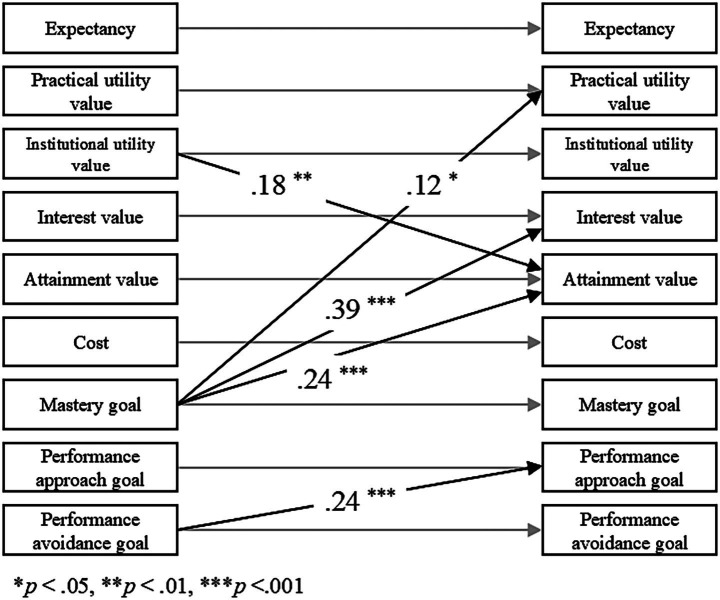
Manabe I, Nakaya M. A short-term longitudinal study of reciprocal relations among expectancy, task value, and achievement goals within the frameworks of the expectancy-value and achievement goal theories. Front Psychol.; 17:1720012. https://doi.org/10.3389/fpsyg.2026.1720012. Figure 1. Licensed CC BY, https://creativecommons.org/licenses/by/4.0/.
Look at the arrows going backwards in time. What you believe about your chances feeds the goal, and the goal feeds what you believe next term. There is no clean starting point. Which is why treating your goal orientation as a fixed trait to be discovered is the wrong frame, and why noticing what your current goal is doing to your studying is the useful move.
If you want the same idea from the other direction, our piece on how thinking about your own thinking changes the way you learn covers what happens when a learner starts monitoring the process rather than only the result.
Does the Classroom Do What It Is Supposed To?
Almost every practical recommendation in this area follows the same logic. Build a mastery-oriented classroom, students will adopt mastery goals, good things follow. Ames set that programme out in 1992 [9]. Judith Meece, Eric Anderman and Lynley Anderman reviewed the whole classroom-structure literature for Annual Review of Psychology in 2006 [61].
The first link in that chain was finally measured properly in 2020.
Lisa Bardach and colleagues meta-analysed 68 studies covering 47,975 students, asking how strongly the goal structure students perceive is related to the goals they personally adopt [62]. Each goal was most strongly related to its own contextual counterpart, which is the theory working. But educational level and world region both moderated the relations, and so did something more procedural: measures that framed the goal structure as a general classroom climate produced higher correlations than measures that framed it around the teacher.
That last detail is the measurement problem again, arriving in the applied literature this time.
Kou Murayama and Andrew Elliot took a more granular run at it in 2009 with 1,578 students drawn from 47 Japanese junior high and high school classrooms [63]. They tested three ways personal goals and classroom structures might combine: a direct effect, an indirect effect and an interaction. Support turned up for 3 of the 3 models [63]. Classroom structures predicted intrinsic motivation and academic self-concept directly and indirectly, and there were cross-level interactions where a personal goal either matched or mismatched the room it was in.
Everything after this point in the section is people testing links further up that same chain, and the pattern holds each time. The link is real. The link leaks.
Marcy Church, Elliot and Shelly Gable had traced the same chain in 2001, from the classroom environment a student perceives, through the goals they adopt, to what they achieve [64]. Martin Daumiller and colleagues went one step further upstream in 2021 and asked whether teachers' own achievement goals and self-efficacy beliefs matter for students' learning, across two studies covering 2,106 and then 16,009 students [65]. Moti Benita and colleagues built an instrument on 317 students in 2021 and then showed across a second sample of 1,331 students that whether a mastery goal gets internalised depends on how much autonomy support arrives with it [66]. Telling a room to value learning is not the same as building a room where learning is what gets valued.
Put all of that together and the applied advice thins out considerably. The environment does something real. What it does depends on the student who walks into it, and on whether the room's message survives contact with the marking scheme.
You can watch the field absorbing that. Devon Chazan, Gabrielle Pelletier and Lia Daniels wrote a review in 2021 aimed squarely at school psychologists [67]. Set its caution beside the confidence of Ames in 1992 and you have the arc of this whole article in two documents. Thirty years ago the applied message was build a mastery classroom. Now it is closer to know what your room is signalling, and check whether the signal survives the marking scheme.
There is a connection here to something we have covered elsewhere. A classroom that rewards visible competence is a classroom that rewards fluency, and fluency is exactly what produces the illusion of knowing, the feeling of understanding that survives right up until you have to produce the answer.
Half a Million Students Later
The most recent work in this area is operating at a scale the founders could not have imagined, using international assessment data.
Yikang Chen, Jiajing Li, Harold Chui and Ronnel King published a study in 2025 using 565,732 students nested in 20,227 schools across 75 countries [68]. They asked what peers do to a student's mastery-approach goals, separating peer cooperation from peer competition at both the individual and school level.
Peer cooperation was positively associated with mastery-approach goals, at both levels. That was expected.
Peer competition was also positively associated with mastery-approach goals, and at 2 of the 2 levels they modelled, the individual student and the school [68]. That was not expected.
The authors say so plainly. Viewing competition as purely maladaptive might be an oversimplification, since competition among peers may also drive self-improvement. If you have absorbed the standard classroom message that competition manufactures performance goals and crushes the desire to learn, that result is a problem for it.
It also fits something Murayama and Elliot had published in 2012 [69]. Their first meta-analysis found no noteworthy direct relation between competition and performance at all. The second explained why: competition prompts performance-approach goals which help performance, and simultaneously prompts performance-avoidance goals which hurt it. Two opposing processes running at once, cancelling in the average. They replicated the pattern across three new studies using three different conceptualisations of competition.
So competition is not good or bad. It is two things at once, and which one you get depends on which goal it activates in a particular student.
King and colleagues used a comparable dataset in 2024, with 595,444 students in 21,322 schools across 77 countries, to look at socio-economic status [70]. Mastery-approach goals mediated the association between family socio-economic status and learning outcomes. School-level status ran the other way, with students in higher-status schools reporting lower mastery-approach goals. The link between mastery goals and outcomes was also weaker in higher-status schools. Motivation is not distributed evenly, and neither is what it buys you.
Two more results belong in this section because they mark the edges of the theory.
Marc Lochbaum and Jarrett Gottardy meta-analysed the approach-avoidance goals and performance in sport in 2015, locating 17 published studies, 2 of the 17 supplying two samples each, and calculating 73 effect sizes [71]. Contrary to the standard prediction, the mastery-approach effect on performance was significant and of equal magnitude to the performance-approach effect. The authors state directly that their significant effects contrast sharply with contemporary meta-analytic findings in education. Domain matters. Van Yperen and colleagues had found the same kind of divergence in 2014, with avoidance goals unrelated to performance in sport while behaving as predicted in education and work [18].
And the constructs travel outside school entirely. Stephanie Payne, Satoris Youngcourt and J. Matthew Beaubien published a meta-analytic examination of the goal orientation nomological net in the work domain in 2007 [72]. They examined three dimensions rather than four, learning and prove-performance and avoid-performance, alongside antecedents including cognitive ability, implicit theories of intelligence, self-esteem and the Big Five, and consequences running from learning strategies and feedback seeking through to job performance [72]. Learning orientation came out positively correlated with the good outcomes and avoid-performance negatively, which is the shape you have been reading about for the last seven thousand words, transposed into an office.
The pattern across domains is worth stating plainly. The four cells travel. The sizes, and occasionally the signs, do not. A finding from a lecture hall is not automatically a finding about a football pitch, and nobody working in this area pretends otherwise once you read past the abstract.
Paul O'Keefe and colleagues revisited the multiple-pathways account in 2022, re-examining what the different goals contribute once you model them together [73]. Lisa Bardach and colleagues added social goals to academic ones in 2022 and analysed the combined profiles [74], which returns the field to where Meece and Holt were in 1993. People carry several goals at once and the combination is the thing worth measuring.
Forty Years in One Column
Forty-one years, and the argument that started it is still open. What has changed is that the question got better. It went from which goal is best to which goal helps whom, under what assessment, measured how.
So What Do You Do With This
No part of this article licenses a self-improvement instruction, and the evidence above will not support one. What it supports is a set of questions that are worth asking about your own studying, and honest answers to them.
Start with the one that actually predicts your mark. What is being assessed, and how clearly has somebody told you? If the demands are explicit and the exam rewards coverage, then the learning agenda framework says the vigilant approach wins, and going deep on the three chapters you find fascinating is a choice with a cost [3]. Senko and Miles measured that cost in 260 students [27]. It is not a small one.
Then ask what you want from the subject in three years. If the answer is nothing, you are doing a coverage exercise and you should optimise for coverage. If the answer is that you intend to keep doing this, the mastery goal is the one that predicts you still will [41].
Notice which of the four cells you are actually in. This is the useful bit of the grid. Not "am I a mastery person", which is the wrong question and probably unanswerable, but: is what I am doing right now organised around reaching something, or around avoiding something? Avoidance is the reliable predictor of trouble in this literature, in both flavours. If you are revising in order to not be humiliated, that is the finding you should take personally.
Watch for the help you are not asking for. Karabenick's 2004 result is the most actionable thing in this article [35]. If you have stopped asking questions because asking looks bad, the goal structure has already cost you something and you will not feel it until much later.
And be careful with the story you tell yourself. Dompnier and colleagues showed that saying you want to learn is the socially rewarded answer, and that endorsing it does not mean it is driving your behaviour [53]. The test is not what you would write on a questionnaire. It is which chapter you opened last night.
The related question of when to stop revising is a different one, and we have covered it separately in our piece on how to know when you have studied enough. Goal orientation tells you what to point at. It does not tell you when you have arrived.
Two more of our articles sit directly downstream of this one. If a mastery goal makes you accept difficulty that a performance goal makes you dodge, then what you are accepting is described in desirable difficulties, the conditions that feel like failure while you are in them and produce better retention afterwards. And the state where difficulty and skill are exactly matched, which mastery goals push you toward and performance goals push you away from, is covered in flow and optimal difficulty.
What Is Still Being Argued
Five things in this article are genuinely unsettled. Any page that presents them as decided is not reporting the literature.
Whether performance-approach goals should ever be recommended. Harackiewicz, Barron, Pintrich, Elliot and Thrash argued in 2002 that admitting them into the theory was necessary and illuminating [75]. The classroom tradition running through Ames, Midgley, Kaplan and Karabenick argues the opposite where schools are concerned, on the grounds that the costs land on the students who can least afford them [36]. Both sides have data. Neither has conceded.
Whether the mastery goal hypothesis survives at all. The failing side is the meta-analytic one, and it rests on the largest evidence base in the argument [1].
That is the disagreement in one line. The prediction failed, and fifteen years later nobody is sure why.
The rescue attempts are three conditional frameworks reviewed in 2019 [3]. A fourth says the measure is catching socially approved answers rather than real goals [53]. A fifth says the item wording is doing the work [22]. None of the five has closed the question.
Whether mastery-avoidance is a real thing. Proposed in 2001, extended in 2011, and still the least accepted piece of the framework [14].
Notice that those are not all the same kind of question. Two of them are about what the theory claims. Two are about how it was measured. One is about where it applies at all. Running them together is what makes the popular summaries sound so much more confident than the papers do.
Whether education findings transfer to sport and work. Lochbaum and Gottardy say their sport results contrast sharply with education [71]. Van Yperen and colleagues found the domain moderating the pattern [18]. Do not generalise across the boundary without checking.
And whether competition produces performance goals. Half a million students say it is more complicated than that [68].
There is a version of this topic that fits on a card. Mastery good, performance bad, be curious rather than competitive. It is memorable, it is what most of the internet says, and the evidence has been pulling against it since 2010.
The real version is harder to fit on a card and more useful once you have it. There are four positions, not two. Two of them are about reaching and two are about escaping, and the escaping ones are where the damage is. What each goal buys you depends on what is being measured. And the reason to want a mastery goal is not that it will raise your mark this term, because on average it will not. It is that it is the only one of the four that predicts you will still be interested when the marking is over.
Nobody grades that. It is the part that lasts.

Frequently Asked Questions
What is the difference between a mastery goal and a performance goal?
A mastery goal defines success against yourself. You are trying to understand the material or do it better than you did before. A performance goal defines success against other people. You are trying to outperform them or to be seen as capable. The distinction goes back to John Nicholls in 1984, who described the same split as task involvement versus ego involvement, and to Carol Dweck in 1986, who named them learning goals and performance goals. The key point most summaries miss is that these are not two ends of one scale. A student can hold both at once, and research going back to a 1993 pattern analysis by Judith Meece and Kathleen Holt finds that most do.
Are mastery goals better than performance goals?
Not in the way you have probably been told. For grades specifically, the evidence runs the other way. A 2010 meta-analytic review of 243 studies covering 91,087 participants found performance-approach goals predicting achievement more consistently than mastery goals. What mastery goals reliably predict is continued interest, deeper processing, persistence and better daily wellbeing while studying. A longitudinal college study published in 2002 found exactly that split, with mastery goals predicting sustained interest and performance-approach goals predicting the marks. So the honest answer is that they predict different outcomes and the right one depends on what you are trying to get.
What is the 2x2 achievement goal framework?
It is the model Andrew Elliot and Holly McGregor proposed and tested across three studies in 2001. It crosses two questions. First, what counts as competence: your own standard, which makes it a mastery goal, or other people's, which makes it a performance goal. Second, are you moving toward success or away from failure, which makes it approach or avoidance. That gives four cells: mastery-approach, mastery-avoidance, performance-approach and performance-avoidance. A later 3x2 model published in 2011 split the mastery standard again, into doing the task correctly and doing better than you did before.
What is a performance-avoidance goal and why does it matter?
It is studying in order not to look incompetent, rather than to win or to learn. It is the one cell in the model where the evidence is not contested, and everything about it is bad. It predicts self-handicapping, the manoeuvre where you arrange an excuse in advance by leaving the work until the last night. It predicts procrastination. It predicts avoiding help, because in a room that rewards looking capable, asking a question announces a gap. A 1997 study by Avi Kaplan and Carol Midgley also found that the damage falls hardest on students who already doubt their own competence, which is the group least able to absorb it.
Why do performance goals predict exam grades better than mastery goals?
The best-supported explanation is behavioural rather than motivational. Goals change what you study. In a 2008 study of 260 undergraduates, Corwin Senko and Kenneth Miles found mastery-oriented students letting their own interests decide where the revision hours went, so they went deep on the topics they found interesting and skimmed the ones they found dull. Their performance-oriented classmates watched the lecturer for cues about what would be assessed and revised that. The exam only rewards one of those strategies. Senko's 2019 review sets out three rival versions of this account and the conditions under which each goal comes out ahead.