
Introduction
You have just finished a chapter on cell biology. Every term looked familiar. The diagrams made sense. The summary matched what you expected. You close the book, confident. Then someone asks: explain how mitosis actually works, step by step. And the words dissolve. What felt like solid knowledge thirty seconds ago turns out to be vapor. This gap between familiarity and true understanding is not a minor inconvenience. It is one of the most studied failures in cognitive science, with roots that reach from the synapses of the medial temporal lobe to the highest-level monitoring circuits of the prefrontal cortex [1].
The confusion is ancient, but the science is remarkably precise. Over the past four decades, researchers have shown that recognition and recall are not two strengths of the same ability. They are different mental operations, supported by different brain structures, producing different electrical signatures, and leading to radically different outcomes when tested [2]. The feeling of knowing something and actually knowing it can be measured, dissected, and, once you understand the machinery, corrected.
This is the story of that machinery. Of psychologists who tricked undergraduates into thinking they understood toilets. Of neuroscientists who pinpointed the exact brain region that generates the false warmth of "I've seen this before." Of a simple discovery in 2006 that rewrote the rules of studying. And of why re-reading your notes may be the most seductive waste of time in all of education.

The Butcher on the Bus
The distinction between familiarity and true understanding has a famous origin story. In 1980, George Mandler at the University of California, San Diego published a paper in Psychological Review that opened with a thought experiment so vivid it became the field's shorthand for the next forty years [3].
You are sitting on a crowded bus. You glance to your left. The man next to you looks intensely familiar. You know you have seen him before. But where? The feeling is strong, almost physical. You search your memory. Was he at a party? A colleague? From television? Minutes pass. Nothing. Then it clicks: he is the butcher from the shop near your house. You have seen his face a hundred times, always behind a counter, always in an apron. Stripped of that context, your brain recognized the face but could not retrieve anything about it.
Mandler used this example to propose something radical for the time: recognition memory is not one thing. It runs on at least two separate engines. The first is fast, automatic, and effortless. It produces a graded signal of familiarity, a warmth that says "I have encountered this before." The second is slower, deliberate, and reconstructive. It recovers context, detail, and meaning. It answers not just "have I seen this?" but "where, when, and what does it mean?"
These two processes, Mandler argued, operate in parallel. And in everyday life they usually converge: you recognize the face and remember who it is. But when they diverge, the feeling of familiarity tricks you into thinking you know more than you do. That is the butcher-on-the-bus problem. And it is the same problem every student faces when they re-read highlighted notes and mistake recognition for recall.

Two Memories, Two Brain Regions
Mandler's proposal remained theoretical for years. The evidence that familiarity and recollection are genuinely different arrived from an unexpected source: patients with brain damage.
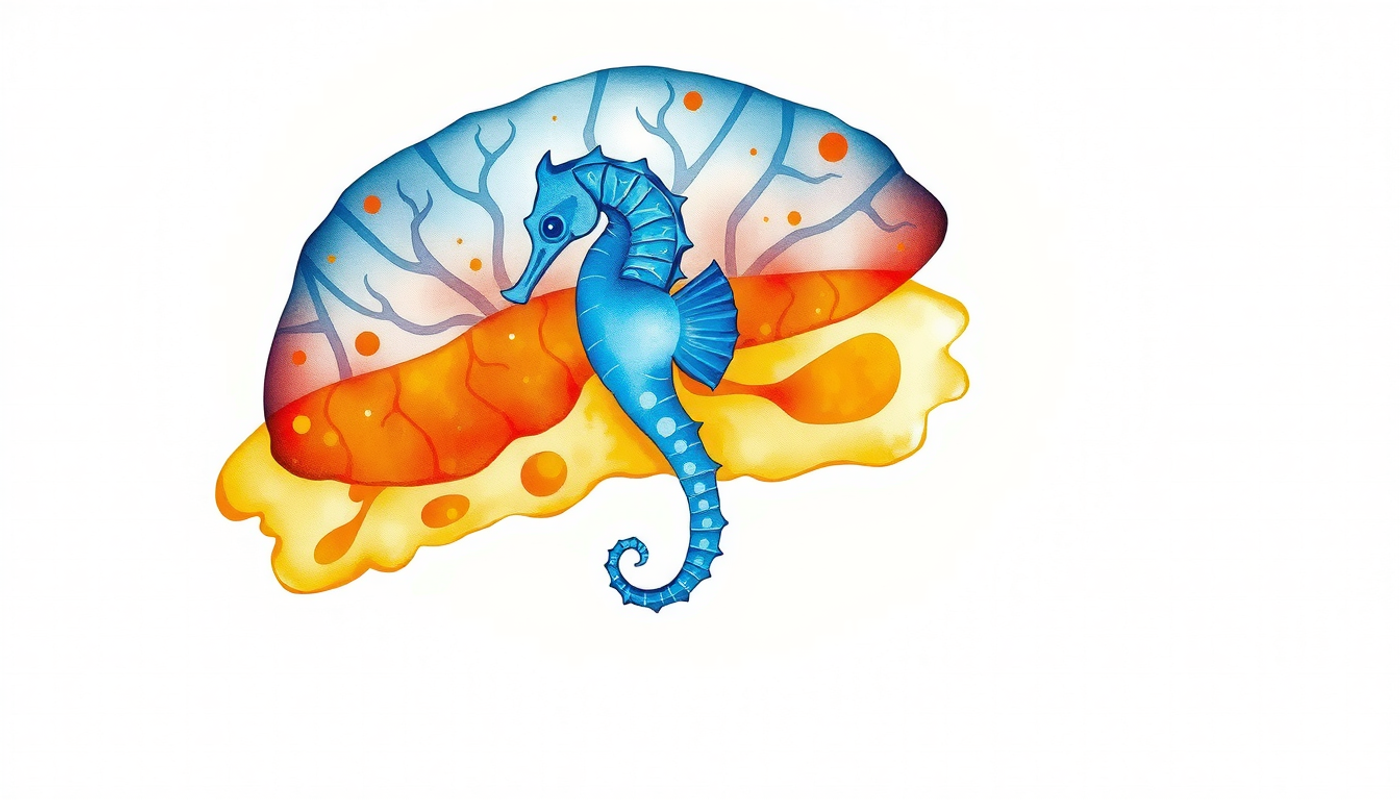
In the medial temporal lobe, two structures sit close together but serve very different functions. The hippocampus, that curved seahorse-shaped structure deep in the brain, binds items to their context, time, and source. It builds episodes. The perirhinal cortex, a strip of tissue wrapped around the hippocampus like bark around a tree, processes item-based familiarity: the signal that says something has been encountered before, without specifying when or where [4].
The clearest evidence came from lesion and imaging studies throughout the 2000s. Laura Davachi at New York University, together with Anthony Wagner at Stanford, used fMRI to show that activity in the perirhinal cortex during encoding predicted whether a person would later recognize an item as familiar, while hippocampal activity predicted whether they would remember the full context of encountering it [5]. Howard Eichenbaum, Andrew Yonelinas, and Charan Ranganath synthesized this work in a 2007 review in the Annual Review of Neuroscience, formalizing a three-component model: the perirhinal cortex handles item familiarity, the parahippocampal cortex handles contextual encoding, and the hippocampus binds them together into a coherent recollection [6].
What does this mean in practical terms? When you re-read a textbook chapter, the perirhinal cortex lights up. It recognizes the words, the diagrams, the structure. Fluency increases. Comfort grows. But because you are not generating anything from memory, the hippocampus is not strongly engaged. No binding occurs. No context is rebuilt. You walk away with a warm feeling of familiarity and a hollow where understanding should be.
Patients with selective hippocampal damage illustrate this starkly. They can recognize familiar faces and objects normally but cannot recall where they saw them or what happened. Familiarity is intact. Recollection is gone [2]. The reverse can also happen: patients with perirhinal damage lose the feeling of familiarity but can still recall detailed episodes when given sufficient cues. The two systems are doubly dissociable.
The Electrical Fingerprints of Knowing
The split between familiarity and understanding shows up not just in brain anatomy but in the millisecond-by-millisecond electrical activity of the brain. Event-related potential (ERP) studies, which measure voltage changes on the scalp after a stimulus, have found two distinct signatures [1].
The first is the FN400, a mid-frontal negativity that peaks between 300 and 500 milliseconds after seeing an item. It is more positive for items that feel familiar, and it does not distinguish between genuinely remembered items and items that merely trigger a sense of having been seen before. It is the brain's familiarity detector.
The second is the Late Positive Component, or LPC, a left-parietal positivity peaking between 500 and 800 milliseconds. This signal tracks recollection. It is larger when people can recall specific details about where or when they encountered something. It reflects the deeper, reconstructive process.
In 2018, Andrew Budson and colleagues at Boston University ran a study that brought this distinction out of the laboratory and into real-world learning [7]. They tested medical students at three time points: before starting a gross anatomy course, immediately after completing it, and six months later. They measured ERP signals while students identified anatomy terms.
The results were remarkable. Students whose brains showed strong LPC activity during the post-course test, meaning they were deeply encoding the information, correctly recalled definitions six months later with statistical certainty (F(2,33) = 20.07, p < .001). Students who showed only FN400 activity (the familiarity signal) could recognize terms as familiar at six months but could not define them. Their knowledge had decayed to a vague sense of having seen the word before.
This is the neural signature of the difference between familiarity and true understanding. One predicts lasting knowledge. The other predicts the illusion of it.
Remember Versus Know
Five years after Mandler's bus scenario, Endel Tulving at the University of Toronto gave researchers a tool to study the subjective side of this split. In a 1985 paper in Canadian Psychology, he introduced what became known as the Remember/Know paradigm [8].
The procedure is elegant. After studying a list of words, participants see each word again and first decide whether it is old or new. If old, they make a second judgment. "Remember" means they can mentally re-experience the moment of studying it, recalling where it was on the page, what they were thinking, some specific contextual detail. "Know" means they are confident the word was on the list but have no contextual memory at all. It simply feels familiar.
Tulving linked Remember responses to what he called autonoetic consciousness, a form of self-aware mental time travel into the past. Know responses reflected noetic consciousness, a detached sense of familiarity without episodic detail. The distinction mapped onto his broader theory of episodic versus semantic memory [8].
Larry Jacoby at McMaster University sharpened this further in 1991 with his process dissociation procedure [9]. His cleverest finding: dividing attention during encoding (asking people to do a distracting task while studying) reduced recollection to nearly zero but left automatic familiarity untouched. This is why studying with your phone buzzing, or with Netflix on in the background, feels productive but fails. You are encoding familiarity signals without building genuine understanding.
Andrew Yonelinas formalized the dual-process model mathematically in 1994 and in a detailed review in 2002 [2]. His ROC (receiver operating characteristic) curve analysis showed that familiarity behaves like a graded signal: it can be weak or strong. Recollection, by contrast, is all-or-nothing, a threshold process. You either reconstruct the episode or you do not. This mathematical distinction has held up across hundreds of studies and multiple brain-imaging paradigms.
You Think You Know How a Toilet Works
In 2002, two Yale psychologists named Leonid Rozenblit and Frank Keil ran an experiment that became an instant classic [10].
They asked Yale undergraduates to rate how well they understood everyday objects (zippers, flush toilets, cylinder locks, sewing machines) on a seven-point scale. Confidence was high. Average self-ratings hovered around 4.5 out of 7. Then Rozenblit and Keil asked them to do something simple: write a step-by-step explanation of how the device actually works. Describe every mechanism. Every cause and every effect.
Confidence collapsed. After attempting the explanation, self-ratings dropped sharply. Students discovered that what they thought was understanding was just familiarity with the object's appearance and general function. They had seen toilets flush thousands of times. They knew the lever went down and the water went away. But they could not explain what the float valve does, why the water level changes, or how the siphon mechanism actually empties the bowl.
Rozenblit and Keil called this the illusion of explanatory depth. And they found it was specific to explanatory knowledge, the kind that involves chains of cause and effect. When they tested factual knowledge (capital cities), procedural knowledge (how to tie a shoe), or narrative knowledge (the plot of a movie), the illusion largely disappeared. People are reasonably calibrated about what facts they know or do not know. But when it comes to how things work, they systematically overestimate their understanding.
The implications for learning are direct. When a student reads a textbook explanation of how protein synthesis works and feels that it "makes sense," that feeling may reflect nothing more than fluency, the ease of processing familiar words and recognizable diagrams. The only reliable test is generative: close the book and try to rebuild the explanation from memory. If the explanation falls apart, the understanding was never there.

The Fluency Trap
The illusion runs deeper than overconfidence about toilets. A body of research on processing fluency has shown that the brain uses ease of mental processing as a proxy for truth, importance, and personal mastery [11].
Daniel Oppenheimer at Carnegie Mellon summarized this work in a 2008 paper in Trends in Cognitive Sciences. When information is easy to read (clear font, simple language), the brain interprets that ease as a signal that the content is true, familiar, and well understood. When the same information is presented in a hard-to-read font, people rate it as less true, less interesting, and less well understood, even though the content is identical [11].
Adam Alter and Oppenheimer (2007) demonstrated a practical consequence. They gave people the classic bat-and-ball problem from the Cognitive Reflection Test: "A bat and a ball together cost $1.10. The bat costs $1 more than the ball. How much does the ball cost?" When the problem appeared in a clear, fluent font, most people answered ten cents (wrong). When the same problem appeared in a disfluent, hard-to-read font, significantly more people engaged their slower, analytic reasoning and answered correctly: five cents [12].
The connection to learning is uncomfortable. Re-reading a textbook chapter is the academic equivalent of the fluent font. Each pass makes the words easier to process. That increasing fluency is felt as increasing mastery. But fluency and mastery are separate phenomena. You can process something effortlessly while encoding almost nothing into long-term memory. The ease is the trap.
Asher Koriat and Robert Bjork made this explicit in 2005. They showed that judgments of learning, meaning students' predictions about what they will remember, are inflated by a structural mismatch between study and test conditions [13]. During study, both the cue and the answer are visible. The pair "ocean, water" looks obvious. Of course you will remember that. But a week later, given only "ocean, ?" the answer does not come. The familiarity generated during study bears no relationship to the retrieval difficulty at test. Koriat and Bjork called this the foresight bias.

Twelve Percent Who Thought They Were Sixty-Two Percent
The most famous demonstration of miscalibrated confidence came from Justin Kruger and David Dunning at Cornell in 1999 [14].
Across tests of humor, grammar, and logical reasoning, they found a striking pattern. Participants who scored in the bottom quartile, around the 12th percentile, rated their own performance at the 62nd percentile. They were not merely overconfident. They were overconfident by a factor of five. And the mechanism was metacognitive: the same skills needed to perform well were also the skills needed to recognize poor performance. Without those skills, people lacked the ability to see what they were missing.
Critics have pointed out that part of this effect reflects regression to the mean and a general above-average bias (Krueger & Mueller, 2002). The original effect size has been debated. But the core observation, that low performers lack the metacognitive tools to detect their own gaps, has survived in modified form and has been replicated across cultures and domains [14].
For learning, the Dunning-Kruger effect intersects directly with the familiarity problem. A student who has re-read a chapter three times has high familiarity and high confidence but may have low actual recall. Without testing, there is no corrective feedback. The illusion persists until the exam, where it collides with reality.
Nelson and Narens formalized this dynamic in 1990 with their metamemory framework [15]. They distinguished a meta level (your beliefs about what you know) from an object level (what you actually know). The meta level monitors the object level and sends control signals: "I know this, move on" or "I don't know this, study more." When monitoring is corrupted by fluency, the control signals are wrong. Students stop studying material they have not actually learned. They allocate their limited time to material they already know, because reviewing familiar material feels productive.

System 1 Said Yes. System 2 Never Got Involved.
Daniel Kahneman's framework of System 1 and System 2, published in Thinking, Fast and Slow (2011), maps directly onto the familiarity-understanding distinction [16].
System 1 is fast, automatic, and effortless. It generates impressions, feelings, and inclinations without conscious deliberation. When you re-read a textbook passage, System 1 registers fluency and translates it into a feeling: this makes sense. System 2 is slow, deliberate, and effortful. It handles logical reasoning, calculation, and complex comparison. Constructing an explanation from memory, checking whether the explanation is internally consistent, identifying gaps. These are System 2 operations.
The central insight is that System 2 is lazy. It monitors System 1's outputs and usually accepts them without scrutiny. Kahneman called this "cognitive ease." When System 1 says "I know this," System 2 tends to nod and move on rather than investing the effort to verify. The conditions that feel best subjectively (fluent processing, smooth comprehension, the comfortable glow of recognition) are the conditions that keep System 2 asleep. And those are the conditions of worst learning.
The reverse is also true. Cognitive strain, the difficulty of generating an answer from memory, the discomfort of failed retrieval, the frustration of not quite being able to explain, activates System 2. And System 2 engagement is what produces genuine encoding. Robert Bjork at UCLA coined the term "desirable difficulties" to describe this paradox: conditions that slow performance during practice but accelerate long-term learning [17].

The Experiment That Changed Everything
In 2006, Henry Roediger and Jeffrey Karpicke at Washington University in St. Louis published a study in Psychological Science that should be pinned to the wall of every study room in the world [18].
They gave students prose passages and assigned them to three conditions. Group one studied the passage four times (SSSS). Group two studied three times and took one test (SSST). Group three studied once and took three tests (STTT). On an immediate quiz, five minutes after studying, the four-study group performed best. But one week later, the results reversed. The group that studied once and tested three times recalled 61 percent. The three-study-one-test group recalled 56 percent. And the four-study group? Forty percent.
Students who re-read felt the most prepared. They were the least prepared. Students who tested themselves felt the least prepared. They remembered the most.
Karpicke and Roediger replicated and extended the finding in 2008 in Science, using Swahili-English word pairs [19]. The design was elegant: they varied whether items were dropped from subsequent study or testing after they were first recalled. The condition where items continued to be tested but were dropped from further study produced approximately 80 percent retention at one week. The condition where items were dropped from testing produced 33 to 36 percent. And across all conditions, students predicted roughly 50 percent recall regardless of their actual condition. They could not introspect the difference.
In 2011, Karpicke and Janell Blunt took this further in a study published in Science [20]. They compared retrieval practice against concept mapping, a study strategy widely believed to promote deep, elaborative processing. On a one-week delayed test measuring comprehension and inference (not just rote recall), retrieval practice produced a benefit of roughly 1.5 standard deviations (d ≈ 1.50) over concept mapping. Even when the final test was itself a concept map, retrieval practice won. Once again, students predicted the opposite. They expected concept mapping to produce more learning. The testing effect works because it forces exactly the kind of generative, reconstructive processing that the hippocampus requires to build lasting representations. Re-reading exercises the perirhinal cortex. Testing exercises the hippocampus.
Spacing: The Long Interval That Builds Deep Knowledge
Retrieval practice tells you how to study. Spacing tells you when. And the two together convert fragile familiarity into durable understanding.
The science of spacing begins with Hermann Ebbinghaus, who in 1885 documented the forgetting curve using nonsense syllables and himself as the sole subject. In 2015, Jaap Murre and Joeri Dros at the University of Amsterdam replicated his entire program, seventy hours of testing, and confirmed the original numbers: roughly 42 percent forgotten after 20 minutes, 56 percent after one hour, 67 percent after one day, and 79 percent after 31 days [21].
In 2006, Nicholas Cepeda and colleagues published the largest meta-analysis of the spacing effect ever conducted: 839 effect estimates from 317 experiments across 184 articles [22]. Their conclusion: the optimal gap between study sessions is approximately 10 to 20 percent of the retention interval. To remember something for one month, space reviews about three to seven days apart. For a year, space them one to two months apart.
Why does spacing work? Each retrieval after a delay forces the brain to partially reconstruct the memory rather than simply recognizing it. fMRI evidence from Gui Xue and colleagues (2010, published in Science) showed that spaced learning reduces neural repetition suppression in frontal and ventral visual regions compared to massed learning [23]. The brain treats each spaced encounter as a partly novel event, building richer and more varied representations. Massed re-reading, by contrast, produces strong repetition suppression: the system stops processing deeply because it has already tagged the input as familiar.
In dual-process terms, spacing forces hippocampally-mediated reconstructive retrieval. In System 1/System 2 terms, spacing reintroduces cognitive strain at precisely the moment when fluency would otherwise bypass deep encoding. The discomfort of struggling to remember something after a delay is not a sign that learning has failed. It is the learning.

A Timeline of Discovery
The science of familiarity versus understanding did not emerge in a single moment. It developed across more than a century, with contributions from psychologists, neuroscientists, and learning scientists.
What this timeline reveals is a consistent pattern: the research community has spent over a century accumulating evidence that passive exposure builds familiarity while active retrieval builds understanding. Yet the most popular study strategies (highlighting, re-reading, summarizing) remain the passive ones. The science of spaced repetition and active recall is well-established, but adoption lags decades behind the evidence.
What Actually Works: The Dunlosky Verdict
In 2013, John Dunlosky, Katherine Rawson, Elizabeth Marsh, Mitchell Nathan, and Daniel Willingham published what amounts to a final exam for study techniques [24]. In a 55-page monograph in Psychological Science in the Public Interest, they reviewed ten commonly used strategies and rated each on a high, moderate, or low utility scale.
Two strategies earned high utility: practice testing and distributed (spaced) practice. Three earned moderate utility: elaborative interrogation, self-explanation, and interleaved practice. Five strategies, including the two most popular among students, earned low utility: summarization, highlighting, the keyword mnemonic, imagery for text, and re-reading.
The irony is sharp. The strategies that feel most productive (highlighting colorful passages, re-reading underlined notes) produce the weakest long-term retention. The strategies that feel most uncomfortable (closing the book and testing yourself, spacing sessions days apart, switching between topics) produce the strongest. The human brain has a built-in bias toward confusing comfort with competence.
Adesope, Trevisan, and Sundararajan confirmed these findings in a 2017 meta-analysis in the Review of Educational Research: the average effect size for testing versus non-testing conditions was g = 0.61, a large effect by any standard [25]. Rowland's 2014 meta-analysis in Psychological Bulletin, drawing on 159 effect sizes, placed the advantage at g = 0.58 [26]. These are not marginal improvements. They represent a transformation.

When the Stakes Are Lives
The consequences of confusing familiarity with understanding are not limited to exam scores. In medicine, the confusion can be lethal.
In 2005, Carol Friedman and colleagues studied 216 medical students, residents, and faculty internists diagnosing nine difficult clinical cases [27]. They measured both diagnostic accuracy and diagnostic confidence. The alignment between the two was disturbingly weak: κ = 0.314 overall, with Kendall's τb = 0.076 (p < .001). Statistically significant, yes. Practically reliable, no. Doctors were confident when wrong and uncertain when right with almost equal frequency.
Berner and Graber expanded on this in 2008 in the American Journal of Medicine, reviewing overconfidence as a major contributor to diagnostic error [28]. Clinicians who rely on pattern recognition, essentially familiarity-based System 1 reasoning, systematically miss atypical presentations. The experienced physician sees a set of symptoms that looks like condition X, feels confident, and acts. But the pattern match was incomplete. The diagnosis was wrong. And the confidence prevented the kind of slow, deliberate, System 2 verification that would have caught the error.
In the legal system, the same confusion operates. Brown, Deffenbacher, and Sturgill showed in 1977 that eyewitnesses can strongly recognize a face while being unable to recall where they saw it [29]. This produces unconscious transference: a bystander encountered before the crime is later identified as the perpetrator, because the witness's brain confuses familiarity ("I've seen this face") with source memory ("this is the person who committed the crime"). The U.S. National Research Council's 2014 report on eyewitness identification cited dual-process memory theory in recommending reforms to lineup procedures.

The Paradox of Productive Failure
If the preceding sections paint a bleak picture, here is the remedy: everything that makes studying feel harder tends to make learning stronger.
Robert and Elizabeth Bjork articulated this paradox as the theory of desirable difficulties [17]. Their New Theory of Disuse (1992) distinguishes storage strength (the durability of a memory) from retrieval strength (its current accessibility). A memory can have high storage strength but low retrieval strength, meaning it is well-learned but temporarily difficult to access. Crucially, when retrieval strength is low, the act of successfully retrieving the memory produces a disproportionately large boost to storage strength. Forgetting a little before reviewing makes the review more effective, not less.
This explains why spacing works, why testing works, why interleaving works, and why all of them feel worse than massed re-reading. They reduce retrieval strength during practice, creating the uncomfortable sensation of difficulty. But they increase storage strength, building the kind of durable, transferable knowledge that survives weeks and months.
detailed reviewThe generation effect, first documented by Slamecka and Graf in 1978, fits the same pattern [30]. Items that are self-generated (producing the antonym of "hot") are remembered better than items merely read ("hot, cold"). The act of generation is a miniature retrieval event, a brief but productive struggle that strengthens the memory trace.
What This Means for You
The science leads to a set of actionable principles. Not tips. Not hacks. Principles grounded in four decades of converging evidence from cognitive psychology, neuroscience, and education research.
First, replace passive review with active retrieval. After reading a chapter, close the book and write everything you remember. The gaps in your reconstruction are the gaps in your knowledge. This is not a failure of memory. It is a diagnostic tool. Familiarity hides gaps. Retrieval exposes them.
Second, test yourself with free recall, not multiple choice. Multiple-choice exercises recognition, the perirhinal system. Free recall exercises reconstruction, the hippocampal system. The format of your practice should match the depth of understanding you are building.
Third, space your reviews. The Cepeda meta-analysis gives a concrete rule: space reviews at roughly 10 to 20 percent of the retention interval. Studying for an exam in 30 days? Your first review gap should be about 3 to 6 days. For an exam in a year, space about one to two months apart.
Fourth, treat difficulty as information. If reviewing feels comfortable and smooth, you are probably exercising recognition, not building understanding. If it feels effortful and uncertain, you are probably in the zone where real learning happens. The discomfort is productive.
Fifth, use the Rozenblit-Keil test on yourself. Pick any concept you believe you understand. Write a step-by-step explanation for someone who knows nothing about the topic. If the explanation breaks down, the understanding was an illusion.
And sixth, delay your judgments of learning. Koriat and Bjork showed that immediate confidence judgments are contaminated by fluency. Wait at least a few hours, or better a few days, before assessing whether you have truly learned something. Your first impression of mastery is almost always inflated.
Conclusion
The line between familiarity and true understanding is not thin. It is a canyon, bridged only by effort. On one side sits the warm glow of recognition, the comfortable feeling that something makes sense because you have seen it before. On the other side sits the harder, less pleasant experience of genuine knowledge: the ability to reconstruct, explain, apply, and transfer what you know to situations you have never encountered.
The brain did not evolve to distinguish these two states. It evolved to conserve energy, and confusing recognition for recall is an energy-saving shortcut that served our ancestors well enough. A forager who recognized a poisonous berry did not need to recall the molecular mechanism of the toxin. Recognition was sufficient for survival.
But modern learning demands more. Exams demand recall. Clinical diagnosis demands reasoning. Engineering demands transfer. In all these domains, familiarity is not just insufficient. It is dangerous, because it feels exactly like competence.
The good news is that the solution is well-characterized and experimentally verified. Close the book. Test yourself. Space your practice. Embrace the discomfort. Every moment of productive struggle is a moment of genuine encoding, a moment when the hippocampus is doing its real work and the perirhinal cortex is not allowed to fool you into thinking you already know.
The philosopher Bertrand Russell once observed that the problem with the world is that fools are full of certainty and the wise are full of doubt. In the science of memory, the observation takes a more precise form: the weakest memories produce the strongest feelings of knowing. True understanding always begins with the admission that you might not understand at all.
Frequently Asked Questions
What is the difference between recognition and recall in memory?
Recognition is identifying something as familiar when you encounter it again, like recognizing a word on a page. Recall is producing information from memory without external cues, like writing a definition from scratch. Recognition requires weaker memory traces and uses the perirhinal cortex, while recall demands stronger traces and engages the hippocampus.
Why does re-reading feel effective but produce poor results?
Re-reading increases processing fluency, the ease with which your brain handles the material. This fluency is misinterpreted as learning. Each pass makes the text feel more familiar, which generates false confidence. But fluency builds recognition memory, not the deeper recall and understanding needed for exams or real-world application.
What is the illusion of explanatory depth?
The illusion of explanatory depth, discovered by Rozenblit and Keil in 2002, is the tendency to believe you understand how things work far better than you actually do. People rate their understanding of everyday devices like toilets or zippers as high, but when asked to explain the mechanism step by step, their confidence drops sharply.
How does the testing effect improve long-term memory?
The testing effect shows that retrieving information from memory strengthens that memory more than additional study does. Roediger and Karpicke (2006) found that students who tested themselves recalled 61 percent after one week, compared to 40 percent for students who only re-read. Testing forces active reconstruction rather than passive recognition.
What are desirable difficulties in learning?
Desirable difficulties are conditions during practice that feel harder but produce stronger long-term retention. Coined by Robert Bjork, these include spacing study sessions apart, interleaving different topics, and testing yourself instead of re-reading. They reduce immediate performance but build more durable and transferable knowledge over time.


