
The Afternoon You Already Know
You know the exact shape of it. The task is right there. You have the time, you have the file open, and you have known about this for eleven days. And instead you are cleaning the kitchen, or reading about a footballer you do not follow, or scrolling something you will not remember by evening.
The strange part is that you are not enjoying it. There is no pleasure in the kitchen. There is a low hum of dread underneath everything, and it gets louder as the afternoon goes.
So why does it work? Why does a person who wants the task done, who will suffer for not doing it, who is not enjoying the alternative, keep choosing the alternative?
The answer most articles give you is that procrastination is an emotion regulation problem rather than a time management problem. That answer is correct. It is also, as usually presented, a claim with nothing underneath it. Almost every page that tells you this asserts it and moves on to a list of techniques. None of them tells you how anybody found out.
Somebody did find out, and the way they found out is worth an hour of your attention. In 2001 a research team ran an experiment that did something clever. They made people feel bad, and then they told some of those people that the bad feeling was temporarily locked in place and could not be changed for the next half hour [1]. If procrastination is just what upset people do, that manipulation should change nothing. If procrastination is something upset people do in order to feel better, it should stop.
It stopped.
That one word is the reason this article exists. Everything after it is detail.
It reframes the delay from a weakness into a transaction. You are trading a small amount of future wellbeing for an immediate improvement in how you feel right now, and the trade closes so fast that you never see it as a trade. The current name for this in the research literature is short-term mood repair [2].
What follows is the case for that account, the evidence against parts of it, and the parts the field is still arguing about. Where the field is still arguing, and it is arguing in several places, the disagreement is named rather than smoothed over. There is a null result in the treatment literature that most articles quietly skip, and it is in here. There is also a number from a study of twins that is stranger than anything else in this field, and almost nobody outside academic psychology has heard it.
You will not find a list of twenty five tools at the end. You will find an explanation of what the machinery is doing, which is a better foundation than any tool.
The Experiment That Froze People's Moods
Start with the study, because everything else in this article leans on it.
By the late 1990s the idea that self-control fails under emotional distress was well established. What nobody had shown was why. There were two obvious candidates. Distress might simply drain the capacity for self-control, in which case the upset person cannot restrain themselves. Or distress might carry some self-destructive impulse, in which case the upset person does not want to.
The 2001 paper by Dianne Tice, Ellen Bratslavsky and Roy Baumeister proposed a third possibility and then tested it in three experiments [1]. Their idea was that upset people are not failing at self-control. They are succeeding at something else. They are regulating their mood, and that goal has quietly taken priority over every other goal in the room.
Most experiments on self-control try to make it harder or easier. This one changed what the failure was worth.
The way to test that is to remove the payoff. So the researchers gave participants a placebo and told some of them it had a side effect: for the next thirty minutes their current mood would be chemically frozen in place, and nothing they did could shift it. This is not true. Nothing about the pill did anything at all. But if you believe it, then eating the biscuit, or seeking the small immediate pleasure, or drifting into something easy instead of the task, stops being useful. The relief is no longer on the menu.
Across the three experiments the pattern held. Distress increased the tendency to eat fattening snacks, to seek immediate gratification, and to procrastinate frivolously, and the authors report that the frozen-mood belief eliminated the effect in each case [1]. Take away the possibility of feeling better and the impulsive behaviour goes with it.
Two things about that study, because the rest of this article leans on it.
The first is that the paper does not state its sample sizes in the abstract, and the full text was not reachable from any open source while this article was being written, so no participant count appears here. It is three experiments with a converging result. Inventing a number to make the sentence look sturdier would be worse than leaving the gap visible.
The second is bigger. This is a social psychology finding from 2001, from the same laboratory and the same era as the ego depletion work, and that literature has had a hard fifteen years. In 2016 a registered replication run across 23 laboratories with 2,141 participants found the ego depletion effect to be small with a confidence interval that included zero, at d = 0.04 with a 95 percent interval from -0.07 to 0.15 [3]. That is a different experiment from this one and it does not refute it. It does tell you how much weight a single finding from that era and that laboratory can carry. No direct replication of the mood-freezing procrastination experiment turned up while this article was being researched. The finding has not been overturned and it has not been confirmed by an independent group either, which is a real gap in what follows. What supports the account is not this one experiment alone. It is that a large correlational literature on emotion regulation, reviewed later here, points the same way, and that the account predicts things the motivational account does not.
The reason the manipulation matters so much is that it changes the category of the behaviour. Before it, procrastination looks like an absence: an absence of willpower, of organisation, of care. After it, procrastination looks like an action with a purpose. The purpose is to make the next few minutes tolerable, and it works, which is exactly the problem.
Fuschia Sirois and Timothy Pychyl later gave the account its name and its full shape. In a 2013 review they described procrastination as the prioritising of short-term mood regulation over the pursuit of longer-term goals, and they pointed out where the cost lands: on the future self, who was not consulted [2]. The general claim that emotion regulation can override other forms of self-control had been argued by Tice and Bratslavsky in 2000, before those experiments were published [4].
What the Word Actually Means
Before going further it is worth being precise, because the word gets used loosely and the research does not.
Procrastination is a voluntary delay of an intended action despite expecting to be worse off for the delay. Every part of that sentence is load-bearing. Voluntary rules out the delay imposed on you by a broken laptop. Intended rules out the thing you never meant to do. And expecting to be worse off is what separates procrastination from sensible postponement, which is a real thing and not a problem.
Frode Svartdal and Piers Steel examined five different procrastination scales in a global sample of 4,169 people in 2017 and found that they share that core, even where they disagree about the details [5]. The measures are not measuring five different phenomena. They are measuring one thing with varying degrees of precision.
When two studies about procrastination disagree, they are usually not disagreeing about what the word means. They are disagreeing about who they asked and how.
The behaviour was first surveyed systematically by Laura Solomon and Esther Rothblum in 1984, in a paper that established both that academic procrastination was widespread and that it correlated with things like fear of failure rather than with poor scheduling [6]. That paper is now forty years old and it is still cited constantly, which tells you how slowly this field has moved on its basics.
One older idea has not survived. For years the literature divided procrastinators into arousal types, who supposedly delay for the thrill of the deadline, avoidant types, who delay out of fear, and decisional types, who cannot choose. Piers Steel tested those categories in 2010 and found little support for treating them as distinct kinds of person [7]. There is one behaviour with different flavours, not three species.
You will notice that none of these definitions mentions laziness. That is not an oversight. A lazy person is not distressed by their own inaction. Procrastinators reliably are, and the distress is part of what keeps the cycle running.
The Delay Is Targeted
There is a detail in your own behaviour that gives the whole thing away, and you can check it against your week without reading a single paper.
You do not procrastinate evenly. The enjoyable half of a project rarely gets put off, and neither does the part you are already good at. What gets pushed tends to be specific, and it tends to be the same handful of things: the email that has been unanswered long enough to be awkward, the section of the document you do not know how to start, the phone call where somebody might be annoyed with you. Meanwhile the parts of the same project that are pleasant get done early and sometimes twice.
If procrastination were about energy or time or discipline, it would spread out. A tired person is tired for all of it. A disorganised person loses track of everything, not selectively of the uncomfortable bits. The selectivity is the tell. Something is being avoided, and it is not effort.
Joseph Ferrari and Steven Scher went looking for that pattern in 2000, and instead of asking students how much of a procrastinator they were, they had 37 of them log the tasks they meant to do each day for five days and whether they did them [8]. The tasks postponed early in the term were the ones the students themselves rated as more effortful and more anxiety-provoking than anything else they had to do. Chores and phone calls got done. It is a small study, and it is measuring what people actually did rather than how they describe themselves in general.
The same targeting shows up in what the field found about task properties. Steel's 2007 synthesis of 691 correlations put task aversiveness among the strongest predictors, which is a formal way of saying that the thing that best predicts whether a task gets delayed is how unpleasant it feels to the person facing it [9]. Not how long it takes. Not how important it is. How it feels.
That is also why the standard advice to break a task into smaller pieces sometimes works and sometimes does nothing at all. When the problem was ambiguity, smaller pieces solve it, because now you can see the first step. When the problem was fear of being judged on the finished thing, smaller pieces change nothing, because every one of those pieces still ends in the same judgement. The technique is fine. It just has to match what the task is doing to you.
Before Anyone Talked About Feelings
The mood repair account did not arrive first. For about two decades the field explained procrastination in terms of motivation, and it did so with real rigour.
The landmark is a 2007 meta-analysis by Piers Steel, which pulled together 691 correlations from the existing literature [9]. It is one of the most cited papers in the whole area and its findings are still the reference point.
Some of what it found was expected. Task aversiveness, self-efficacy, impulsiveness and conscientiousness came out as strong and consistent predictors. Some of it was not. Neuroticism, rebelliousness and sensation seeking, which are the traits popular writing tends to reach for, showed only weak connections to procrastination [9]. The image of the procrastinator as an anxious rebel chasing a deadline high does not survive contact with the data.
Read that list again. Three of the four strongest predictors are about how a task feels or how capable you feel facing it. Only one is about the kind of person you are in general.
Steel's own framework, developed with Cornelius König in 2006, is called temporal motivation theory [10]. It combines expectancy theory with hyperbolic discounting into a single equation. The motivation to do something rises with how much you expect to succeed and how much you value the outcome, and falls with how impulsive you are and how far away the reward sits. Delay the reward far enough and its present value collapses. Bring the deadline close and it spikes.
The equation is more useful than it sounds. It tells you which levers exist: raise the expectancy, raise the value, lower the impulsiveness, or shorten the distance to the payoff. Most advice pulls one of those without saying which.
That model explains the shape of the curve well. It predicts the last-minute surge, the January enthusiasm, the way a deadline three weeks out generates nothing at all. Steel and colleagues tested it across multiple goal stages in a longitudinal study published in 2018 and found the predicted pattern [11].
What it does not explain is why the delay feels good. An equation about discounted value has no place in it for relief. And relief is the thing every procrastinator recognises immediately.
The two accounts are not really rivals. Temporal motivation theory describes the arithmetic of the decision. Mood repair describes what the decision is buying. You need both, and most popular writing has neither.
What Makes a Task Feel Bad
If the delay is a response to a feeling, then the useful question is what produces the feeling. The research points at properties of the task, not properties of the person.
Norman Milgram and colleagues put discomfort and task aversiveness at the centre in 1995, and their work is where the modern emphasis begins [12]. Gregory Schraw, Theresa Wadkins and Lori Olafson took a different route in 2007 and simply interviewed students about what they were doing and why, building a grounded theory from the ground up [13]. Christopher Wolters had already framed the same behaviour in 2003 as a breakdown in self-regulated learning [14].
Three different methods, three decades apart. A questionnaire study, a set of interviews and a theoretical account of self-regulated learning all put the properties of the task, rather than the character of the person, at the centre of the explanation.
Four properties come up again and again.
Ambiguity is the first, and it is underrated. A task you cannot picture finishing is a task you cannot start. Lena Wieland and colleagues measured this directly in 2022 using experience sampling, which means asking people about specific tasks in the moment rather than about their general tendencies, and found task ambiguity tracking academic procrastination [15]. This is why "write the report" sits untouched on the list for a week while "open the template and write the first heading" does not.
You can test this on yourself in about a minute. Take the thing you have been avoiding longest and try to say out loud what the first physical action is. If you cannot finish that sentence, you have found the problem.
Difficulty is the second, but not in the way people assume. What matters is not how hard the task is. It is whether you believe you can manage yourself through it. Robert Klassen and colleagues showed in 2008 that self-efficacy for self-regulation predicted procrastination better than general academic self-efficacy did [16]. You can be confident you could write the essay and have no confidence at all that you will sit still long enough to do it. The second belief is the one that governs the afternoon. This is neighbouring territory to cognitive load, where a task that overwhelms working memory feels impossible rather than merely long.
Those are two different beliefs and people mix them up constantly. One is about the work. The other is about you at three in the afternoon with a phone within reach.
Threat is the third. When a task carries the possibility of being judged, starting it means starting the judgement. A 2026 study of students in higher education found fear of failure predicting procrastination and academic performance together [17]. The link between fear of a bad outcome and delay is one of the oldest findings in the field and it runs straight back to Solomon and Rothblum in 1984. It is also why the way a goal is framed matters so much, which is the subject of mastery and performance goals.
This is the version most people recognise in themselves once it is pointed out. The task is not hard. The task is a verdict waiting to be delivered.
Boredom is the fourth, and it is the one that surprises people. A task can be aversive by being empty rather than by being frightening. That state carries its own signal value, which we cover in what boredom is actually telling you.
Marie Rebetez and colleagues clustered cognitive, emotional and motivational factors together in 2015 and found that procrastinators do not form a single profile [18]. Different people arrive at the same behaviour by different routes, and that matters for what will help any one of them.
Underneath all four sits a general capacity. In a 2020 study of 250 students, Jahangir Mohammadi Bytamar and colleagues found difficulties in emotion regulation associated with academic procrastination, with the strongest link running through a person's belief about whether they can regulate an unpleasant feeling at all [19]. That last detail is the interesting one. It is not only the skill. It is the expectation that the skill exists.
The Relief Is the Trainer
Here is the part most explanations leave out, and it is the reason the behaviour is so hard to shift.
Think about what happens in the moment you decide to check your phone instead of opening the document. The dread does not fade gradually. It stops. Immediately. There is a small, clean, unmistakable improvement in how you feel, and it arrives almost at once.
In learning terms, that is negative reinforcement. A behaviour that removes an unpleasant state gets stronger. It does not need you to approve of it. It does not care that you will regret it in four hours. The timing is what does the work, and the timing here is perfect.
Be clear about the status of what follows, because the rest of this section is an inference rather than a result. No study in this article ran a conditioning experiment on procrastination. What the evidence gives us is the trigger and the payoff separately: negative affect before the delay, and relief that the delay removes. Reading those two as a reinforcement loop is the standard way learning theory would describe that pair, and it explains several things the field has measured. It has not been tested directly, and the paragraphs below should be read as the account this article finds most plausible rather than as a demonstrated one.
So every episode of procrastination is also a training session. The task gets a little more strongly associated with dread, because you keep pairing them. The avoidance gets a little more automatic, because it keeps being rewarded. The two effects compound. That is why the fifth day of avoiding something is harder than the first, which anyone who has done it will recognise, and it is the same machinery described in how habits become automatic.
This is also why the usual advice lands so badly. Telling somebody to try harder assumes the behaviour is under deliberate control at the moment it happens. It mostly is not. By the time you are three tabs deep, no decision was made that you would recognise as a decision. There was a feeling, and then there was a hand moving.
And there is a nasty second-order effect. Each round of avoidance adds guilt, and guilt is itself an unpleasant state that wants repairing. So the failed afternoon becomes part of the fuel for the next one. People often describe this as a spiral, which is accurate, though spiral makes it sound mysterious. It is simply the same trade running again from a slightly worse starting position.
The loop above is the argument of this article in one picture. Notice that there is no point in it where laziness appears, and no point where more information about time management would break the circuit.
There is a second layer, and it is made of beliefs. Marcantonio Spada and colleagues found in 2006 that people hold metacognitive beliefs about their own delaying: that they work better this way, that thinking about the task now would be unbearable, that they need to feel ready first [20]. Bruce Fernie and colleagues developed a scale for those beliefs in 2009 and showed they can be measured separately from procrastination itself [21]. The beliefs are not decoration. They are what licenses the delay in the moment it happens.
What the person does with the reclaimed time is almost beside the point, and the research has looked at this directly. Jessica Myrick surveyed people about watching internet cat videos in 2015 and found exactly the expected pattern: guilt about the procrastination, and improved mood afterwards [22]. The cat videos are not the problem. The mood improvement is the mechanism, and it would work just as well with laundry.
This is why swapping one distraction for another never helps for long. Block the app and the relief simply relocates, usually to something more respectable and equally useless.
Two studies are worth putting beside that, because they show the loop is not the only thing running. Lutz Wartberg and colleagues tied emotion regulation, procrastination and perceived stress together in 2021 [23], and Marek Wypych and colleagues modelled impulsivity, motivation and emotion regulation in one path model in 2018 [24]. Neither found a single dominant factor.
The relief loop sits inside a person who also has a level of impulsivity, a level of motivation and a stress load, and those move the throttle.
The Person Who Pays
The relief has to come from somewhere. It comes from a person who will be sitting at this desk on Thursday, and the interesting question is why you do not care about them.
There is a line of research on what psychologists call future self-continuity, and its organising idea is that the person you will be is treated somewhat like a stranger. Not entirely, but enough. The more continuous you feel with that person, the more their interests weigh in what you decide now. Eve-Marie Blouin-Hudon and Timothy Pychyl showed in 2015 that this sense of continuity, and specifically its emotional component rather than its logical one, related to procrastination [25]. Feeling connected to a future you is not an abstract philosophical stance. It is a measurable individual difference that predicts what you do this afternoon.
The emotional part matters more than the logical part. Everybody knows abstractly that they will exist on Thursday. Not everybody feels it.
In 2024 Xiaotian Zhao, Rong Zhang and Tingyong Feng went looking for the brain basis of that continuity in 114 participants with a mean age of 21.31 years [26]. Behaviourally, future self-continuity and procrastination correlated at r = -.209 [26]. Grey matter volume in the right ventromedial prefrontal cortex tracked continuity, and so did the resting connectivity between that region and the left inferior parietal lobule.
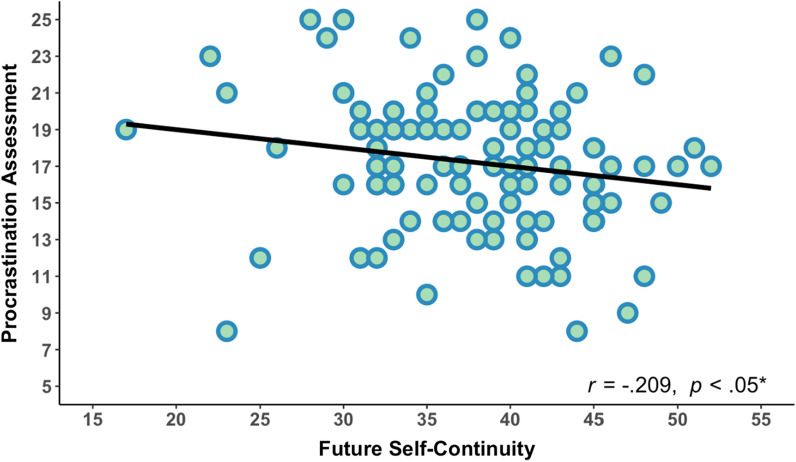
Zhao X, Zhang R, Feng T. The vmPFC-IPL functional connectivity as the neural basis of future self-continuity impacted procrastination: the mediating role of anticipated positive outcomes. Behav Brain Funct. 2024 May 9; 20:11. https://doi.org/10.1186/s12993-024-00236-z. Fig. 1. Licensed CC BY, https://creativecommons.org/licenses/by/4.0/.
Look at that scatter for a moment. The relationship is real and the line slopes the right way. It is also loose. Plenty of people high in future self-continuity procrastinate a great deal, and plenty of people low in it barely procrastinate at all. A correlation of about -.21 across 114 participants is a genuine finding and a small one. It is the size of thing that shifts averages across a group, not the size of thing that fixes an individual afternoon.
That said, the intervention has been tried. Blouin-Hudon and Pychyl ran a mental imagery exercise in 2016 designed to increase future self-continuity and reported reduced procrastination afterwards [27]. The direction is right, and nothing in that literature reports an effect large enough to solve the problem for one person on one afternoon. The gap between a real effect and a solution is where most productivity advice quietly lives.
There is also direct evidence for the discounting side of the story. Haiyan Wu and colleagues recorded brain activity in 2016 while participants made choices between smaller sooner and larger later rewards, and found that high procrastinators preferred the immediate option while low procrastinators did not [28]. The high group also showed a larger and delayed P2 component, which the authors read as slower encoding of delay information. Fuschia Sirois pulled the time perspective literature together in a 2014 meta-analysis and found the same orientation toward the present [29].
Shunmin Zhang, Peiwei Liu and Tingyong Feng reviewed the cognitive mechanisms and neural substrates in 2019, and that review remains the best single summary of this side of the field [30]. Ting Xu and colleagues added a 2021 study connecting self-control to procrastination through prefrontal connectivity [31]. All of this work is correlational and the samples run to a few hundred people at most. Treat it as suggestive rather than settled.
One Point Zero
Now the strangest number in the literature, and one you will not find on any page of self-help advice.
In 2014 Daniel Gustavson, Akira Miyake, John Hewitt and Naomi Friedman studied 663 individuals from 347 same-sex twin pairs, 181 identical and 166 fraternal, drawn from the Colorado Longitudinal Twin Study [32]. Twin designs let you split the variation in a trait into the part that runs in families genetically and the part that does not.
Both traits came out moderately heritable. Procrastination was estimated at 46 percent and impulsivity at 49 percent [32]. That is unremarkable, and most behavioural traits land somewhere in that region.
The remarkable part is what happened when the authors asked whether the genetic influences on the two traits were the same influences. At the level of behaviour the two are clearly separable, with a phenotypic correlation of .65. At the genetic level the correlation was estimated at 1.0, with a 95 percent confidence interval running from .86 to 1.0 [32]. Complete overlap. In that sample there was no genetic influence on procrastination that was not also a genetic influence on impulsivity, and variation in goal-management ability accounted for much of the shared variance.
And then, in the same year, somebody checked it. John Loehlin and Nicholas Martin tested the same question in two large Australian twin samples and obtained a genetic correlation of 0.299 [33]. Not 1.0. They concluded that a genetic correlation between the two traits is real, and that a correlation of that size is consistent with many different accounts of how the traits are related.
So the position to hold is that the two best estimates in this literature are 1.0 and 0.299, from different samples on different continents, and nobody has reconciled them. Take the striking number seriously and do not take it alone.
Be careful with what this means. It does not mean procrastination is impulsivity. Behaviourally they come apart, and a phenotypic correlation of .65 leaves a great deal of room between them. It means that whatever heritable machinery produces one appears to produce the other, and the candidate the authors point at is the ability to hold a high-priority goal in mind and let it govern what you do next.
Twin studies answer a narrow question about one population at one time. They do not tell you what any individual can change.
That reframes the moral question, because it moves the thing being inherited from something like willpower to something much more specific: the machinery for keeping a chosen goal in charge of what you do next. Several studies point at the same target. Marie Rebetez and colleagues found in 2017 that impulsivity and intrusive thoughts about other activities were both involved in the delay [34]. Csaba Hamvai and colleagues traced a path in 2023 through a survey of 211 students training in medicine, running from attentional impulsivity through academic and bedtime procrastination to poor sleep and a subjective drop in cognitive capacity [35]. Kylie Sutcliffe and colleagues connected academic procrastination to delay discounting and psychological flexibility in 2019 [36].
None of that makes the behaviour fixed. Heritable does not mean unchangeable, and the intervention literature later in this article is evidence of that. But it does make the standard framing of procrastination as a character defect look thin.
It also sits neatly with the rest of this article rather than against it. Goal management is the thing that loses. Mood repair is what it loses to. A person whose goal-holding machinery is weaker has less standing between an unpleasant feeling and the delay that ends it, which is why the same trigger produces a lost afternoon in one person and a mildly unpleasant hour of work in another.
The Bill Arrives
For a long time the health claims about procrastination were built on cross-sectional surveys, where you measure everything at once and cannot tell what came first. That has changed.
In 2023 Fred Johansson and colleagues published a cohort study of 3,525 students recruited from eight universities around Stockholm and Örebro [37]. The sample was 63 percent women with a mean age of 24.8 years [37]. Procrastination was measured with five items from the Swedish version of the Pure Procrastination Scale, scored from 5 to 25, and sixteen health outcomes were measured 9 months later.
The design is the point. Measure first, wait, then measure the outcome. That ordering is what a snapshot survey can never give you.
Those outcomes were not narrow. They covered symptoms of depression, anxiety and stress, disabling pain in the neck and back and limbs, sleep quality, physical inactivity, tobacco and cannabis and alcohol use, breakfast skipping, loneliness, economic difficulty and general health. Higher procrastination at the start was associated with worse results across that range at the follow-up.
Now the caveats, because they matter and most write-ups skip them. Both the exposure and the outcomes are self-reported. Nobody was randomly assigned to procrastinate. A study like this can tell you the association runs forward in time, which is more than a snapshot can do, and it cannot tell you that procrastination caused anything.
That distinction is where most coverage of the study stops.
Fuschia Sirois, Christopher Stride and Timothy Pychyl went after the mechanism in 2023 with a three-wave longitudinal study of 379 participants measured at one-month intervals [38]. The path from chronic procrastination to health problems ran mainly through stress, and it survived controlling for conscientiousness and neuroticism. That last detail is the important one. It is easy to argue that procrastinators are simply low in conscientiousness and that conscientiousness is what predicts health. This analysis says something is left over once you account for that.
Stress is the mechanism to remember. The work you did not do does not sit quietly in a drawer. It costs you something every hour it stays undone, which is why a delayed task feels heavier on Friday than it did on Monday.
Sirois also published a conceptual review in 2023 arguing that the link between procrastination and stress depends heavily on context, and that treating it as a fixed relationship obscures more than it explains [39]. Murat Balkis and Erdinç Duru connected procrastination to lower academic life satisfaction and worse affective wellbeing in 2015 [40].
The academic cost is smaller than people expect. Kyung Ryung Kim and Eun Hee Seo ran a meta-analysis in 2015 on procrastination and academic performance and found a negative relationship [41]. It is real, it is not catastrophic, and plenty of people who procrastinate heavily still do fine on paper. Sonia Rahimi and colleagues tracked procrastination longitudinally in 2023 and found it stable enough across a semester to behave like a trait rather than a mood [42].
The stress finding is the one to hold onto. The delay does not remove the load. It moves the load, and it adds interest.
Going to Bed Is a Deadline Too
The purest case of procrastination has no boss, no grade and no external consequence at all. It happens at eleven o'clock at night, and the task is going to bed.
Floor Kroese, Denise De Ridder, Catharine Evers and Marieke Adriaanse named it in 2014 and defined it carefully: failing to go to bed at the intended time when no external circumstance prevents you from doing so [43]. In a survey of 177 people drawn from the community, bedtime procrastination was negatively associated with self-regulation and predicted reported insufficient sleep beyond both demographics and general self-regulation [43]. The team followed it with a self-regulation account of sleep insufficiency in the general population in 2014 [44].
The definition does a lot of work there. It rules out the parent with a crying baby and the nurse on a late shift. What is left is the person who simply did not go.
Think about what is odd here. There is no aversive task. Nobody dreads going to bed. And yet the same structure appears: an intended action, a voluntary delay, an expectation of being worse off.
What is being repaired is the day. The evening is often the only unclaimed time a person has, and giving it up means accepting that the day is over and that tomorrow starts. In 2019 Sun Ju Chung, Hyeyoung An and Sooyeon Suh compared 106 young adults split into 54 high and 52 low bedtime procrastinators using time use surveys [45]. The high group reported more depression, anxiety and insomnia, and in the three hours before bed they spent roughly 61 minutes more per day on their phones than the low group did [45].
An hour is not a rounding error. Over a term it is the difference between a rested person and a tired one, assembled entirely out of evenings nobody planned.
The Environment Got Much Better at This
Nothing in the mood repair account requires a smartphone. The mechanism is old. What has changed is how close the relief now sits, and a large amount of recent research is essentially about that.
The literature has grown accordingly. Bo Yan and Xiaomin Zhang mapped the field in 2022 across 1,635 articles published between 1990 and 2020, and found the research heavily concentrated on student samples and on personality differences, with task characteristics and environmental conditions drawing far less attention [46]. That imbalance matters. If the trigger lives in the task and the relief lives in the environment, a field studying mostly traits is looking slightly to the side of the thing.
The phone studies are the exception, and there are a lot of them. Yaoguo Geng and colleagues surveyed 355 students in China in 2021 and found smartphone addiction scores associated with depression and anxiety through bedtime procrastination, with self-control acting as a buffer. That is a snapshot, and the authors say so themselves [47]. Guanghui Cui and colleagues followed 1,181 students across two measurements 12 months apart in 2021, and their cross-lagged analysis found bedtime procrastination predicting later depressive symptoms in one direction [48].
Notice the direction that analysis points, because it is easy to read backwards. The delay is the step that tracks the later symptoms. The phone is what makes the delay effortless. A two-wave panel cannot prove which one causes which, and it is still the better piece of evidence than a snapshot.
The pattern is not confined to students. Santiago Correa-Iriarte and colleagues surveyed 313 people aged 18 to 60 in Spain in 2023, 53.2 percent of them men, and found that problematic smartphone use had no direct effect on sleep quality at all [49]. Its effect ran entirely through bedtime procrastination. That is a cross-sectional mediation, so it cannot establish a direction on its own. What it does say is that the phone and the tiredness are not directly linked in that sample. Whatever the phone is doing, it is doing it through the delay.
Bo Mao and colleagues surveyed 3,687 students in 2022, 38.73 percent of them male with a mean age of 16.17 years, and found how a person relates to future time associated with bedtime delay through impulsiveness and phone use, again in a single snapshot [50]. That is the future-self story again, in a different room, at a different hour.
None of this means the phone invented procrastination. Solomon and Rothblum found plenty of it in 1984 with nothing more distracting than a corridor. What the phone changed is the distance between the unpleasant feeling and the thing that switches it off. That distance used to be a walk to the kitchen. Now it is a thumb.
"I Work Better Under Pressure"
This is the most common thing people say about their own procrastination, and it deserves a straight answer rather than a dismissal.
In 2005 Angela Chun Chu and Jin Nam Choi proposed that some delay is deliberate and functional [51]. They called it active procrastination: choosing to work close to the deadline because the pressure helps, and still delivering. They reported that these people looked more like non-procrastinators than like passive procrastinators on the outcomes that were measured. Choi and Sarah Moran built a scale for the construct in 2009 [52].
Part of what makes the claim appealing is that it converts an embarrassing habit into a working style. That is worth being suspicious of on its own.
It is a popular idea. It is also under sustained attack.
Shamarukh Chowdhury and Timothy Pychyl published a direct critique in 2018 arguing that the construct does not measure procrastination at all [53]. Their case is definitional. If procrastination requires an expectation of being worse off, and active procrastinators expect to be better off, then whatever that scale measures, it is purposeful delay rather than procrastination. Maarten Pinxten and colleagues reviewed the Active Procrastination Scale critically in 2019 and arrived somewhere similar [54].
That is a definitional argument rather than a data argument, and definitional arguments are often the ones that matter most. If a scale is not measuring the thing its name claims, every finding built on it inherits the problem.
So the answer to "I work better under pressure" comes in two parts. Strategic delay is a real thing and some people do it well. And it is probably not what is happening on the afternoon you spend not opening the document while feeling terrible about not opening the document. Those two states share a timetable and almost nothing else.
That table summarises a live argument rather than a settled ranking. Each row has evidence behind it and each row has a hole in it.
The Things People Get Backwards
Four claims circulate widely, and each one is either wrong or too coarse to be useful.
The first is that procrastination is laziness. It is not, and the definitions rule it out. Laziness implies no intention to act. Procrastination requires an intention that then goes unacted on, and the gap between them is exactly where the distress lives.
The second is that it is a time management problem. This one is half true, and it needs care. Scheduling is not the cause: the strongest predictors in the meta-analysis are about how the task feels and how capable you feel facing it. But scheduling is not useless as a treatment either, and the one head-to-head trial in this article found a time management arm doing about as well as an emotion-focused one. A wrong theory of the cause can still produce a technique that helps, and the section on what works comes back to this.
Notice how the advice industry depends on this one being true. A feelings problem does not sell planners.
The third is perfectionism, and here the popular version has the sign wrong in places. Douglas Saddler and Laurie Sacks reported associations between multidimensional perfectionism and academic procrastination in 1993 [55]. But perfectionism is not one thing. Tanja Lischetzke and colleagues followed 183 people training as teachers across six performance situations over 9 months in 2024, sampling their state repeatedly during 910 separate preparation phases, and found perfectionistic strivings relating to wellbeing differently depending on how a person's procrastination changed over time [56]. High personal standards are not the risk factor. The fear of falling short and being judged for it is. Wei-Wen Chen and colleagues traced one route into that fear in 2022, through authoritarian parenting [57].
This is the one that trips up the most people, because the word covers two quite different things that happen to share a name.
So the accurate sentence is that fear of a bad outcome predicts delay, and wanting a good outcome does not.
The fourth is that procrastination is just ADHD. Here the evidence is thinner than the confidence with which the claim gets made. Hannah Niermann and Anouk Scheres studied 54 students in 2014 with varying levels of self-reported ADHD-related behaviour, and found that once each symptom domain was controlled for the other, only inattention correlated with general procrastination, not impulsivity [58]. Fifty-four is a small sample and the authors described the finding as preliminary themselves. Elizabeth Bodalski and colleagues linked ADHD symptoms to procrastination through emotion dysregulation in 2022, which fits the account in this article rather neatly [59]. Procrastination is not an official symptom of ADHD, there is real overlap on the inattention side, and none of that amounts to a diagnosis.
Depression overlaps too. Alison Flett, Mohsen Haghbin and Timothy Pychyl examined the relationship from a cognitive perspective in 2016 [60]. Laura Rabin and colleagues studied 212 students in 2010 and found several self-reported executive function domains predicting academic procrastination, including initiation, planning, inhibition and task monitoring, over and above depression, anxiety, neuroticism and conscientiousness [61].
Overlap is not identity, and the direction of travel is not obvious. A person who is depressed will procrastinate more. A person who procrastinates enough will also start to feel worse about themselves.
If your delay is severe, persistent and costing you things that matter, that is worth taking to a clinician rather than to a productivity system. That is the only sentence of its kind in this article.
What the Measurements Cannot See
There is a quiet problem sitting under the whole literature.
Almost all of it is self-report. People fill in a questionnaire about how much they tend to delay things, and that score becomes the variable. This is not a small caveat. It means the field is largely studying how people describe their own delaying rather than how much they delay, and those are different measurements that can come apart.
The daily-log study described earlier in this article is the exception rather than the rule. Nearly forty years after Solomon and Rothblum, the field still mostly asks people to rate themselves. The experience sampling work is the encouraging development, because a phone prompt at four in the afternoon catches the behaviour while it is happening rather than through the filter of self-image.
Prevalence figures are where this bites hardest. You will see confident percentages of the population described as chronic procrastinators. Those numbers come from different scales, with different cut-offs, applied to different populations, most of them students. They are not comparable to each other, and stacking them produces a figure that means nothing. Jesse Harriott and Joseph Ferrari published prevalence estimates in adult samples in 1996 [62]. Quote a study and its sample, or quote nothing, which is what happens here.
Workplace procrastination has been measured more carefully than most of it. Baran Metin and colleagues validated a Procrastination at Work Scale in 2020 [63], having established in 2018 that having too little meaningful work to do is a large part of what produces the behaviour in offices [64]. Some workplace delay may be less a failure of self-control than a shortage of anything worth doing, which no amount of personal discipline fixes.
What Actually Helps, and What Did Not
If the cause is emotional, the treatment should be emotional. That is the prediction. The evidence partly supports it and partly does not, and both halves belong here.
The strongest trial is from 2015. Alexander Rozental and colleagues randomised 150 people to guided internet-delivered cognitive behavioural therapy, unguided internet-delivered CBT, or a wait-list [65]. Against the wait-list, effects on the Pure Procrastination Scale were d = 0.70 for the guided version, with a 95 percent confidence interval from 0.29 to 1.10, and d = 0.50 for the unguided version [65].
Those are the headline numbers. The interesting ones come immediately after them.
On the Irrational Procrastination Scale the figures were d = 0.81 and d = 0.69 [65]. Clinically significant change was reached by 31.3 to 40.0 percent of the guided group and 24.0 to 36.0 percent of the unguided one [65], and the two conditions did not differ from each other on any outcome measure.
Read those numbers properly. Moderate effects, a minority of people reaching clinically significant change, and no advantage at all for having a therapist attached. That is a real result and a modest one. A one-year follow-up of the same 150 participants in 2016 found the gains maintained and in some cases improved, with large within-group effect sizes ranging from d = .97 to d = 1.64 on the procrastination measures [66]. Within-group figures always run higher than between-group ones, so those two sets of numbers are not in conflict. They are answering different questions.
It is one of the better-designed trials in the area, and the better-designed trials produce numbers this modest.
Now the study most articles leave out. In 2015 Debra Glick and Susan Orsillo compared an acceptance-based behavioural intervention against a time management intervention in college students, measuring how much assigned reading people predicted they would complete against how much they actually did [67]. There were no group differences in procrastination. The acceptance-based approach helped only the participants who already placed a high value on academics, and a non-significant trend actually favoured the time management group on reading completed.
That null does not demolish the mood repair account. It does mean that going after the emotion is not automatically the winning move, and anybody who tells you otherwise is selling something.
Other approaches have been tested. Hassan Soleimani Rad and colleagues ran a randomised mindfulness intervention for academic procrastination in 2023 [68]. Marcus Eckert and colleagues showed in 2016 that training emotion regulation skills reduced procrastination [69], and Laura Schuenemann and colleagues followed the same approach in 2022 [70].
None of these are large trials, and none of them tested one approach against another. They point in a consistent direction and that is as far as they go.
Carola Grunschel and colleagues found in 2016 that students using motivational regulation strategies procrastinated less and performed better [71]. That is a different lever from either scheduling or therapy: it is about what you do to your own motivation while the task is in front of you.
Motivation is not a fixed quantity you either wake up with or do not. It is partly something you do to yourself while the work is in front of you.
Self-compassion keeps appearing, and the direction is counterintuitive. People who are kinder to themselves about having procrastinated report less of it, and the proposed reason is that self-criticism is itself a negative affect that then needs repairing. Both of the studies below are correlational, so this is an association rather than a demonstrated effect of doing it deliberately. Fuschia Sirois examined that relationship through stress in 2013 [72] and, with Sanne Nauts and Danielle Molnar, applied the same idea to bedtime procrastination in 2018 [73]. If that reading is right, beating yourself up after a wasted day adds to the pile of feeling that tomorrow's task has to be avoided in order to escape.
Planning still has a role, but a narrower one than the productivity industry claims. Timothy Valshtein, Gabriele Oettingen and Peter Gollwitzer applied mental contrasting with implementation intentions to bedtime procrastination in 2019 [74]. Sooyeon Suh and colleagues developed a bedtime-specific psychological intervention in 2021 [75]. What those share is that they remove the decision point rather than trying to win it. The moment of choosing is the moment the mood wins, so the intervention moves upstream of that moment.
Shlomo Zacks and Meirav Hen reviewed the academic intervention literature in 2018 and the overall picture is of many small studies and very few large ones [76]. One adjacent finding fits here. Jeremy Jamieson and colleagues showed in 2022 that teaching people to reappraise their stress arousal as helpful rather than harmful improved affective, neuroendocrine and academic outcomes [77]. That is not a procrastination study. It is the same principle running one level down: change what the feeling means, and the behaviour it drives changes with it.
There is direction here and not much certainty. Most of these are small studies, and the ones that compared two active approaches against each other did not separate them.
Put the treatment evidence together and a shape emerges. Nothing here is a cure. The effects that exist are moderate, they come from small trials, and the one head-to-head comparison in this article found no difference between the emotionally targeted approach and plain time management. What the better-supported approaches have in common is not a technique. It is that they interrupt the loop somewhere other than at the moment of choosing, either by changing what the task feels like before you get there, or by removing the decision entirely, or by lowering the cost of the failure so that it does not feed the next round.
If the account in this article is right, the move that should make the loop worse is anything that makes the task feel bigger, and anything that lowers the cost of starting should work with the mechanism rather than against it. That prediction has not been tested head to head, so treat it as a prediction. It is also why deliberately difficult practice can feel wrong and still work, which we cover in desirable difficulties. A task pitched at the right level of challenge stops producing the aversive signal in the first place, which is what flow and optimal difficulty is about. And whether a task feels chosen or imposed changes that same feeling before you ever sit down, which is the territory of self-determination theory.
Why This Is Hard to Believe About Yourself
There is one more obstacle, and it is not in the research. It is that the mood repair account does not match how procrastination feels from the inside.
From the inside it feels like nothing. There is no moment where you weigh the task against your feelings and choose your feelings. You simply find yourself somewhere else. The whole transaction is finished before it reaches the part of you that narrates your day, and then that part has to explain what happened, so it reaches for the vocabulary it has. Lazy. Undisciplined. Bad at this.
Those explanations are worse than useless, because each one adds another unpleasant feeling to the pile that started the problem. But they persist, and it is easy to see why. They are the only account available if you believe the delay was a decision.
The research keeps pointing at the same alternative. Difficulty regulating emotion predicts the behaviour, task aversiveness predicts it, people who treat themselves more kindly report less of it, and in one unreplicated experiment removing the possibility of feeling better removed it. Those findings differ in how much weight they can carry. What they have in common is that every one of them is about feelings and none of them is about character.
This matters practically, not just morally. If you believe your problem is discipline, you will buy a system. If you believe your problem is how a specific task makes you feel, you will ask a different and much more answerable question: what is it about this one that I do not want to touch? Most of the time the answer is short and slightly embarrassing, and once it is said out loud the task shrinks. Not because the work got easier, but because the feeling stopped being invisible.
What Is Settled and What Is Not
A short inventory, because a research article that will not distinguish between the two is not much use.
Settled enough to state plainly: procrastination is a voluntary delay against your own intention and your own expectation. Task aversiveness is among the strongest predictors. The relief is immediate and the cost is deferred. Bedtime procrastination is a real and separable behaviour. Procrastination and impulsivity are strongly related, whatever turns out to be true about whether they are the same underlying thing.
Still open: whether that asymmetry is the engine, which is this article's reading and not a tested result. Whether negative affect reliably precedes the delay rather than only following it, which the one experiment that bears on it has never been replicated. Whether active procrastination is a coherent category at all. Whether procrastination is meaningfully separable from impulsivity, given a genetic correlation estimated at 1.0 in 663 twins with a confidence interval running down to .86. Whether the self-report measures the literature runs on capture the behaviour well enough to support what is built on them. Which interventions work, for whom, and by how much. And whether procrastination is really becoming more common, which Steel described in 2007 as something that appears to be growing, phrased carefully as an impression rather than as a measurement [9].
That is an ordinary state for a field this size. It is not the state most writing about procrastination presents.
The Ordinary Machinery
Here is where this leaves you.
The next time you find yourself an hour into something that is not the task, the thing to notice is not that you are weak. It is what stopped. Some specific unpleasant feeling was present before you opened the other tab, and it is not present now, and the gap between those two states is about a second wide.
That is the whole trade. It is not hidden. It is just fast.
Knowing this does not dissolve it. If the frozen-mood result is right, it worked by removing the payoff rather than by explaining anything to anybody, and nobody has explained their way out of this. But it does change what you would sensibly try. You would stop looking for a better calendar. You would look at what specifically about this task produces the feeling, whether that is not knowing what finishing looks like, or expecting to be judged, or an evening that feels like the last unclaimed hour of the day.
And you would stop treating the aftermath as a character verdict, because the self-criticism is more of the same fuel.
The mechanism is not broken. It is doing exactly what a system built to keep you comfortable over the next few minutes would do. It is just running in an environment full of tasks whose costs land weeks away, on somebody the system does not recognise as you.
Frequently Asked Questions
Is procrastination the same thing as laziness?
No, and the research definitions rule it out. Procrastination requires an intention to act that then goes unacted on, while laziness implies no intention in the first place. The distress is the giveaway: a lazy person is not upset about the afternoon they just spent, and a procrastinator reliably is. There is a second giveaway that is easier to check on yourself. Laziness would be uniform, and procrastination is targeted. People put off the specific parts of a job that are ambiguous, unpleasant or likely to be judged, and get the enjoyable parts done early. Piers Steel's 2007 meta-analysis of 691 correlations found task aversiveness and self-efficacy among the strongest predictors, and neuroticism and rebelliousness only weakly connected.
Why do I procrastinate on things I actually want to do?
Because wanting the outcome and dreading the process are separate things. The delay responds to how the task feels right now, not to how much you value finishing it. A task can be ambiguous, or carry the risk of being judged, or simply feel like more effort than you can imagine mustering, and any one of those produces the negative feeling that the delay switches off. This is why creative projects and personal goals get postponed as reliably as tax returns. There is often more fear attached to failing at the thing you care about, not less.
Is it true that some people work better under pressure?
Partly, and the field is arguing about it. Angela Chun Chu and Jin Nam Choi proposed active procrastination in 2005 to describe people who deliberately work close to deadlines and still perform well, and Shamarukh Chowdhury and Timothy Pychyl argued in 2018 that whatever that describes, it is not procrastination, because procrastination is defined by expecting to be worse off. The practical test is simple and you can apply it to yourself. Did you decide in advance to start on Thursday, and then feel fine until Thursday? That is planned delay. Did you mean to start on Monday, not start, and feel worse each day until the deadline forced you? That is the other thing, and the pressure at the end is not what made the work good. It is what finally made the task less aversive than the consequence of avoiding it.
Does procrastination actually harm your health?
The evidence has improved recently and it still stops short of proving cause. In 2023 Fred Johansson and colleagues followed 3,525 Swedish university students and measured sixteen health outcomes nine months after measuring procrastination, finding higher procrastination associated with worse results across mental health symptoms, disabling pain, sleep and lifestyle behaviours. Both the exposure and the outcomes were self-reported and nobody was randomly assigned, so it shows the association running forward in time rather than showing that procrastination caused the harm. A separate three-wave study of 379 people published the same year found the path running mainly through stress, after controlling for conscientiousness and neuroticism.
Why does being hard on myself make me procrastinate more?
Because self-criticism is itself an unpleasant feeling, and unpleasant feelings are what the delay exists to switch off. If finishing a wasted afternoon means an hour of harsh self-assessment, the task now carries that as well, and tomorrow it is more aversive than it was today. Fuschia Sirois examined self-compassion and procrastination-related stress in 2013, and with Sanne Nauts and Danielle Molnar applied the same idea to bedtime procrastination in 2018. The counterintuitive part is that treating yourself gently about a lost day appears to make the next day easier rather than encouraging more of the same.


