
Introduction
You know somebody who works to an exacting standard and seems fine. Maybe it is you. They rewrite the email, they check the spreadsheet twice, they will not send a thing until it is right, and at the end of the day they close the laptop and go and have dinner.
You also know somebody who works to an exacting standard and is not fine at all. The email gets rewritten eleven times. The spreadsheet gets checked, then checked again, then abandoned at 2am. Something small goes wrong and it does not stay small. It becomes evidence.
From the outside these two people look identical. They set the same bar. They put in the same hours. They would both tick the box on a survey that asked whether they hold themselves to very high standards. And yet one of them is having a good life and the other one is being slowly ground down by exactly the same behaviour.
Search for an explanation and you will find the same answer everywhere. There are two kinds of perfectionism, the pages say. Adaptive and maladaptive. Healthy and unhealthy. Good and bad. Then a list of signs, and a suggestion that you might want to speak to someone.
That answer is not wrong, exactly. It is a summary of something much stranger, and the strangeness is the interesting part. Because the field that produced this distinction has been arguing about it for two decades, the argument is still live, and one of the people arguing against the existence of healthy perfectionism is the man who co-wrote the questionnaire that most of the research uses to measure it.
This article is about what perfectionism actually is when you measure it rather than describe it. It is about two research groups who published two different scales with the same name one year apart. It is about what happened when somebody ran both scales on the same people at once. And it is about the specific, technical, still-unresolved disagreement that sits underneath the tidy two-box model you have been given, because once you can see that disagreement you can also see the honest answer to the question in the title.
The short version, if you want it now: high standards and self-punishment are not two ends of one dial. They are two different measurements. Most of what goes wrong in a perfectionist's life tracks the second one, and almost nothing tracks the first one on its own. But the two are entangled, telling them apart is harder than it looks, and the field has not finished working out whether the untangling is even legitimate.
Let us start with the two rulers.
Two Scales, One Name, and Two Different Questions
In 1990, Randy Frost and colleagues at Smith College published a paper called "The dimensions of perfectionism" [1]. In 1991, Paul Hewitt and Gordon Flett published a paper in the Journal of Personality and Social Psychology called "Perfectionism in the self and social contexts" [2].
Both papers introduced a questionnaire. Both questionnaires were called the Multidimensional Perfectionism Scale. Neither group was measuring quite the same thing.
This is not a piece of trivia. It is the reason the public conversation about perfectionism is confused, and it is the reason two studies can both say "perfectionism predicts X" and mean genuinely different claims.
Frost's scale asks what is going on inside the person. It has six subscales. Concern over mistakes, which is the tendency to treat an error as a verdict rather than an event. Personal standards, which is the height of the bar you set. Doubts about actions, which is the nagging feeling that whatever you just did was not done properly. Parental expectations and parental criticism, which are about what you believe your parents wanted and how they responded when you fell short. And organisation, which is a preference for order and turned out to sit oddly apart from the rest.
Hewitt and Flett's scale asks a different question entirely: who is the demand aimed at? It has three subscales. Self-oriented perfectionism is demanding perfection of yourself. Other-oriented perfectionism is demanding it of everyone around you. Socially prescribed perfectionism is the belief that other people are demanding it of you.
Read those two lists again and notice what they do not share. Frost is describing the machinery. Hewitt and Flett are describing the direction of travel. A person could score high on concern over mistakes and you would still not know whether they think the pressure is coming from inside them or from a boss, a parent, a coach or an imagined audience.
That table is worth sitting with for a second, because almost every article you will read about perfectionism recites the Hewitt-Flett three as though they were the types of perfectionism, full stop. They are not. They are one of two founding descriptions, and the other one has six parts and asks a different question.
The psychometrics of the Hewitt-Flett scale were published the same year in a companion paper [3]. Both instruments went into wide use immediately. And for a couple of years the field had two rulers and no clear idea whether they were measuring the same object.
What Happened When Someone Ran Both Scales At Once
Then somebody did the obvious experiment.
In 1993, Frost and colleagues administered both instruments to the same people and factor-analysed all the subscales together [4]. If the two scales were measuring unrelated things, the subscales would have scattered. They did not scatter. They collapsed onto two higher-order factors.
One factor gathered up concern over mistakes, doubts about actions, parental criticism, parental expectations and socially prescribed perfectionism. The other gathered up personal standards, organisation, self-oriented perfectionism and other-oriented perfectionism.
That result is the origin of everything that follows. The field eventually settled on names for the two factors. The first one is called perfectionistic concerns. The second is called perfectionistic strivings.
Look at what fell into each pile. Perfectionistic strivings is the bar. It is the part of you that sets an ambitious target and aims at it. Perfectionistic concerns is the punishment. It is the fear of the mistake, the doubt about whether it was good enough, and the sense that someone is keeping score.
The two-factor structure has been checked repeatedly since. Cox and colleagues replicated it in 2002 in both a clinically distressed sample and a college sample, which matters because a structure that only holds in undergraduates is not much of a structure [5].
It has also been probed with more demanding methods. In 2017, Gäde and colleagues fitted a set of bifactor models to eight perfectionism subscales in 481 people [6]. Their best-fitting model produced a clean separation between strivings and concerns, and the strivings factors each held a substantial amount of variance that the general factor could not explain. So far so tidy. But the general factor in that model turned out to be concern over mistakes itself, and the authors ended by questioning whether the other concerns subscales exist as reliable things at all once you account for it.
Hold on to that. It is the first sign that the neat picture has loose threads.
Nine subscales, two piles. That diagram is thirty years of measurement compressed into one picture, and it is the closest thing the field has to a map.
The measurement work did not stop in the 1990s. In 2016 Smith and colleagues published the Big Three Perfectionism Scale, an attempt to consolidate decades of overlapping subscales into one instrument with a defensible structure [7]. The same year, Flett and colleagues published a psychometric analysis of how discrepancy should be assessed, discrepancy being the gap a person perceives between the standard they set and what they actually achieved [8].
That second one is more interesting than it sounds. Discrepancy is arguably the purest measure of the thing this article is about. It is not the height of the bar and it is not the outcome. It is the felt distance between them, which is exactly where self-punishment lives.
The Answer To The Question In The Title
So here is the answer, stated plainly before we complicate it.
High standards are perfectionistic strivings. Self-punishment is perfectionistic concerns. They are separate factors, they were separated empirically rather than invented for a magazine article, and nearly every interesting difference in thirty years of research falls along the seam between them.
Think about the two people from the introduction. Both of them score high on strivings. They set the bar in the same place. The difference is what happens in the gap between the bar and the performance. For one of them the gap is information. For the other it is a verdict about who they are.
That is why the popular advice to lower your standards misses. The standard is not usually the problem. What the standard costs you is the problem, and the cost is levied by a different psychological system.
You can see this most clearly in what the two factors correlate with. In 2019, Smith and colleagues meta-analysed 77 studies covering 24,789 people to work out how perfectionism fits into the five-factor model of personality [9]. Perfectionistic concerns were characterised by neuroticism at r = .50, by lower agreeableness at r = -.26 and by lower extraversion at r = -.24 [9]. Perfectionistic strivings were characterised by conscientiousness instead.
Read that again. One of these factors sits next to being organised and diligent. The other sits next to being anxious and easily distressed. They are not the same trait at different intensities.
This is also the point where perfectionism gets confused with something it is not. Setting a demanding target is a goal, and the research on what you are actually aiming at when you study covers that ground properly. Perfectionism is not a goal. It is what happens to you when the goal is missed.
One more thing needs saying about what perfectionism is not, because the internet is confident here and mostly wrong. Perfectionism is not a diagnosis. There is no perfectionism in the diagnostic manuals. It is a personality trait that raises the risk of a range of problems, which is a different kind of thing entirely. Smith and colleagues, reviewing the construct's first thirty years, said they prefer to call it a core vulnerability factor rather than a transdiagnostic factor, precisely because only some of the outcomes it predicts are diagnoses at all [10].
Nobody is telling you that you have something. They are telling you that a measurable trait moves the odds.
The Argument You Were Never Told About
Now the part that page one of your search engine leaves out.
If perfectionistic strivings is the clean half, an obvious thought follows. Perhaps there is a good perfectionism after all. Set the high bar, skip the self-flagellation, enjoy the results.
That thought is old. In 1978 Don Hamachek proposed exactly it, distinguishing normal perfectionism from neurotic perfectionism. The idea sat quietly for decades. Then in 2006 Joachim Stoeber and Kathleen Otto published a review that pulled it back into the centre of the field, gathering the evidence that perfectionistic strivings travel with positive characteristics and that people classified as healthy perfectionists score better than unhealthy ones on a range of measures [11].
There was a problem, and it is statistical rather than philosophical.
The two factors correlate with each other. In the real world, people who set very high standards also tend to be more afraid of missing them. So if you want to know what pure striving does, you have to strip the concerns out of it, and the standard way to do that is a technique called partialling: you statistically remove the shared variance and look at what is left.
Do that, and perfectionistic strivings starts looking rather good. Which is roughly how the positive case was built.
In 2014, Andrew Hill published a paper with the title "Perfectionistic strivings and the perils of partialling" [12]. He gave measures of personal standards and concern over mistakes to 283 athletes aged 18 to 43, along with a set of related constructs, and then compared what strivings correlated with before and after the partialling. The relationships changed. Not slightly. His argument was that partialling does not purify perfectionistic strivings, it replaces it. The residual variable left over is not high standards with the anxiety removed. It is something else, and calling it perfectionistic strivings is a labelling error that then gets interpreted as evidence for healthy perfectionism.
Stoeber and Gaudreau replied in 2017 with a paper called "The advantages of partialling perfectionistic strivings and perfectionistic concerns", defending the method and setting out when it is appropriate [13].
It is worth pausing on how unusual this is. Most disagreements in psychology are settled by one side quietly not citing the other.
Hill replied to the reply, in the same journal, the same year. He called it "Real and imagined perils" [14].
This is a real argument between serious people and it has not been settled. It is also not merely academic. Every time you read that healthy perfectionism is beneficial, you are reading a claim that rests on a statistical manoeuvre that one side of the field thinks changes the meaning of the variable.
There is a separate objection from a different direction. Hewitt and Flett, whose scale supplied the self-oriented dimension that the positive case leans on, have never accepted the reading. The 2022 review of the construct's first thirty years, written by Smith, Sherry, Ge, Hewitt, Flett and Baggley, states it flatly: Hewitt and Flett did not propose self-oriented perfectionism as a form of positive achievement striving, and treating it as adaptive is not in keeping with the theory, which casts it as a diathesis [10].
A diathesis is a vulnerability that only shows itself under pressure. That framing does real work in this argument, because it changes what counts as evidence. If self-oriented perfectionism is a vulnerability factor rather than a straightforwardly harmful trait, then studies finding weak or absent correlations with distress in ordinary samples are not surprising and are not disconfirming. The trait is supposed to be quiet until something goes wrong.
You can see why this is hard to resolve. One camp says the good half is real and the evidence shows it. The other says the good half is a statistical artefact, and that the apparent harmlessness of self-oriented perfectionism is exactly what a dormant vulnerability looks like.
Not everyone accepts that partialling is the only way to ask the question. Gaudreau and Thompson proposed an alternative in 2010, the 2 x 2 model, which crosses high and low strivings with high and low concerns to make four groups rather than trying to isolate one factor [15]. It has been tested empirically since [16]. It sidesteps the objection by never producing a purified variable in the first place.
There is also a much older disagreement running underneath all of this about whether perfectionism is multidimensional at all. In 2002, Shafran, Cooper and Fairburn argued for a narrower construct they called clinical perfectionism, essentially one-dimensional and defined by self-worth being dependent on striving [17]. Hewitt, Flett, Besser and Sherry replied the following year under a title that left little doubt about their position: "Perfectionism Is Multidimensional" [18]. Later work found that even the questionnaire built to measure clinical perfectionism splits into two factors that look a lot like strivings and concerns [19].
Fourteen entries and no resolution. That is what a live question looks like from the inside.
The Finding That Makes The Comfortable Version Hard To Hold
If you want one result to weigh against the healthy perfectionism story, it is this one.
In 2021, Smith and colleagues collected every longitudinal study they could find on perfectionism and depression, and used meta-analytic structural equation modelling to test which way the arrows run [20]. The search yielded 67 longitudinal studies covering 20,583 people, including undergraduates, community members, medical students, treatment-seeking adults and psychiatric patients [20].
Two results came out of it.
The first is unsurprising. Perfectionistic concerns and depressive symptoms feed each other. Concerns predict later depression, and depression predicts later concerns. It is a loop, and if you are inside it, that is not news.
The second is the one that matters here. Perfectionistic strivings also predicted increases in later depressive symptoms. And the relationship was unidirectional. Depression did not predict later strivings. The arrow only ran one way, which is precisely the pattern you would expect from a vulnerability factor rather than a by-product.
The supposedly healthy half is not neutral.
This finding does not settle the argument, and it should not be reported as though it does. Stoeber and Gaudreau's position is about what happens when the two factors are separated statistically, and a meta-analysis of raw longitudinal associations is answering a slightly different question. But it does mean that anyone telling you perfectionistic strivings are harmless is making a claim that 67 longitudinal studies do not support.
There is a related result worth having, because it heads off the obvious objection that all of this is just anxiety wearing a hat. In 2016, Smith and colleagues meta-analysed 10 studies covering 1,758 people and asked whether perfectionism dimensions still predict change in depressive symptoms after controlling for both baseline depression and neuroticism [21]. All seven dimensions tested still did. Small effects, but they survived. Perfectionism is not neuroticism relabelled.
Do Perfectionists Actually Perform Better?
Set the mental health question aside for a moment. There is a purely practical question underneath the popular version of all this, and it is the one people are usually asking when they say their perfectionism is the good kind: does it work?
The most numerically careful answer comes from Osenk, Williamson and Wade, who in 2020 meta-analysed 67 studies producing 378 effect sizes on perfectionism and academic outcomes in students with a mean age of 19 [22]. They looked at four different perfectionism questionnaires and separated the subscales rather than lumping them.
The result is more interesting than a simple yes or no. The standards-type subscales, which include personal standards and self-oriented perfectionism, were positively related to academic performance. So striving does buy you something. But only one subscale, High Standards, showed negative associations with the unhelpful outcomes as well, and that subscale is the one whose items are about pursuing excellence rather than demanding perfection. Two of the four concerns subscales, Discrepancy and Doubts about Actions, were negatively related to academic performance. Every concerns subscale was positively associated with unhelpful outcomes.
The authors drew a conclusion that is close to the honest answer to this whole article: perfectionistic concerns are bad for learning, and it may be worth distinguishing perfectionistic strivings from a healthier pursuit of excellence that is not the same thing.
A separate meta-analysis of perfectionism and academic achievement reached the field around the same time [23]. Its full text sits behind a publisher authentication wall and no abstract is indexed anywhere we could reach, so we cite it as pointing the same direction and print no figure from it.
Then there is the physical question. Do perfectionists actually work harder, or do they just say they do? Almost all the evidence on effort is self-reported, which is a problem when the trait being measured includes a strong belief about how hard one is trying.
In 2016, Harper and colleagues answered it with a cardiograph [24]. They gave 111 college students the Hewitt-Flett scale and then a self-paced parity task, paying three cents for every correct response [24]. Effort was measured through impedance cardiography, reading autonomic reactivity during the task rather than asking about it afterwards. If self-oriented perfectionism means what the positive case says it means, it should show up as increased cardiac effort.
Neither dimension predicted it. Self-oriented perfectionism came out at a coefficient of -.09 and socially prescribed at .03, and neither was significant [24]. Everyone in the task showed the physiological signature of real effort. Perfectionism simply did not change how much of it they produced.
That is a null result and it deserves to be read as one, not stretched. What it does show is that effort is not the thing perfectionists have more of, which quietly undercuts the folk theory that perfectionism is just trying harder. The same study found that people higher in socially prescribed perfectionism rated the task as more difficult and performed marginally worse.
The most striking result in this section comes from a study that ran for six years. Endleman and colleagues followed 604 Canadian adolescents from Grade 7 to Grade 12 in 2021, and crucially used teacher-rated grade point average rather than self-reported grades, which removes a well-known source of inflation [25]. Then they ran path analysis to see which way the relationship travelled over time.
Academic achievement positively predicted self-oriented perfectionism at every single time point.
Read the direction. Doing well made teenagers more perfectionistic, not the other way around. If you have ever wondered why the highest achievers in a school are so often the most anxious about slipping, that finding is at least part of the answer. Success teaches you what you are capable of, and then that becomes the new floor.
Two older classroom studies help explain why the picture is muddy. Bieling and colleagues followed students through an actual university course in 2003 in a paper called "Making the grade", looking at what perfectionism did to behaviour rather than to a questionnaire score [26]. Mills and Blankstein asked a related question in 2000 about the kind of motivation perfectionism runs on, and about the study strategies that follow from it [27].
The pattern across this work is that the strivings side buys you effort and organisation, and the concerns side spends it. You can be doing more work and learning less from it, because a portion of the capacity is going into monitoring rather than into the task. That is not a metaphor, and the next study makes it concrete.
There is one more study here, and it is the best demonstration of the strivings and concerns split doing real work outside a questionnaire. In 2026, Kleinrensink and colleagues took 55 people with no laparoscopic experience and had them practise a peg-transfer task on a surgical simulator, then return within 48 hours for a retention test [28]. Half of them practised with the target positions continuously visible. The other half saw each target for one second only, which loads visuospatial working memory and leaves less capacity free for rumination.
Perfectionistic strivings predicted nothing about skill retention in either group. In the ordinary condition, higher perfectionistic concerns significantly predicted worse retention of movement efficiency. Under working memory load, that relationship disappeared.
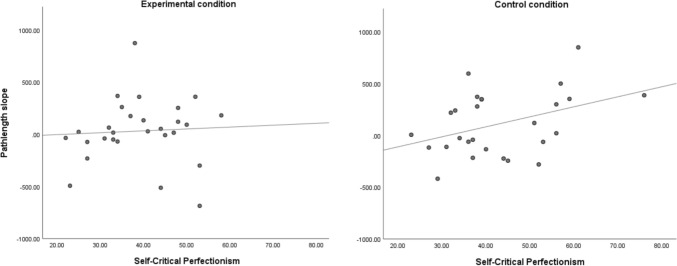
Kleinrensink VEE, Kranenburg LW, Kleinrensink GJ. Taxing working memory during laparoscopic training: reducing the impact of perfectionistic concerns on skill learning. Surg Endosc. 2026 Mar 25; 40(6):4995-5002. https://doi.org/10.1007/s00464-026-12739-z. Fig. 2. Licensed CC BY, https://creativecommons.org/licenses/by/4.0/.
The two panels are the argument. On the right, in the ordinary practice condition, self-critical perfectionism tracks the outcome. On the left, with working memory occupied, the slope flattens. Same people, same task, same trait. The difference is whether there was spare mental room for self-criticism to run in.
Overall practice and retention performance did not differ between the two conditions, so the loading did not cost anything. This is a small first study and the authors say so themselves. But it points at something the adjective-based version of perfectionism cannot: the damage is not done by the standard, it is done by a process that needs attention to run, and taking that attention away changes the outcome.
The Dimension That Does The Damage
Of the three Hewitt-Flett dimensions, one stands out consistently in the outcome literature, and it is not the one about your own standards.
Socially prescribed perfectionism is the belief that other people require perfection from you. Not that you require it of yourself. That someone else does, and that falling short will cost you something with them.
In 2022, Flett and colleagues devoted a full review in Clinical Psychology Review to arguing that the destructiveness of this dimension has still not been properly recognised [29]. Their case is that socially prescribed perfectionism is a chronic pressure that produces helplessness and hopelessness at high levels, and that its reach extends past mental health into relationships, physical health and social outcomes.
The evidence behind that is substantial. Limburg and colleagues in 2016 conducted a meta-analysis of the perfectionism and psychopathology literature that retrieved 284 relevant studies and produced 2,047 effect sizes [30]. Across clinical diagnoses of depression, anxiety disorders, obsessive-compulsive disorder and eating disorders, and across symptom measures of all four, perfectionistic concerns were the dimension doing the work.
One finding from this literature belongs here and it is stated once. In 2017, Smith and colleagues meta-analysed 45 studies covering 11,747 people and found that socially prescribed perfectionism predicted longitudinal increases in suicidal ideation beyond baseline levels [31]. That is why the field treats this dimension seriously rather than as an interesting personality quirk.
Two things follow from a pressure you believe is coming from outside you. It does not switch off when you succeed, because the next judgement is already scheduled. And you cannot argue with it privately, because the standard belongs to someone else.
Two more recent studies fill in the picture. Etherson and colleagues tested perfectionism alongside a construct called mattering in 2022, asking whether the sense of being significant to other people sits between perfectionism and distress [32]. Robinson and colleagues examined perfectionistic self-presentation, which is the effort to appear perfect rather than to be perfect [33].
That distinction between being and appearing deserves a moment. You can hold ordinary standards and still spend enormous energy concealing every shortfall, and the concealment is its own load. It also makes the trait hard to spot from outside, because the person doing it is by definition good at hiding it.
Rnic and colleagues followed the depression link longitudinally in 2021, which matters because most of the perfectionism literature is cross-sectional and cross-sectional data cannot tell you which came first [34].
What makes socially prescribed perfectionism strange is that it is a belief about other people, and beliefs about other people can be wrong. Smith and colleagues asked this directly in a 2017 paper titled "Is socially prescribed perfectionism veridical?" [35]. It is a good question, and it does not have a comfortable answer either way. If the pressure is imagined, the distress is still real. If it is accurate, the person is not distorting anything and the advice to challenge their thinking is misplaced.
There is at least one context where the pressure is demonstrably doing something to other people rather than just to the person holding it. Sherry and colleagues followed romantic couples across 14 days of daily diaries in 2014 and asked whether socially prescribed perfectionism predicted daily conflict [36]. Daily diary designs are unusually good at this kind of question because they catch the thing on the days it happens rather than asking people to summarise a year.
The link to helplessness is worth pulling out, because it connects this dimension to a much older line of research. If you believe that an external standard is being applied to you, that you cannot meet it, and that meeting it is required, you are in a situation with the same structure as the experiments that produced learned helplessness: the outcome matters, and nothing you do reliably controls it. That is not a coincidence of vocabulary. It is the same shape.
It also puts perfectionism next to the research on where motivation comes from. Self-determination theory distinguishes motivation that is autonomous, arising from your own values, from motivation that is controlled, arising from pressure. Socially prescribed perfectionism is close to a pure case of the second kind. That framing is not a rebranding, it is a different research tradition arriving at a neighbouring place.
There is a third dimension in the Hewitt-Flett scale that gets much less attention, and it is worth a paragraph because it behaves differently. Other-oriented perfectionism is demanding perfection of everyone else. Stoeber showed in 2013 that it is genuinely distinct rather than a third flavour of the same thing, with its own pattern of associations [37]. It is the dimension least likely to make the person holding it miserable, and the most likely to make the people around them miserable. That asymmetry is the reason it rarely appears in articles written for people worried about themselves.
Worth knowing too is how any of this shows up hour by hour rather than in a trait score. Dunkley, Zuroff and Blankstein ran a study in 2003 that tracked self-critical perfectionism against daily affect, separating what the trait does in general from what it does on a bad day [38]. The trait did not simply set a lower mood baseline. It changed how the day's events landed. An earlier structural model from Dunkley and Blankstein in 2000 had pointed the same way, with coping and daily hassles sitting between the trait and the distress [39].
That is a more precise claim than saying perfectionists are unhappy. It says the trait is a multiplier on events, which is why two people with the same week can end it in very different states. And it connects to a much older finding: Rice, Ashby and Slaney showed in 1998 that self-esteem sits between perfectionism and depression as a mediator rather than the two being directly wired together [40].
Why Perfectionists Put Things Off
Here is a pattern that looks like a contradiction until you know about the two factors.
Perfectionists procrastinate. They put off starting, they put off finishing, and they hand things in late. Which is odd, because the popular picture of a perfectionist is somebody who cannot stop working.
The founding work on this is old. Flett, Blankstein and Hewitt published on the components of perfectionism and procrastination in college students in 1992 [41]. It has held up since, and in populations that are not the usual undergraduate convenience sample.
Rice and colleagues traced perfectionism, procrastination and psychological distress together in 2012 [42]. Cho and colleagues found the same link in medical students in 2022 [43]. Huang and colleagues found it in undergraduate nursing students in 2023 [44]. These are people under real deadline pressure with real consequences for missing them, which is worth noting because the objection to a lot of this literature is that it studies eighteen-year-olds with nothing at stake.
But it is not high standards that predict the delay.
Stöber and Joormann separated the components carefully in 2001, distinguishing the amount of worry from pathological worry and from perfectionism, and it was the doubting and concern side that tracked procrastination [45]. More recent work has gone after the mechanism directly. Yosopov and colleagues in 2024 identified failure sensitivity as the link, which is a more precise claim than a correlation between two questionnaires [46].
Notice what these mechanisms have in common. None of them is about the size of the task or the shortage of hours.
The thirty-year review makes the same point from the measurement side, noting that doubts about actions in particular shows up as high procrastination in university students [10].
So the mechanism is not what people assume. You do not delay because your standards are high. You delay because starting means eventually finding out whether you met them, and the finding out is the part that hurts. Delay postpones the verdict.
If that sounds familiar it is because it is the same machinery described in the research on procrastination as a mood repair strategy: the delay is not a time management failure, it is an emotional one, and it works in the short term. What perfectionistic concerns add is a supply of bad feeling to repair. There is always another judgement coming.
The unfinished task then does its own damage. A job left half done keeps its hold on attention in a way a finished one does not, which is the effect Bluma Zeigarnik described in the 1920s. Combine the two and you get a familiar bad week. The thing is not started because starting risks judgement, and not starting means it never leaves your head.
The Cost Of Running On Concerns
Perfectionistic concerns are expensive over time, and burnout is where the bill arrives.
Hill and Curran meta-analysed the perfectionism and burnout literature in 2015, retrieving 43 studies covering 9,838 people and 663 effect sizes across work, sport and education [47]. Perfectionistic strivings had small negative or non-significant relationships with burnout. Perfectionistic concerns had medium-to-large positive relationships with it.
There is an irony worth naming. After controlling for the overlap between the two dimensions, pure perfectionistic strivings looked notably more protective. That is the partialling move, used by the same author who would publish "the perils of partialling" the year before this meta-analysis appeared. Nobody in this field is being careless. The method is genuinely useful and genuinely contested at the same time, and researchers use it while arguing about what it means.
The domain-specific evidence lines up, and it lines up in places where burnout is expensive. Hill and colleagues found the pattern in junior elite soccer players in 2008, with fear of failure carrying the relationship [48].
Sport is a good place to look for this, because the standard is public and the scoreboard is not negotiable.
Two workplace studies are worth having side by side. Spagnoli and colleagues ran a two-wave cross-lagged design during the COVID-19 crisis in 2021, which is the kind of design that can say something about direction rather than just association [49]. Martin and colleagues tested perfectionism as a predictor of physician burnout in 2022 [50].
It starts well before anyone has a career to burn out of. Seong and colleagues identified distinct profiles of perfectionism, achievement emotions and academic burnout in South Korean adolescents in 2021, which is a useful way to look at it because it groups people rather than assuming everyone sits on one continuum [51].
If you have watched a study routine curdle into something joyless, the mechanism has a name and a literature, and what happens when a study system becomes a source of failure evidence is a specific case of the general pattern. The same is true of high-stakes assessment, where the psychology of exams that matter enormously supplies exactly the conditions perfectionistic concerns need: a single measurement, publicly scored, with no way to hedge.
The clinical end of the same range is well documented. Antony and colleagues mapped perfectionism dimensions across the anxiety disorders in 1998 [52]. Vanzhula and colleagues used network analysis in 2021 to show perfectionism acting as a bridge between eating disorder and obsessive-compulsive symptoms [53]. Egan, Wade and Shafran argued in 2011 that perfectionism should be understood as a transdiagnostic process, cutting across diagnostic categories rather than belonging to any one of them [54].
That transdiagnostic claim is still being tested rather than assumed. Claus and colleagues ran a longitudinal network analysis in a community sample of 447 women aged 18 to 30, measuring both perfectionism dimensions and symptoms of obsessive-compulsive disorder, eating disorders, anxiety and depression at baseline and again 6 months later [55]. Estimating cross-lagged networks is a more demanding way to ask whether perfectionism precedes symptoms than a correlation is.
Where It Comes From
Nobody is born rewriting emails. So where does this start?
The two obvious hypotheses have names. The social expectations model says children become perfectionistic in response to parental expectations and parental criticism, because self-worth becomes contingent on meeting them. The social learning model says children copy their parents' perfectionism by watching it.
For years both were plausible and the evidence was messy. Then in 2022 Smith and colleagues ran the first meta-analytic test of the two models against each other, pooling 46 studies covering 13,364 people [56].
The result has a shape worth noticing. Parental expectations had unique positive relationships with all three Hewitt-Flett dimensions. Parental criticism had a unique association with only one: socially prescribed perfectionism.
That asymmetry is genuinely useful. Expectation, on its own, seems to raise the bar broadly. Criticism specifically teaches the lesson that other people are watching and scoring, which is the definition of the dimension that predicts the worst outcomes.
This is correlational. Nobody randomly assigned children to critical parents, and nobody could. Read it as a pattern in the data rather than a proven cause.
The developmental picture has been filled in by studies that follow the same people. Soenens and colleagues traced intergenerational transmission in 2005, with parental psychological control as the path [57], and extended the analysis in 2008 [58]. Damian and colleagues followed 744 adolescents with a mean age of 15 across four waves spaced 6 months apart in 2021 and used growth mixture modelling to identify trajectories [59]. Self-oriented perfectionism followed three: low and decreasing, medium and decreasing, and high and stable.
Look at that last group. High and stable. For most adolescents in that sample the trait declined across the four waves. For one group it did not move at all.
Molnar and colleagues caught an unusual natural experiment in 2022, having measured perfectionism and distress in 187 adolescents, 80 percent of them female, before the pandemic and then again during two lockdowns [60]. Studies that happen to straddle a shock like that are rare and worth more than their sample size suggests.
Perfectionism is measurable in children well before any of this hardens. Hewitt, Caelian and Flett published on perfectionism in children and its associations with depression, anxiety and anger in 2002 [61], and a dedicated Child-Adolescent Perfectionism Scale followed [62].
Is It Actually Getting Worse?
You will have seen the headline. Perfectionism is rising among young people. It is one of the few findings from this field that reached the general public, and it comes from a single well-known paper.
In 2019, Thomas Curran and Andrew Hill published a cross-temporal meta-analysis in Psychological Bulletin [63]. They gathered 164 samples in which American, Canadian and British college students had completed the Hewitt-Flett scale between 1989 and 2016. That came to 41,641 students of whom 70.92 percent were women, with a mean age of 20.66 [63]. Then they tested whether scores moved with the year the data was collected.
All three dimensions rose linearly. The trends held when controlling for gender and for differences between countries.
The paper translates the change into percentile terms, which is the clearest way to see the size of it. If the average college student in 1989 sat at the 50th percentile, the average student in 2017 sat at the 55th percentile for self-oriented perfectionism, the 58th for other-oriented, and the 66th for socially prescribed. The authors describe those as increases of 10 percent, 16 percent and 32 percent respectively [63].
The dimension that moved most is the one the outcome literature flags as most damaging. That is the finding, and it is worth more than the headline it produced.
Now the honest caveats, because this result is routinely stretched.
This is a cross-temporal meta-analysis. It measures scores on one questionnaire, in college students, in three English-speaking countries, over 27 years. It does not measure perfectionism in the general population, and it does not tell you that there are more perfectionists than there used to be. It tells you that the average score on this instrument in this population moved up.
The percentages above are percentile shifts, not shares of people. A 32 percent increase in socially prescribed perfectionism means the average 2017 student had moved from the 50th to the 66th percentile of the 1989 distribution. It does not mean a third more people are perfectionists.
So why? Curran and Hill went after that in 2022, with two more meta-analyses [64]. The first found that perceived parental expectations and criticism correlate with perfectionism, and that the effects on socially prescribed perfectionism were large. The second turned the cross-temporal method on those perceptions. They had risen linearly too, between 1989 and 2019.
So the reported pressure went up alongside the reported perfectionism. That is consistent with the parenting explanation, and the authors present it as the most plausible account currently available rather than as a demonstrated cause. Same design, same limits.
What Actually Works
The advice you will find online is to lower your standards, be kinder to yourself, and remember that done is better than perfect. Some of that is closer to the evidence than it sounds, but none of it is what was actually trialled.
What was trialled was therapy, and it works.
Lloyd and colleagues published the first systematic review and meta-analysis of psychological interventions targeting perfectionism in 2014 [65]. Note the year. This paper is very commonly cited as 2015, including by later researchers, but the record says 2014. They identified eight studies and analysed change from before to after intervention on the Personal Standards and Concern over Mistakes subscales of the Frost scale and the Self-Oriented and Socially Prescribed subscales of the Hewitt-Flett scale. The pooled effect sizes were large.
Suh and colleagues extended that work in 2019, restricting the analysis to randomised controlled trials and adding depression and anxiety as outcomes [66]. Ten studies met the criteria, producing 65 perfectionism effect sizes, eight depression effect sizes and eight anxiety effect sizes. Interventions reduced perfectionism dimensions, depression and anxiety, all with medium effects.
Their most practically useful result was a null one. They tested delivery method as a moderator and found no significant difference between face-to-face and online delivery. Guided internet-based programmes did about as well as sitting in a room with a therapist.
The trials since have broadened the range of what gets tested. In 2023 Hewitt and colleagues ran a randomised controlled trial comparing two group therapies in 80 community-recruited highly perfectionistic adults, allocating 41 to group dynamic-relational therapy and 39 to group psychodynamic supportive therapy, 12 sessions each, with follow-up 6 months later [67]. It is notable that a research group known for arguing that perfectionism is an interpersonal problem went and tested an interpersonal treatment for it.
Self-compassion has been tested directly rather than recommended. Woodfin and colleagues ran a pre-registered randomised wait-list controlled trial in university students, consisting of four seminars and a silent half-day retreat drawing on Mindful Self-Compassion and mindfulness-based stress reduction [68]. A total of 89 participants completed it [68]. Maladaptive perfectionism, anxiety and depression all fell relative to the waiting list, and self-compassion rose.
One detail in that trial speaks to the whole argument of this article. The intervention moved maladaptive perfectionism clearly. Adaptive perfectionism moved only slightly, and only in the more sensitive of the two analyses. The two factors did not respond as one thing, because they are not one thing.
Ferrari and colleagues found in 2018 that self-compassion moderates the link between perfectionism and depression in both adolescents and adults, which is the correlational counterpart to the trial result [69]. And in 2026 Fuster and colleagues reviewed the interventions aimed at children and adolescents specifically, pooling 20 studies that yielded 25 independent intervention-control comparisons and finding them clinically effective at reducing overall perfectionism [70].
None of this is advice, and this article is not the place to get any. It is a description of what has been tested and what the trials found. The reason it belongs here is that the treatment literature quietly confirms the structure: the interventions that work go after the concerns, not the standards.
So What Is The Difference?
Back to the question in the title, with everything now on the table.
The difference between high standards and self-punishment is not a matter of degree. It is not that self-punishment is high standards turned up too far. They are two separable factors that were pulled apart empirically in 1993, have held up under repeated re-examination, and predict very different things once you can tell them apart.
High standards, on their own, look fine. They correlate with conscientiousness. They predict better academic performance. In the surgical simulator study they predicted nothing bad at all.
Self-punishment is the expensive one. It correlates with neuroticism at .50. It predicts depression in both directions, burnout with medium-to-large effects across 43 studies, procrastination through failure sensitivity, worse skill retention, and at the far end of the range the outcomes that make clinicians pay attention.
That is the answer, and it is genuinely useful. But it comes with two honest qualifications, and leaving them out is how this gets turned into the comfortable version.
The first is that the two factors travel together. In real people, high standards and fear of failing them are correlated, which is why separating them requires statistics and why the statistics are disputed. You do not get to decide which one you have. Scoring high on one makes scoring high on the other more likely.
The second is the one that keeps the argument alive. When Smith and colleagues looked at 67 longitudinal studies and 20,583 people, perfectionistic strivings still predicted later depression, on their own, in one direction. The clean half is not perfectly clean. Whether that is because strivings are genuinely a vulnerability, or because unpartialled strivings are carrying concerns along with them, is exactly what Hill and Stoeber and Gaudreau were arguing about in 2017 and have not settled.
So the most defensible thing anyone can tell you is narrower than a self-help page would like, and more useful.
Wanting to do something excellently is not the problem here. The one subscale that measures exactly that came out cleanly positive in the largest academic meta-analysis available. What the questionnaires call perfectionism is not that. It is that plus a scoring system, and the scoring system is where the damage lives. The question worth asking yourself is not how high your bar is. It is what happens in the gap when you miss it.
If missing it produces information, you are running on standards. If it produces a verdict about you, that is the other factor, and it has a large literature and a set of treatments that work about as well online as in person.
There is one more thing worth saying, because it is the part people take badly.
Nothing above says that a person with high perfectionistic concerns is doing something wrong, or that they chose it. The developmental evidence points at expectations and criticism experienced early, the trait is measurable in children, and one trajectory group in a four-wave adolescent study stayed high and stable while everyone else's declined. Nobody in that group decided to be there.
And nothing above says the trait is fixed. The treatment literature is not large but it is real, the effect sizes are medium to large, and the delivery format turned out to matter much less than anyone expected. The thing that responds is the concerns half, which is the half doing the damage. That is a more encouraging finding than it first looks.
The field will keep arguing about whether the first thing can exist in pure form. That argument is thirty years old and it is not going to finish soon. In the meantime the distinction is real enough to act on, which is more than most of what you will read on this subject can say.
Frequently Asked Questions
What is the difference between perfectionism and high standards?
Research separates perfectionism into two measurable factors. Perfectionistic strivings is setting very high standards. Perfectionistic concerns is the fear of mistakes, the doubt about whether anything was good enough, and the sense that others are keeping score. The two were pulled apart statistically in 1993 when both major perfectionism questionnaires were factor-analysed together, and almost every negative outcome in the literature tracks concerns rather than strivings. High standards on their own correlate with conscientiousness and with better academic performance. Concerns correlate with neuroticism at .50 in a meta-analysis of 77 studies covering 24,789 people. The catch is that in real people the two factors are correlated, so most high-standards people carry some of the second factor too.
Is there such a thing as healthy perfectionism?
This is an open argument in the field rather than a settled question. Joachim Stoeber and Kathleen Otto made the case for a positive form in 2006, reviving a distinction Don Hamachek proposed in 1978. Andrew Hill argued in 2014 that the statistical technique the positive case relies on changes what perfectionistic strivings means rather than purifying it. Stoeber and Gaudreau replied in 2017 and Hill replied again in the same journal. Separately, Paul Hewitt and Gordon Flett, whose scale supplies the dimension the positive case leans on, have never accepted that reading and treat it as a vulnerability factor instead. A 2021 meta-analysis of 67 longitudinal studies found that perfectionistic strivings also predicted later depressive symptoms, which makes the healthy reading harder to hold. Anyone who tells you this is settled is not reporting the field accurately.
What are the three types of perfectionism?
The three most commonly cited types come from Paul Hewitt and Gordon Flett's 1991 scale and are defined by who the demand is aimed at. Self-oriented perfectionism is demanding perfection of yourself. Other-oriented perfectionism is demanding it of other people. Socially prescribed perfectionism is believing that others demand it of you. That third one is consistently linked to the worst outcomes. It is worth knowing that this is not the only founding description. Randy Frost and colleagues published a different scale with the same name in 1990 that has six subscales and asks what the perfectionism consists of rather than who it targets.
Why do perfectionists procrastinate?
Not because their standards are high. When researchers separate the two factors, it is perfectionistic concerns that predicts delay, and more recent work points at failure sensitivity as the specific mechanism. Starting a task means eventually finding out whether you met the standard, and for someone whose self-worth is riding on the answer, that discovery is the painful part. Delay postpones the verdict. This also explains the apparent contradiction in the popular image of a perfectionist who cannot stop working and yet hands things in late.
Is perfectionism a mental illness?
No. There is no perfectionism diagnosis in the diagnostic manuals. It is a personality trait that raises the risk of several conditions, which researchers describe as a transdiagnostic process or, in the words of a 2022 review of the construct's first thirty years, a core vulnerability factor. The authors of that review prefer the second term precisely because only some of the outcomes perfectionism predicts are diagnoses at all. Psychological interventions do reduce it, with medium to large effect sizes across the trials that have been meta-analysed, and online delivery performed about as well as face-to-face in a 2019 analysis of ten randomised controlled trials.


